Two More Books

It was gratifying to read Meagan Lucas’ debut novel Songbirds and Stray Dogs because Ms. Lucas contributed her story “Daisy Mae Returns” to the Spring 2018 edition of Teach. Write (43-45). Something special about that for me as an English teacher, especially since Ms. Lucas is one as well.

Taking place in the early ’80’s, the novel tells the story of Jolene, who finds herself, pregnant, alone, and abandoned in a small coastal town. She makes her way to the mountains of Western North Carolina, where she encounters more loneliness and hostility until she meets someone as lonely and broken as she and learns to trust, love, and hope again.

I liked the way the story develops with the distinctive alternating perspectives of a woman and a man. Ms. Lucas effectively captures the struggle of how two ordinary people find a way despite loneliness and despair. Our world needs more of their spirited perseverance.

The book is published by Main Street Rag. Hope you will buy it and support a promising new voice in Southern fiction.

A very different book I finally finished is an extraordinary biography of Johann Sebastian Bach by German musicologist Christoph Wolff.

I started reading this book quite a while ago, but it is difficult reading for me because I am not that knowledgeable about music, and the book goes into great technical detail about Bach’s compositional style.

I am, however, knowledgeable about scholarly research and can recognize the incredible achievement this book is, giving readers a detailed look at Bach as performer, composer, scholar, theologian, husband, and father. Also, even though I didn’t understand it all, I was fascinated when Wolff explains Bach’s music in detail.

Well worth the time.

At the end of the last chapter, Wolff quotes from another Bach biography, the New Bach Reader, relating an anecdote about Mozart upon his first hearing of the motet Singet dem Herrn, ein neues Lied:

“Mozart knew this master more by hearsay than by his works, which had become quite rare; at least his motets, which had never been printed, were completely unknown to him. Hardly had the choir sung a few measures when Mozart sat up, startled; a few measures more and he called out ‘What is this?’ And now his whole soul seemed to be in his ears. When the singing was finished he cried out, full of joy: ‘Now there is something one can learn from!'”

And I did!

The text, in translation, of the aria:

God, take us to Yourself from now on!
For without You we can accomplish nothing
with all of our belongings.
Therefore be our protection and light,
and if our hope does not deceive us,
You will make it happen in the future.
Happy is the person who strictly and firmly
abandons himself to You and Your mercy!

Now listen, dear reader, to Vocalconsort Berlin singing Sing to the Lord a New Song:

Mrs. Winkler Keeps Reading

Updated June 16, 2020

NOTE: Scroll to the end to see additions to this review. CAUTION: SPOILERS

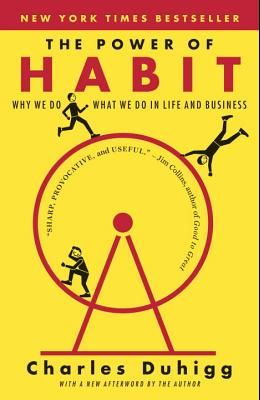
I joined an online book club for Western Carolina University alumni, and The Power of Habit by Charles Duhigg is the first book we are reading. The book has given me some food for thought and its simple formula for changing habit (cue, routine, reward) has been actually working for me. I have completed short yoga routines for 80 days in a row and am regularly meeting my quota of 600 words a day towards completion of my novel, writing six of seven days a week for the past three weeks, just to name two examples.

Not bad.

One of the main themes of the book is not trying to suppress bad habits but to replace bad habits with positive ones through changing the routine. Duhigg explains and gives examples of the idea that habits are born of cues that trigger the behavior and lead to some kind of reward. He calls it The Golden Rule of Habit Change: “You can’t extinguish an old habit. You can only change it.”

He shows how this works by using a multitude of examples. In the first part of the book he shows how mainly positive examples, including Tony Dungy, coach of the Tampa Bay Buccaneers, who changed the team’s habits to eventually lead them to the Super Bowl and Bob Wilson, the founder of AA, how the program’s success for so many people comes in part from establishing new habits.

But in both cases, Duhigg talks about belief, not necessarily a spiritual belief, but some sort of faith must be present to successfully form good habits and this faith is normally found by being part of a group.

The chapter that will be most useful to me as a teacher is “Chapter 5: Starbucks and the Habit of Success.” This chapter talks about how Starbucks had become a powerhouse coffeehouse chain by, simply put, teaching willpower. At the same time, Starbucks has found that giving employees a voice is one of the ways to help develop the self-discipline and willpower needed to train and retain productive employees.

The implications for teaching are obvious–our students need to have more power over what they are learning. If they feel they have choice, they will be more likely to exhibit the self-control necessary to complete their studies

Interesting.

One of the most relevant parts of the book for today is “Chapter 6: The Power of a Crisis.” Duhigg gives an example of a Rhode Island hospital that made radical changes for the better by changing institutional habits following the senseless death of one of their patients.

Following the example, Duhigg states:

“But sometimes, even destructive habits can be transformed by leaders who know how to seize the right opportunities. Sometimes, in the heat of a crisis, the right habits emerge.”

Updated June 16, 2020

In response to a question posed by our book club leader, I wrote the following about the chapter in the book I appreciate in some ways but took exception to in others:

Overall, I have a positive reaction to the book and its author, but my perspective changed quite a bit towards both as I was reading Chapter 7, especially the Target example. The author seemed to treat this example in a positive light at first–as if intrusion into a woman’s reproductive privacy is no big deal. It is only when the marketing team and the data researcher finally question whether his intrusive data collection would actually make money or not that they apparently begin to question how pregnant women might feel.

Interesting also that the author gives an example of an angry father to make his point about negative reactions from the public. I found myself wondering what was happening to the poor young woman who was the daughter of that angry father. How did she feel about the father talking to a manager at Target about her pregnancy? Did the father kick her out of the house because she got pregnant? Did father and daughter reconcile? Is he forcing her to keep the child or marry, or not marry, the father of her child against her wishes? How does the young woman’s mother feel about all of this? But none of this matters to the data collectors or the author of the book, it seems. Maybe it does, but not enough to find out and give examples of how any individual woman feels about this kind of marketing strategy, I guess.

Perhaps the author being a male and the subject of his example being a male was my cue to go to the routine of rolling my eyes at this obtuse behavior. The reward is another great example for my students of sexism and manipulative advertising tactics.

After reading this chapter I was reminded how important it is to continue teaching my students about the power of persuasive techniques that are legal but border on, or are downright, unethical but widely accepted as the norm because they make a lot of money. It is up to my students as consumers to use critical thinking when viewing advertising and recognize the incredible powers of data-driven marketing. It is up to me as their instructor to provide proof of these questionable tactics and for that, I am grateful to the author and his book.

One final question: Why did the author not comment on the initial question the marketers asked the mathematician to solve?

Here’s the question: “Can your computers figure out which customers are pregnant, even if they don’t want us to know?” (182). (Emphasis mine).

That’s okay? I guess so because “Figuring out whose pregnant…could make Target millions of dollars” (184), and this little gem “So for companies, pregnant women are goldmines” (192). Oh, I get it. Priorities.

I think if there is a new edition, Duhigg should consider leaving out Chapter 7. It was the reason I gave the book four stars instead of five. At the very least, he should spend some time trying to get at least one pregnant woman’s view of this kind of advertising.

I know I have harped on the bad, but there is much good to be gleaned from the book as well, so I am glad I read it and have taken part in the discussion.

Mrs. Winkler’s Summer Reading Redux

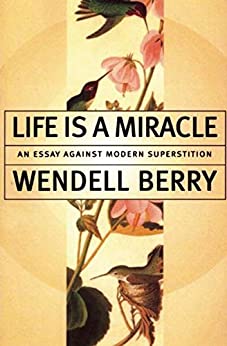
I finished reading Wendell Berry’s Life Is a Miracle, written 20 years ago but still relevant today. I don’t know where to begin talking about it. There are so many things it touched on, including cultural and creation care, the dangers of corporate control of the arts and sciences, of people whose primary interest are wealth and power having control of higher education. I suppose that latter point is the one that resonates with me the most as an English instructor at a community college during this time.

This time. How strange it is. There are so many questions, and I can’t say that reading Berry’s book has offered me any specific answers, but perhaps it gives me something more important.

A new outlook.

At first Berry seems to be criticizing modern science, but it doesn’t take long before the reader realizes that his objections are more towards the commercialization of science and how it is being isolated from other academic disciplines–how undergraduate programs in our colleges and universities are moving away from the traditional idea of one student embracing multiple disciplines, working across curriculums for the good of all, to more and more isolation and specialization. Ironically, this movement is causing us to be less and less concerned with specific problems, and more importantly, the people who are right around us.

Early on, when Berry introduces his thesis, he caught my attention, discussing what he means by professionalism, which is not what most people think when they hear the word:

“All of the disciplines are increasingly identifiable as professionalisms, which are increasingly conformable to the aims and standards of industrialism…The professionals don’t care [his italics] where they are….They subscribe to the preeminence of the mind and (logically from that) of the career. The questions of propriety, calling as they must for local answers, call necessarily for small answers. But small local answers are now as far beneath the notice of porfessionalism as of commercialism. Professionalism aspires to big [his italics] answers that will make headlines, money, and promotions. It longs, moreover, for answers that are uniform and universal–the same styles, explanations, routines, tools, methods, models, beliefs, amusements, etc., for everybody everywhere. And like the corporations, whose appetite for ‘growth’ seems now ungovernable, the institutions of government, education, and religion are now all too likely to measure their success in terms of size and number. All the institutions seem to have learned to imitate the organizational structures and to adopt the values and aims of industrial corporations. It is astonishing to realize how quickly and shamelessly doctors and lawyers and even college professors have taken to drumming up trade, and how readily hospitals, once run according to the laws of healing, mercy, and charity, have submitted to the laws of professionalism, industrial methodology, careerism, and profit” (pp 14-15).

Yes! Yes! Yes!

Do you know how relieved I am that someone who is so widely respected, a prophet of our time, has written these words that my soul has been shouting for years?

Yes! Yes! Yes!

A publically funded college is a place where learning is fostered for all of the people in the community, not to be centered on corporate or government interests. Not that these interests are unimportant. Of course, they are, but they are best served by a faculty dedicated to teaching students to think and communicate clearly and critically, a staff that supports students and their instructors toward that end, an administration that is devoted to the welfare of ALL students, faculty, and staff. No matter what career the student is interested in pursuing, even if she dreams of being a writer, an artist, a musician or, God forbid, an actor. No matter what subject the professor teaches, even if he teaches the history of jazz. No matter what the staff members do, whether they be registrars or receptionists.

It is not the job of any administrator, board member or government entity involved with a college or university to decide what learning is valuable and which is not.

The quote above raises another issue that has long been heavy on my heart– the insane idea of trying to standardize college-level instruction. Why do so many in higher education think it is a benefit to a young adult to encounter the same material, assignments, activities, grading rubrics, online platforms? Why this emphasis on sameness? How can students learn to navigate an ever-changing world if they don’t start learning to adapt to change while they are in college?

Wendell Berry gave me the answer–because sameness comes from the corporate mindset of “producing” as many “successful” graduates as cheaply and quickly as possible. And what is the sign of success?–a job.

But, I digress. Sorry, it’s the way I’m built. Just ask my students.

Berry discusses three institutions he feels are most affected by this professionalism–science, the arts, and religion. He begins with science and much of what he says has great relevance to two crises in our world today–do I need to even name them?

When discussing the limitations of science due to the deficiencies of our mental capacities (we don’t like to think we are limited but that we are is beyond doubt), Berry says the following:

“The fallibility of a human system of thought is always the result of incompleteness. In order to include some things, we invariably exclude others. We can’t include everything because we don’t know everything…. The incompleteness of a system is rarely if ever perceptible to those who made it or to those who benefit from it. To those who are excluded from it, the incompleteness of a system is, or eventually becomes, plain enough. One weakness of the present system,… is that it excludes all inscrutable and ineffable things, including the life history of the human soul” (pp. 34-35).

When a writer like Wendell Berry, not only a writer and a poet, but also a farmer and conservationist, some would even call an environmental activist, writes about science, he embues his words with the inscrutability and ineffabilty that he sees lacking in modern science. How he strings the words together, how he brings more than simple meaning but part of his soul to the page is evidence of what is at the crux of what I think is his intended meaning.

Science, the arts, religion, they need each other, depend on each other.

We need the complexity, the exactness of science, we need the mystery and symbolism of the arts, we need the sanctity and hope of religion to help bring us together and to help us include those who have for too long been excluded.

I don’t have time to talk about all of the many great ideas in Berry’s book, so I will conclude this scattered review with one piece of advice: Read it!

And with one last quote from the book:

“If we were as fearful of our knowledge and our power as in our ignorance we ought to be–and as our cultural and religious traditions instruct us to be–then we would be trying to reconnect the disiplines both within the universities and in the conduct of the professions” (p. 145).

Amen.

Work Cited

Berry, Wendell. Life Is a Miracle, Counterpoint, 2000.

Feeling Better

Photo by Pixabay on Pexels.com

I received two rejections in one day yesterday, so it got me a little down, but I still worked on the novel anyway and got in more than my quota of words for the day.

Today, I found a rough draft I wrote during the Asheville North Carolina Writers’ Network conference last year and turned that little exercise into a nice flash fiction piece that I revised and submitted to a publication called Every Day Fiction.

While I was recording my submission on duotrope (my submission management service), I re-discovered a story that was published online in 2016 that I had forgotten about. The publication, The Flash Fiction Press, is now believed to be defunct, but my story is still there!! And there were some nice comments, too.

I added the story with a link to the Mrs. Winkler’s Writing page. It’s called “Ballade” and is inspired by Chopin’s Ballade, No. 3, in A-flat major, Op. 47 that I heard on my way home from seeing a play at Mars Hill College on Chopin’s 200th birthday.

Here is pianist Krystian Zimerman performing the ballade:

I feel much better now.

Mrs. Winkler’s Summer Reading Continues

I will be adding more to this post in the near future to give more details about these two books, so stay tuned!!!

Also, updates on the novel and on Teach. Write.: A Writing Teachers’ Literary Journal.

I have had this book for years and started reading it but put it aside. I’m not sure why; perhaps the time is right for it now, but it is a marvel. So much of it is resonating with me now, especially as I am working on a novel that satirizes higher education in the world today. It’s like I’m doing accidental research.

One of my alma maters, Western Carolina University offered an online book club for alumni, so I joined. Why not?

This is the first book we are reading. I am about half way through, but I got distracted once I started reading Berry’s book. However, I am going to be excited to get back to it because I am definitely learning a great deal.