NCWN Fall Conference Was Inspiring

Total honesty. I wasn’t really looking forward to the North Carolina Writers’ Network fall conference as much as I have in the past. I’m not sure why, but I think the main reason was my inner critic. I guess sometimes I don’t think I deserve to call myself a writer. I know I am one, but, oh, I don’t know what I mean. I think I should have had a book published by now, I suppose. I have had many short stories published. I’ve had four plays produced, I blog, I edit and publish a journal, but….

But, but, but, but…why do I do this to myself?

Anyway, this is the way I had been talking to myself BEFORE the conference.

First, thing, though, I saw two writer friends whom I hardly ever see except at writing conferences. We talked about our writing, got caught up on life events, our families. We ate several of our meals together and chatted about what we learned from the sessions we attended. I always feel so much better when I get together with other writers. They get me. So, they totally understood why I was so happy to find out that my play “A Carolina Story” made it to the finals for the Dramatists Guild Foundation’s Virtual Musical Theatre Fellowship.

I was also glad I went because of the quality faculty. All my sessions were led by people with the knowledge, experience, and wisdom that I was looking for. Most memorable was the session on writing books of essays led by Patrice Gopo because it helped me get a breakthrough about how I want to structure Lessons, the teaching memoir/methods book that I’m working on. I can’t wait to read her book Autumn Song to see how she applied the techniques described in her session.

Another great thing that happened is I met one of my contributors. He walked up to me and introduced himself, saying how much he appreciated my acceptance of his work for the last edition of Teach. Write. Especially meaningful was how he thanked me for giving teachers an outlet for their work. Man, made me feel good.

Finally, I just had fun. I was relaxed. It was the first conference I attended without having to worry about checking work e-mail in between sessions or getting behind in planning classes, maintaining online courses, or grading essays. It was glorious to use my break just to walk around the little lake by the conference hotel on a glorious autumn day.

If you’ve never heard of the North Carolina Writers’ Network, then I encourage you to check it out. You don’t have to live in North Carolina to be a member. The thing I like most about it, as I rediscovered this past weekend, is that it is a true network of writers, and more than a few teachers, who teach and learn from each other, who understand the struggles and triumphs of the writing life.

Those Who Can’t, Teach

Photo by JESHOOTS.com on Pexels.com

George Bernard Shaw’s 1903 play Man and Superman gave us the infamous saying, “Those who can, do; those who can’t, teach,” which has long been used to disparage teachers. Of course, it isn’t true. Many of the greatest thinkers and doers have been teachers: Albert Einstein, George Orwell, Alexander Graham Bell, and Robert Frost; Maya Angelou, Stephen King, and Steve Wozniak, co-founder of Apple. In addition, presidents John Adams, Lyndon Johnson, Jimmy Carter, and Barack Obama were also teachers.

Shaw’s maxim is silly, perhaps intentionally so, but the saying persists in more than a few people’s minds: teachers are those who have failed to reach their desired vocational goals and are forced, because of inability, to “settle” for teaching. For arguments sake, let’s say it’s true: Community college instructors are second rate. Most of them don’t even know their subject very well. They weren’t able to get a “real” job in what they went to school for, so they teach. Blah. Blah. Blah.

Photo by Andrea Piacquadio on Pexels.com

I hear all of that, and then, I get confused. I mean, during the pandemic, the hue and cry was open the schools back up! Students need in-class instruction with faculty in order to truly learn. Open the schools! Online classes aren’t good for students. We want teachers to find better ways to teach online. We want faculty to immediately pivot to effective, engaging online learning, even though many of them have never taught online because they know teaching face-to-face is more effective.

Photo by Vlada Karpovich on Pexels.com

Then, after the pandemic, it was students want more online classes! It’s more convenient. Let’s severely limit the time in seated classes because that’s the demand, even though our faculty is telling us that we should go back to more seated classes, especially for developmental students. Or–we don’t want these liberals teaching us or our kids. We honored and trusted them during the pandemic, or said we did, but we don’t trust or honor them now. We want to tell teachers what and how to teach even though we know little or nothing about the subjects they are teaching or about the art and science of teaching itself. Of course, we don’t want to do the actual teaching because who wants to do that thankless, low-paying job? Only someone who can’t do, right?

So, if teachers can’t do, then why is the world asking them to do so much? I’ll tell you why–because teachers are willing to do it. Hell, some of them even love doing it!

Photo by Yan Krukau on Pexels.com

Here is the thing about quality instructors and professors, even if they aren’t capable of being at the top of the professions they teach: they are willing to go into the classroom day in and day out to do their duty–helping students reach their personal and career goals. The classroom teacher is the grunt of the academic world, following orders and taking the risks for the sake of their students with little hope of reward. Yes, those who become tenured professors may see good salaries or if they are in a “high demand” area such as nursing or engineering, but many of the least paid general education instructors take the brunt of the criticism from students, parents, and administrators, even fellow instructors, because they teach the gateway classes like math and English that are often the hurdles that many community college students have trouble getting over.

Maybe teachers can’t do the one thing society values more than anything, making a lot of money, but the good community college teachers, the true teachers, do one thing that many are not willing to do these days. They show up.

Photo by cottonbro studio on Pexels.com
  • creating new lesson plans
  • learning and using new educational technology
  • enforcing academic integrity, when allowed
  • entering the classroom daily without tenure, sometimes without contracts
  • continuing despite unclear or unfollowed policies and procedures
  • going on despite constant criticism and little praise
  • enduring someone else’s idea of professional development
  • sticking with it in the midst of distrust
  • risking their livelihoods with few administrators whom they can turn to for support

Yes, they show up every day for people who often ignore them, despise them, or even mistreat them.

Photo by Kampus Production on Pexels.com

Many are choosing not to stay, and who can blame them? Others are staying, but any passion they had has cooled. Teaching has just become a job. However, I have found that more than a few, dare I say many, soldier on and fight, wondering to what purpose–until that student comes along–the one who stops by the office to ask a question, who brings an essay in to be honestly reviewed, who stays in the writing center until the knowledge breaks through. Once and a while, a teacher can make a class smile or laugh and learn all at the same time. Then, it is a good day.

Why do they do it? Why do they keep on keeping on?

The good teacher answers: “I can’t do much, but tomorrow, I am willing to walk into that classroom again and teach, because that is something, by God, I can do.”

And do well.

Photo by Katerina Holmes on Pexels.com

New edition of Teach. Write. out tomorrow

Since the fall of 2017, I have edited and published a literary journal designed specifically for composition teachers. Although I am open for submissions that follow the guidelines from anyone, anywhere, my emphasis has always been on writing that explores the art of teaching. I love to have the opportunity to build up teacher/writers like me, who have had limited time to write and market their own work because they are so busy helping their students learn how to write.

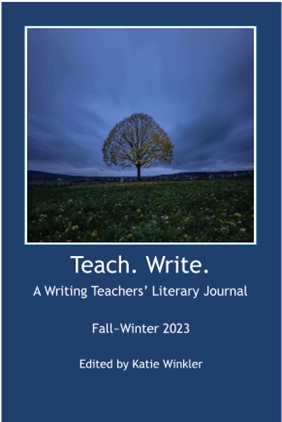
The 2023 fall~winter edition of Teach. Write. comes out tomorrow, continuing the tradition of showcasing the work of teachers and the art of teaching, along with other work that I hope simply inspires all to enjoy well-crafted and timely stories and poems. This edition, however, now that I have more time to work on improving the journal, has resulted in some changes:

  • Membership in the Community of Literary Magazines and Presses. See the journal’s page at clmp.org
  • New website–teachwritejournal.com–where you will be able to access the new edition tomorrow, October 1.
  • Largest edition ever, representing almost 50 regular and new contributors from around the country and the world.
  • More editing time has, I hope, resulted in a more polished and professional edition.
Photo by Susanne Jutzeler, suju-foto on Pexels.com

When I first started Teach. Write., the journal was primarily an escape from the pressures of teaching composition and literature at a small community college in an increasingly contentious bureaucratic environment where I was experiencing the slow erosion of the autonomy I had at first enjoyed. I’m not escaping anymore. I’m fighting.

Teach. Write. is my Sting.

It’s only a rusty dagger gripped by a little old warrior, but she is inspired and empowered by those, represented in her journal, who love words and stories, rhyme and rhythm, form and style. She is dedicated to those who care about sharing that love with others, especially students, in a world that is strangely hostile to their profession at times but one that needs those who practice the art of teaching more than ever.

Teaching, Writing, and Relationships

Photo by Mikhail Nilov on Pexels.com

I am writing a book about teaching. It’s non-fiction, but other than that, I’m not sure how to describe it. It’s part memoir and part teaching methods to begin with. In many ways, it is also like my blog–musings and mutterings about my life’s work.

I don’t mind telling you, I’m struggling. It’s not writer’s block. Oh, no. I’m not sure I believe in writer’s block anymore anyway. The only way I’ve ever written anything of any length is to write six days out of seven. The biggest excuse for not turning in work I heard over my years of teaching was some form of “I’ve got writer’s block, Mrs. Winkler.” It’s hogwash, I would tell them. Well, no, I wouldn’t say it that way. After 40 years of teaching, one learns how to spin. I would dress it up with the appropriate metaphor, analogy, etc., but in the end my student was more than likely procrastinating and not even trying to write.

Photo by Yan Krukau on Pexels.com

You can’t write anything, if you don’t write something. Hmmm, that’s pretty good. I wonder if I ever used that one in class.

So, again, no. It’s not writer’s block. The first day of my official retirement, August 1, I set a daily average quota for the book in order to finish a rough, rough draft by the end of the year. I’m well ahead of schedule in that regard; I haven’t had trouble writing pages and pages and pages. Because I’m not plotting (I’m a terrible plotter), the words, stories, feelings, and ragings about my life in teaching just pour out.

Photo by Mikhail Nilov on Pexels.com

Frankly, my struggle is having a point. But, no, it’s not that either–I have so many points, so many things I want to say about teaching, that the book is just a hodge podge of memories interspersed with my concerns (aka fears) about what is happening in education, especially higher education in America, especially here in North Carolina.

Sometimes, I think I’m writing two books, but if I want to keep the memoir part intact, the part that reflects who I was as a teacher, how I changed, and why teaching was more than a career, if I want to do that, then maybe this mishmash of a book is exactly what I want to write.

However, I still feel that the book needs to have a central theme, something on which to hang all the dangly pieces, and entice the reader to hear what I have to say. Also, even though it faces the truth about the educational perils of our time, I want the book to be, overall, positive in its outlook as it promotes the intrinsic value of education.

I think I’ve got it now–at least the germ of an idea.

Relationships.

Photo by Kampus Production on Pexels.com

Education begins and ends with relationships–between student and teacher, yes, but it doesn’t end there–also between student and family, family and teacher, teacher and other teachers, teachers and administrators, administrators and staff, staff and students, staff and teachers, and civic leaders, business owners, the community at large, and, okay, you get it. Success in education depends on the health of all these relationships. I think my book already reflects that, but I want to strengthen that theme in revision.

One of the spires of Lincoln’s Inn, London, October 2015 photo by Katie Winkler

So far, my book not only reflects some of these personal relationships, but also the relationships between events of my life and teaching. A large chapter in the book, for example, is showing how my travels in America and Europe reflected themselves in my teaching. I also want to talk about the relationship between socio/cultural shifts and the classroom, how I had to adapt my lessons to new trends (after I got over being furious about them).

I’m not sure. I’m still struggling, but I’m not blocked. I’m not discouraged. I am practicing what I preached all of those years: “Just get started. Vomit.” Yes, I said vomit–always got their attention. “Vomit it all out on the paper and then start cleaning up through revision and editing.” That’s where the heart of good writing lies.

More about that later.

Other than writing the book, I have also been putting together the fall/winter 2023 edition of Teach. Write.: A Writing Teachers’ Literary Journal, which will publish Oct. 1. As I mentioned in my last post, the journal has its own website now! The spring/summer edition is there as well as submission guidelines and some other information. Why not take a look? Just go to teachwritejournal.com.

Retiring?

Mrs. Winkler photo by Scott Treadway at Treadshots.com

So, it’s true. Retirement after almost 40 years of teaching English composition is, number 1, freaking awesome! Not having the constant class planning and paper grading has been true freedom for me. I guess I didn’t realize what a huge chunk of my life was wrapped up in doing those two things. Even in the summer when I wasn’t teaching, I was still spending on average a couple of hours each day tweaking old assignments, writing new ones, and updating online material (necessary but oh so tedious), among other college-related things I would just as soon forget.

The second true thing is that I have planned way too much for the first few months. So many people told me that I would be busier than ever when I retired, but I didn’t believe it could be true.

It is.

Here are a few of things I’m working on:

  • A teaching memoir–this is highest on my list because my 87-year-old mother suggested it, and I love the idea. I am ahead of schedule, even though I’m not writing at least six days a week as I promised myself I would. That said, when I do write, the words just flow out, and I’m averaging over my quota per day.
  • Writing blogposts more often. My goal is to write a post, on average, once a week. I am quickly learning that I won’t be able to write on the same day every week. My schedule is too unpredictable, but if I write four posts a month, I’m going to feel pretty darn good about myself.
  • Applying for membership in the Community of Literary Magazines and Presses (CLMP). I told myself that once I retire, I want to improve the quality of my literary magazine Teach. Write.: A Writing Teachers’ Literary Journal. Then, I discovered CLMP, and I knew becoming a part of this organization would help me reach my goal.
  • The first step in being approved for membership in CLMP is developing an independent website for Teach. Write. I have already launched the new site, but there isn’t much content yet, so I am taking some time several days a week to work on that project.
  • Launching the next edition of Teach. Write. on October 1. Still on schedule to launch the new edition on the new site!!
  • Writing and submitting new short fiction. I’ve written and submitted one new story for a contest already and submitted one other story that I love but still hasn’t found a home. I think it is important to keep submitting my shorter works while I’m working on this long non-fiction project.
  • Thinking about my next play project–just thinking about it. I have two plays in mind–one is an adaptation and the other is original. At this point, I’m just re-reading the novel I’m thinking of adapting and doing some minor research on the original play idea.

These are only my writing and teaching-related activities. Despite all I’m doing as a writer/teacher, I don’t feel as stressed because I know I don’t have to do them. Also, because those two huge responsibilities–planning classes and grading papers–are no longer looming, I have time to do all the things I’ve been able to barely do and do them better. At least, I’m trying to do them better.

Yes, retirement suits Mrs. Winkler very well.

Photo by Nathan Martins on Pexels.com

Read. Write.

photo by Katie Winkler

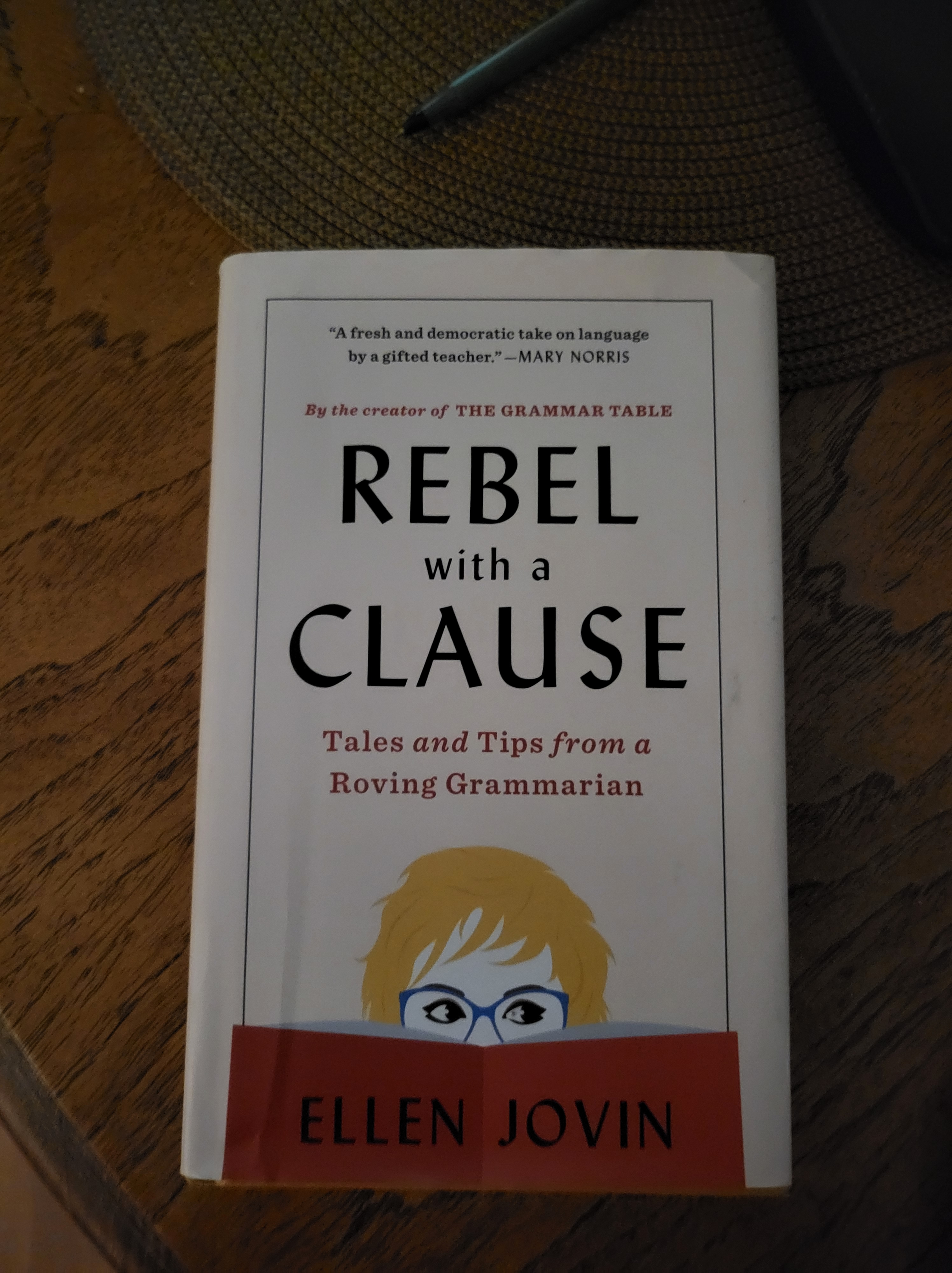
Just finished reading one of the gift books (pictured above) that a dear friend and former colleague gave me my last day at work. It is simply charming and a perfect choice for a woman who has retired from teaching English but will always love grammar.

That’s right. I said it. I love grammar, always have. I remember when I was in high school VOLUNTEERING to take an advanced grammar class because even then I felt drawn to grammar for some strange reason. Side note: Isn’t amazing that a high school in Jenks, Oklahoma, outside of Tulsa, would be able to fill an advanced grammar class?

With its in-depth discussion of parts of speech and detailed diagrams of complex sentences like the Preamble to the Constitution, that grammar class cemented my love and affinity for all aspects of language, including what I used to think most people found uninteresting and mundane. However, Ellen Jovin’s social experiment offers proof that many people find grammar not only interesting but often worth debating–seriously.

Jovin indicates in her introduction that she left her New York City home in the fall of 2018 armed with a folding table, a sign that reads “Grammar Table,” several English language handbooks, and a husband–to record each grammar session for a documentary that is now in post-production. By the time the book was published in 2022, the duo had visited 47 states, missing only Alaska, Hawaii, and Connecticut. I know what you’re thinking, why Connecticut? I mean, it’s right there! In the witty style that suffuses the book, Jovin explains that they were hungry for pizza, got caught up enjoying it, and called it a day without setting up the table. Then came Covid.

Jovin went ahead and wrote the book. Good for her! Each chapter discusses “hot” grammar topics at the table, beginning with one that scorches, the Oxford comma. You know the one–“eats, shoots, and leaves” or “eats, shoots and leaves?” Her measured response to even those who feel most strongly pro or con, mainly pro, is another hallmark of the book. I love the way that Jovin finds a way to smooth the ruffled feathers of even the staidest visitors to her table.

Some of my favorite topics include participles, gerunds, punctuation of all sorts, homophones, and possessive apostrophes. Foremost, I found validation as I was in agreement with this grammar expert in almost every case and can remember explaining concepts in a similar way to my students over the years. Jovin uses example sentences and draws little diagrams and simple drawings as aids, just like I did, and they work! Just like they did for me. To use a southernism–It just tickles me.

Photo by Vlada Karpovich on Pexels.com

Her style and organization have inspired me as I continue to work on my own writing project, a memoir of my career as an educator. Like her I don’t want to write in chronological order but topically, showing how my life experiences have impacted the classroom. I also want to infuse humor and introduce interesting, quirky characters into the work as she does. I want it to be entertaining as well as informative. I want to teach and write, just like I ask others to do.

~~~~~~~~~~~~~~~~

Speaking of Teach. Write., if you have anything you would like to submit for this edition, then the deadline is fast approaching–September 1. The fall/winter edition will publish on Oct. 1, and I will reopen for submissions at that time. I have some great pieces to share with you in this new edition, so stay tuned for more information.

Back to School?

For the first time in 27 years, I did not go back to work today. July 28, I said goodbye to the community college where I developed curriculum for and taught, at one time or another, English composition, developmental reading and writing, creative writing, and business English as well as American and British literature. Some of my other duties over the years included advising and registering students each semester, regularly writing the weekly BRCC column that appeared in the local paper, serving as the faculty council chair for two years, writing plays, screenplays, and press releases as well as frequently appearing in productions for the college’s drama department. Those last few things were less responsibilities and more for the sheer joy of it.

I was also interested in online learning and one of the first instructors to teach online. Unlike many of my colleagues, I enjoyed engaging in new educational technology and preferred teaching some classes online. For about a ten year period, I frequently attended state and national conferences to share what I was learning about using technology more effectively in English classes.

Another thing that I did all those years was ask questions. I asked a lot of questions that were rarely answered, not to my satisfaction anyway, and led to me getting a reputation as a “trouble maker.” But honestly folks, I just asked questions. Honest questions.

Truth be told, since I’m still trying to be honest, although I felt many administrators’ displeasure, no one every really tried to overtly interfere with what I did in the classroom. I’m not sure why that is, except maybe I earned my high school nickname, Bulldog, for a reason. Hey, maybe I was just a really good teacher. I like to think I was. No, the pressure on me was much more subtle—patronizing condescension, gradual marginalization, simple avoidance.

Oh, well.

For the bulk of my career, I loved my work despite the occasional bureaucratic and administrative headaches because I felt like I was a vital part of the college, that I mattered more than a body to cover the classes that needed to be covered, record grades, or register students so the college could reach new statistical highs and claim bragging rights. Towards the end, and one reason I retired early, I just didn’t think I mattered anymore. Worse, I couldn’t continue to watch the people in power care less and less about my students beyond the data their presence produces.

So today, I begin again and go back to a different kind of school, one with a curriculum of my own design, that will guide these early years of my “refirement” (see my last blogpost) because I still have much to learn and many questions…so many questions.

Come back next week and see what questions Mrs. Winkler is asking now!

Refire, not Retire!

My father always said, in his loveably corny way, that he wasn’t ever going to retire, but refire! I think I will take his mantra as I embark on this new phase of my life. I have taken a few days to just re-evaluate things and decide what I want to spend my time doing.

So much of my time the last 55 years and more has been about getting an education or being an educator that it is going to take time to learn how to focus on other things, but I’m eager to try. I am already loving the freedom to order my life according to what is important to me, not my teachers or my employers.

Where to begin? Sheesh, now that it comes down to it, I’m having trouble even putting anything down. I know I want to spend more time with my family without annoying them, and I want to do things for them without hovering or being bossy.

But when it comes to the non-essentials, I guess the first thing I want is to write. I know that! Of course, I will continue writing this blog—my goal is to write a post once a week. But more than that, I want to start marketing the blog more and learn more about the business side of blogging and up my game a bit in that department. So, I guess I will be going back to school in that sense, but again, I want to do it. Nobody can make me anymore. Or voluntell me!!

It’s been a year since I worked on my podel (podcasted novel) Campus: A Novel That Wants to Be a Musical, so I want to pick that back up. I think I will shoot for one episode a month and try to increase that gradually. I want to improve the quality of the productions as well, which I am looking forward to doing.

My podcasting set up thanks to husband and daughter

I have already started working on the book that my mother suggested I write—a memoir of my teaching career. My goal is to finish by the end of the year, which means averaging about 600 words a day, so I’m on track. I am pleased with the format I’ve chosen and the writing is coming so much easier now that I am not spending so much of my summer vacation days planning my classes for the fall semester.

Spending more time with each edition of Teach. Write., the literary journal I founded, edit, and publish, is also something I want to do. I feel like I have made small improvements since the first edition in 2017, but I have always felt rushed to get each edition out. I am glad that retirement will afford me more time to work on this passion project.

First edition of Teach. Write.

So many other things I want to do, but I never want to forget that I also want to leave room in my life to be less busy, to listen more, read more, and have times like today to just sit on a porch in Alabama with a cup of coffee on a cool summer morning before the day heats up, listen to the collared Eurasian doves coo, pet a soft German shepherd puppy, and talk about life with my baby brother.

It’s a good life.

Me several years ago before seeing a play at the Peace Center in Greenville, SC.

Chatting with ChatGPT

Photo by Andrew Neel on Pexels.com

I had a chat with ChatGPT today. It was very interesting and actually quite encouraging. I know that a great many educators are extremely worried about what AI will do to the teaching of composition, and I have my concerns as well, even after my “interview” with Chatty (my pet name for it), but just as I said in a meeting with English faculty and administrators when ChatGPT was breaking in the news earlier this year, I think we should embrace AI and move to change the way we teach and assess research skills and writing. 

So, here are some excerpts from my little talk with Chatty: Note: Together the two of us generated 2, 749 words in about 15 minutes. It took me longer to type my questions than it did for ChatGpt to answer in most cases.

Q 1–(truncated) How can English composition instructors combat students cheating with AI?

Photo by Andrea Piacquadio on Pexels.com

A 1–To combat students cheating with AI in English composition classes, instructors can employ several strategies:

1. Clear Academic Integrity Policies: Establish and communicate a comprehensive academic integrity policy that clearly defines what constitutes cheating and the consequences for such behavior. Make sure students are aware of the ethical implications and the importance of original work.

3. Assign Original and Personalized Topics: Design writing assignments that require students to express their own thoughts, opinions, and analysis. Select topics that prompt critical thinking and reflection, making it difficult for AI tools to generate suitable responses. (I have long been a proponent of this technique. It has helped reduce plagiarism in my classroom) 

4. Promote Authentic Assessment: Incorporate assessment methods that emphasize originality and creativity. Encourage students to engage in class discussions, presentations, and debates that showcase their unique perspectives. Use open-ended questions and prompts that elicit thoughtful responses. (Ditto on this technique)

5. Frequent Progress Checks: Break down assignments into multiple stages, such as topic selection, thesis statement, outline, rough draft, and final submission. Require students to submit their work at each stage, ensuring progress and monitoring the writing process. (And this one–problem is that even using a checklist or rubric, the grading load can be brutal if the instructor has to teach 16 weeks of material in 8 weeks) 

8. Personalized Feedback and Revision: Provide individualized feedback on writing assignments, highlighting areas of improvement and offering suggestions for further development. Emphasize the value of the writing process and the importance of revisions. (Also can be brutal with a heavy teaching load, but I asked Chatty about that. See below)

9. Foster a Supportive Classroom Environment: Encourage open communication and foster a classroom culture that values originality and academic integrity. Engage students in discussions about the ethical implications of cheating and the benefits of personal growth through authentic learning. (Difficult when teaching online. It can be done, but it requires a great deal of work that overloaded instructors often don’t have.)

By implementing these strategies, English composition instructors can actively discourage and prevent students from cheating with AI while promoting the development of essential writing skills and fostering a culture of integrity.

Q2–What if I have over 100 students’ papers to grade? How can English instructors do the things you suggest when they have so much grading to do?

Photo by fauxels on Pexels.com

A2–Grading a large number of student papers can be time-consuming and challenging. However, here are some suggestions to manage the grading process effectively while still implementing the strategies mentioned earlier:

1. Set Clear Expectations: Clearly communicate your grading criteria, expectations, and the reasoning behind them to students at the beginning of the course. This will help students understand the parameters within which they should work and reduce the likelihood of cheating.

2. Use Rubrics: Develop a comprehensive rubric that outlines the key components you will assess in students’ papers. This will provide a structured approach to grading and ensure consistency across multiple papers.

3. Prioritize Key Assignments: Consider selecting a few key assignments that require more in-depth analysis and focus your efforts on providing detailed feedback on those. For less critical assignments, you can use more streamlined feedback methods, such as highlighting common errors or providing general comments.

5. Implement Efficient Grading Techniques: Explore strategies to streamline the grading process. For example, you can set a specific time limit for grading each paper to maintain consistency and prevent burnout. Additionally, consider using abbreviations or standardized comments to provide feedback efficiently.

7. Consider Sampling: Instead of grading every paper in its entirety, you can employ sampling techniques. Randomly select a subset of papers to grade comprehensively, while giving the others a lighter evaluation, focusing on key areas or specific aspects you want to assess.

Remember, it’s important to strike a balance between providing valuable feedback and managing your workload efficiently. By implementing these strategies, you can effectively grade a large number of papers while still incorporating the suggested methods to combat cheating with AI.

Q3–How can I incorporate AI into the English composition classroom? Can you give me a sample assignment?

Photo by Mikhail Nilov on Pexels.com

A3–Incorporating AI into the English composition classroom can offer various opportunities for engaging and innovative assignments. Here’s a sample assignment that integrates AI technology:

Assignment: Exploring AI in Writing Analysis

Objective: To critically analyze the impact of AI on writing and language usage.

Instructions:

1. Research: Begin by conducting research on the applications of AI in the field of writing and language analysis. Explore topics such as automated grading systems, AI-powered writing assistants, and language generation algorithms.

2. Case Studies: Select at least two case studies or examples where AI has been utilized in the context of writing analysis. These could include plagiarism detection tools, grammar and style checkers, or content summarization algorithms.

3. Comparative Analysis: Compare and contrast the strengths, limitations, and ethical implications of each AI tool or system you have chosen. Consider factors such as accuracy, bias, privacy concerns, and the impact on creativity and originality in writing.

4. Critical Reflection: Write a reflective essay that addresses the following points:

   a. Describe your experience using AI writing tools, if applicable. How did they impact your writing process and outcomes?

   b. Evaluate the effectiveness of AI tools in detecting plagiarism, improving grammar, or enhancing writing style. Reflect on their strengths and weaknesses.

   c. Discuss the ethical considerations associated with AI use in writing analysis. Explore concerns related to authenticity, privacy, and the potential suppression of unique voices.

5. Recommendations: Based on your analysis and reflection, provide recommendations for students, instructors, and policymakers on how to navigate the use of AI tools effectively and ethically in writing contexts.

6. Class Discussion: Engage in a class discussion where students share their findings, insights, and recommendations. Facilitate a dialogue on the benefits and challenges of integrating AI into the writing process, while considering the broader implications for education and society.

By assigning this project, students can deepen their understanding of AI’s impact on writing, critically evaluate its benefits and limitations, and develop informed perspectives on the responsible use of AI tools. Additionally, class discussions allow students to engage in collaborative learning, exchanging ideas, and exploring diverse viewpoints.

(I love these ideas. I am not going to teach much longer, so I won’t have a chance to try them out in the classroom; I retire on July 28, but I certainly will encourage faculty to use some of these techniques through this blog and in my upcoming book about teaching. I hope to have it finished by the end of the year.)

Q4–I feel that educators are going to end up using computers to grade computer-generated material produced by students. Any suggestions on how to prevent this from happening? 

Photo by cottonbro studio on Pexels.com

A4–(truncated) If you have concerns about the potential over-reliance on computer grading systems, here are some suggestions to prevent or mitigate the exclusive use of such systems:

1. Emphasize the Value of Human Evaluation: Educators can highlight the importance of human evaluation and the unique insights and perspectives that human graders bring to the assessment process. Promote the understanding that human evaluation encompasses qualities that automated systems cannot fully capture, such as creativity, critical thinking, and context-based analysis.

2. Educate Stakeholders: Engage in conversations with administrators, fellow educators, and policymakers about the limitations of computer grading systems. Share research and evidence that supports the benefits of human grading in assessing complex skills, such as writing, where context, nuance, and originality play crucial roles.

8. Involve Students in the Discussion: Foster open dialogues with students about the value of human evaluation and its impact on their learning experience. Encourage their active participation in the assessment process and seek their feedback on the benefits and limitations of different grading methods.

By actively promoting the importance of human evaluation, engaging in advocacy efforts, and encouraging a balanced approach to assessment, educators can help prevent an overreliance on computer grading systems and ensure that the value of human assessment is recognized and upheld in the educational setting.

Q5 omitted 

Q6–Write a paragraph about how a college can improve its online teaching using at least one academic source cited in MLA 9 format

Photo by Christina Morillo on Pexels.com

A6–Improving online teaching in colleges requires a comprehensive approach that considers pedagogical strategies, technological infrastructure, and student engagement. According to Smith (2020), incorporating active learning techniques in virtual classrooms can enhance student participation and deepen understanding. One effective method is the use of breakout rooms, which allows for small group discussions and collaboration. Additionally, integrating multimedia elements, such as videos and interactive simulations, can facilitate content comprehension and engagement (Jones, 2019). To ensure equitable access to online education, institutions should prioritize providing necessary technology and reliable internet access to all students (Johnson et al., 2021). By implementing these strategies and considering the recommendations from academic sources, colleges can enhance the quality of online teaching and create a more interactive and inclusive virtual learning environment.

References:

Jones, A. B. (2019). Enhancing engagement in online courses through multimedia learning materials. Journal of Online Learning and Teaching, 15(4), 160-177.

Johnson, K. D., Veletsianos, G., Seaman, J., & Henderikx, P. (2021). U.S. Faculty and Administrators’ Experiences and Approaches in the Early Weeks of the COVID-19 Pandemic. Online Learning Journal, 25(2), 6-24.

Smith, J. M. (2020). Active Learning in Online Instruction: Evidence-Based Practice and Future Directions. Online Learning Journal, 24(4), 198-213.

(Very impressive in some ways, especially that Chatty generated this paragraph in a few seconds; however, the citations are in APA 7 style, not MLA 9. Knowing this, I can warn students ahead of time that if they use AI to generate their papers, they still need to know MLA 9 well enough to make changes to the citations. Another thing missing is the database name, url, or doi that I require to indicate where the student found the article. AI is not able to generate that but students should be required to provide it.)

Q7–Can you use a source from NCLive to support the previous paragraph?

A7–I apologize for the inconvenience, but as an AI language model, my responses are generated based on a mixture of licensed data, data created by human trainers, and publicly available data. I have not been directly trained on specific publishers or have access to proprietary publishers like NCLive. I should note that while I strive to provide accurate and up-to-date information, my responses may not always reflect the most current research or publications in the field.

I encourage you to consult NCLive or other reputable sources directly to obtain the necessary information and academic sources in MLA 9 format to support your paragraph on improving online teaching in colleges.

(I was quite encouraged by this answer. If instructors will craft their assignments in such a way as to require more local or regional resources to support more specific, personalized subjects, then students will be less likely to be successful in using AI to generate an inordinate amount of material for their compositions.)

Q8–I am a teacher trying to discover how to prevent cheating by using AI. You have given me some good information, but I don’t know how to convince students of the importance of academic integrity when society seems to care mainly about the final grade a student receives in any given course. Any suggestions on how I can convince students of the importance of academic integrity? 

Photo by RDNE Stock project on Pexels.com

A8–(truncated) Convincing students of the importance of academic integrity requires a multifaceted approach that combines education, engagement, and fostering a culture of integrity. Here are some suggestions to help convey the significance of academic integrity to your students:

1. Start with the Why: Begin the conversation by explaining the underlying principles and values that academic integrity upholds. Emphasize that it goes beyond just obtaining a grade and is essential for personal growth, ethical development, and long-term success in academia and beyond. (In an 8-week online course, I try to do this through frequent recorded sessions. Students are required to attend live or view the recording)

2. Create Meaningful Connections: Connect academic integrity to real-world examples and situations that students can relate to. Discuss the impact of dishonesty and plagiarism on professional reputation, the trustworthiness of research, and the consequences in various fields and industries. (Hard to do in an accelerated online course) 

5. Explain the Learning Process: Help students understand that the primary purpose of assignments and assessments is to promote learning, critical thinking, and skill development. Emphasize that by engaging in academic dishonesty, they are robbing themselves of the opportunity to grow and succeed based on their own abilities. (I also use the recorded sessions to explain the learning process.)

6. Teach Research Skills and Citation: Offer guidance on proper research methods, citation practices, and the use of academic sources. Demonstrate how correct citation and referencing strengthen their arguments, demonstrate credibility, and contribute to the scholarly conversation.

7. Showcase Academic Achievements: Highlight and celebrate instances of exemplary academic work, original thinking, and creativity. Recognize and reward students who demonstrate a commitment to academic integrity, reinforcing the value and importance of ethical conduct. (I wish I had more time to do this technique, but it is tough with a heavy teaching load and accelerated classes.)

10. Lead by Example: Demonstrate integrity in your own teaching practices. Clearly communicate expectations, provide fair assessments, and model ethical behavior in the classroom. Be available to answer questions and provide guidance when students face challenges.

By consistently promoting the value of academic integrity, fostering open dialogue, and providing support and guidance, you can help create a classroom environment where students recognize the significance of academic honesty and are motivated to uphold it.

***

Chatty certainly offers some excellent advice and demonstrates an impressive command of educational techniques. However, like so many other technological tools to help students and educators, Language AI is not the savior nor the threat that so many seem to take it. It is a tool to be used for good or ill, as a valuable time-saver or as a debilitating crutch. It is only as good as the human using it. 

In the end, education doesn’t happen through the use of impressive technology. Even in the age of AI, teachers still reach students the same way they always have, through building relationships, one student at a time.

Photo by Kampus Production on Pexels.com

What’s Mrs. Winkler Up To?

Well, she’s up to her neck, actually, but trying to remember that this too shall pass and that after this spring semester will be three more small, short summer classes, and then RETIREMENT!!

Of course, only Katie Winkler would say yes to doing a play right at the end of the spring semester–our second to last performance will be on graduation day! But, I am actually glad I said yes because I am spending time with old friends and making new ones. Also, it keeps me busy and makes the days feel like they are rushing by!! When the horse is headed for the pasture, she needs time to fly!!

The play is called The Savannah Sipping Society by Jesse Jones, Nicholas Hope, and Jamie Wooten. If you are in the Asheville area May 5-14, why not come see this cute little play? It’s mainly a fun frolic but does have its poignant moments that get to the core of what makes for true friendships and how important they are in our lives.

Cover of Spring~Summer 2023 edition of Teach. Write. See the online edition here: 2023 Spring ~ Summer

As well as the rehearsals, I, of course, have had all of the end-of-semester grading that comes along with teaching English at a community college. That along with so many other things has set back editing and preparing the print version of the spring-summer edition of Teach. Write. I just want all my contributors to know that I haven’t forgotten and will be working on the print version this week.

Today’s my birthday, and though most of it will be spent at the theater and grading papers, the day is a reminder of all the grand adventures I’ve had in my life. I feel blessed and humbled to have had the opportunity to be an actor, writer, teacher, friend, sister, daughter, mother, and wife.

It’s a grand life. Happy birthday to me!!!