Happy Birthday, Wikipedia!

Photo by Mikael Blomkvist on Pexels.com

Every January still brings a little spark of that old classroom rhythm — the sense of fresh starts, shiny new laptops, and the promise of innovative ideas. Even in retirement, I find myself paying attention to the tools, like Generative AI that continue to shape how students learn and how all of us make sense of the world. This year, one of those tools is celebrating a milestone: Wikipedia just turned twenty‑five. A quarter‑century of open collaboration, spirited debate, and dedicated volunteers tending the largest living reference work ever created. As it reaches this milestone, I’ve been thinking about how much it has influenced the way we teach research, develop curiosity, and encourage critical thinking.
Photo by Markus Spiske on Pexels.com

A Starting Point That Changed the Classroom

When Wikipedia launched in 2001, it felt like a grand experiment. Could strangers on the internet really build a reliable encyclopedia together? Twenty‑five years later, the answer is complicated in the best possible way. Wikipedia now contains millions of articles in hundreds of languages, all maintained by a global community of volunteer editors. It’s messy, transparent, and constantly evolving — which is exactly why it became such a powerful tool for students.

When I was teaching at Blue Ridge Community College in Flat Rock, North Carolina, I never allowed Wikipedia as a source in research papers. Most teachers didn’t. But I always encouraged my students to use it as a starting point. So many of them would come to me with enormous, unwieldy topics — “gun control,” “immigration,” “the death penalty,” “global warming.” Wikipedia helped them narrow their focus. They could skim the broad strokes, learn the vocabulary, and begin to see where the real scholarly conversations were happening.

Photo by Mikhail Nilov on Pexels.com

Then there were those glorious lists at the bottom of each article! I used to tell students, “Scroll all the way down. That’s where the good stuff is.” Wikipedia’s citations often led them to peer‑reviewed journals, reputable news outlets, books, and primary sources they could use. In a world where students often feel overwhelmed by information, Wikipedia, along with a good teacher, could teach them how to trace knowledge back to its roots.

Transparency as a Teaching Tool

One of Wikipedia’s greatest strengths has always been its openness. Every edit is logged. Every claim must be sourced. As a composition teacher, I was able to point this out to students. We were able to actually look at the edits. Also, our librarians would point out the dangers of taking Wikipedia at face value and look at some of the hoaxes and false information rooted out and eliminated. One of my favorite hoaxes was about my college’s hometown of Hendersonville, North Carolina, stating that the city in the Southern mountains had monkeys roaming its streets. However, such is Wikipedia’s transparency that it keeps track of hoaxes and misinformation on its own wiki!

Challenges in an AI‑Shaped World
Photo by Hartono Creative Studio on Pexels.com

Of course, openness comes with challenges. Wikipedia has spent years grappling with issues of representation, bias, and the uneven distribution of editors across cultures and languages. And now, a new challenge has arrived: generative AI.

AI tools — including the one helping me write this article— learn from vast amounts of online text. Wikipedia is one of the richest sources of human‑curated knowledge available, which means AI companies have been using, and maybe even misusing it, to train their models. As human traffic has dipped, bot traffic has surged, sometimes disguising itself to avoid detection and placing strain on Wikipedia’s infrastructure.

This raises big questions: How do we protect an open resource in a world where machines consume information faster than humans can contribute it? How do we ensure that the volunteers who built Wikipedia aren’t overshadowed by the tools that learned from them?

A New Kind of Collaboration

Photo by Markus Winkler on Pexels.com

For its 25th birthday, Wikipedia chose a path that feels true to its spirit: collaboration. The Wikimedia Foundation announced new licensing agreements with major AI companies — Amazon, Meta, Microsoft, Perplexity, and Mistral AI among them. These agreements ensure that companies relying on Wikipedia’s data contribute to the cost of maintaining it.

For decades, Wikipedia survived on the generosity of individual donors — millions of them — who believed in free knowledge. But as AI companies increasingly depend on Wikipedia’s content, the Foundation has made it clear: if you’re going to build your models on the work of volunteers, you need to help sustain the platform that made that work possible.

What This Means for Education

For teachers, this moment feels especially important. Students today often encounter information through AI‑generated summaries rather than clicking through to original sources. When they write, pressed for time, they may be tempted to let AI do all the work, not properly contributing or even editing what the computer spits out. That means fewer opportunities to see how knowledge is constructed — and fewer chances to practice evaluating it.

We can only hope that Wikipedia’s new partnerships will help preserve the ecosystem of inquiry that educators rely on. By ensuring responsible, sustainable access to its data, the Foundation is protecting the integrity of the source material. And because Wikipedia remains free for human users, students can still dive into the articles themselves, explore the citations, and follow the breadcrumb trail of research.

A Future Rooted in Curiosity

As part of its birthday celebration, Wikimedia, the parent organization of Wikipedia, has highlighted the people behind the pages — librarians, teachers, retirees, students — all contributing to this improbable project. It’s a reminder that Wikipedia’s greatest strength isn’t its technology but its community.

In a world where information can feel slippery, Wikipedia’s commitment to openness — imperfect, collaborative, and human — feels more vital than ever, especially for the classroom.

So Happy Birthday, Wikipedia! Live long and prosper!

Face-to-face and One-on-One

Samford Hall at Auburn University–Photo by Pixabay on Pexels.com

I was talking to my nephew Ruben this past weekend. He just started this semester attending Auburn University after getting his Associates at Southern Union Community College in Opelika, AL. He has an interesting perspective on American colleges and universities because, although he has an American father, he was raised and educated in Germany, where my brother has lived and worked for decades as a pastor after making the wise decision to marry my wonderful sister-in-law, who is a German doctor.

Ruben was glad that he attended a community college first so that he could establish residency, improve his already excellent English language skills, and acclimate to the American educational system. He did well and accomplished his goals, grateful for a low-cost alternative for satisfying his general education requirements.

Photo by SERHAT TURAN on Pexels.com

However, at Auburn this semester, he has been able to begin working on his major area of study, graphic design, and that has been the highlight of his time in American higher education so far. Why? Of course, working on projects that are teaching him the skills necessary for his desired employment is one of the reasons. The class is several lab hours a few days a week where students’ work is evaluated and critiqued openly. In addition, students are expected to work on projects outside of class and those who wish to do well will come to work in the studios late at night. But, since Ruben almost always meets his fellow students in the studio, where there’s plenty of talk and laughter, he doesn’t mind the late-night work so much.

As I listened to my nephew, though, I soon realized that the main reason he is enjoying his graphic design so much is the professor. Turns out she’s tough and demanding, expecting students to show up prepared for class and able to take constructive criticism. She roams the studio during class, watching students work, looking at their projects, and pointing out what needs to be improved. She is not all warm and fuzzy, and Ruben likes this. It’s a challenge that he enjoys rising to.

Photo by cottonbro studio on Pexels.com

I felt so heartened as I listened to Ruben talk about his class, about working hard and enjoying it. So much of that had been lost in my last few years of teaching. Now that I’m retired over a year, I can see that some of my discouragement came from burnout. I was just so ready to retire. However, some of that burnout came from showing compassion for students who were truly struggling with serious issues of physical or psychological abuse, food and housing insecurity as well as with the subject matter, while shoring up the resilience and persistence of others whose overprivileged lives and faux fragility was crippling them.

Both types of students need a rigorous and challenging hands-on learning experience with a dedicated educator like Ruben’s professor, who demands excellence from her students and yet takes the time to build relationships with them. The ones who have it tough often find hard course work and thinking as an escape, and the ones who’ve never needed to work hard before need it because, well, they need to learn how to work hard for something–we all do. As Dad said, “It builds character.” Of course, the students have to be, like my nephew, willing to accept critique and respect the professor’s expertise. Ruben does not feel that he has nothing to learn, that he’s just ticking off a box. He is approaching the class with diligence and humility, which in turn is, I’m sure, allowing the professor to give more of what she has to give.

Photo by Kampus Production on Pexels.com

I felt better about higher education after talking with my nephew on Saturday. As long as there are teachers who are willing to give and students who will receive, face-to-face and one-on-one, then solid American higher education will continue, and our country will be the stronger for it.

Teaching Again

All they did was ask me to do a 15-minute devotional at my church’s drama camp, 3rd-8th graders and young high school and college-aged counselors, but I felt like I was back in the classroom again. The camp leader said I should talk about perseverance and use our verse for the week–James 1: 2-4.

2 Consider it pure joy, my brothers and sisters,[ a] whenever you face trials of many kinds, 3 because you know that the testing of your faith produces perseverance. 4 Let perseverance finish its work so that you may be mature and complete, not lacking anything.

I was ridiculously excited to put together this little lesson. Just like in the old days, I tried to consider my audience–a wide range of ages, more girls than boys, artsy theater kids, not easy to engage–a challenge. Yes!

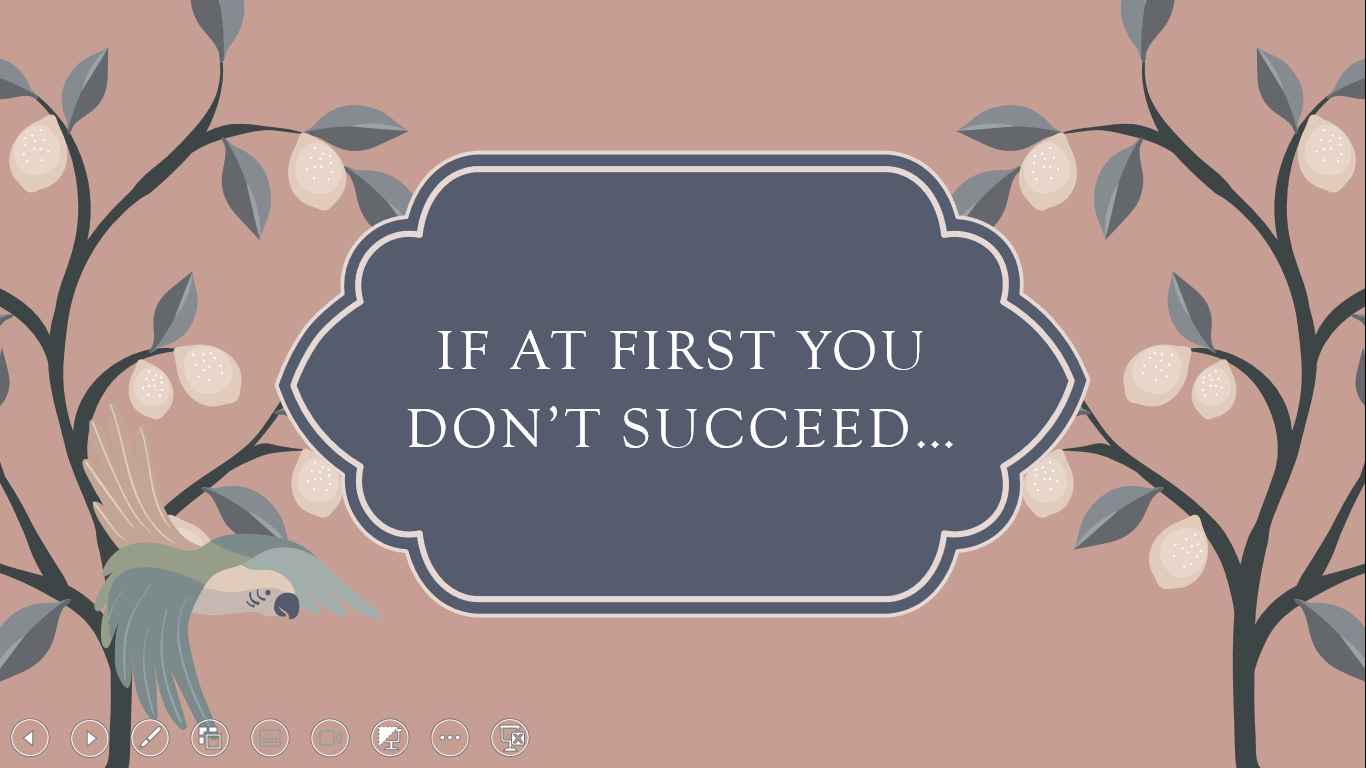
The first think I did was choose a PowerPoint theme with some interesting graphics and give my talk a title. I chose a presentation template called Pheasant and called it “If at first you don’t succeed.” I know what you’re thinking, PowerPoint is so passe, how can that engage? What a corny title, how will that grab kids’ attention? I didn’t know how. I just went with my gut–just like in the old days.

First thing good teachers do is review, right? So, I reviewed the verse, emphasizing how perseverance helps us grow. Then, as an example, I did research on some young actors who went through adversity before they made their breakthroughs and settled on Millie Bobby Brown, who started trying to get commercials and roles at a very young age. She and her family were about to give up when she got the role of Eleven in the hit Netflix series Stranger Things, for which she won a Screen Actors Guild Award. My thinking was that trying to get roles and failing would resonate with kids who the day before had auditioned for the little plays we would do at the end of the week. Not all of them received the roles they had set their hearts own. My strategy worked. This rowdy bunch of kids were quiet, listening, engaged.

Next came the question for the audience: Have you ever failed at something? Raise your hand. Many of them raised their hands? Give me one word to describe how you felt? The answers came–sad, depressed, bad, heart-broken, mad. Just as in my classrooms before, I wanted my talk to be interactive. I continued to ask questions of the group as we proceeded.

The camp leader had asked me to share a little about my background as a playwright and writer, so in this context, I decided to share about my failures–how in 40 years of working to be published I had about 30 short stories published and four plays produced at a community college. If that sounds like a lot, I said, it isn’t. After about ten years I quit counting my rejections. I had reached 200 by then and since then had had hundreds more.

By this time, I could have heard a pin drop. I had them! I told them that none of that mattered. That success as a writer, an actor, a musician, is in the doing. I told them that I express my heart through my writing and need to write. I can’t not write, I told them. The striving and the working to become better and better makes the tangible successes that much sweeter.

Now was time for the pièce de résistance

I showed a short video of when Heather Dorniden, now Kampf, raced in the 600m, fell flat on her face, got up and came back to win the race. This part of the talk especially seemed to speak to the older girls; some of them were athletes, some had seen the clip before. But all the kids were mesmerized. You can see the race for yourself:

I had done some further research on Kampf and found an interview where she explained in more detail about the race and some of her experiences, good and bad, that happened in her running career after that incredible race. When I explained Heather’s background and the victories and hardships throughout her career, the point was made. The last slide read:

I don’t know if those drama campers will remember my talk, but I will never forget how this old, retired teacher felt that familiar fire as I looked into those young faces and could see hope and inspiration there. No, I don’t want to go back to grading endless comparison essays in overcrowded online classes or deal with all the bureaucratic and political crap I had to put up with over the years, but I sure do miss that feeling.

It was good to get it back once again, even if just for fifteen minutes.

Education should begin with education

Photo by Angelica Reyn on Pexels.com

I’ve probably written this in a post before, but it bears repeating. One of the best teaching professors I ever had said, “The goal of any good teacher is to become increasingly unimportant.” To me, that meant teachers are successful when they help students learn how to be independent, critical thinkers–self-starters who can be trusted to troubleshoot and problem solve yet still ask for assistance when needed–people who aren’t afraid of a challenge or obstacles or even failure. My goal was to give my students tools to meet those challenges and overcome obstacles, to learn from failure and become resilient. I wanted to equip students for all of life, not just work.

Photo by Thirdman on Pexels.com

But here in North Carolina and elsewhere in our country, education has become more of a means to an end. The general attitude seems to be “get those general ed classes out of the way” (I heard that ALL the time). They seemed to say to me, “Those classes, especially English and math, are just annoying steps a person must take to be pumped into “the pipeline” and “enter the workforce.” Gaining an education that helps people live better lives, no matter what they do for a living, or if they choose to stay home and raise children or pursue their art, has been replaced with training for a particular, specific field with a goal of employment, not life-changing education.

Photo by Yan Krukau on Pexels.com

So many of the intangibles that occur when students are truly engaged in an educational experience are lost when the emphasis is on training for local, narrowly focused workforce development based on current trends that will shift and change with every economic bubble that bursts. In the last few years of my teaching, I yearned for the days when so many of my students actually enjoyed going to school, who relished simply learning something they never knew about before. They built relationships with their classmates, studied and ate meals together, listened to music, played video games between classes and had spirited discussions in and outside of the classroom. I remember the days when students would work together, pouring hours of work into extra-curricular activities like producing a play, some of them spending hours in rehearsal on top of all of their classes and after school jobs, but they did it because they wanted to–they had a passion for it, even if they had other long-term vocational plans.

Photo by Pixabay on Pexels.com

There was a time at the college where I taught when all students in the college transfer program were required to take a literature class. There they had a chance to stretch themselves by reading complex texts that are at the foundation of not only ours but the world’s culture and government. Now, a student can get either an Associate of Science or even an Associate of Arts degree without having to take a literature course at all. How can that be?

In addition, more and more in our community colleges, three disturbing trends have taken hold–asynchronous online learning for developmental English students, high school students earning high school and college English credit for the same college-level class, and so-called accelerated classes. I helped to develop some of these courses and taught them, so you would think that I would be a proponent, but in my defense, I was misled in all of these cases into thinking the situations were temporary or that only advanced students would be taking these classes. I feel like a fool. That’s an understatement.

Photo by Liza Summer on Pexels.com

I am mortified.

In my and the college’s defense, the developmental co-requisite English class that I had developed, which was part of North Carolina’s third iteration of developmental education in less than a decade, was not intended to be an online program. The plan was that all developmental classes be taught in the classroom. Then, in March of 2020, when we were soon to roll out our new co-requisite English classes, the pandemic hit. All classes, including the co-requisite English courses, were forced to go online.

It didn’t go well.

Come back soon and I’ll explain.

AI and the Changing Composition Classroom

Photo by Tara Winstead on Pexels.com

Many instructors are fearful about artificial intelligence and what it will do to student writing in freshman composition classes. I understand their concern, especially with the recent announcement about changes in Open AI’s leadership; however, it seems to be clear that AI is here to stay and is quickly changing the school and workplace landscape. Composition instructors, therefore, have a choice. Fight a losing battle or change the way they teach so as to meet the needs of students and their future employers.

If I were still in the classroom, I would seek to use AI in constructive ways. Indeed, AI may prove to be a boon to overloaded, overworked, and overwrought composition teachers, helping them deal with the heavy courseloads they are given. The answer, as indeed in most things, is engagement. Have a curious and playful attitude when using AI in the classroom, discussing the ethical implications along the way.

One assignment I thought might be useful is to introduce a common topic that students in general might find relevant to their lives. Work together as a class to come up with one or two paragraphs produced by Chat GPT. Then, discuss the positive and negative aspects of the paragraphs. Also, teachers might want to pursue a discussion of the ethical considerations of students using AI. When would it be appropriate to use it? When would it be harmful? Why would it be counterproductive to submit a purely AI-written essay in any college classroom?

Photo by Airam Dato-on on Pexels.com

I asked Chat GPT to come up with a couple of paragraphs on the topic of pros and cons of mandatory classroom attendance for college students. At first Chat GPT just gave me lists of pros and cons, which seems to be its favorite style of writing, so I asked it to write the pros and cons in paragraph form. Here’s what it gave me:

College Classroom Attendance: Striking a Balance

The debate over mandatory attendance in college classrooms revolves around finding a delicate equilibrium between engagement and autonomy. On the positive side, compelling students to attend classes can create an environment conducive to active learning. In-class discussions, real-time feedback from professors, and collaborative projects thrive when students are consistently present. The communal aspect of the classroom, where ideas are shared and debated, contributes to a rich educational experience. Furthermore, mandatory attendance fosters a sense of responsibility and discipline, essential skills that students carry into their professional lives. The structure imposed by attendance policies can guide students in time management and the establishment of a routine, skills that are beneficial beyond the college environment.

However, the cons of mandatory attendance are not to be overlooked. College is a time for individuals to explore their independence and learning styles. For some, this involves engaging with course material independently, through readings, research, and self-directed study. A rigid attendance policy may stifle this autonomy, impeding students from developing the self-discipline needed for lifelong learning. Additionally, external obligations such as work commitments or family responsibilities may clash with a strict attendance policy, putting undue stress on students. In such cases, the emphasis on attendance becomes a hindrance rather than a facilitator of learning. Moreover, there’s a risk that attendance policies incentivize mere compliance rather than genuine intellectual curiosity. Students might attend classes to fulfill a requirement, but the focus on attendance metrics does not guarantee a meaningful engagement with the subject matter. Striking the right balance between encouraging attendance and respecting individual learning styles and circumstances is a nuanced challenge for educators.

Photo by Yan Krukau on Pexels.com

I would hope some of the following points would come up in our discussion:

  • Paragraphs are well-written with few writing errors.
  • A strong thesis statement begins each paragraph.
  • The paragraphs are well-organized and uses effective transitions.
  • The paragraph is logical and makes good arguments for and against mandatory classroom attendance.
  • One issue is the phrase “there’s.” I teach my students to avoid contractions and the use of the expletive “there is.”
  • The diction in general is too formal and sounds rather pretentious for a college-level paper. Really need to get rid of “incentivize” in the second paragraph. Yuck!
  • The paragraphs need to be fleshed out with specific examples and details, preferably from the writer’s own experience, some things that show the pros and cons more clearly and make the paragraphs more interesting to read. With good examples, these two paragraphs could be the basis for an entire essay.
  • Use this opportunity to talk with students about the importance of developing their own unique voice.

Another great thing to do would be to see if any students disagree with Chat GPT. What do students think about the logic presented in these paragraphs? Encourage students to “argue” with Chat GPT or “defend” it. Maybe have a classroom debate about mandatory classroom attendance. What ideas did the classroom come up with that Chat GPT didn’t include?

Photo by Markus Winkler on Pexels.com

Another idea is to help students brainstorm ideas about topics that they are interested in, a process that is not always easy, I found. But asking relevant questions like how to pay for college without going into debt or managing mental health without medication might spark a student’s interest and inspire them to THINK FOR THEMSELVES.

How about even being brave and venturing into controversial topics, like the difference between banning and challenging books in public schools, transgender rights, universal health care, and Black history studies. Yes, I know, it can be scary, and administrators may not thank you, but remember that college is meant for adult learners, many of whom are already wrestling in the real world with all of these topics. Furthermore, using AI may help remove some of the fallacious reasoning some students use when writing about sensitive topics. In fact, try using Chat GPT to start a discussion about fallacies of logic.

The main idea is to get them to realize that all good writing needs their real-life experiences and their own critical thinking to add interest, for the reader, sure, but especially for themselves because writing that the writer doesn’t care about will be dry as toast and not worth anyone’s time. Give students confidence in their own ideas through lively, mediated debate, and then ask them to write, by hand, if possible, right there in front of you.

Photo by William Fortunato on Pexels.com

The old-fashioned way.

Comma Lessons

An excerpt from the rough draft of my upcoming book, Lessons: A Teacher’s Life:

Long story ahead, but it will relate to commas, eventually, I promise.

Photo by Smntha.Mntsr on Pexels.com

I know how incredibly blessed I am by having my education provided for me. When I went to a private, Christian university for undergraduate degrees in English and German, I went tuition free because both my parents worked for the university. My mother was a librarian, first in acquisitions and then in special collections, and my father, after he received his master’s in theology, became a representative, which basically meant that he was an itinerant preacher–moving around the southeastern states and visiting people who supported the ministry that supported the university. One of the benefits of working at the university for at least two years was free tuition for your children.

 My parents didn’t make that much money, so this benefit made it possibly for my older brother and me to go to college. For the first part of my time there, I lived at home with my parents, but when they moved back to Alabama to be closer to their own aging parents, I lived in the dormitory. My grandmother and great aunt paid for my room and board. I carried two jobs and paid for the upkeep on my vehicle, gas, and books, so I got off easy. 

Photo by Pixabay on Pexels.com

Then, when I went to Auburn University two years later, it was my grandmother and great aunt who paid my tuition. They had both been long time educators themselves who had risen from poverty because of their teaching degrees and knew better than most the value of an education; they helped all their grandchildren, nieces, and nephews at one time or other.  At Auburn, I once again lived with my parents, paid for my books by working horrible jobs (more about this later) and never had to take out a loan or apply for scholarships. 

My master’s in education at Western Carolina came quite a bit later, but once again, I was blessed. I had been applying for teaching jobs as soon as my husband John and I decided to move to North Carolina, and although I had already become certified to teach 8-12 grade English and German, I couldn’t get a job, even after John started working as an ultrasound technologist at a small hospital south of Asheville. I had several interviews in several counties but no go. 

On a whim, I decided to apply for graduate school at Western Carolina University in Sylva, about 60 miles from our home south of Asheville. I was accepted but didn’t think I would be able to go since we were newly married, newly moved–my husband with a new job fresh out of ultrasound school, and me without a job at all. I wouldn’t be able to afford the out-of-state tuition. We were hoping to buy a house soon on top of all of that. I had signed up to do some substitute teaching, $50 a day, and rarely worth it. You know how kids teach substitutes. 

Photo by Element5 Digital on Pexels.com

But, probably less than a week after I got my acceptance letter, I received another letter from the English department asking if I would come in for an interview. I guess my five years of high school teaching experience and the emergency need for freshman composition instructors made me a good candidate for receiving a graduate assistantship. My out-of-state tuition fees would be waived; my stipend was enough to pay my tuition, books, and the gas it would take to drive from Hendersonville to Cullowhee. 

It was settled. I was going to graduate school. 

Finally, we get to the commas. Well almost. 

The first semester I was required to take a course called “Teaching Rhetoric and Composition”–a down and dirty English composition teaching course. Despite my having taught for five years and having had several teaching courses at Auburn while I worked on my English Education degree, I had to take the course. All graduate assistants were required to take it, and although a bit miffed at first, I soon found the course useful and learned quite a bit.

One of the things I learned, I’ve written about at length in this blog–The Five Easy Ways to Improve Your Writing. Those ideas came from a visiting lecturer in the rhetoric course.

Photo by Polina Tankilevitch on Pexels.com

The other part of that first semester was working in the university’s writing center. My job was to tutor students as they came in to work on their essays. I stayed very busy in the center, especially because of Western’s CC program. I forget what CC stands for, but essays in any non-English class that did not meet basic college-level writing requirements received a CC. If students received two CC’s, they had to take a developmental English course that was notoriously hard to pass, and if the student did not pass, then they were suspended. Quite a few students, therefore, would come in to the Writing Center after the first CC to avoid that grammar class. 

The woman who ran the center was one of the best teachers I ever had. She taught by example. I would listen as she tutored students, helpful and patient but never overhelping, even when sorely tempted. Plus, she had all sorts of materials available to help students and gave me permission to take and use any materials as long as I credited the center. One of the most used handouts at the center was the director’s six simple comma rules. I used this handout as the base of my comma lecture for years because the rules were easy to understand, using little grammatical terminology, and the examples illustrated each rule well. 

Photo by Ivan Samkov on Pexels.com

I’m afraid that handout is only in my mind now, but I used some form of those basic rules throughout my tenure as a community college instructor. It was just always the easiest for my students to grasp in the triage-type grammar teaching that I found myself doing. I added the comma rules to my editing workshop worksheet that I gave to my students when they were preparing their final manuscripts for grading. Here’s what they boiled down to:

Use commas

  1. to separate items in a series of three or more
  2. to set off introductory material
  3. around words interrupting the flow of thought
  4. between complete thoughts joined with a conjunction (if two complete thoughts are joined with just a comma, the writer has a comma splice—major grammar error)
  5. with direct quotations
  6. with everyday material such as dates and addresses

Although I tried to keep grammatical terminology to a minimum, I did use some, so at the beginning of the lesson, I would remind students of some basic terms: 

  • Noun
  • Subject 
  • Verb
  • Coordinating conjunctions (FANBOYS)
  • Independent clause 
  • Dependent clause. 

After the review, I went through each of the six comma rules, giving examples of each. If time was short, I would just cover the first four. 

As a warmup to the lesson, I would try to engage students by using another cool example I learned in grad school.  At the beginning of class, without saying anything else, I would write the following sentence on the board: 

A woman without her man is nothing. 

I asked the students to write the sentence down and add two commas. I gave a minute to complete that and then would ask for volunteers. Often, here in the South at a small community college where sexism is alive and well, students, both male and female, would answer, “A woman, comma, without her man, comma, is nothing.” 

Of course, I would challenge them, tell them there was another solution: A woman, comma, without her, comma, man is nothing. One comma, one comma, I would say, totally changes the meaning of the sentence. That’s how important commas are, I said. 

Then I would begin. 

Rule #1 –Items in a series–First because it was usually the comma rule that students were most familiar with. 

I like apples, bananas, and oranges. 

I explained that if you have three or more items in a series, then you need to add commas between the items. 

I use the Oxford comma and only talked about the option of leaving that remaining comma out if a student brought it up. Commas are confusing enough to students, especially those in developmental classes, so I tried not to complicate things unnecessarily. 

Rule #2–Two independent clauses joined with a coordinating conjunction. I would give an example: 

The dog ran after the cat, but the cat held its ground and fought back. 

It is good to include a compound sentence that needs a comma and another coordinating conjunction that does not need to be separated from the rest of the sentence so that you can explain the difference. 

I explained that you have two independent clauses, reminding them that the only seven words that can join two complete sentences together are the FANBOYS, the coordinating conjunctions: for, and, nor, but, or, yet, so. In the case of this example, you have two complete sentences (independent clauses) joined with but, one of the fanboys, so you need the comma, I would tell them. 

I asked students if they see another conjunction. They would usually find the and. I asked, Why do we not use a comma here? Often times they didn’t answer, so I would ask if there were a complete sentence on either side of the conjunction. No. Then, there is no need for a comma. 

Rule #3–Commas after introductory material. I would explain that you need a comma after words, phrases, and clauses that come before the main clause and give examples:

  • Nevertheless, I left the room and never returned–nevertheless is a conjunctive adverb that modifies the whole sentence, so it needs to be set off by a comma.
  • In the middle of the night, Julia heard a loud bang. In the middle of the night are two prepositional phrases coming before the main clause, so you need a comma to notify the reader that the two phrases are coming before the main clause. 
  • As John was reading the book, he realized that he had read it before. As John was reading the book is a dependent clause–he realized that he had read it before is the main clause, so you need a comma after the dependent clause. 

Rule #4–Anything that interrupts the flow of thought. The next rule is super simplified, but usually this explanation helped students get the commas right without getting bogged down in too much grammar, especially restrictive and non-restrictive clauses. Oh, Lord, don’t go there. I explained that you need commas (most of the time) around words, phrases and clauses that interrupt the flow of thought in the sentence. Alternatively, I said that if you can pull the word, phrase, or clause out of the sentence and the sentence still makes sense, then you need commas around that word phrase or clause. Then, once again, I gave examples:

  • The new owners, sadly, declined to renew the flood insurance on their house.
  • The cat, along with its four siblings, were left in a box on the side of the road.
  • The man, who is standing over there in a red shirt, is my partner. 

Note: This lesson is most effective if spread over two class periods, so there is enough time to answer questions, show more examples, or put students into groups to practice. One exercise I liked to do with students is have them write sentences that use the different comma rules but leave the commas out, exchange papers, and correct each other’s sentences.

I guess, I’m weird, but I really loved comma lesson day. It was pure unadulterated, nobody-could-accuse me-of-indoctrination day, except for that “woman without her man” sentence, of course. Might be too engaging for today’s classroom.

Another reason I’m glad to be retired.

Process over Product

Photo by Canva Studio on Pexels.com

Years ago, when I used to be encouraged to attend conferences, I worked with the head librarian at my college to develop a presentation called “Process, not Plagiarism” that addressed the growing concern English faculty had over the proliferation of plagiarized essays that we were seeing following the advent of the World Wide Web. More and more, students were able to easily copy and paste material from the sources they found on their topics. Plagiarism was rampant.

The thesis of our presentation was that rather than a punitive approach, zero tolerance policies, harsh penalties, and other such punitive measures, faculty might be better served to focus on the research and writing process as opposed to the actual essay itself.

We began our presentation by showing a short film called “Copy Cops,” intended to engage our audience and make our point in a lighthearted, entertaining way. Making the film was an educational experience for our students and was a project that I still remember fondly. Several IT guys helped my friend who headed the drama department and I with the filming and editing. The librarian’s husband, a professional sound technician, also lent a hand. Students from the drama department acted out the script I wrote.

Photo by Pixabay on Pexels.com

The film opens with our cop pulling up to the college’s main building in a police cruiser, borrowed from the college’s law enforcement training program. He has his blue lights blazing and hop outs declaring that he got a plagiarism call. “Must be research paper time,” he says. Then, we see him sneaking down the dark hallway, crashing through the door. Three students who are typing away, stop and look up. Caught red handed.

Our cop interrogates each perp–the first one was trying to buy a paper off the internet–blatant plagiarism. The cop says, “Don’t you know we have software to pick that up.” The second plagiarist claims “I changed around a few words, so it’s okay.”

“No!” says the cop. He explains that he has committed mosaic plagiarism. The student bows his head in disgrace. The final plagiarist is a sad case, according to the cop. She had, she says, “50 MLA citations at the end” of her paper, but the cop explains that she also must have citations within the essay to show where she used which sources.

Photo by MART PRODUCTION on Pexels.com

“But, I didn’t know,” she cries.

Our compassionate cop feels for her but arrests her anyway, along with the other violators of one of academia’s most serious offenses. As he puts her into the patrol car, he laments, “Ignorance of the law is no excuse.”

Showing the video at the presentation set the perfect tone. Of course, it is ridiculous to consider plagiarism the kind of crime we can or should prosecute. Trying to contain the uncontainable is academic folly. What is needed, I would tell my audience, is preemption.

Then, the librarian and I would go through the methods we used to help preempt. Here are a few we would discuss in our sessions:

  • Develop research questions. Instructing the students to develop specific research questions helps focus the research and prevents students from writing researched essays that are too generic and easily plagiarized. In the last decade of my teaching, I required students to develop research questions that were specific to our college or one of the communities that the college served. This method worked particularly well in helping reduce plagiarism. Even if I couldn’t prevent the student from plagiarizing, the essay would usually receive a poor grade because it was too vague and general, not within the parameters of the assignment.
  • Multiple trips to the library accompanied by the instructor and the librarian. The more the instructor can observe the students work, the better. Also, our librarians were always looking for sources to help students once they knew what was needed.
  • Grade each step of the research process. Of course, I would offer low stakes assignments that gave their averages a boost but took little effort to grade. In exchange for a little extra work, I had continual contact with the students’ essays and could be aware of the progress each student was making.
  • Require an annotated bibliography. In the last few years, I shortened the length of the research paper and lowered the number of required sources from ten to six; however, three of the six sources had to be found in the college library’s databases, two had to be websites relevant to their specific local topics, like local news and government sources. The MLA citation included the information that would show the students were using the college’s resources. In addition, the annotations had to be more than a summary of the source. Students had to explain how they might use the source in the essay.
  • Require students to interview at least one local expert. This is a great way to observe the students’ progress as well as help engage students. Over the years, I have observed the wonderful effects interviews have had on students.

For example, once I had a student who was from a poor family and never could afford to go to the famous Biltmore House when he was growing up, but because he was interested in interior design and architecture, he had decided to write about how Christmas was celebrated at the Biltmore House. He wasn’t sure who to interview. I suggested contacting public relations, explaining his assignment, and seeing if someone there would have time for an interview.

Photo by Ray Strassburger on Pexels.com

“Can I do that?” he said.

“Of course, you can,” I assured him. “The worse they can say is ‘No’.”

The next class period, he came in with a huge smile, saying that he called and scheduled an interview with the head florist. I was so excited for him as we worked in class that day preparing the interview questions. And even more excited when, after the interview, he explained what had happened the day he went to mansion.

He was nervous when he went up to the gate house, he began. He had been told to give his name to the security guard who would tell him what to do. My student did as he was told and after the guard marked his name off the list, he was instructed to drive straight up to the house and park in the employee parking lot, which he did. The head florist greeted him warmly and proceeded to give him a 45-minute interview. Not only did she answer his questions, but she had a folder of materials for him to use on his essay, including photocopies of an article from Southern Living about the Biltmore House at Christmas and a copy of an actual purchase order for the mansion’s Christmas supplies from the time when the Vanderbilts lived there in the late 19th and early 20th centuries.

Photo by Valeria Vinnik on Pexels.com

After the interview was over and the florist had given him multiple souvenirs from the gift shop, she asked my student, “Would you like to see the house?” He was ecstatic. It was more than he ever thought possible when he worked up the courage to make the call to the public relations office. After about a half hour tour of viewing and explaining the floral designs and other Christmas decorations at America’s largest privately owned home, the florist explained that she had another appointment, but she wanted him to stay at the house and tour the gardens as long as he liked, that he was her guest. She also told him to please be sure to send her a copy of his essay once he finished and to let her know if he had any more questions.

Over the years, I often told that story to my students, and to audiences of my “Process, not Plagiarism” presentation. They were eager to hear many more “Biltmore” type experiences that helped engage my students in the process of researching their topics. I still believe, even in these days of artificial intelligence and its implications for teaching composition, if students are truly interested in what they are writing about, they will be far less likely to plagiarize. What’s more, many of my students have come away with a life-changing experience because the focus was not on the final essay but on finding something they were really interested in and learning how to write about it well. Writing a researched essay can then become not about the end product but the process–the journey of discovery.

Photo by Mikhail Nilov on Pexels.com

Do I Help Too Much?

Photo by Anna Tarazevich on Pexels.com

Simply put, yes!

Of course, I tell myself that I help so much because I care, and I do; more than that, I truly like my students–no matter what their age or socio-economic status. However, just like a too-permissive parent, sometimes I help simply because it is easier to do so than not. Yes, I could say that I’m being pushed to help my students more and more, but the reality is, I am helping more to help myself feel better. If I work more and they work less, while they still maintain an A, or in some cases a B, then maybe they will like me, and they, or their parents, won’t complain to the administration or give me a poor evaluation. Maybe I can keep my retention and success rates up so that the administration will see me as a good and effective instructor because the data will prove it, right?

Photo by ThisIsEngineering on Pexels.com

Therefore, I assign work due on a regular schedule and reinforce the due dates with reminders in the morning on the day something is due. These reminders appear on a Course Announcements forum and in the students’ college e-mail, but I am aware that many students do not check their college account regularly, so sometimes I go to our college’s retention management system where I can send messages to the student’s personal e-mail as well. If their grades get too low, I report that to the student through the LMS, copy that message, and send an alert through the advising and retention system, which sends messages to a team of people, including a “success coach,” an advisor, and sometimes one of the counselors. BTW, students can access their gradebooks at any time through the LMS and know exactly where they stand as I make sure to keep up with my grading, especially recording zeros when students miss work.

Photo by Brett Jordan on Pexels.com

I also answer student e-mails and messages during each work day, usually within minutes, and often after 8:00 pm in the evening, on weekends, and vacations. If students say they need the assignment explained more clearly, I explain it again. They miss class and need to have more explanation than the thorough instructions already given on the LMS? Okay, I supply that explanation in an e-mail.

Why am I over-helping? I never did it before the advent of the early college or before so many online classes. Perhaps I never helped this much because all of society knew that to be successful in college, students would have to take on more personal responsibility for attending regularly, reading important material, following instructions, working diligently, and meeting deadlines. You know, like they will have to do in real life. For whatever reason, I’m helping too much, and I need to stop because it is bad for my students. Now that I’m teaching seated classes again, including a large number of high school students, I can see that doing too much leads to dependence and a lack of confidence, something I began to see in my students before March 2020.

Photo by Edward Jenner on Pexels.com

The pandemic only exacerbated a growing tendency to lower our expectations for the sake of younger or underprepared students. High school students should be treated differently than college students, apparaently. I mean, how can we expect them to perform as college students when they are facing so much and times are so hard? Almost all of our students have to work, so we shoud be more understanding and offer more extensions on assignments when many of us already offer a more than generous late work policy.

We educators breed some of these problems because we want, we need, our students to perform better, on paper anyway, because that is how we are judged as educators by our data-driven society. We can’t afford to let the students figure out how to do things for themselves because then they might receivie less than desireable grades, withdraw, or fail, and if that happens, it is a poor reflection on us, so we provide as much as we possibly can. To do anything less would be wrong, wouldn’t it?

But now I ask myself, isn’t it equally as wrong to deny my students the opportunities to build the all important life skills that will mean more to them, and their employers, than anything else–skills like reading comprehension, time management, clear and concise communication, problem solving, critical thinking, respect for authority, persistence, and resilency?

Students acquire these skills only by being challenged. In order for that to happen, I have to stop trying to make the way quick and easy by smoothing over every trouble and answering every question. I must take the much harder route of leading them, sometimes painstakingly, to answers they discover for themselves.

Photo by Pixabay on Pexels.com

Is Convenience Overrated?: An Educational Fable

Photo by RODNAE Productions on Pexels.com

So let me tell you a story:

The English instructor was in a rush that day, like too many other days, and she needed convenience. She hadn’t eaten much, and as a Type II diabetic, she needed to, but there was no time to go in, sit down, and have a decent meal, or so she thought. She decided, against her better judgment, to stop by a fast food place. She had heard that some places were offering more healthy options and that nutrition information is listed for the customer’s convenience, so she could just quickly get in line and get a salad or something.

That wouldn’t be too bad, would it?

The first place she saw she just passed on by because the line was so long. The next two places were no different, but the fourth place was a charm–short line. She got up to the board and found out why. The choices were limited–not really any healthy options as she had hoped– and the service was extremely slow and unfriendly. She didn’t blame the worker, though. Who wants to work for $7.25 an hour at a burger joint? And with the staffing problems these days, probably working double shifts as well.

Finally got her food. A Combo #1 because she mistakenly thought that would be the most convenient. Not exactly the healthy option she had hoped for. On top of that, it wasn’t really the kind of food that she could safely eat while driving, so she pulled into the parking lot to eat it while sitting in the car.

Photo by cottonbro studio on Pexels.com

She thought it might be good to check her work e-mail while she was eating in case a student had a question or concern. For the convenience of the students, the faculty had been told to answer questions for students as soon as they can, you know. She reached over to grab the phone, accidentally hitting the lid of the container that held her food, including the three packets of ketchup that she had squirted out to put on her French fries. All of the ketchup and some of the greasy fries ended up on her skirt and blouse.

Therefore, when she returned to the college, she had to go to the restroom to clean up. Fortunately, she thought, she had a convenient little emergency laundry pen she carried in her purse for just such occasions that would take care of that ketchup in a jiffy. However, once she got to the restroom, she couldn’t find that little pen anywhere, even after searching through her purse for a few seconds, so she just gave up and did the best she could with a wet paper towel and a bit of soap.

Smelling still a bit tomatoey, she headed to her English composition class for workshop day, an opportunity for students to read each other’s essays and ask for advice, but before the workshop could begin, one student informed the instructor that he would have to leave in thirty minutes for a doctor’s appointment. Two students came up together saying they were up late the night before closing at the restaurant where they worked, so they didn’t have time to write the rough draft. Could they have an extension?

Photo by fauxels on Pexels.com

The instructor, having been told by her supervisors to do everything possible to accommodate the customers and to “find a way to say ‘yes,'” took the first student’s essay and told him that she would do the workshop herself, scan her feedback, and e-mail it to him, and of course, she would give the other two students their extensions. Then, they packed up their computers and began to leave, saying it would be more convenient for them to work on the essays together at home since they had the same work schedule. Of the remaining ten students in the class (there were 18 enrolled), two had partial drafts written in their notebooks and four students had rough drafts without the required in-text citations and works cited list. Only four had completed rough drafts with the proper documentation.

The instructor passed out the workshop worksheets and went to the computer closet down the hall to bring two students who had forgotten to bring computers despite numerous convenient reminders during class and through the LMS (Learning Management System). She came back to find that another student had packed up and left. “They said their hand was raised but you ignored it and then just left the room, so they went to ask last semester’s teacher for help,” said another student.

Then, there was Greg. Unbeknownst to the instructor, the previous day Greg had worked until six as a pharmacy assistant. He had taken the job to see if he was interested in becoming a pharmacist. It wasn’t easy balancing the job with all of the other things he had to do, but he was saving up to transfer to UNC-Chapel Hill, his dream school. After work, he had gone by to pick up his little sister who is a junior at one of the local high schools. She was at basketball practice, and his mother, a widow, didn’t get home until late some nights, so he was glad to help. He had to wait for his sister a little, but it gave him time to check on his classes. He saw the reminder from his English instructor that the rough draft of one of the class’s major essays was due for a workshop the next day. He hadn’t even started.

Photo by Klaus Nielsen on Pexels.com

At home, he and his sister whipped up some whole wheat spaghetti noodles and heated up a bottle of his mother’s homemade spaghetti sauce that she had canned the previous weekend since she knew it was going to be a busy couple of weeks. They made a salad with some fresh vegetables from the garden to go along with it. Since their dad died, they were on a pretty strict budget, and the vegetables from the garden their mom started saved them a pretty penny. Even better, working in the garden was a good chance for them to relax and be together as a family. His sister loved it so much she was planning to take a class in horticulture at the college in her senior year. Right now, though, she wanted to concentrate on doing well in her high school classes, playing basketball, and helping out around the house.

Their mom got home about the time Greg and his sister sat down to eat. She joined them and they had a nice meal, talking about their days and laughing together, but Greg could tell how tired his mom was. She was a nurse and the long hours at the understaffed hospital where she worked were really getting to her. Plus, she was still grieving for their dad. They all were. His sister had some tough discrete math homework to do, and he remembered how hard that was, so he volunteered to do the dishes while his mom went to watch some TV and have a little downtime. His sister sat at the table and shot him questions when she ran into a tough problem. After he finished, he sat down beside her to help some more. It felt good to get off his feet.

Photo by Edward Jenner on Pexels.com

He had some other homework to do and a test to study for, so it was getting close to midnight when he finally started working on the essay, but he knew it was only a “messy” draft, and as long as he met the basic requirements, a complete three pages, double-spaced with at least two sources cited in the text, and works cited list, he would get full credit. He was pretty tired and tempted to just not worry about the draft, but then he remembered his dream of going to Chapel Hill and becoming a pharmacist like he promised his dad he would. He went back to work and finished the paper around 1:30 am.

The next day in class, Greg waited patiently for his English instructor to look at his essay, but time was running out. Finally, she came around to him with about five minutes of class left. “I’m so sorry, Greg,” she said, “Now that classes have been shortened again for the convenience of students, we’re almost out of time.”

“That’s okay.” He tried to sound cheerful but was a bit disappointed. She had been an English teacher for a long time, and he valued her opinion.

Photo by MART PRODUCTION on Pexels.com

“But I feel bad.”

He believed her.

“Listen, do you have time to stay and come to my office? I could take a better look at the essay and give you some feedback.”

“Sure,” he said. “If you don’t mind.”

“I don’t mind at all.”

They went to her office, and she spent thirty minutes with him talking about organization, sentence structure, and word usage. He even started understanding comma splices better, finally. He was definitely sleepy from staying up late the night before, but in the end, it was worth it.

After Greg left and his instructor turned to the dozens of assignments she had to grade before she could allow herself to go home, she smiled, thinking the same thing. Definitely worth it.

The End

And the moral to the story: A homemade education slow-cooked with care and concern by students, faculty, and staff beats a fast, “millions sold per day” credential designed, not to satisfy, but to placate. That kind of education wears off awfully fast, leaving the “customer” malnourished, yet ravenous, once again.

If You Ask Me…

Photo by Leeloo Thefirst on Pexels.com

When state performance measures came out this year and the Credit English Success (p.7) rate was below the average band, my first instinct was to become defensive. “It’s not my fault!” I wanted to scream and quickly blame someone else. Another instinct was to point the finger at society’s focus on data. However, after the initial flare up of self-protection, I calmed down and began to reflect more completely on the entirity of the report, which helped to put things into perspective. I want to be prepared to offer suggestions for improvement should anyone ever show any interest in what a retiring English educator with 33 years of experience thinks.

Although our college is considered below average in Credit English Success, we are above average in College Transfer Success (p. 17.) This is encouraging to me because it says that despite extraordinary circumstances such as the pandemic with its accompanying economic and cultural effects, our students who transferred to four-year institutions were well-prepared to continue their education.

Another encouraging factor is that while we are below the average band, only by .03 index points, I know we, and I don’t mean just the English department, I mean the entire college, WE can do so much more to help our students perform better in their English classes. One thing is already in the works, and that is a push to encourage, or even to require, students to take their English classes early in their programs. However, there is more that we as a college can do to help improve College English Success. Here are a few ideas:

Photo by Min An on Pexels.com
  • Normalize high standards for reading and writing. If students heard from every instructor across divisions how important reading and writing well is to success in school and the workplace, and if instructors incorporated more reading and writing assignments in all classes, our scores would go up.
  • Improve the writing assessment skills of instructors. Although most instructors have advanced degrees in their subject area and are experts in writing within their discipline, few have had any formal education on how best to assess reading and writing skills. Understanding ways to incorporate reading and writing assessments within instructors’ particular divisions based on the writing assessment techniques already used in the college’s English department would be a way to permeate all programs with a consistent standard without violating any instructor’s academic freedom. Topics of professional development could include

  • incorporating vocabulary and other reading lessons into any course
  • adding consistent writing criteria into advanced grading methods such as rubrics, checklists, and marking guides.
  • composing engaging writing assignments with clear instructions.
  • teaching best practices of composition teachers and explore how to translate these techniques into the non-English classroom
  • how to save time when grading written assignments while maintaining high standards of written communication
  • Promote the importance of communication skills throughout the College, maybe even plan special events that highlight the importance of reading and writing in all disciplines. Many organizations are eager to partner with community colleges, groups such as PEN America and the National Writing Project that declares, “Writing is essential to learning, critical thinking, and active citizenship” (NWP).
Photo by Andrea Piacquadio on Pexels.com
  • Across the campus, teach not only students but also faculty and staff the importance of strong reading and writing skills for school and for the workplace. Here are just a few facts.
    • Reading well improves the ability to follow instructions, and reading complex texts, like literature, peer-reviewed scholarly articles, and professional journals, increases critical thinking, a skill highly prized by today’s employers according to World Economic Forum.
    • An August 2022 article from Business News Daily, reports on the professional benefits of reading books, fiction as well as non-fiction, including fostering empathy and creativity as well as developing problem-solving and cognitive skills. According to the article, reading can even lessen stress and build perseverance, skills students definitely need now and in the future. Imagine if all instructors were curating interesting and engaging readings for their students. They would be expanding their knowledge of their own disciplines while encouraging their own students to develop their reading skills.
    • The importance of strong communication skills in the workplace continues to be of high importance in 2022 as reported by major educational institutions like Harvard and MIT as well as career-seeking sites, such as Indeed, Monster, Zip Jobs, and Linked In.
Photo by Last Chwezi on Pexels.com

  • Another thing we can do to work on the problem is to develop a college-wide system for remediating students who need extra help with their writing. For example, when I was a graduate student at Western Carolina University low these many years ago, I worked as a graduate assistant in the Writing Center. I would often tutor students who had received a “CC” on their essays in a course other than English. I can’t remember what CC stands for after all of these years, but I do remember that professors gave CC’s to essays that did not meet basic college-level English standards. Students who received two CC’s would be enrolled at no expense in a remedial English program. The word was that no student wanted to endure that class, so they would come to the Writing Center for help. I remember receiving a thank you note from one grateful student whose scores on all of his essays improved upon just a few visits to the Writing Center. Our college might do something like this–develop a system to identify students in non-English classes who have writing issues and allow them to complete revisions for a higher grade only if they visit the Student Success Center to work on that revision. We already have a referral system in place, but if all instructors could be more proactive in addressing the need to improve writing skills campus-wide, then our success rates would increase.

Just a few ideas of what the college as a whole could do to improve our English scores. Next time on Hey, Mrs. Winkler I’ll offer some suggestions on ways the administration can help English faculty as they struggle to help improve retention and success for our students.

Even if they don’t ask me.