Herman Melville, Lincoln’s Inn and Serendipity

Lincoln’s Inn–London (photo courtesy of Honourable Society of Lincoln’s Inn)

One of the things I love doing as a teacher is creating opportunities to become a student again. It renews the love of learning that is at the heart of my profession but sometimes gets lost under the mind-numbing bureaucratic tasks and pointless political pandering that has become so much a part of what it means to be an educator.

It’s at times like these that I most need to remember how exciting it is to learn something new, to read and study a work I’ve never encountered before, to visit places I’ve never been. My trip to London in the fall of last year provided me with many such opportunities.

Like the day I discovered Lincoln’s Inn.

I say discovered because I hadn’t gone looking for Lincoln’s Inn. I didn’t know it was there. I didn’t know anything about it. I certainly didn’t know that a month later I would be writing a lesson on Herman Melville for my new online American Literature I class and encounter Lincoln’s Inn once again.

It happened this way:

I woke up the first day that I was alone in London, finally free to do some serious walking and exploring. I planned out a trip that I had been longing to take ever since I developed a sample travel project for my British Literature II class several years ago. I decided to walk from my hotel in Russell Square to the Sir John Soane Museum at Lincoln’s Inn Fields. Sir John Soane was a famous and wealthy Regency Era architect who designed the Bank of England and other famous landmarks, including his own house that he willed to his country.

Not knowing how long it would take me to walk there, I sat out rather early, clutching my google map instructions tightly in my hands. I made quick work getting there, too quick in fact. The museum was not yet open. With more than 20 minutes to wait, I decided to cross e street to Lincoln’s Inn Fields and walk around. Although it is a beautiful little park with its trees at their peak of Autumn foliage, I still had about 15 minutes to spare after walking the perimeter.

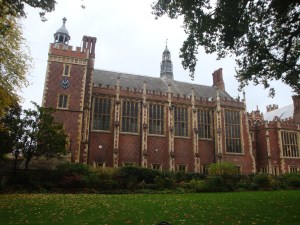
I decided to explore just a little further, and noting the street names began to head towards the most interesting brick building. As I approached, I realized that there were other similar buildings. Then, I passed through what looked to be a very old tower gate, and I realized I was in some sort of compound–beautifully landscaped and tended–the large main building almost like a church with beautiful stone accents and stained glass windows. I saw that there was a library  in the building and got a hint to its use when I saw a man traditionally dressed in barrister’s robes walking up the sidewalk towards the building.

I returned to the Morton Hotel after many more wonderful adventures, including the Sir John Soane Museum that I finally got to see (it was magnificant), an outdoor art display by Ai Weiwei at the Royal Academy of Arts (incredible), lunch at a classic London Pub (tasty onion and mushroom pie) and a trip to the British Museum (I love that place). Even though I visited the British Museum on my first trip to London, I went to rooms I didn’t get to see that first time–my favorite being the Ancient European room and the clock room.

After a bite to eat from the little Tesco down the street and a hot shower, I settled in to find out what exactly that incredible building was. I quickly discovered that what I had been looking at and admiring was none other than Lincoln’s Inn, one of the four Inns of Court, which are the professional organizations for all barristers in England and Wales. I researched and read until late in the night, fascinated and excited to learn something new that would help me read, study and teach more effectively as well as humbled, feeling that I, as a teacher of British literature, should have known more about these things already.

When I returned home, I immediately found ways to incorporate what I had learned in my British Literature I class. That goes without saying, but I had no idea how my experience of discovering Lincoln’s Inn would enhance my teaching in American Literature until I read Melville’s “A Paradise of Bachelors.” The setting is one of the Inns of Court where the main character in this highly autobiographical story goes walking through the streets of London just as I did and is impressed with the beauty and grandeur of the grounds around the Temple Bar, just as I was.

IT lies not far from Temple-Bar.

Going to it, by the usual way, is like stealing from a heated plain into some cool, deep glen, shady among harboring hills.

Sick with the din and soiled with the mud of Fleet Street — where the Benedick tradesmen are hurrying by, with ledger-lines ruled along their brows, thinking upon rise of bread and fall of babies — you adroitly turn a mystic corner — not a street — glide down a dim, monastic way flanked by dark, sedate, and solemn piles, and still wending on, give the whole care-worn world the slip, and, disentangled, stand beneath the quiet cloisters of the Paradise of Bachelors. Sweet are the oases in Sahara; charming the isle-groves of August prairies; delectable pure faith amidst a thousand perfidies: but sweeter, still more charming, most delectable, the dreamy Paradise of Bachelors, found in the stony heart of stunning London.

Melville’s description spoke to my experience so completely. His observations so piquant that I immediately found renewed admiration for this, one of the greatest of American writers.

“Found in the stony heart of stunning London.”

It’s Worth It

Just looking purely pragmatically, it is still worth getting a four-year college degree. The Bureau of Labor Statistics shows that the higher the degree level, the lower the unemployment rate and the higher the median wages, with the exception of professional degrees garnering higher wages on average and lower unemployment than a Phd. The chart below shows the 2014 statistics:

More and more, however, I hear people, including former students and fellow educators, voice how working towards a four-year degree is virtually a waste of time and money.  I couldn’t disagree more. Even if a person never works in her or his degree field, the skills, life experience and connections made will not only help a person be more employable at a higher rate of pay, but can also help that person be a better informed partner, parent and citizen.

Of course, any acquired skills must be applied. Those who feel entitled to work their dream job at a high rate of pay soon upon graduation are never likely to feel that their education was “worth” anything. Also, there are many who do not get four-year degrees who have meaningful, prosperous careers. I know because my husband is one of them, although his time in training is comparable to a four-year degree in many ways.

I, on the other hand, have worked in my major field of study, English education, for most of my career, yet I have had the experience of not being able to find a teaching job. It was when my husband John was receiving his ultrasound training at Aultman Hospital in Canton, Ohio. Before moving to Ohio I had applied, tested for and been granted a 8-12 English and German teaching certificate. I had spent most of my last year teaching at Armuchee and Coosa High Schools in Rome, Georgia, applying for teaching jobs without a single bite.

We had saved enough money that I didn’t have to work, but things were going to be pretty tight if I didn’t land at least a low-paying position. I did have one interview at a high school, and although I don’t remember much about it, I do remember getting the impression that this little ole southern gal didn’t have a snowball’s chance getting a teaching job in Canton.

So I started looking outside of the education arena into places where my writing and teaching skills might be of use-copy editor, day-care worker, teacher assistant, tutor, but nothing doing. Then, one day I was looking through the want ads and saw that there was a position open for a job trainer at Goodwill Industries, Inc. The ad said that a background in education was a plus, so I called and set up an interview.

The very nice man who interviewed me was the vocational rehabilitation coordinator, Marc Manheim. He asked me about my educational background and also was interested in what kind of work I did unrelated to my degree. My list was long: Day care worker, cafeteria line worker, custodian, groom and exercise girl at an Arabian horse farm, riding instructor, restaurant hostess, dishwasher and secretary. I got the job.

While my experience working in the service industry was invaluable, I found that my teaching skills were absolutely necessary to be successful in my work. As a job trainer I was required to work side by side with my clients, helping them do the job and keep up their rate of production as they were learning the job and then slowly back away and help the client become more and more self-sufficient until I was not needed any more.

As a result I found myself doing many of the tasks I did as a classroom teacher, including mastering the skills I was going to teach my clients, creating a daily plan (in essence a lesson plan), instructing my clients in the numerous skills needed for their work as well as social skills, assessing their progress and the effectiveness of my instruction, then altering my instructional methods and re-assessing.

Because of my experience and the experience of as many as one-third of college graduates according to one study, who do not get jobs in their major area, I can better advise my current students and encourage them to study what they love, learn how to work hard and apply what they learn, developing dedication and tenacity.

photo2_run

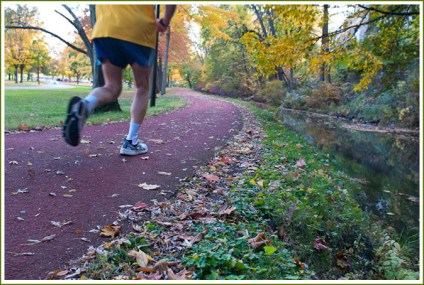
The park in Canton, Ohio, where I used to walk and jog.

Do that and they won’t need to worry about getting a job. They will either find one, it will find them, or they will create one for themselves.

England–Days Seven and Eight

Large Day of the Dead Statue--British Museum-October 2015

Large Day of the Dead Statue British Museum-October 2015

Happy Halloween, Everybody!

It’s Halloween, and I made it back late last night. I was hoping to work on my blog while I was waiting in the airport, but I couldn’t connect to the Heathrow WiFi. I’m one of those throwbacks who doesn’t have a smart phone. And that’s my first word of advice for my literary travelers is GET A SMART PHONE and pay for short term international use if you are going to be out of the country. What few problems I had during the trip would have been helped if I had been able to communicate better. I have some serious jet lag today, but I have the weekend to recuperate and have time to catch up with my classes.

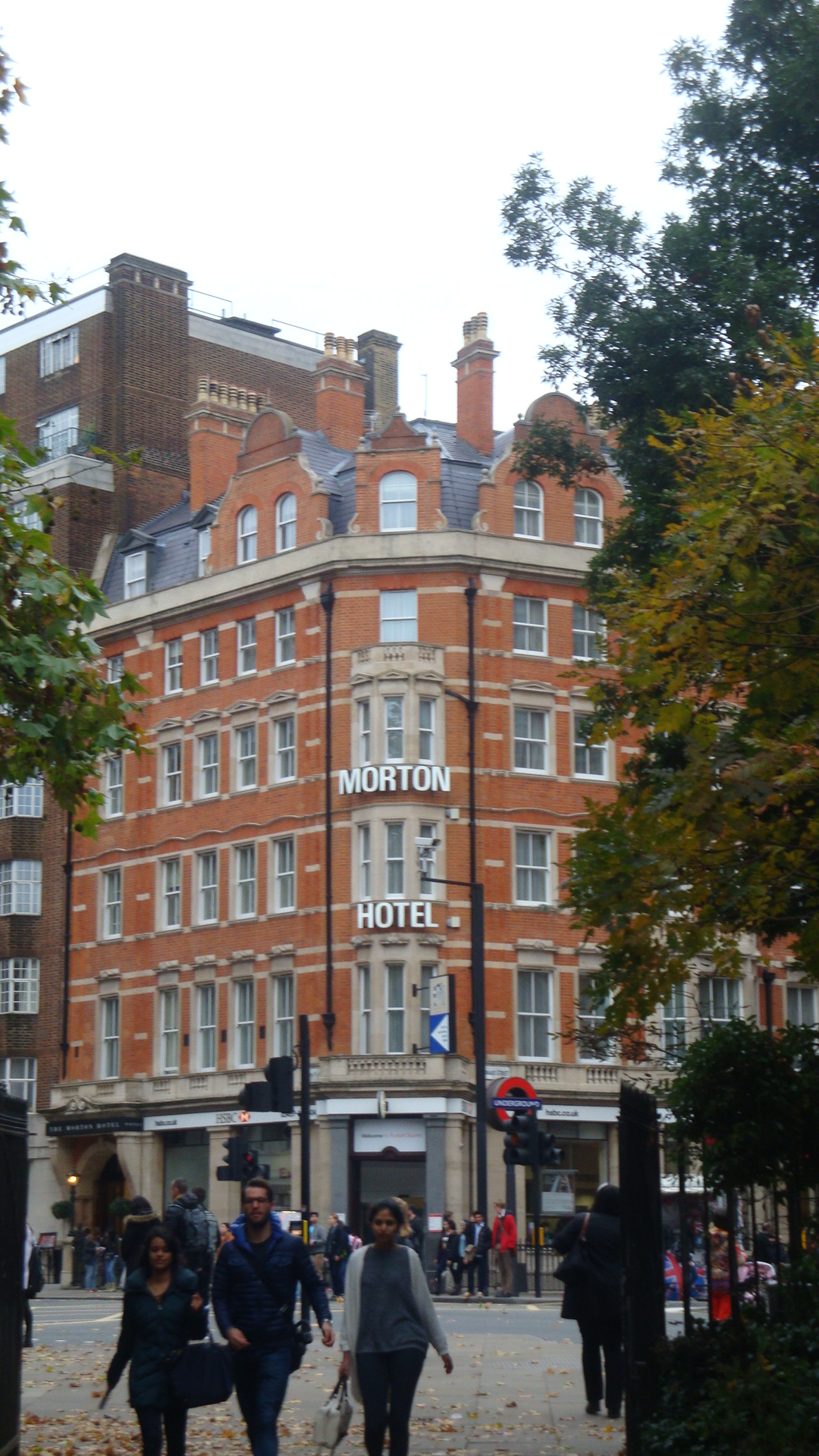
The Morton Hotel on Russell Square October 2015

The Morton Hotel from Russell Square
October 2015

My last full day in London was simply marvelous. I had a grand continental breakfast at the hotel–quite a spread. There were all kinds of pastries, including real English muffins, not the kind we eat–they are more of a spongy type of bread– and all kinds of fresh fruit, plus a variety of cold meats and cheeses. I lingered over my coffee and got caught up on some correspondence with family, students and colleagues.

The hotel has a pleasant sitting room, which serves several purposes–reception, general seating, bar and breakfast room, all decorated for Halloween, which originated as the Celtic festival of Samhain. As with Christmas, eventually the pagan traditions blended with the Christian All Hallow’s Eve, the day before All Saints Day. Both pagan and Christian traditions commemorate the changing of seasons and passage from life to death, to be renewed again in the spring, with Easter, another holiday with combined Christian and pagan elements.

The Brits seem to love to celebrate Halloween just as much as we do, and like in the States, Halloween seems to be becoming increasingly popular with adults, with all sorts of announcements about parties at different restaurants, hotels and pubs. In fact, the Morton Hotel is slated to have a Halloween High Tea today.

After breakfast I started off towards the first stop on my agenda–The Sir John Soane Museum. When I wrote my first sample travel project a few years ago on Georgette Heyer and her Regency novel “The Foundling,” I discovered a little gem of a museum in the house of the eccentric Sir John Soane, best known as the architect of the Bank of England, who adored his wife Eliza and was heart-broken after her death, which fits in so well with the spirit of the Regency romances written by Georgette Heyer and, of course, Heyer’s inspiration, Jane Austen.

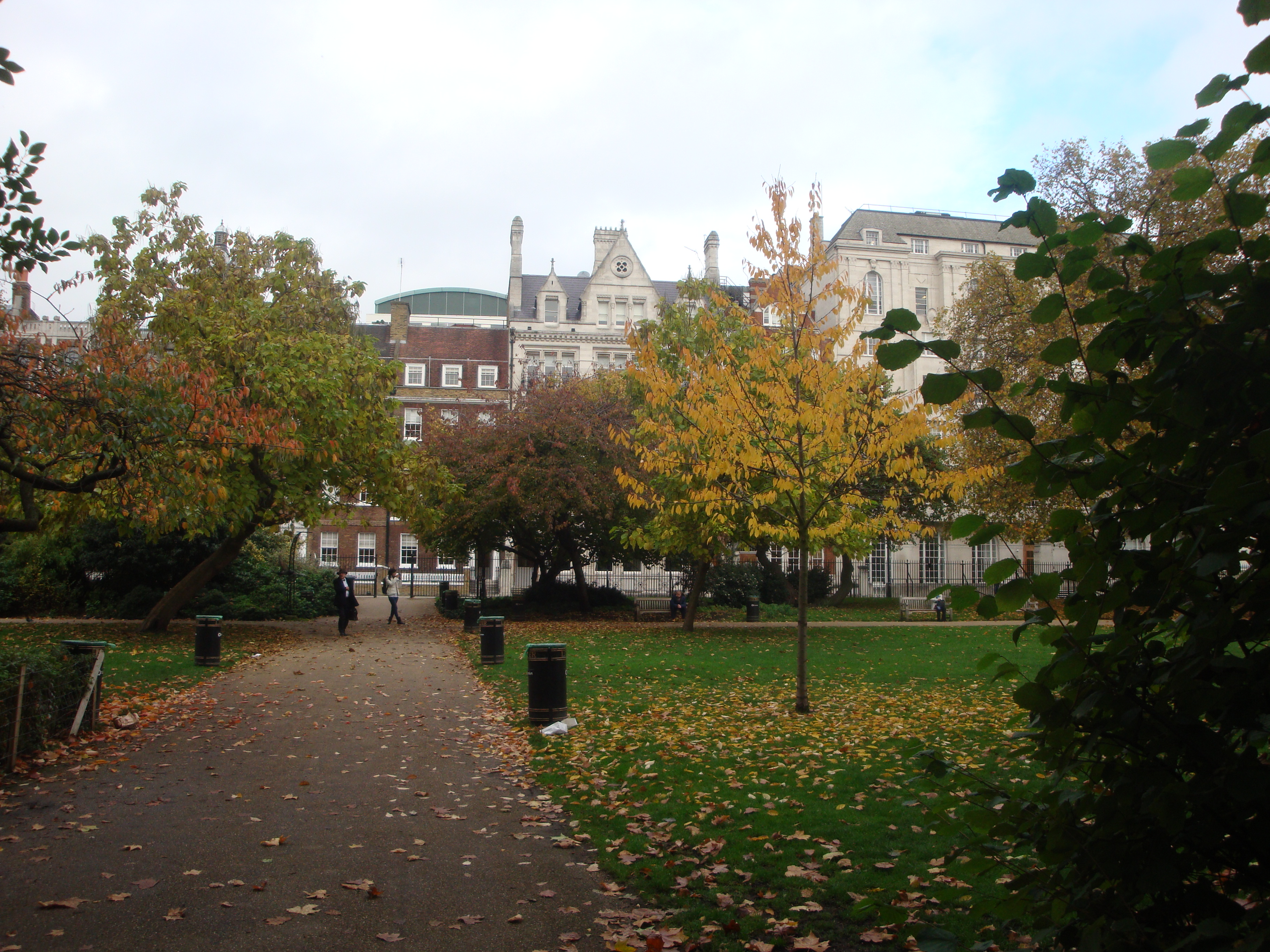
I was going to take the Underground to the Soane, but once again, the line was shut down temporarily where I needed to go, so I  hoofed it, but it felt good to walk and soak in yet another area of London I had not yet explored, so I didn’t mind. I got there early and enjoyed strolling around Lincoln’s Inn Fields, London’s largest public square, across from the museum.

Lincoln's Inn Fields October 2015

Lincoln’s Inn Fields looking toward the Soane Museum–October 2015
October 2015
Lincoln's Inn October 2015

Lincoln’s Inn
October 2015

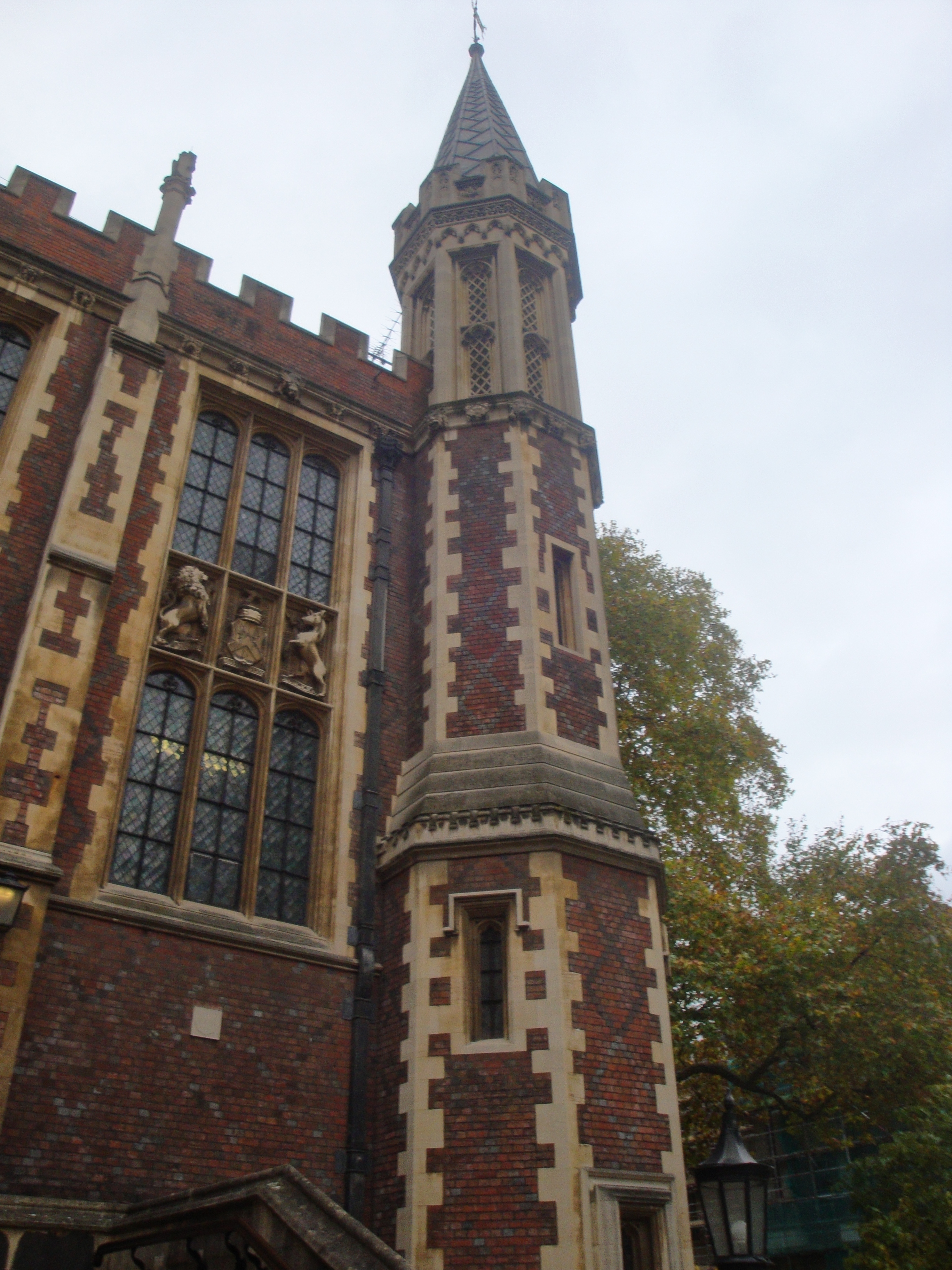
I took pictures there and then walked around some more and found Lincoln’s Inn itself. This incredible building is not what you think of when you hear the word inn. Lincoln’s Inn is the name and location of one of four legal associations that developed in the 13th and 14th Centuries, making this a good place to visit for anyone basing their literary tour on Chaucer. I could imagine the Man of Law from the Canterbury Tales being a member of this association even if the actual Lincoln’s Inn buildings weren’t built until later. Because the buildings were built in the 16th and 17th Centuries, this would also make a great place to visit if studying Shakespeare or Marlowe. The architecture is marvelous.

One of the spires at Lincoln's Inn October 2015

One of the spires at Lincoln’s Inn
October 2015

Today, Lincoln’s Inn houses the offices of many London barristers (lawyers) and includes an extensive law library. I saw one barrister going to work dressed in the traditional legal garb that British men and women of law have been wearing for centuries, although the dress code is now somewhat relaxed. The man I saw was dressed much like David Tennant in the picture below from the movie The Escape Artist.

DavidTennantEscapeArtist

When I made my way back to the Soane Museum, there was already a short queue forming as the hallways in the house are narrow and there are only a few people allowed in at a time. But I didn’t wait long. Entrance to the museum is free, but I bought the more detailed guide book to use as a source for my sample itinerary (I’m going to do an update sometime soon).

Sarcophagus of Seti Sir John Soane Museum London, October 2015

Sarcophagus of Seti
Sir John Soane Museum
London, October 2015

With the book I was able to just roam around and spend as much time as I wanted in this fascinating place. Soane ran his architectural business from his home, so there was a tiny office and rooms full of architectural artifacts for himself, his clients and students to study. He was also quite a collector and one of the most fascinating things at the museum is a sarcophagus, a huge stone coffin, that once housed the remains of Seti, the father of Ramses the Great.

One of my favorite places in the museum was the picture room. It’s a small room, so I had to wait to make my way in there. Each room has a guide who can answer questions about Soane and the house. The guide in the picture room was particularly helpful. He showed us how Soane built the room with pull out panels to hold more of his art collection in a smaller space, very clever.

My favorite pieces were another series by the British painter William Hogarth, called The Election. I had seen a similar series by Hogarth in the National Gallery, and his paintings do a marvelous job satirizing life in England during the 18th Century, with that mixture of humor and pathos that is my very favorite style of writing, seen here in picture form. The guide described the series as one of the first “graphic novels” and pointed out details of the pictures and explained their historical context–really an early form of the political cartoon.

Soane’s house is the perfect place for anyone who is interested in what England was like during the Georgian age–late 18th to early 19th Centuries. I had no idea when I included the museum in my first sample literary tour itinerary several years ago that I would get to visit the museum one day. It is delightful! Here’s a link to the museum’s website: http://www.soane.org/

The British Museum October 2015

The British Museum
October 2015

After leaving the Soane Museum, I made my way to the British Museum, not far at all from my hotel. Although it was not yet noon, I was hungry, so when I passed by The Plough, a typical British pub with a plaque outside remarking how it has been frequented by British writers through the years, I decided to have lunch there. I had another typical British pie, but this one vegetarian–mushroom and onion–washing it down with a lager. It came with chips (French fries) and some tasty veggies. Hit the spot. Now it was on to the museum.
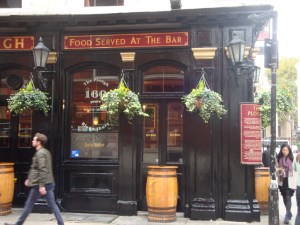
The Plough Restaurant October 2015

The Plough Restaurant
October 2015

I went to the British Museum, also free admission, on my trip in the summer of 2011, but the place is so huge that it would take many visits just to see the permanent collections. I was greeted by huge skeletons like the one above in the courtyard and a big skull along with a skeleton in the atrium area where the Rosetta Stone is displayed, but I passed quickly by them. I wanted to focus my visit this time on the literary and old European collections, and I’m glad I did. Anybody doing any literary tour about a British author should plan to include the British Museum in the itinerary because it covers all aspects of British history and because so many authors have been influenced by items in the museum.

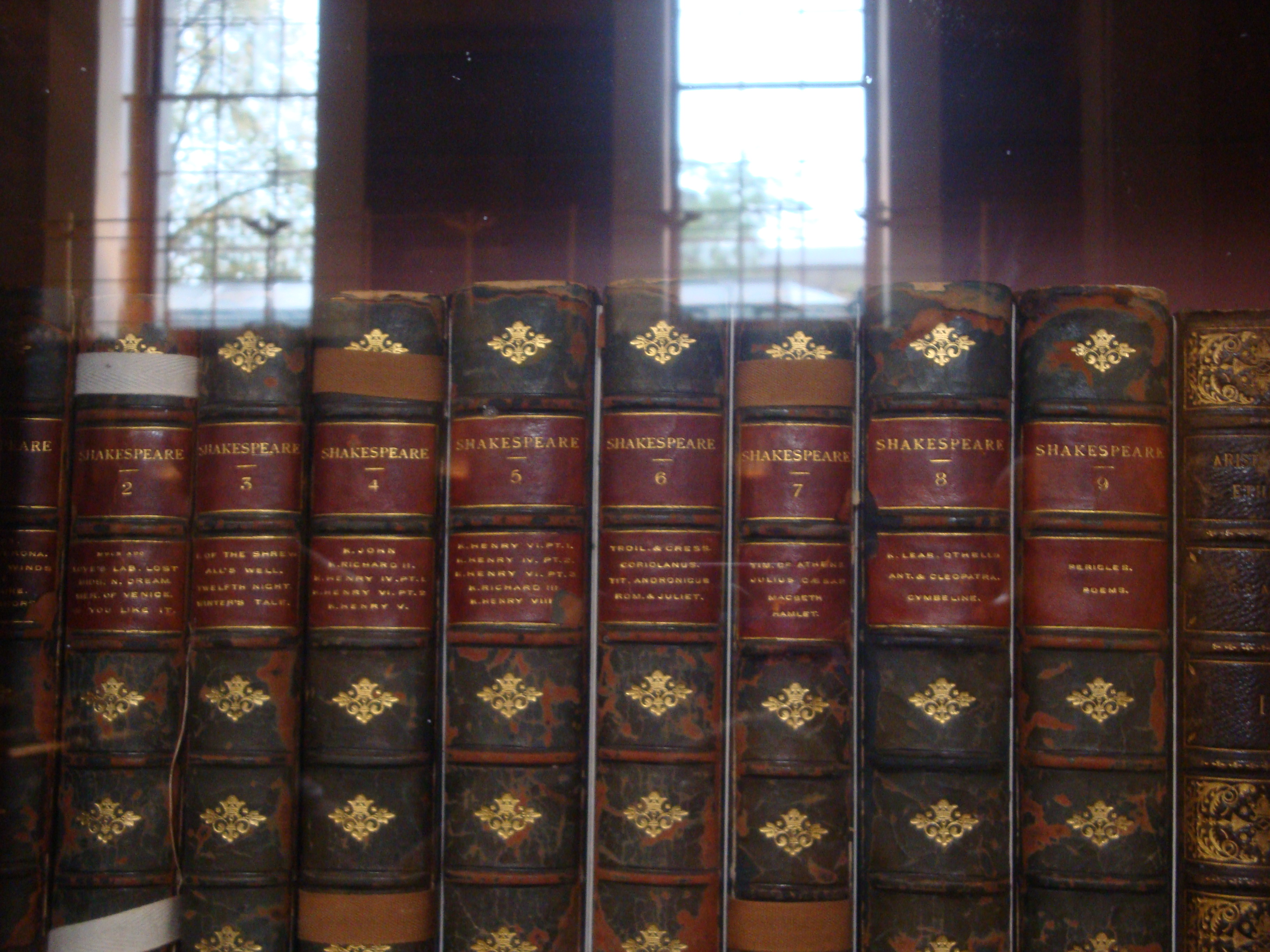
One of the first rooms I went in includes selections of hundreds and hundreds of old books, including the beautiful editions of Shakespeare seen here.

Old Volumes of Shakespeare's Work British Museum, October 2015

Old Volumes of Shakespeare’s Work
British Museum, October 2015

Then, in the old European room, I hit the jackpot, finding and photographing many artifacts from the burial ship found unearthed at Sutton Hoo, believed to date back to the time of Beowulf. Most fascinating to me were the helmets, swords and shields.
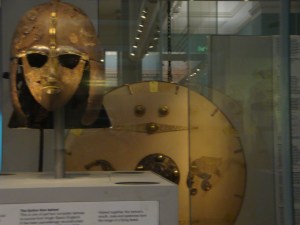
Helmet and shield found in the burial ship at Sutton Hoo British Museum, October 2015

Helmet and shield found in the burial ship at Sutton Hoo
British Museum, October 2015

Could Beowulf's Sword looked like this?

Could Beowulf have used a dagger like this?

Celtic Brooches and Sword British Museum, October 2015

Celtic Brooches and Sword
British Museum, October 2015

In another room were marvelous examples of Celtic art, including crosses and the large ornamental brooches seen to the right. Anyone doing a project on Dream of the Rood, Beowulf, Lanval or any of the early British works would appreciate these rooms.

I could have spent hours and hours at the British Museum, but I was getting a bit weary and had a big night ahead, so I went back to the hotel, caught up on some more work and took a nap. Good move. Naps, if not too long, can really help travellers get the most out of their visits.

I had some tea and a biscuits (shortbread cookies) in the room and headed out early to get to the Savoy Theatre, next to the famous Savoy Hotel on the Strand, another vibrant section of England that was really hopping that night, even though there was a steady drizzling rain. Londoners and tourists alike have learned to adapt to the rain, which comes and goes frequently. As I passed through Covent Garden on my way to The Strand, I noticed people sitting outside under canopies, seated around these little outdoor fire grates, laughing, talking and ignoring the rain.

Covent Garden at Night

Covent Garden at Night

I arrived at my destination early, so I walked up and down the Strand, soaking in the atmosphere (no pun intended, but I did forget my umbrella the one time I needed it). I bought a soda at a little kiosk and headed back to the theater to wait some more, but boy, oh, boy, was it worth the wait.

I’ve seen Gypsy several times, and I was an assistant stage manager for a community theater production of it, so I know the show very well, but this was hands down the best production of it I have ever seen or been a part of, mainly because of Imelda Staunton as Rose, who was simply astounding. Some of the best acting I’ve ever seen and the lady has pipes!

Imelda Staunton as Rose Savoy Theatre, London, October 2015

Imelda Staunton as Rose
Savoy Theatre, London, October 2015

The final scenes between Gypsy and Rose were everything they were meant to be and the final number, Rose’s Turn, was the final release of all the pent up anger and resentment of a woman who has spent too long living her life for and through her children, not realizing the damage she was doing to herself and all the ones she loved. It was heartbreaking and triumphant. It was so real. I don’t know how anyone can act like Imelda did that night. Simply amazing! Then, in the final scene, Gypsy comes on stage and Rose breaks down again–finally humbled and remorseful, a broken woman as she leaves the stage, and her daughter’s last gesture, a simple arm over her mother’s stooped shoulders, just said it all.

I was also thrilled to see Peter Davison, who played the role of Herbie, Rose’s friend and would be husband, who loves Rose despite everything but has to leave her in the end. It was a special treat seeing Davison, whom I had a crush on when I was a teenager and loved to watch him play Tristain in the British TV series All Creatures Great and Small. He also was one of the many actors to play Dr. Who (the 5th doctor).

It was a great way to end my last night in London. I didn’t even mind the walk back in the rain and the crowded subway as I made my way to Russell Square. I stopped one last time at the Tesco’s and bought supplies for a midnight snack and some breakfast before going to my room. They were still showing all the Harry Potter movies, so I watched Imelda Staunton again as Dolores Umbrage in the final Potter movie while I had my snack and checked e-mail.

What a great day!

The final day was all about travel.

I left the hotel pretty early after getting all packed up because I also like to arrive early and wait rather than rush and worry about missing my plane. I discovered that because I had an oyster card and had bought an extension to London when I arrived that I didn’t have to pay any more. I also discovered that I had paid a 5 pound deposit that can be returned with any money you do not spend when traveling, if any. If you prefer, you can keep your Oyster card, and it is still good when you return to London. I definitely recommend an Oyster card if you are going to spend any time in London.

English Breakfast at Heathrow before I Boarded the Plane October 2015

English Breakfast at Heathrow before I Boarded the Plane
October 2015

Once I got to the airport, checked in and got to the correct terminal, I had my last meal in England, a traditional English breakfast washed down with an English lager. This time I had the beans but still didn’t try the black pudding. I’m not that English!

The trip was uneventful from then on out. It was a long trip back, but it was totally worth it, and gave me a better understanding of the country, people, history and literature of England, which is important to all Americans because we share a language and England is our mother country, one of our best friends in the world today.

I hope you have enjoyed my blog posts about my trip to London. I have learned so much and am so looking forward to using what I have learned to improve my instruction of not only my British literature courses, but all of my classes.

Cherrio and Mind the Gap!!!!

BON VOYAGE!

Featured image

Professional development–It means different things to different people, I suppose, but in my mind, I will soon be experiencing the most wonderful professional development a teacher of British literature could ask for. I’m going to England! One of the highlights of the trip will be seeing Benedict Cumberbatch performing the leading role in Hamlet at the Barbican in London.

The timing is perfect because while I am there, seeing Hamlet live, my students will be reading Hamlet and watching a movie version of it. I wish I could take them with me, but I plan to do a video pre and post show in front of the Barbican and take as many pictures and videos as I can to use in my British literature classes.

I also plan to use my experiences to continue to refine the major capstone project in my online literature classes–the literary travel project that I have discussed in previous blogs. I have created sample literary travel projects, and now I can test out my own literary travel plans to further refine those samples, as well as the project directions, and help my students get the most out of their major research project.

Keeping up with all of my classes, seated and online, will be a challenge, but I thought one way to stay in touch with them, and with anyone who is interested in the value of international travel as professional development for faculty. will be interested in my blog posts over the week–STARTING ON FRIDAY, OCTOBER 23!

Some Weeks Are Good

I know I whine, but not always. Sometimes things work out. Some weeks are good. Last week was one of those. Classes went well. Real collegiality and collaboration took place. Respect was the watch word. Yes, it was a good week. In celebration, I’m printing the lyrics (rough draft) to one of my favorite songs in my new musical CAMPUS. This song is sung by the three “fairy godteachers.” Enjoy!

The Liberal Arts

Mrs. H (singing)
When I lived in Chicago.

Mrs. Mc and Mr. T.
You lived in Chicago?

Mrs. H
Back when I was a girl.
One thing I used to do

Mrs. Mc and Mr. T
What was it?

Mrs. H
I used to read.

Mr. T
Who would have guessed?

Mrs. H
I mean only read.
You’d think the teachers would agree
That reading was a great activity
But they would roll their eyes and give that look
When they called on me and my nose was in a book.
I read
The Three Musketeers in history.
I think Jane Eyre in PE
In Science it was Pride and Prejudice
Lord of the Rings I read in Math
I even got in trouble for reading
In English class.

Ms. M
Why was that?

Mrs. H.
I’m not sure of the cause
But I think it was
Because I was reading Judy Blume
Instead of Sylvia Plath

Mr. T
But what does this have to do
With signing up kids for class?
How do we make them move
Get up off their tiny…

Mrs. H
I’ll tell you.
And then there came a day
That wonderful, glorious day.

Mr. T
Here we go.

Mrs. H
When I knew
Without doubt
What learning was all about…
It was fifth grade and I was all alone
I had no friends to call my own.
Just only had my books
To keep me company
To keep away the looks
They gave to me.

Then we went to the art museum
The Chicago art museum
And walking down the staircase
I looked up and saw it fill the wall
A painting all in black

Ms. M and Mr. T
All in Black?

Mrs. H
Mainly black.
With a thin line of white running down the middle
And an orange line running down the side.
That was all

Then I walked down that massive stairway
Step by step
Moving closer
Moving nearer
To the truth.

Mr. T.
What truth?

Mrs. H.
There was something
In all the blackness
You couldn’t see it from afar
There was meaning
In the darkness
Shapes and form
And art

Ms. Mc
I love this little story
But I’m not sure what it means

Mr. T
That makes two of us
I just don’t see
What you’re trying to say.

Mrs. H
I’m trying to say
That after that day
I knew what school was all about
Giving me knowledge for my work
But teaching me so much more
Teaching me how to live and
What to live for.
Because you only know what truth is
When you get close enough to see
I learned that’s what the liberal arts
Could give to me.

The Liberal Arts
The Liberal Arts
Because you only know what truth is
When you get close enough to see.

Ms. Mc
Now I know what you mean
I’ve felt it too
I only cared about computing
When I was in school
And Chemistry was okay too
The calculations were somewhat challenging.

Then I went to a symphony with my class
Drug to hear a full orchestra on the lawn
Of an old mansion in downtown Tulsa.

Mr. T
Tulsa?

Ms. Mc
Downtown Tulsa on the lawn
With my 10th grade class
When I was just fifteen
I sat through some baroque
Didn’t really have a choice
And some other too straight forward
I can’t remember what it was
Then came The Moldau

Mr. T.
The what?

Mrs. H.
Bedrich Smetana’s The Moldau

Mr. T
Right.

Ms. Mc
I’d never heard anything like it before
It was a river
A river flowing through the music
Through my mind
Starting as a stream
Running through the strings
And I heard the poem
The musical poem
With structure and form

So I’m trying to say
That after that day
I knew that school was all about
Giving me knowledge for day to day
But teaching me so much more
Teaching me how to live and
What to live for.

Because you only know what truth is
When you sit still enough to hear
I learned that’s what the liberal arts
Could make so clear.

ALL
The Liberal Arts
The Liberal Arts
Because you only know what truth is
When you sit still enough to hear.

Mr. T
Well, you two can really get on my nerves
I just don’t like people it’s true,
But you’re really all right you two.
I see what you’re trying to say.
Because it happened to me one day.

Mrs H and Ms Mc.
It did?

Mr. T.
It did.
Actually it was one night.

Mrs. H.
Oh, no, not one night.

Mr. T
Well, yes there was a girl
A beautiful girl
With brown eyes and brown hair
Who wore lots of leather
If I remember right
In my acting class.
But she was different than the others
Didn’t want to be a star
She studied and studied
Wanted to be a doctor
But I didn’t care
I just wanted to get with her
Backstage.

Mr. H.
Oh, please.

Mr. T
Well, anyway,
She wanted to go on this field trip
I didn’t really want to go
To the planetarium in Pittsburgh.

Mrs. H.
I didn’t know you lived in Pittsburgh

Mr. T
There’s a lot you don’t know.

So I signed up for the field trip
Flirted with her on the bus.
But she wouldn’t sit next to me
In a darkened room with us
Boys. I guess she was right.
Not to sit next to us boys that night.

So I was bored out of my skull
As the show began to start.
Just about to go to sleep
Until it happened.

Mrs. H and Ms Mc
What happened?

Mr. T.
Out came the stars
In the center of the winter night
They said I could see a hunter.
A hunter I didn’t see
They said two stars mark his shoulders
And two stars mark his knees
Then they outlined his form
Standing with his arms upraised,
A hunter standing strong
I saw Orion.
I saw the Orion Nebula

I’m trying to say
That after that day
I knew what school was all about
Giving me knowledge for my work
But teaching me so much more
Teaching me how to live and
What to live for.

Because you only know what truth is
When someone points you to the light
I learned what liberal arts can do
That fine winter’s night.

ALL
The Liberal Arts
The Liberal Arts
Because you only know what truth is
When someone points you to the light

Mr. T
That’s the day I wanted to teach drama

Ms. Mc
That’s the day I wanted to teach math

Mrs. H
That’s the day I knew I could teach English

All
The day we finally understood
And knew we could

Teach the liberal arts

Who Are You?

California_09 007

“Who Are You?” –These are the words of a text message I received recently in response to a work-related request. I responded back, “Katie Winkler.” No message came back. It was a little thing and was not meant to offend. It’s not important in the grand scheme of things, but it is symbolic of the way I feel sometimes as an instructor at a community college.

Who are you to ask questions about the college’s policies and procedures developed by those with little or no educational background?

Who are you to request materials to support the recruitment of students at a college with declining enrollment?

Who are you to question the expenditure of nearly a quarter of a million dollars on an initiative that many studies show leads to little improvement in retention and completion rates?

Who are you, Katie Winkler?

I am an instructor who comes in early and stays late, even though I am not required to. I am an instructor who works on the weekends grading papers and writing instructional material for my online class because I’ve been interrupted throughout the week by non-instructional tasks, reports, and meetings when I wasn’t teaching and preparing for my seated classes. I am an instructor who tries to answer student e-mails within a few hours of receiving them, even on the weekend.  I am an instructor who works throughout the summer on my classes, even though I am not being paid because I want my students to have the best possible experience while keeping an insane grading load manageable. I am an instructor who cares.

Who are you, Katie Winkler?

Even though you have worked at an institution for over 20 years, people still ask you how many of those years were full-time as if your adjunct years were of no value. You are asked to take minutes as soon as you walk through the door for your first meeting on a new committee when the room is already full of other people. Your integrity is questioned concerning your instruction, your travel, your compensation and your intentions. You are accused of being uncooperative in open meetings by people who rarely communicate with you except to criticize you. You are frequently chastised by members of support staff for mistakes you make in filling out forms that have little to do with actual instruction, even though the procedures for filling out said forms are unclear. You are asked to make your own appointments when you have questions of support staff. You are often interrupted on a whim, without regard to students who might need your assistance. You are an instructor who is forced to send maintenance request to get toilet paper and hand soap in a bathroom frequented by students but no one else. You are a little person with little power who is considered to be of little worth and quite a thorn in the side of many because you demand to be heard on behalf of yourself, your colleagues and your students.

But who are you, really, Katie Winkler?

You are respected by your immediate supervisor, your close colleagues and your students. You are a gifted instructor in class and online who regularly holds 75% to 80% retention rates in online classes. You have made a positive difference in the lives of your colleagues and students. You are a good collaborator who is willing to learn and adapt to new methods and technologies for the sake of your students.

You are dedicated, determined, knowledgeable, well-read, kind, long-suffering, stubborn, assertive, whiny, strong-willed, caring, cooperative, impulsive, decisive, intelligent, self-effacing, witty, maternal, greatly flawed but self-assessing and driven to improve.

Who are you, Katie Winkler?

You are wife, mother, writer, actor, preacher, counselor, nurse, adviser, editor, chef, reviewer, director, mentor and friend.

You are a good teacher.

Sometimes I just have to remind myself.

Another Guest –Hey, I’m busy reaching my writing goals for the summer

thought-police-e1369141340932

I’m busy with my fiction and playwriting, but here’s another great guest article. This is from The Atlantic–“The Coddling of the American Mind” by Greg Lukianoff and Jonathan Haidt–interesting read. It comes through an organization I support called FIRE–Foundation for Individual Rights in Education. They support and promote free speech on college campuses–even speech the general college population doesn’t want to hear. I like that about them. They are quoted in the article, which is about the pervasiveness of political correctness on our campuses that is quenching free speech and maybe even harming the psychological well-being of students.

Here’s the link: http://www.theatlantic.com/magazine/archive/2015/09/the-coddling-of-the-american-mind/399356/

Guest Blogger James Hogan on the State of Education in North Carolina

I’m in Alabama visiting with my mother and brother and helping them get ready for my older brother and his family visiting from Germany, but this article by James Hogan, re-printed by Valerie Strauss of the Washington Post is worthy of a read.

Here’s the link:

http://www.washingtonpost.com/blogs/answer-sheet/wp/2015/08/07/north-carolinas-step-by-step-war-on-public-education/?postshare=7261439154188373

Katie Goes on a Tear

liberal arts

Classical Liberal Arts

Recently a posting about the cost of education in America compared to countries that offer “free” education got me really going on a tear for some reason. Some of the comments by people I know, like and admire, made me realize how many misconceptions people have about a liberal arts education. First of all, I understand people’s frustration with the current state of higher education in America–it’s a case of paying too much for too little. However, it isn’t entirely the learning institutions’ fault, though they certainly share the blame.

No, the biggest reason behind the failure of our high schools, colleges and universities is that we, as a people, do not understand the true nature of a liberal arts education and therefore devalue it. Listening to some administrators, students, their parents and the general public, I conclude that most people view getting an education as a means to an end–getting a job. Many people seem to think that when they, or the government, pay tuition that they are basically purchasing a diploma, certificate or degree that they need in order to become employed, like purchasing transportation or clothing or anything else that makes work possible.

See, I’m still on the warpath, but I’ll get over it. I’ll have to in order to keep my sanity. It did help to vent on the hapless people who commented on my comments on Facebook, and I thought some of my points were pretty darn good, actually, so I’m going to re-print them here.

Point #1–There is something to be said for providing high performing high school students with at least the first two years of college, like in Georgia. It’s not free–students have to work very hard in high school to maintain a B average to get a Hope Scholarship. Getting an education is the goal–not getting a job. We need citizens who know how to read and write well and most importantly how to think critically. We need to give people an incentive to truly learn something in high school, and we need to give parents an incentive to push their kids to do well in school. We could do this if we adopted something like what Georgia has.

Point #2–Getting an education is about more than getting a job–it’s about learning how to think critically and problem solve and be autonomous, not under anyone’s control except God’s. It’s power to the powerless, it’s learning how to appreciate art and literature and music. It’s about making life better for yourself and the people you love. We have lost our way; we have forgotten what a real education is, and we have substituted it with this paltry idea of mere job training. Show me a person who is truly educated–and I don’t mean has a degree–I’m not talking about degrees, and I’ll show you someone who has a career that fulfills him or her. And if that thinking person doesn’t have a job, then he or she doesn’t want or need one. (A bit hyperbolic but I was fired up)

Point #3–We need to start realizing that education is for everyone and start making our middle and high schools places of real learning again. I don’t think everyone needs a four-year degree. I think we need to start coming up with alternative ways for people to get their education, but the biggest concern should be helping people see the value of an education–of learning how to read with real comprehension, to write clearly and effectively, to use modern technology to do meaningful, practical research. Diplomas, degrees and certificates are meaningless unless people are learning skills like problem-solving that will benefit them no matter what they do for a living because more than likely they will be changing careers and jobs more than once in their lifetime, so they need to learn skills that will help them adapt to new work situations quickly–they need to learn how to critically think–we still have that in this country but it’s quickly being lost to this idea of utilitarian education that has been proven (just look at the results of the Industrial Revolution)–it’s called a liberal arts education and it works but only if the public understands the value of it, and right now liberal arts education is under fire and too many people don’t see its value. That is a crying shame.