Face-to-face and One-on-One

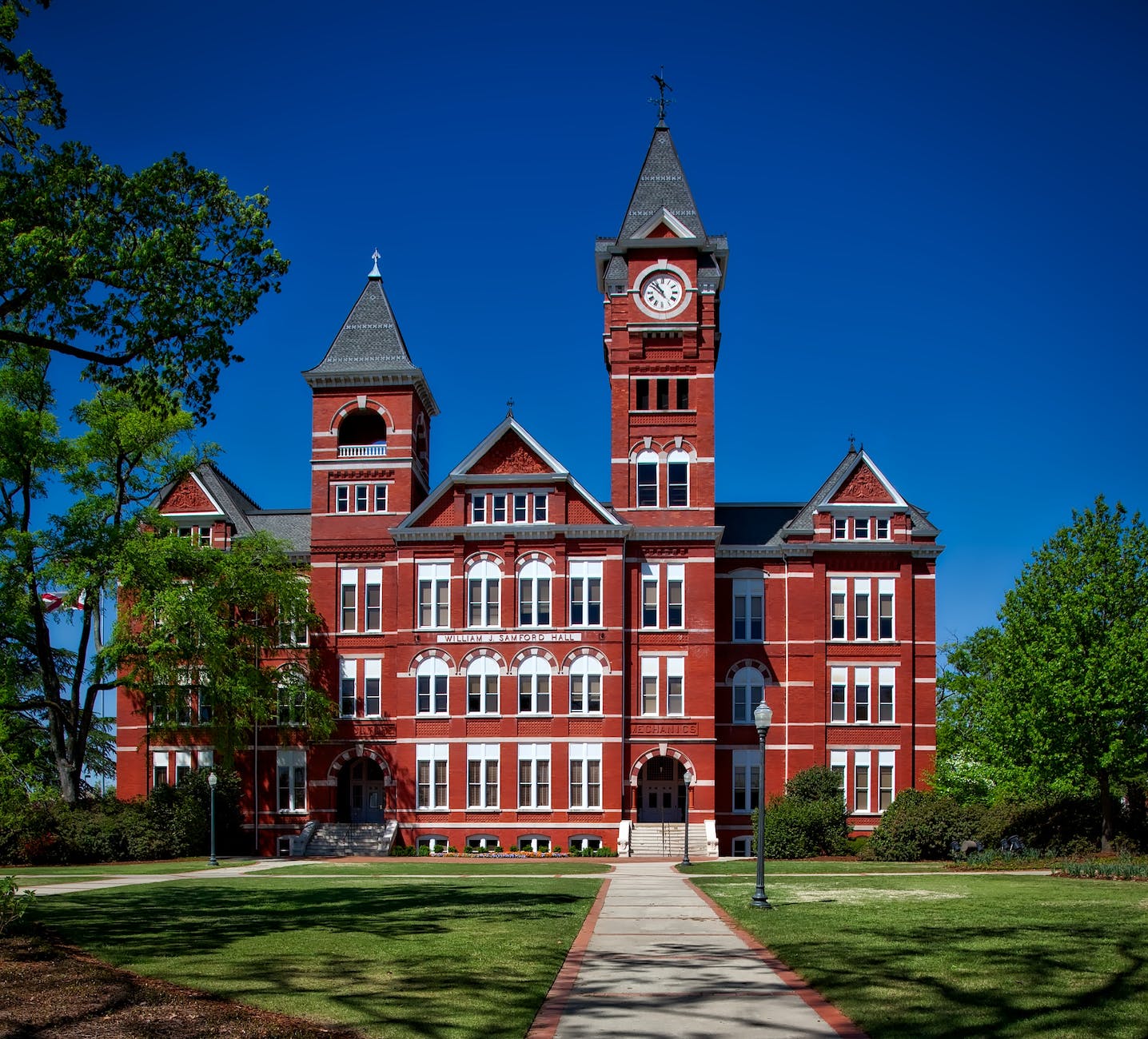
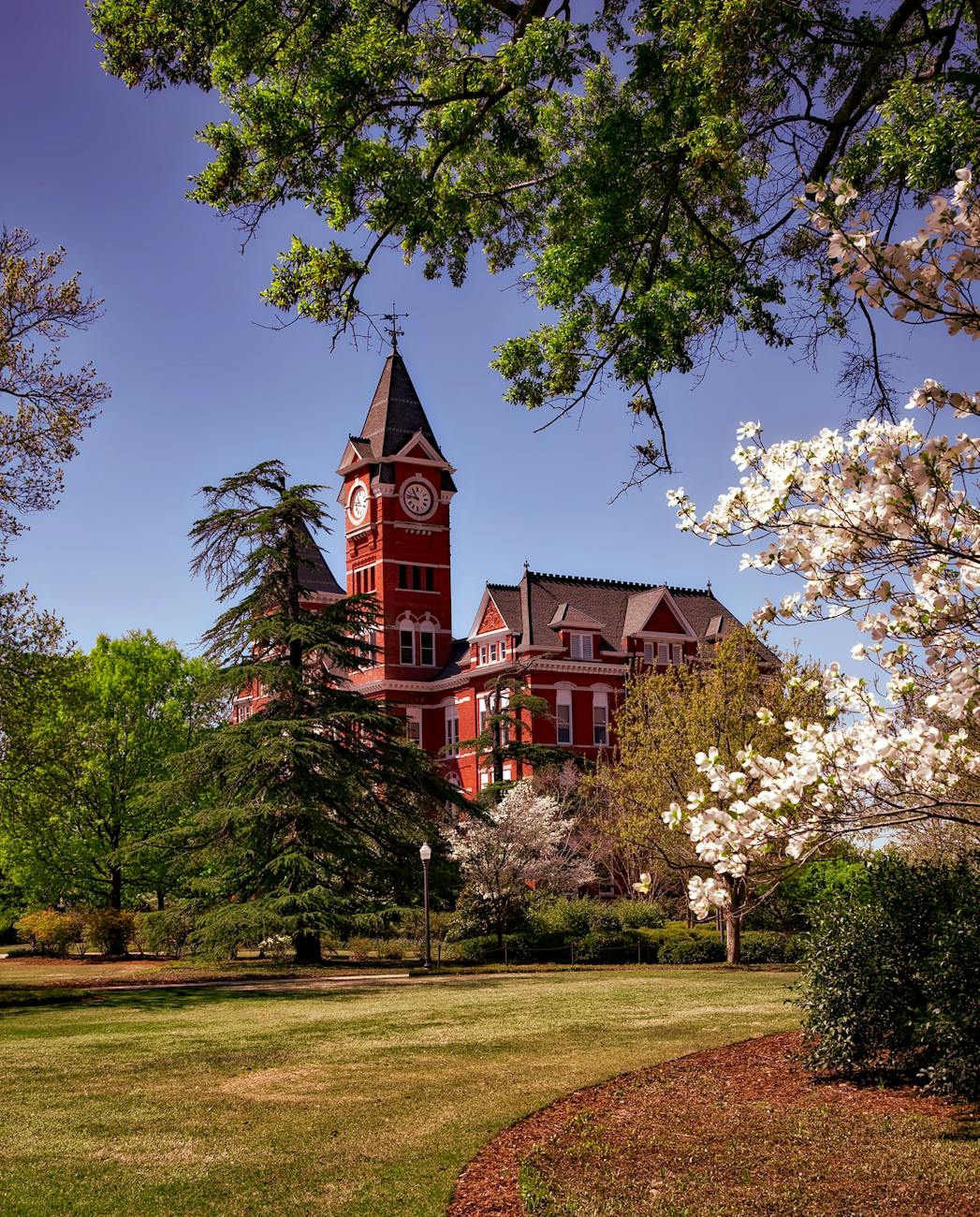
Samford Hall at Auburn University–Photo by Pixabay on Pexels.com

I was talking to my nephew Ruben this past weekend. He just started this semester attending Auburn University after getting his Associates at Southern Union Community College in Opelika, AL. He has an interesting perspective on American colleges and universities because, although he has an American father, he was raised and educated in Germany, where my brother has lived and worked for decades as a pastor after making the wise decision to marry my wonderful sister-in-law, who is a German doctor.

Ruben was glad that he attended a community college first so that he could establish residency, improve his already excellent English language skills, and acclimate to the American educational system. He did well and accomplished his goals, grateful for a low-cost alternative for satisfying his general education requirements.

Photo by SERHAT TURAN on Pexels.com

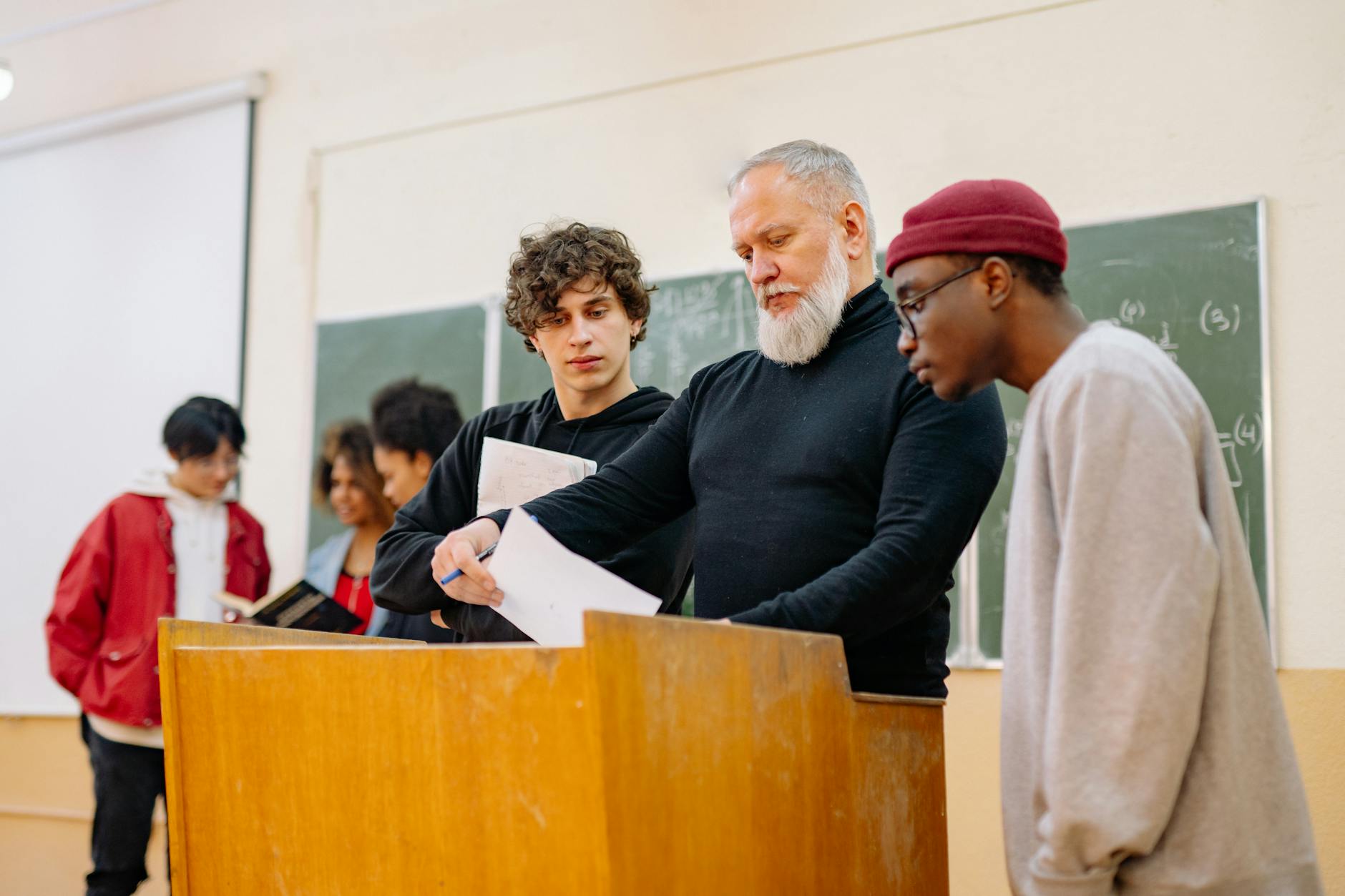
However, at Auburn this semester, he has been able to begin working on his major area of study, graphic design, and that has been the highlight of his time in American higher education so far. Why? Of course, working on projects that are teaching him the skills necessary for his desired employment is one of the reasons. The class is several lab hours a few days a week where students’ work is evaluated and critiqued openly. In addition, students are expected to work on projects outside of class and those who wish to do well will come to work in the studios late at night. But, since Ruben almost always meets his fellow students in the studio, where there’s plenty of talk and laughter, he doesn’t mind the late-night work so much.

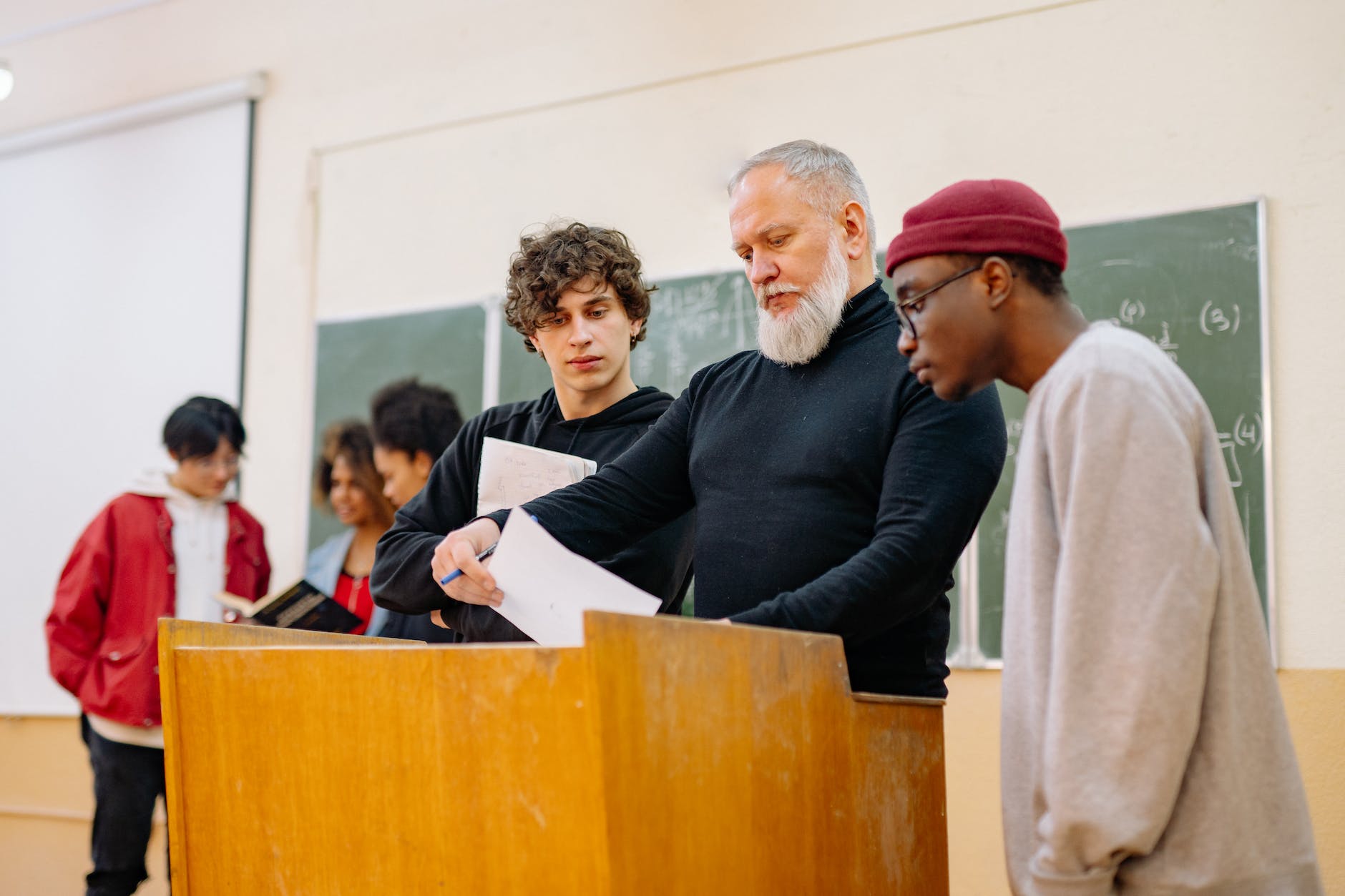
As I listened to my nephew, though, I soon realized that the main reason he is enjoying his graphic design so much is the professor. Turns out she’s tough and demanding, expecting students to show up prepared for class and able to take constructive criticism. She roams the studio during class, watching students work, looking at their projects, and pointing out what needs to be improved. She is not all warm and fuzzy, and Ruben likes this. It’s a challenge that he enjoys rising to.

Photo by cottonbro studio on Pexels.com

I felt so heartened as I listened to Ruben talk about his class, about working hard and enjoying it. So much of that had been lost in my last few years of teaching. Now that I’m retired over a year, I can see that some of my discouragement came from burnout. I was just so ready to retire. However, some of that burnout came from showing compassion for students who were truly struggling with serious issues of physical or psychological abuse, food and housing insecurity as well as with the subject matter, while shoring up the resilience and persistence of others whose overprivileged lives and faux fragility was crippling them.

Both types of students need a rigorous and challenging hands-on learning experience with a dedicated educator like Ruben’s professor, who demands excellence from her students and yet takes the time to build relationships with them. The ones who have it tough often find hard course work and thinking as an escape, and the ones who’ve never needed to work hard before need it because, well, they need to learn how to work hard for something–we all do. As Dad said, “It builds character.” Of course, the students have to be, like my nephew, willing to accept critique and respect the professor’s expertise. Ruben does not feel that he has nothing to learn, that he’s just ticking off a box. He is approaching the class with diligence and humility, which in turn is, I’m sure, allowing the professor to give more of what she has to give.

Photo by Kampus Production on Pexels.com

I felt better about higher education after talking with my nephew on Saturday. As long as there are teachers who are willing to give and students who will receive, face-to-face and one-on-one, then solid American higher education will continue, and our country will be the stronger for it.

Education should begin with education

Photo by Angelica Reyn on Pexels.com

I’ve probably written this in a post before, but it bears repeating. One of the best teaching professors I ever had said, “The goal of any good teacher is to become increasingly unimportant.” To me, that meant teachers are successful when they help students learn how to be independent, critical thinkers–self-starters who can be trusted to troubleshoot and problem solve yet still ask for assistance when needed–people who aren’t afraid of a challenge or obstacles or even failure. My goal was to give my students tools to meet those challenges and overcome obstacles, to learn from failure and become resilient. I wanted to equip students for all of life, not just work.

Photo by Thirdman on Pexels.com

But here in North Carolina and elsewhere in our country, education has become more of a means to an end. The general attitude seems to be “get those general ed classes out of the way” (I heard that ALL the time). They seemed to say to me, “Those classes, especially English and math, are just annoying steps a person must take to be pumped into “the pipeline” and “enter the workforce.” Gaining an education that helps people live better lives, no matter what they do for a living, or if they choose to stay home and raise children or pursue their art, has been replaced with training for a particular, specific field with a goal of employment, not life-changing education.

Photo by Yan Krukau on Pexels.com

So many of the intangibles that occur when students are truly engaged in an educational experience are lost when the emphasis is on training for local, narrowly focused workforce development based on current trends that will shift and change with every economic bubble that bursts. In the last few years of my teaching, I yearned for the days when so many of my students actually enjoyed going to school, who relished simply learning something they never knew about before. They built relationships with their classmates, studied and ate meals together, listened to music, played video games between classes and had spirited discussions in and outside of the classroom. I remember the days when students would work together, pouring hours of work into extra-curricular activities like producing a play, some of them spending hours in rehearsal on top of all of their classes and after school jobs, but they did it because they wanted to–they had a passion for it, even if they had other long-term vocational plans.

Photo by Pixabay on Pexels.com

There was a time at the college where I taught when all students in the college transfer program were required to take a literature class. There they had a chance to stretch themselves by reading complex texts that are at the foundation of not only ours but the world’s culture and government. Now, a student can get either an Associate of Science or even an Associate of Arts degree without having to take a literature course at all. How can that be?

In addition, more and more in our community colleges, three disturbing trends have taken hold–asynchronous online learning for developmental English students, high school students earning high school and college English credit for the same college-level class, and so-called accelerated classes. I helped to develop some of these courses and taught them, so you would think that I would be a proponent, but in my defense, I was misled in all of these cases into thinking the situations were temporary or that only advanced students would be taking these classes. I feel like a fool. That’s an understatement.

Photo by Liza Summer on Pexels.com

I am mortified.

In my and the college’s defense, the developmental co-requisite English class that I had developed, which was part of North Carolina’s third iteration of developmental education in less than a decade, was not intended to be an online program. The plan was that all developmental classes be taught in the classroom. Then, in March of 2020, when we were soon to roll out our new co-requisite English classes, the pandemic hit. All classes, including the co-requisite English courses, were forced to go online.

It didn’t go well.

Come back soon and I’ll explain.

Quit Dissing College!!

Photo by Pixabay on Pexels.com

Poor college!!! Seems like every Tom, Dick, and Henrietta is taking a pot shot at you these days. I know, I know, you can be expensive, especially if people get sweet-talked into taking on college loans (Don’t do it unless you absolutely have to!). Also, some classes and professors will be really sucky at your place. People can be downright mean, too. Plus, students can get in a lot of trouble given the kind of freedom that you bring. Don’t forget, you forced me to question my core beliefs. Yes, I didn’t abandon those beliefs, but admit it, I did question them, loudly and a lot.

But…

Photo by Keira Burton on Pexels.com

Is it just me, or did you, along with a supportive family and friends, help me find my way through my late teens and early twenties? Did you help me forge positive, meaningful relationships with people from other cultures and countries with varying backgrounds and values? I think it was you who qualified me for a fulfilling career as an English and German teacher at the high school and college level. During my working years, you helped me provide a strong high school education for my child and made it possible for me and my husband to pay for her now debt-free education (two degrees). You allowed me to contribute to a pension plan that means I can enjoy a financially secure retirement.

Because of you, in undergraduate school at a Christian university, I traveled to Europe for six weeks, studying German and history. I visited West Berlin when it was still trapped within a wall, but somehow still free because of what my country, along with England and France, did for that city. I laid hands on the graffiti-laden free side of that wall and was thankful to be a citizen of a nation that saw the value in maintaining the democracy of a country with which it had so recently been at war.

Photo by Ann Buht on Pexels.com

Because of you, I visited Christians in East Berlin who were trapped outside the wall by an oppressive communist regime that would not let them worship freely. Yes, older people could go to church, but their every movement was monitored by the Stasi, the East German secret police, and younger people were prevented, by law, from attending church. And yet, in those few hours in the East, I witnessed the bravery of those who longed for freedom–an old woman who shook the hands of every student and said in broken English, “Tell them we have no freedom here. Tell them we have no freedom here. Tell them we have no freedom here.” The young people in their teens and twenties who traveled two-by-two just to meet, in secret, a group of American Christians, tell them their stories, and fellowship with them.

Because of you, I was able to spend the second half of my German trip in Tübingen to visit my brother who was studying theology there. I lived in the international dorm and traveled into the city, learning the mass transit system (new to me), eating at the Mensa (student cafeteria), visiting the old castle where my brother preached his first sermon to an intimidating crowd of professors, and sitting in on lectures about biblical archeology, some of which I could actually understand! We punted flat boats on the Neckar River, took walks into the forests, and had picnics with my brother’s friends. We took a train to Munich to hear The Rolling Stones at the Olympic Stadium and hitchhiked the way back (not recommended these days but safe back then).

Photo by Pixabay on Pexels.com

Only because of you could I have afforded this trip. You didn’t pay for it outright, but you supplemented it, enriched it with quality faculty members who had the knowledge to plan our trip in order to give us the best educational and personal experiences possible. I also learned how to work for what I wanted, taking on two jobs and saving to raise the funds.

I had so many other wonderful experiences during my college years because of the support you offered, and I have gotten so much more out of my experiences since then because of you, but you also gave me a chance to make a living doing what I love to do–teach. The data shows that you give many people that opportunity–people with a bachelor’s, master’s, professional, or doctoral degree still make more on average AND have lower unemployment than those with a two-year degree or less, according to the Bureau of Labor Statistics using 2022 data. You give so many of us so many opportunities we wouldn’t have without you.

Photo by olia danilevich on Pexels.com

I know you’re not perfect. Far from it. You have so many problems that more and more people are saying you’re not worth it. But you are!! Even though I realize you are not right for everybody–my own husband went to trade school to study x-ray and ultrasound technology, which has led to a great career for him. But for me, you made the difference despite the drawbacks. College, you have enriched my life more than I can say in one brief post. I can keep writing about you and the lessons you taught for at least the length of one book.

Oh, I think I will.

How about that for a segue? I hope to finish the rough draft of my educational memoir “Lessons” by the end of the year. I will keep you updated about the progress and maybe spin some more tales as I’m working on the book.

Also, the journal I edit and publish, Teach. Write., is open for submissions until March 1. The 2023 Spring/Summer edition is to be published on April 1. See the submission guidelines at teachwritejournal.com.

Those Who Can’t, Teach

Photo by JESHOOTS.com on Pexels.com

George Bernard Shaw’s 1903 play Man and Superman gave us the infamous saying, “Those who can, do; those who can’t, teach,” which has long been used to disparage teachers. Of course, it isn’t true. Many of the greatest thinkers and doers have been teachers: Albert Einstein, George Orwell, Alexander Graham Bell, and Robert Frost; Maya Angelou, Stephen King, and Steve Wozniak, co-founder of Apple. In addition, presidents John Adams, Lyndon Johnson, Jimmy Carter, and Barack Obama were also teachers.

Shaw’s maxim is silly, perhaps intentionally so, but the saying persists in more than a few people’s minds: teachers are those who have failed to reach their desired vocational goals and are forced, because of inability, to “settle” for teaching. For arguments sake, let’s say it’s true: Community college instructors are second rate. Most of them don’t even know their subject very well. They weren’t able to get a “real” job in what they went to school for, so they teach. Blah. Blah. Blah.

Photo by Andrea Piacquadio on Pexels.com

I hear all of that, and then, I get confused. I mean, during the pandemic, the hue and cry was open the schools back up! Students need in-class instruction with faculty in order to truly learn. Open the schools! Online classes aren’t good for students. We want teachers to find better ways to teach online. We want faculty to immediately pivot to effective, engaging online learning, even though many of them have never taught online because they know teaching face-to-face is more effective.

Photo by Vlada Karpovich on Pexels.com

Then, after the pandemic, it was students want more online classes! It’s more convenient. Let’s severely limit the time in seated classes because that’s the demand, even though our faculty is telling us that we should go back to more seated classes, especially for developmental students. Or–we don’t want these liberals teaching us or our kids. We honored and trusted them during the pandemic, or said we did, but we don’t trust or honor them now. We want to tell teachers what and how to teach even though we know little or nothing about the subjects they are teaching or about the art and science of teaching itself. Of course, we don’t want to do the actual teaching because who wants to do that thankless, low-paying job? Only someone who can’t do, right?

So, if teachers can’t do, then why is the world asking them to do so much? I’ll tell you why–because teachers are willing to do it. Hell, some of them even love doing it!

Photo by Yan Krukau on Pexels.com

Here is the thing about quality instructors and professors, even if they aren’t capable of being at the top of the professions they teach: they are willing to go into the classroom day in and day out to do their duty–helping students reach their personal and career goals. The classroom teacher is the grunt of the academic world, following orders and taking the risks for the sake of their students with little hope of reward. Yes, those who become tenured professors may see good salaries or if they are in a “high demand” area such as nursing or engineering, but many of the least paid general education instructors take the brunt of the criticism from students, parents, and administrators, even fellow instructors, because they teach the gateway classes like math and English that are often the hurdles that many community college students have trouble getting over.

Maybe teachers can’t do the one thing society values more than anything, making a lot of money, but the good community college teachers, the true teachers, do one thing that many are not willing to do these days. They show up.

Photo by cottonbro studio on Pexels.com
  • creating new lesson plans
  • learning and using new educational technology
  • enforcing academic integrity, when allowed
  • entering the classroom daily without tenure, sometimes without contracts
  • continuing despite unclear or unfollowed policies and procedures
  • going on despite constant criticism and little praise
  • enduring someone else’s idea of professional development
  • sticking with it in the midst of distrust
  • risking their livelihoods with few administrators whom they can turn to for support

Yes, they show up every day for people who often ignore them, despise them, or even mistreat them.

Photo by Kampus Production on Pexels.com

Many are choosing not to stay, and who can blame them? Others are staying, but any passion they had has cooled. Teaching has just become a job. However, I have found that more than a few, dare I say many, soldier on and fight, wondering to what purpose–until that student comes along–the one who stops by the office to ask a question, who brings an essay in to be honestly reviewed, who stays in the writing center until the knowledge breaks through. Once and a while, a teacher can make a class smile or laugh and learn all at the same time. Then, it is a good day.

Why do they do it? Why do they keep on keeping on?

The good teacher answers: “I can’t do much, but tomorrow, I am willing to walk into that classroom again and teach, because that is something, by God, I can do.”

And do well.

Photo by Katerina Holmes on Pexels.com

At the Door of the School

At the Door of the School by Nikolay Bogdanov-Belsky (1897),
Public domain, via Wikimedia Commons

Who am I?

Am I one of the students, my head bowed over my books, not looking up, only intent on myself and what I must see and read and learn?

Who am I?

Am I the old teacher, standing before the blackboard, not even seeing him as he waits patiently in his tattered rags with all he has?

Who am I?

Am I the stern pedant patrolling the hall, who will shoo him away, tell him to come back another day, when he looks more the part?

Or, am I the one who opened the door? Do I stand behind him now, whispering, “Go on in, boy. You belong there, just as you are.”?

New Episode of “CAMPUS: A Novel That Wants to Be a Musical” is Available

Episode 8

THE LIBERAL ARTS

One thing I love about creative work is serendipity. What a wonderful occurrence when things just fall into place. It was last summer when I was writing every day to finish the rough draft of CAMPUS when I started doing research to find the right piece of music that I imagined would inspire a fifteen-year-old girl, uninterested in the concert of classical music she was “forced” to attend.

On the Kennedy Center’s website, I found a short article, written for young people, about The Moldau, by Czech composer Bedrich Smetana. According to the article Smetana was inspired by his love for his country and for the Moldau River that runs through the Czech countryside and into Prague.

It is a musical poem, telling the story of the river’s journey as it encounters the people and landscapes that Smetana loved. There is even a musical description of whitewater rapids! (“Down by the River”).

Being a musical novice, I appreciated the simple language of the article that explained how the French horns and trumpets could represent hunters chasing deer through the forest and violins playing a polka at a wedding feast. Flutes become mermaids in the moonlight. Below the description of the piece was a video of The Moldau being performed at the Kennedy Center.

Astounding.

I knew I had found the piece that had inspired my character.

See? Serendipity.

But it doesn’t stop there. Oh no. Now, I had to find a recording in the public domain that I could freely use. Would it be possible? Nothing ventured, nothing gained. I support creative commons for a reason, so that’s the first place I went and I wasn’t disappointed. A simple search led me to a recording of The Moldau in the public domain provided by Musopen

I learned that, I’m quoting from their website, “Musopen is a 501(c)(3) non-profit focused on improving access and exposure to music by creating free resources and educational materials. We provide recordings, sheet music, and textbooks to the public for free, without copyright restrictions. Put simply, our mission is to set music free.” I discovered all sorts of things that will help me with this project and more.  The website even has a free streaming classical radio station that I’m listening to as I write this.

See? Serendipity.

But there’s more!!! I uploaded the music into Audacity (another open source that I love) and then just started reading the lyrics to my song, “The Liberal Arts.” It was such an incredible experience—without planning or manipulating anything, the lyrics of the song just seemed to fall into place with the music. Is this what musicians feel like when they are improvising? Whatever it is, it’s a great feeling.

Serendipity

Now, full confession—the piece was too long for my song, so I did cut some out of the middle, so I could have the ending that I love so much. Sorry to you musical purist out there, but not really. I am creating, feeling free from the shackles of having to do anything any certain way. Good or bad, this podel is mine, and I love it.

Serendipity—it’s a beautiful thing!

Mrs. Winkler’s Summer Reading Redux

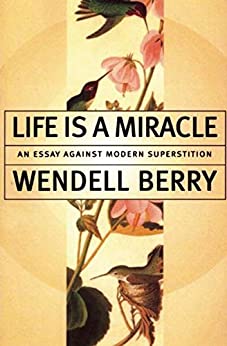
I finished reading Wendell Berry’s Life Is a Miracle, written 20 years ago but still relevant today. I don’t know where to begin talking about it. There are so many things it touched on, including cultural and creation care, the dangers of corporate control of the arts and sciences, of people whose primary interest are wealth and power having control of higher education. I suppose that latter point is the one that resonates with me the most as an English instructor at a community college during this time.

This time. How strange it is. There are so many questions, and I can’t say that reading Berry’s book has offered me any specific answers, but perhaps it gives me something more important.

A new outlook.

At first Berry seems to be criticizing modern science, but it doesn’t take long before the reader realizes that his objections are more towards the commercialization of science and how it is being isolated from other academic disciplines–how undergraduate programs in our colleges and universities are moving away from the traditional idea of one student embracing multiple disciplines, working across curriculums for the good of all, to more and more isolation and specialization. Ironically, this movement is causing us to be less and less concerned with specific problems, and more importantly, the people who are right around us.

Early on, when Berry introduces his thesis, he caught my attention, discussing what he means by professionalism, which is not what most people think when they hear the word:

“All of the disciplines are increasingly identifiable as professionalisms, which are increasingly conformable to the aims and standards of industrialism…The professionals don’t care [his italics] where they are….They subscribe to the preeminence of the mind and (logically from that) of the career. The questions of propriety, calling as they must for local answers, call necessarily for small answers. But small local answers are now as far beneath the notice of porfessionalism as of commercialism. Professionalism aspires to big [his italics] answers that will make headlines, money, and promotions. It longs, moreover, for answers that are uniform and universal–the same styles, explanations, routines, tools, methods, models, beliefs, amusements, etc., for everybody everywhere. And like the corporations, whose appetite for ‘growth’ seems now ungovernable, the institutions of government, education, and religion are now all too likely to measure their success in terms of size and number. All the institutions seem to have learned to imitate the organizational structures and to adopt the values and aims of industrial corporations. It is astonishing to realize how quickly and shamelessly doctors and lawyers and even college professors have taken to drumming up trade, and how readily hospitals, once run according to the laws of healing, mercy, and charity, have submitted to the laws of professionalism, industrial methodology, careerism, and profit” (pp 14-15).

Yes! Yes! Yes!

Do you know how relieved I am that someone who is so widely respected, a prophet of our time, has written these words that my soul has been shouting for years?

Yes! Yes! Yes!

A publically funded college is a place where learning is fostered for all of the people in the community, not to be centered on corporate or government interests. Not that these interests are unimportant. Of course, they are, but they are best served by a faculty dedicated to teaching students to think and communicate clearly and critically, a staff that supports students and their instructors toward that end, an administration that is devoted to the welfare of ALL students, faculty, and staff. No matter what career the student is interested in pursuing, even if she dreams of being a writer, an artist, a musician or, God forbid, an actor. No matter what subject the professor teaches, even if he teaches the history of jazz. No matter what the staff members do, whether they be registrars or receptionists.

It is not the job of any administrator, board member or government entity involved with a college or university to decide what learning is valuable and which is not.

The quote above raises another issue that has long been heavy on my heart– the insane idea of trying to standardize college-level instruction. Why do so many in higher education think it is a benefit to a young adult to encounter the same material, assignments, activities, grading rubrics, online platforms? Why this emphasis on sameness? How can students learn to navigate an ever-changing world if they don’t start learning to adapt to change while they are in college?

Wendell Berry gave me the answer–because sameness comes from the corporate mindset of “producing” as many “successful” graduates as cheaply and quickly as possible. And what is the sign of success?–a job.

But, I digress. Sorry, it’s the way I’m built. Just ask my students.

Berry discusses three institutions he feels are most affected by this professionalism–science, the arts, and religion. He begins with science and much of what he says has great relevance to two crises in our world today–do I need to even name them?

When discussing the limitations of science due to the deficiencies of our mental capacities (we don’t like to think we are limited but that we are is beyond doubt), Berry says the following:

“The fallibility of a human system of thought is always the result of incompleteness. In order to include some things, we invariably exclude others. We can’t include everything because we don’t know everything…. The incompleteness of a system is rarely if ever perceptible to those who made it or to those who benefit from it. To those who are excluded from it, the incompleteness of a system is, or eventually becomes, plain enough. One weakness of the present system,… is that it excludes all inscrutable and ineffable things, including the life history of the human soul” (pp. 34-35).

When a writer like Wendell Berry, not only a writer and a poet, but also a farmer and conservationist, some would even call an environmental activist, writes about science, he embues his words with the inscrutability and ineffabilty that he sees lacking in modern science. How he strings the words together, how he brings more than simple meaning but part of his soul to the page is evidence of what is at the crux of what I think is his intended meaning.

Science, the arts, religion, they need each other, depend on each other.

We need the complexity, the exactness of science, we need the mystery and symbolism of the arts, we need the sanctity and hope of religion to help bring us together and to help us include those who have for too long been excluded.

I don’t have time to talk about all of the many great ideas in Berry’s book, so I will conclude this scattered review with one piece of advice: Read it!

And with one last quote from the book:

“If we were as fearful of our knowledge and our power as in our ignorance we ought to be–and as our cultural and religious traditions instruct us to be–then we would be trying to reconnect the disiplines both within the universities and in the conduct of the professions” (p. 145).

Amen.

Work Cited

Berry, Wendell. Life Is a Miracle, Counterpoint, 2000.

Standing Up

close up photo of book pages

Photo by Ravi Kant on Pexels.com

It has been a long time since my last post, but my students must come first.

I have a confession to make–I haven’t always believed that.

For many years of my career, I put myself ahead of my students’ education, always thinking about what I can do to make my work easier, to make myself look good, to further my career, to improve my “numbers” (recruitment, retention, and success rates).

Despite this, I think I was still a good teacher; self-interest and ambition are strong motivators to improve one’s performance. Also, one of my strengths is that I have always cared about my students as people. In addition, I still believe a strong liberal arts education means more than a ticket to a job but will help my students lead better, more productive lives. The non-pecuniary benefits of a liberal arts education are real.

And yet, I don’t think I always valued their education enough to stand up for it.

I have to get grading again, but soon, I will elaborate.

Until next time!


Purely Pecuniary

full frame shot of eye

Photo by Vladislav Reshetnyak on Pexels.com

For, money makes the world go around
…the world go around
…the world go around.
Money makes the world go ’round
The clinking, clanking sound of…
Money money money money
Money money money money…
Get a little, get a little
Money money money money…
Mark, a yen, a buck or a pound,
That clinking, clanking, clunking sound,
Is all that makes the world go ’round,
It makes the world go ’round

from “Money Makes the World Go Around” by John Kander and Fred Eb from the musical Cabaret.

Remember that song from Cabaret? When the sleazy, clown-like emcee and outrageous Sally Bowles sing “Money Makes the World Go Around”?  The film version of the classic musical about greed and corruption in pre-Nazi Germany made a huge impression on me when I first saw it as a youngster.  Liza Minnelli and Joel Grey were “divinely decadent” in the scene, provocatively contorting as they extolled the virtues of the Almighty Dollar, or mark, or yen.  Here’s a link if you want to see it: Money.

Kind of creepy, isn’t it?

Don’t get me wrong. I like money. I really do. I appreciate that with sensible management, thanks largely to my wonderful husband, we are able to sustain a comfortable living, allowing us to travel frequently to see family, provide the basis of financial security for our daughter, give to the charities of our choice, as well as save for emergencies and retirement. All of these things are wonderful.

What creeps me out about money is the overwhelming love for it that the society at large seems to have. And I mean love in the biblical sense, as in the root of all evil kind of love. I mean hot and heavy LUST for it. It permeates everything, including higher education, of course.

Here’s the even bigger problem for me.

I can’t do a darn thing about it.

I mean, I’ve tried. I speak up about the intrinsic value of education beyond training a workforce. I write about it on this blog. I try my best to provide a true education to my students–one that goes beyond passing tests or turning in assignments with a modicum of grammatical and mechanical errors so they can earn a grade in a course and be passed on to the next course. I try to give my students an education that honors their individuality, that challenges them, that enters into their hopes and dreams, no matter what their socio-economic status, no matter how much it will cost the State to educate them, no matter what they want to study, even if they want to study arts and humanities.

But I am losing the battle. Why? Because Money. Makes. The World. Go. Around.

Alright then, I can play along. Let’s play Purely Pecuniary. Let’s only talk about Money.

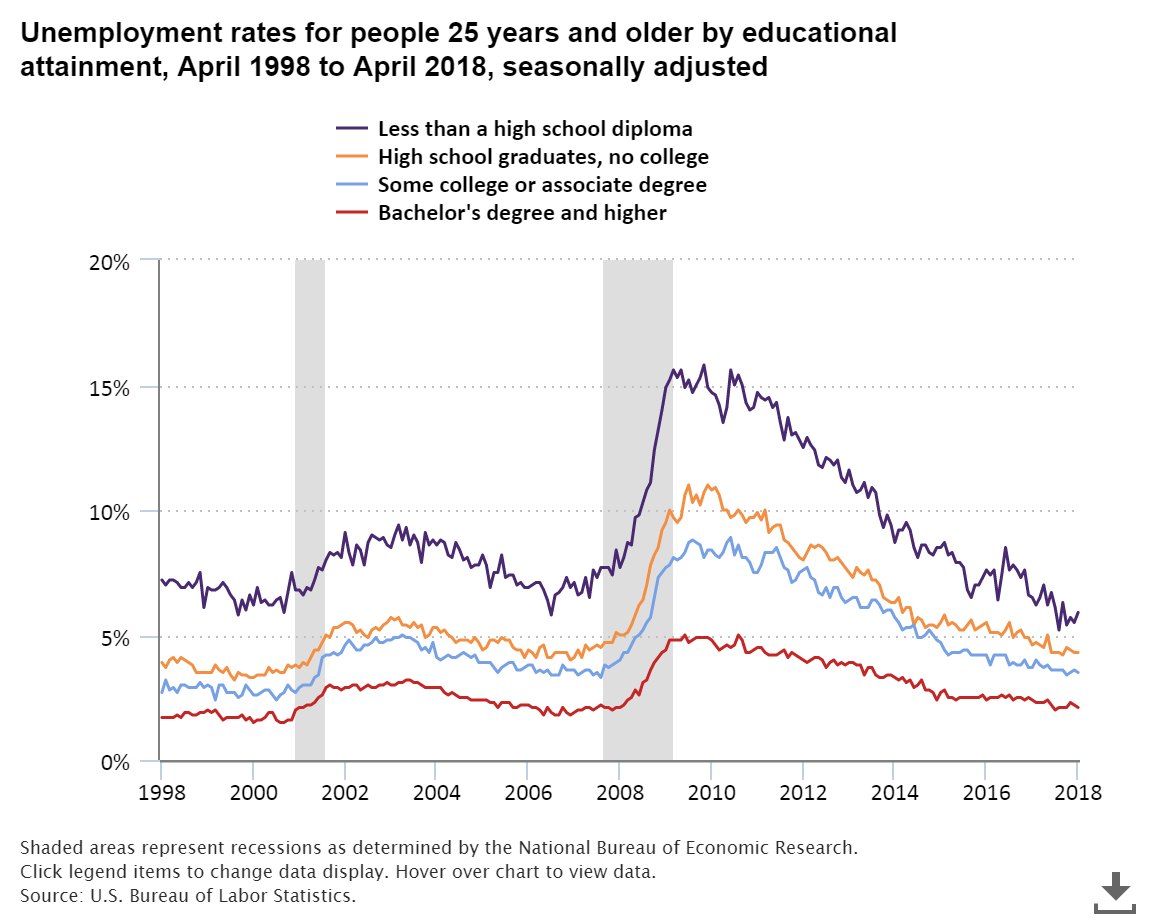
The Bureau of Labor Statistics (BLS) is a good place to go. It takes a few easy searches to find information that shows a bachelor’s degree or more is preferred if the goals are employment and wages:

chart (2)


Notice that at all times from 1998 to 2018 those who have bachelor’s degrees or higher have the lowest unemployment rate, adjusting for seasonal work.

employment growth

  • Note that production (the gray dot) is projected to have almost negative 5% growth by 2026 with wages decreasing to below the median annual wage. 
  • Notice the highest growth of employment is healthcare support followed closely by personal care and service, but these two occupations, requiring little to no post-secondary education, are also located well underneath the median wage line.
  • The higher paying careers with high employment are also in the healthcare area, but both occupations require either advanced degrees or the equivalent in technical education. Obviously, those with more advanced degrees will make more money.
  • Computer and mathematical careers have higher wages, but to get those higher wages, many will need a four-year degree or higher as this next graph indicates:

degree earnings

Clearly, earning a bachelor’s degree or higher is not only the most likely avenue to employment but is also the best direction for those who wish to make two times the median wage, or more. If you want to read more (and see more charts with important data ), then go to this informative slideshow from the BLS.

So, if indeed money does make the world go around (I don’t really believe it for a second), then obtaining a  liberal arts education or professional degree is the way to do it, and if students need or want to save money, they can begin that journey by obtaining an associate’s degree at a quality community college and transferring to a university as a junior.

Furthermore, some universities in my state and others have drastically lowered tuition, so if students transfer to a cost-effective four-year institution nearby so they can live at home, they will have an opportunity to graduate with little or no debt. Win-Win. 

See, I like money. But I LOVE providing students with an education that will give them more than a paycheck. I want to help students receive an education that frees them to seek meaningful work and otherwise enhances their lives, and the lives of others, more than they ever dreamed possible, by giving them a purpose beyond consumption–beyond material gain.