What Is a “Good Job,” North Carolina?

Lately, I keep seeing headlines and hearing talking points about how employers and colleges are “working together to create lasting good jobs in Western North Carolina.” It’s a hopeful phrase, one that suggests stability, opportunity, and a future worth investing in. But the more I look into it, the more I find myself asking a simple question that somehow has no simple answer: What exactly is a good job? And perhaps more importantly, good for whom?

Photo by Lukas Blazek on Pexels.com

From the context, you might assume “good job” means higher pay, better benefits, or a career path that allows a young person to build a life here in the mountains. But when you dig into how the term is actually being used by state agencies, workforce boards, and community colleges, a different picture emerges. “Good job,” in the current North Carolina policy vocabulary, often means something closer to “an employer’s need filled” or “a job that aligns with the programs colleges want to run.” The worker’s perspective—what makes a job good for the person doing it—rarely appears in the definition.

Across the state’s workforce initiatives, a “good job” tends to be defined by a few recurring criteria:

  • It’s in a high‑demand field where employers report shortages.
  • It supports regional economic development goals.
  • It requires a credential or degree that community colleges can provide.
  • It is assumed, though not guaranteed, to pay a “living wage.”

Photo by KATRIN BOLOVTSOVA on Pexels.com

Notice what’s missing: predictable schedules, safe working conditions, advancement opportunities, work‑life balance, or alignment with a student’s interests or long‑term goals. These are the things workers consistently say matter most, yet they rarely make it into the official definition.

And here’s where the disconnect becomes especially clear. In Buncombe County, the 2025 living‑wage benchmark is $23.15 an hour for a single adult renting a modest one‑bedroom apartment (according to Just Economics of Western North Carolina, the region’s recognized living‑wage certifying organization). Yet many of the jobs most aggressively promoted as “good jobs” in Western North Carolina — such as certified nursing assistants, medical assistants, and early childhood educators — often pay several dollars below that threshold. These roles are labeled “good” not because they reliably support a stable life, but because employers are desperate to fill them and colleges can train people quickly for them. The wage reality simply doesn’t match the rhetoric.

Photo by Pavel Danilyuk on Pexels.com

But students and job seekers see things differently. Take a young person who loves small children and has decided to become a childcare worker. She or he can expect to make about $15 an hour on average, according to Salary.com — not nearly enough to reach that $23.15 living‑wage threshold. And the situation may get worse. Some of the proposed legislative changes now under consideration would loosen staffing and capacity rules for childcare centers. Providers warn that these changes could increase workload, reduce safety, and intensify burnout — all without any proposed increase in pay. In other words, the job may become harder and more stressful, while remaining financially unsustainable.

This gap between employer‑centered and worker‑centered definitions is not new, but it feels especially stark right now. Western North Carolina is in the middle of a major workforce push—post‑pandemic, post‑Helene, post‑manufacturing decline—and the pressure to fill certain roles is intense. Community colleges are under their own pressures: enrollment challenges, funding tied to workforce outcomes, and the need to demonstrate “return on investment.” When employers and colleges sit down together to define “good jobs,” it’s no surprise that the definition leans toward labor‑market needs rather than human needs.

Photo by Vitaly Gariev on Pexels.com

But students and job seekers see things differently. For them, a good job is one that allows them to build a stable life, not just fill a vacancy. It’s a job that pays enough to live in the community they serve. It’s a job with dignity, safety, and a future. It’s a job that fits who they are and who they hope to become.

So when we hear that North Carolina is creating “good jobs,” we should ask: Are these jobs good because they help employers grow, or because they help workers thrive? Ideally, the answer would be both. But right now, the rhetoric leans heavily toward the employer side of the equation. Until we broaden the definition to include the lived realities of workers and students, we risk building pipelines (the very term dehumanizes) that serve institutions more than people.

Maybe the better question isn’t “What is a good job?” but “What is a fulfilling one?”
Horrible Helene

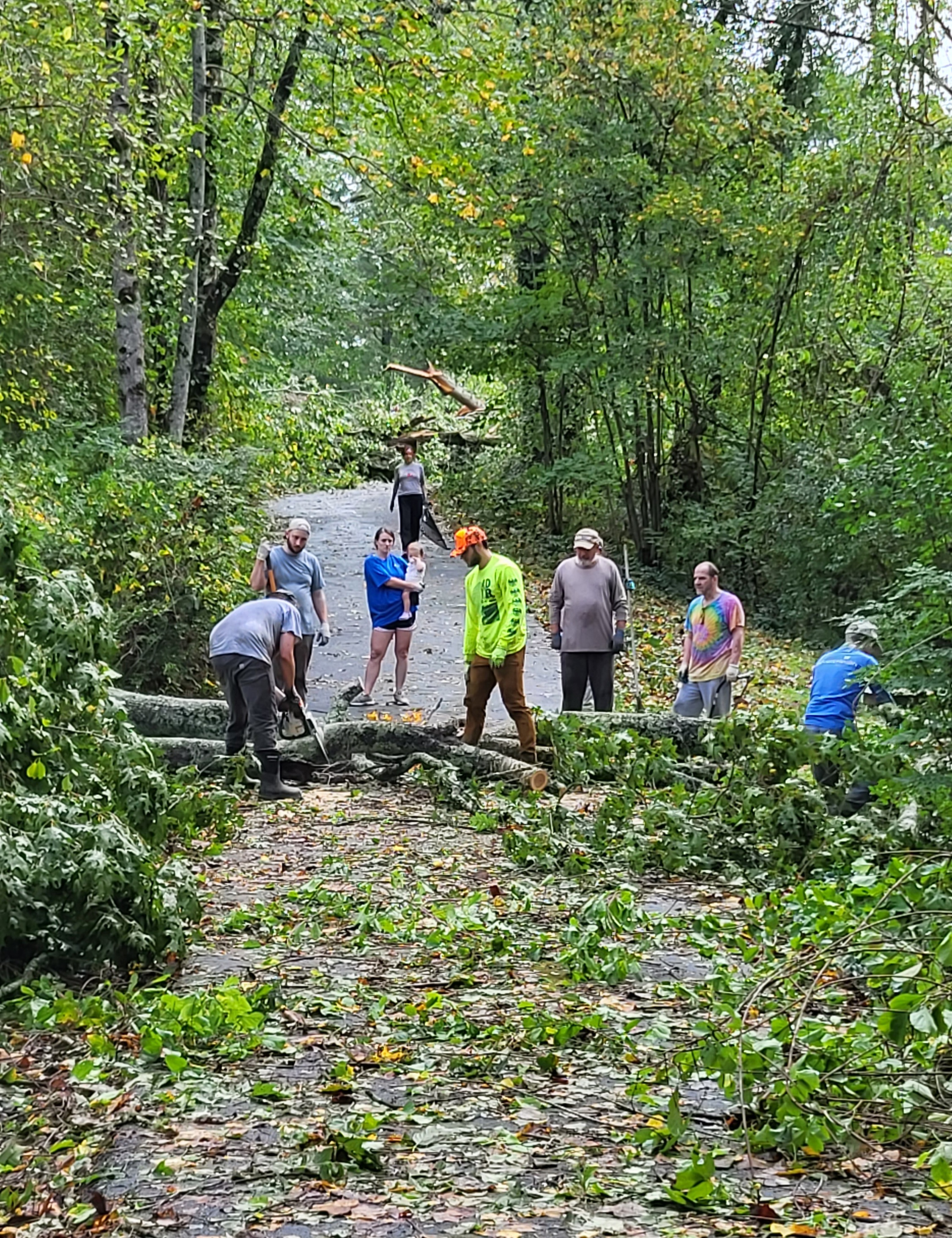
Neighbors Helping Neighbors–Photo by Katie Winkler

My hometown in Western North Carolina lay directly in the path of Tropical Cyclone Helene as it made its mad way through the Southeast. Never in my life did I think I would encounter the worst natural disaster in the state’s history here in the mountains. In my little neighborhood of two narrow dead-end roads, our neighbors joined together to remove six downed trees in less than half a day, so that we could get out of our neighborhood. For weeks we have shared news, food, water, the best roads to travel and when, where the best cell reception could be found. We have become better friends.

Over and over again in the almost four weeks since the storm hit, I have been astounded at the way our people have come together to care for each other and how people from all over the United States and Canada have joined to help us. My heart is full of gratitude.

And you know, none of us talked about politics.

I wonder, however, as we near the end of a contentious election season, if our togetherness during the crisis can withstand our political divisions, especially when it comes to education.

To me, in the race for the North Carolina Superintendent of Education, the choice seems to be amazingly clear, Mo Green, who has served North Carolina Public Schools as superintendent of Guilford County Schools and general consul for Charlotte-Mecklenberg Schools. Hands down! His knowledge of the public school system is extensive because of these positions. He is already intimately area of how our system works, its strengths and weaknesses. In addition, his mother, a special education teacher, instilled in Green a deep respect for teachers that his opponent, MIchele Morrow, lacks. She has in the past called schools “indoctrination centers” and its teachers “groomers.” A quick search of her well-documented past reveals even more alarming rhetoric, including calling for the public execution of President Obama and the overthrowing of the constitution.

However, the extremism is not only in the past. Michele Morrow simply can’t help herself. Although she has toned down her rhetoric during debates and public appearances, focusing on “safety,” her bias, especially against LGBTQIA+ individuals and immigrants, keeps cropping up as in her Sept. 16 post on X. Ironically, Morrow begins her post writing, “We must keep EVERY student safe in ALL our schools!” However, after criticizing her opponent Mo Green for winning the endorsement of Equality NC, a pro-LGBTQIA+ group, Morrow’s pre-campaign rhetoric comes out once again: “NEWSFLASH: the ‘+’ includes PEDOPH*L*A.” How such an untrue and inflammatory implication can serve to keep every student safe, especially non-binary ones, is unclear. 

Another attack on the LGBTQIA+ community occurred during Pride month (June) last year. Morrow made one of her frequent visits to the Wake County School Board meetings, and during a three-minute rambling statement said, “There is no pride in perversion.” One might say that Morrow is entitled to her opinion about queer people, which is certainly true, but her rhetoric clearly belies her concern for the estimated 10% of students who identify as non-binary according to a survey conducted by the Williams Institute at UCLA’s School of Law.

 Her statement is consistent with her continuing obsession with the “indoctrination” of our public schools by what she calls the far left. However, a 2021 national study by the conservative think tank The Heritage Foundation, revered by many Christian nationalists, found no evidence of the extremes and even concluded the following: 

The average teacher response was consistently more moderate than that of the average liberal in the nationally representative sample. We find little evidence that a large percentage of teachers are systemically imposing a radical political agenda in K–12 classrooms. We discuss implications of these results—including the possibility that teachers may often be allies, rather than opponents, of parents concerned about critical race theory, the 1619 Project, and other divisive ideologies in public schools.

Trees down in my neighborhood–Photo by Katie Winkler

My prayer is that unity and togetherness that came to us during the aftermath of Horrible Helene will remain with us as we go into the coming storm of one the most contentious elections in our nation’s history. May we make decisions based on respect for all teachers, students, and parents–not just those who hold a certain worldview.

https://twitter.com/i/status/1810263505536205206

https://youtu.be/xCxiCqInRRI?si=ymIgxsNwIQC6oXf- 

LGBT Youth Population in the United States – Williams Institute (ucla.edu) 
BG3672.pdf (heritage.org)