Me receiving an Appy Inkwell Award for Best Memoir at the Appalachian Writer’s Conference, 2024
About this time last year, I found out that the opening pages of my teaching memoir, Lessons: A Teaching Life, won a contest sponsored by Martin Sisters Publishing, a small press in Barbourville, Kentucky. With the prize came eventual publication. My long year of revising, editing, and polishing began at the beginning of this year. At the end of July, I reached a milestone, finishing my personal revision and editing stage! Now, I’m working with my wonderful editor, Ryan Wineberg, to edit the book and ready it for the publisher. If all goes well, I hope to have my first book published in the first quarter of next year.
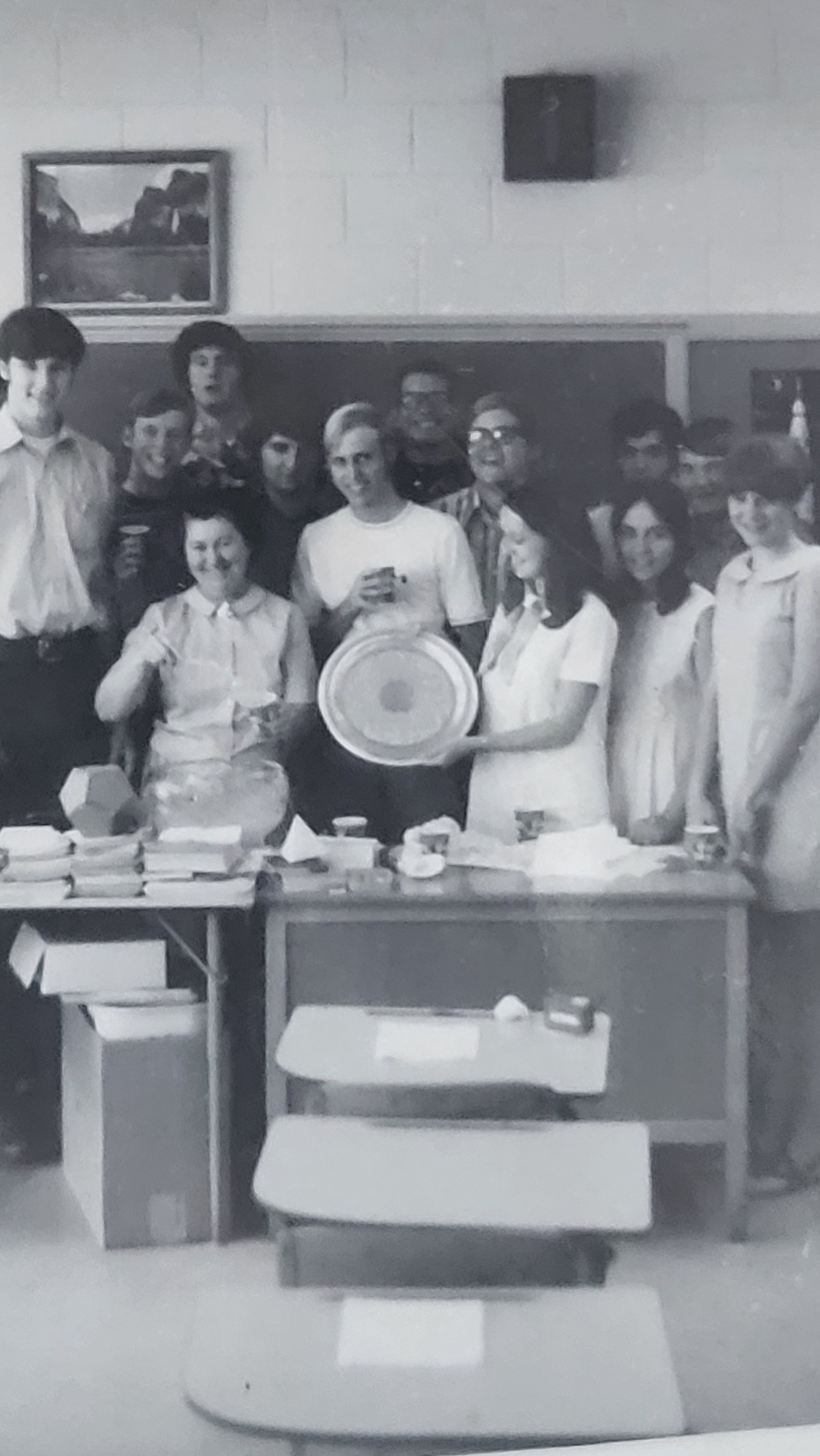
My grandfather when principal of Ridge Grove School (far right, back row)
One of the first things Ryan asked me to do was think about adding pictures, which for some reason, I had never thought about doing before. It’s been an interesting process and trip into my teaching roots, especially the pictures I have found of my own and my mother’s family, many who were educators. My grandfather, Gordon Dabbs, died before I was born, but through my mother I have learned what a great principal and physics teacher he was. My grandmother, Katherine, and her sister, Jane Leath, were also teachers as was my mother’s brother Eldridge Dabbs. My father was a principal, teacher, and coach. My mother taught English but spent the bulk of her career as a high school librarian, now retired for many years. My mother’s first cousin Judson Jones became a principal, too, and two of his daughters, Leah and Lori work in education; Lori has her doctorate like her daddy.
My grandmother with her first class at Lanett High School, Lanett, Alabama (front row, far right)
Great Aunt Jane at her retirement celebration (front row, far left)
It’s been great to look back and see pictures that represent this rich legacy that helped shape the value I put on education. For me and my family, it’s been priceless!
I will sure keep you all updated about the book’s progress. In the meantime, I’ll be traveling to the Appalachian Writers’ Conference again in September. Excited to go back and keep learning–as my dad always said, “I’m not going to retire. I’m going to refire!”
I am writing a book about teaching. It’s non-fiction, but other than that, I’m not sure how to describe it. It’s part memoir and part teaching methods to begin with. In many ways, it is also like my blog–musings and mutterings about my life’s work.
I don’t mind telling you, I’m struggling. It’s not writer’s block. Oh, no. I’m not sure I believe in writer’s block anymore anyway. The only way I’ve ever written anything of any length is to write six days out of seven. The biggest excuse for not turning in work I heard over my years of teaching was some form of “I’ve got writer’s block, Mrs. Winkler.” It’s hogwash, I would tell them. Well, no, I wouldn’t say it that way. After 40 years of teaching, one learns how to spin. I would dress it up with the appropriate metaphor, analogy, etc., but in the end my student was more than likely procrastinating and not even trying to write.
You can’t write anything, if you don’t write something. Hmmm, that’s pretty good. I wonder if I ever used that one in class.
So, again, no. It’s not writer’s block. The first day of my official retirement, August 1, I set a daily average quota for the book in order to finish a rough, rough draft by the end of the year. I’m well ahead of schedule in that regard; I haven’t had trouble writing pages and pages and pages. Because I’m not plotting (I’m a terrible plotter), the words, stories, feelings, and ragings about my life in teaching just pour out.
Frankly, my struggle is having a point. But, no, it’s not that either–I have so many points, so many things I want to say about teaching, that the book is just a hodge podge of memories interspersed with my concerns (aka fears) about what is happening in education, especially higher education in America, especially here in North Carolina.
Sometimes, I think I’m writing two books, but if I want to keep the memoir part intact, the part that reflects who I was as a teacher, how I changed, and why teaching was more than a career, if I want to do that, then maybe this mishmash of a book is exactly what I want to write.
However, I still feel that the book needs to have a central theme, something on which to hang all the dangly pieces, and entice the reader to hear what I have to say. Also, even though it faces the truth about the educational perils of our time, I want the book to be, overall, positive in its outlook as it promotes the intrinsic value of education.
I think I’ve got it now–at least the germ of an idea.
Education begins and ends with relationships–between student and teacher, yes, but it doesn’t end there–also between student and family, family and teacher, teacher and other teachers, teachers and administrators, administrators and staff, staff and students, staff and teachers, and civic leaders, business owners, the community at large, and, okay, you get it. Success in education depends on the health of all these relationships. I think my book already reflects that, but I want to strengthen that theme in revision.
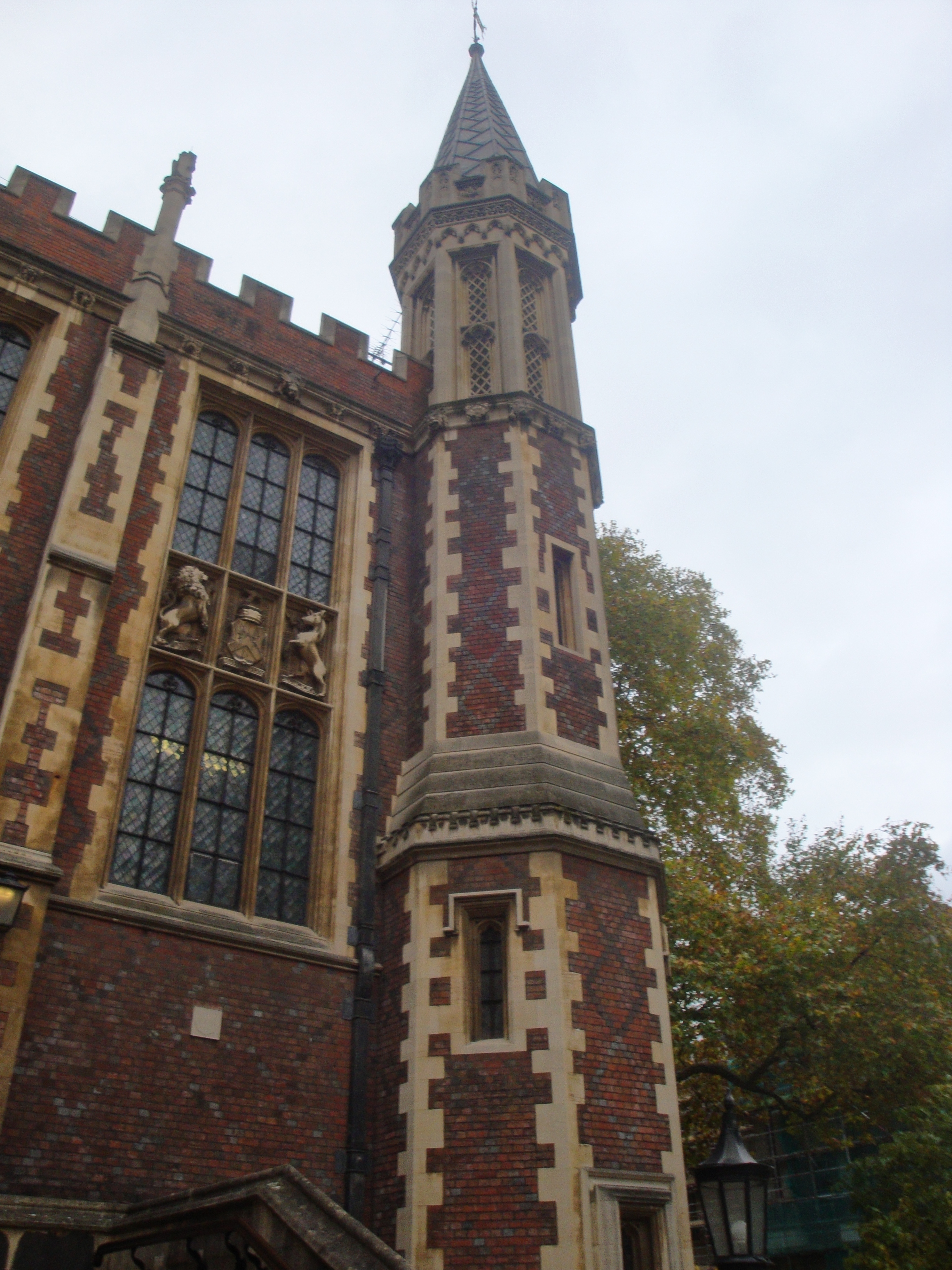
One of the spires of Lincoln’s Inn, London, October 2015 photo by Katie Winkler
So far, my book not only reflects some of these personal relationships, but also the relationships between events of my life and teaching. A large chapter in the book, for example, is showing how my travels in America and Europe reflected themselves in my teaching. I also want to talk about the relationship between socio/cultural shifts and the classroom, how I had to adapt my lessons to new trends (after I got over being furious about them).
I’m not sure. I’m still struggling, but I’m not blocked. I’m not discouraged. I am practicing what I preached all of those years: “Just get started. Vomit.” Yes, I said vomit–always got their attention. “Vomit it all out on the paper and then start cleaning up through revision and editing.” That’s where the heart of good writing lies.
More about that later.
Other than writing the book, I have also been putting together the fall/winter 2023 edition of Teach. Write.: A Writing Teachers’ Literary Journal, which will publish Oct. 1. As I mentioned in my last post, the journal has its own website now! The spring/summer edition is there as well as submission guidelines and some other information. Why not take a look? Just go to teachwritejournal.com.
Mrs. Winkler photo by Scott Treadway at Treadshots.com
So, it’s true. Retirement after almost 40 years of teaching English composition is, number 1, freaking awesome! Not having the constant class planning and paper grading has been true freedom for me. I guess I didn’t realize what a huge chunk of my life was wrapped up in doing those two things. Even in the summer when I wasn’t teaching, I was still spending on average a couple of hours each day tweaking old assignments, writing new ones, and updating online material (necessary but oh so tedious), among other college-related things I would just as soon forget.
The second true thing is that I have planned way too much for the first few months. So many people told me that I would be busier than ever when I retired, but I didn’t believe it could be true.
It is.
Here are a few of things I’m working on:
A teaching memoir–this is highest on my list because my 87-year-old mother suggested it, and I love the idea. I am ahead of schedule, even though I’m not writing at least six days a week as I promised myself I would. That said, when I do write, the words just flow out, and I’m averaging over my quota per day.
Writing blogposts more often. My goal is to write a post, on average, once a week. I am quickly learning that I won’t be able to write on the same day every week. My schedule is too unpredictable, but if I write four posts a month, I’m going to feel pretty darn good about myself.
The first step in being approved for membership in CLMP is developing an independent website for Teach. Write. I have already launched the new site, but there isn’t much content yet, so I am taking some time several days a week to work on that project.
Launching the next edition of Teach. Write. on October 1. Still on schedule to launch the new edition on the new site!!
Writing and submitting new short fiction. I’ve written and submitted one new story for a contest already and submitted one other story that I love but still hasn’t found a home. I think it is important to keep submitting my shorter works while I’m working on this long non-fiction project.
Thinking about my next play project–just thinking about it. I have two plays in mind–one is an adaptation and the other is original. At this point, I’m just re-reading the novel I’m thinking of adapting and doing some minor research on the original play idea.
These are only my writing and teaching-related activities. Despite all I’m doing as a writer/teacher, I don’t feel as stressed because I know I don’t have to do them. Also, because those two huge responsibilities–planning classes and grading papers–are no longer looming, I have time to do all the things I’ve been able to barely do and do them better. At least, I’m trying to do them better.
For the first time in 27 years, I did not go back to work today. July 28, I said goodbye to the community college where I developed curriculum for and taught, at one time or another, English composition, developmental reading and writing, creative writing, and business English as well as American and British literature. Some of my other duties over the years included advising and registering students each semester, regularly writing the weekly BRCC column that appeared in the local paper, serving as the faculty council chair for two years, writing plays, screenplays, and press releases as well as frequently appearing in productions for the college’s drama department. Those last few things were less responsibilities and more for the sheer joy of it.
I was also interested in online learning and one of the first instructors to teach online. Unlike many of my colleagues, I enjoyed engaging in new educational technology and preferred teaching some classes online. For about a ten year period, I frequently attended state and national conferences to share what I was learning about using technology more effectively in English classes.
Another thing that I did all those years was ask questions. I asked a lot of questions that were rarely answered, not to my satisfaction anyway, and led to me getting a reputation as a “trouble maker.” But honestly folks, I just asked questions. Honest questions.
Truth be told, since I’m still trying to be honest, although I felt many administrators’ displeasure, no one every really tried to overtly interfere with what I did in the classroom. I’m not sure why that is, except maybe I earned my high school nickname, Bulldog, for a reason. Hey, maybe I was just a really good teacher. I like to think I was. No, the pressure on me was much more subtle—patronizing condescension, gradual marginalization, simple avoidance.
Oh, well.
For the bulk of my career, I loved my work despite the occasional bureaucratic and administrative headaches because I felt like I was a vital part of the college, that I mattered more than a body to cover the classes that needed to be covered, record grades, or register students so the college could reach new statistical highs and claim bragging rights. Towards the end, and one reason I retired early, I just didn’t think I mattered anymore. Worse, I couldn’t continue to watch the people in power care less and less about my students beyond the data their presence produces.
So today, I begin again and go back to a different kind of school, one with a curriculum of my own design, that will guide these early years of my “refirement” (see my last blogpost) because I still have much to learn and many questions…so many questions.
Come back next week and see what questions Mrs. Winkler is asking now!
My father always said, in his loveably corny way, that he wasn’t ever going to retire, but refire! I think I will take his mantra as I embark on this new phase of my life. I have taken a few days to just re-evaluate things and decide what I want to spend my time doing.
So much of my time the last 55 years and more has been about getting an education or being an educator that it is going to take time to learn how to focus on other things, but I’m eager to try. I am already loving the freedom to order my life according to what is important to me, not my teachers or my employers.
Where to begin? Sheesh, now that it comes down to it, I’m having trouble even putting anything down. I know I want to spend more time with my family without annoying them, and I want to do things for them without hovering or being bossy.
But when it comes to the non-essentials, I guess the first thing I want is to write. I know that! Of course, I will continue writing this blog—my goal is to write a post once a week. But more than that, I want to start marketing the blog more and learn more about the business side of blogging and up my game a bit in that department. So, I guess I will be going back to school in that sense, but again, I want to do it. Nobody can make me anymore. Or voluntell me!!
It’s been a year since I worked on my podel (podcasted novel) Campus: A Novel That Wants to Be a Musical, so I want to pick that back up. I think I will shoot for one episode a month and try to increase that gradually. I want to improve the quality of the productions as well, which I am looking forward to doing.
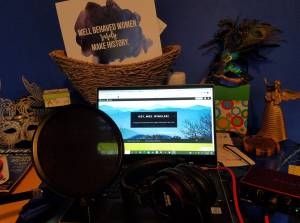
My podcasting set up thanks to husband and daughter
I have already started working on the book that my mother suggested I write—a memoir of my teaching career. My goal is to finish by the end of the year, which means averaging about 600 words a day, so I’m on track. I am pleased with the format I’ve chosen and the writing is coming so much easier now that I am not spending so much of my summer vacation days planning my classes for the fall semester.
Spending more time with each edition of Teach. Write., the literary journal I founded, edit, and publish, is also something I want to do. I feel like I have made small improvements since the first edition in 2017, but I have always felt rushed to get each edition out. I am glad that retirement will afford me more time to work on this passion project.
First edition of Teach. Write.
So many other things I want to do, but I never want to forget that I also want to leave room in my life to be less busy, to listen more, read more, and have times like today to just sit on a porch in Alabama with a cup of coffee on a cool summer morning before the day heats up, listen to the collared Eurasian doves coo, pet a soft German shepherd puppy, and talk about life with my baby brother.
It’s a good life.
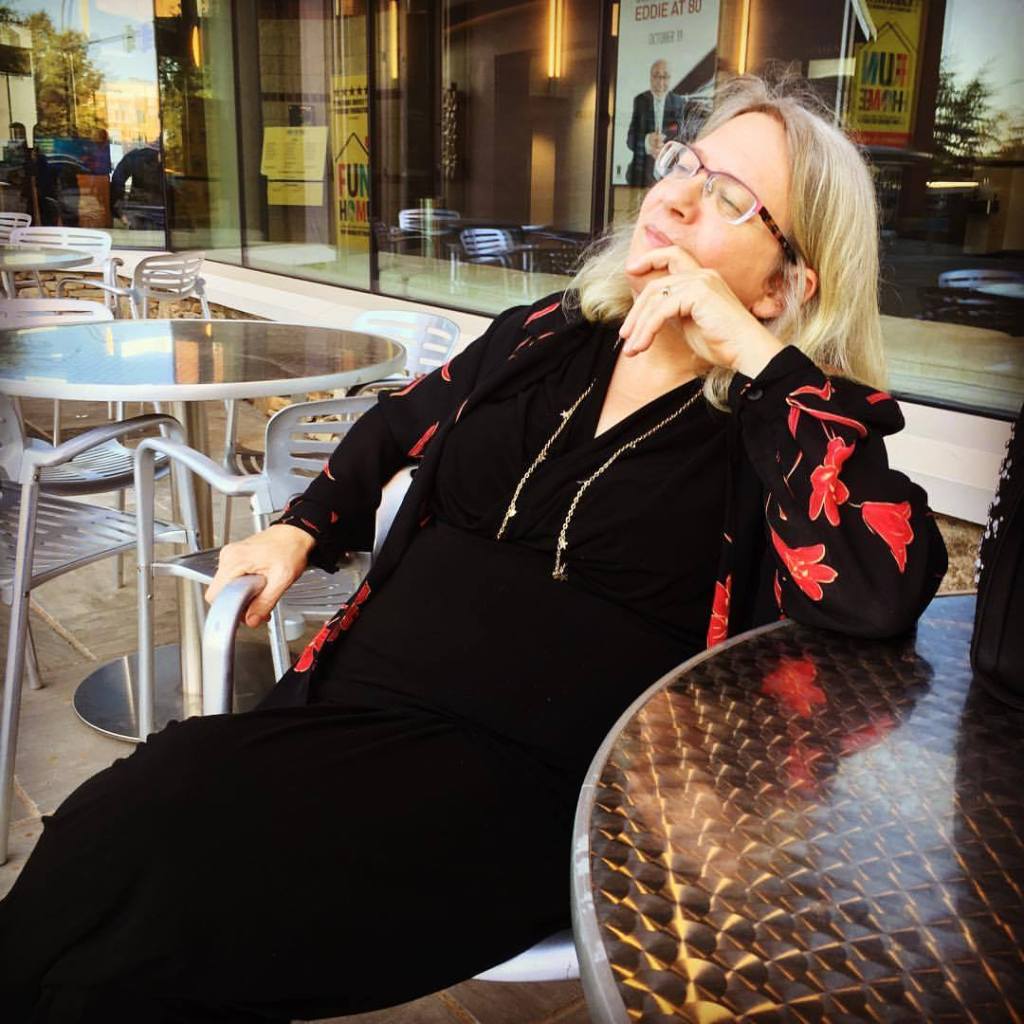
Me several years ago before seeing a play at the Peace Center in Greenville, SC.
I’m behind keeping up with my summer loves, especially reading and writing, because I’m working this summer. It’s not too bad a gig–Monday through Thursday schedule, three classes instead of five or six, ten weeks instead of sixteen with a two-week vacation at the end. I can handle it this summer and the next because I have something to look forward to–permanent summer break.
Yes, retirement begins on August 1, 2023. I’m a little excited. Can you tell?
In the meantime, I make the best of things in my temporary office in the library at our college as we await the final touches being put on the new multi-million dollar building that replaces two of the oldest buildings on campus. One of those buildings was my work home for 26 years, so as the building is being torn down, I admit I have become nostalgic. Who wouldn’t?
photo by Katie Winkler
However, I am not too sorry to see it go. It served us all well over the years, but it was built during a different time and doesn’t meet the needs of a 21st-century student body or its faculty. My students being able to access the WI-FI from my office will be a nice change. I hear the adjustable stand-up desks are really rad as well. Do people still say “rad”?
So, I watch the goings-on across the lake, answer numerous messages and emails, occasionally chat with colleagues, teach one small seated class, and grade, grade, grade the assignments and essays of my mere 43 composition and developmental students. During regular semesters, English faculty usually teach six classes and have 100 or more students. To earn an overload, an instructor must have over 110 students or more than six courses, so this “leisurely” pace helps a little.
Despite the tedious nature of grading essays, I know from long experience that working directly with student writing through grading and conferencing and therefore establishing a relationship with students as individuals is the most important work I do as a composition teacher. I do not think there is any substitute for it.
Hence the dilemma.
The demand for English instructors to deliver online instruction is higher than ever, but course loads that already did not consider how much time an English professor needs to deliver meaningful writing instruction online have not been altered to reflect the nature of effective andragogy in the English classroom and how it has been affected by the increasing number of online students.
In addition, the number of students desiring accelerated online English instruction has increased. If you take the already heavy grading load of a 16-week semester and cut it in half, something’s got to give. Often times that is the student, who may or may not have been advised that the course must cover 16 weeks of material in 8 weeks’ time.
Currently, I am the only instructor at my institution who is crazy enough to attempt teaching eight-week online freshman composition classes. I must say, now that I have taught them for several semesters, the accelerated classes work extremely well for a certain type of student, especially those who are working towards degrees to gain a promotion at work. Highly motivated students like those in our pre-nursing, emergency medical services, and law-enforcement programs also tend to do well.
Students who are not good candidates for online learning, are not prepared for the workload, are not willing to make changes to their schedules to make room for the extra time they will need to spend, or those who do not manage their time well, along with those who are weak students or writers in general, simply should not take the accelerated course.
But they do.
So what is an English teacher who cares about learning for ALL students, whether they should be there or not, supposed to do? Furthermore, what does an instructor do if she wants to infuse her own personality into her course and resists the impersonal “canned” classes that so often do not fit her institution’s student body and do not help build the vital personal relationships that are required for good teaching of any kind?
Find a way.
With all that extra time (guffaw) I have this summer, I am continuing to make changes in hopes that the Mad English Person who, after my retirement, steps into the perilous land of acceleration will have an easier time of it. Here are a few things I have done and am doing to help that poor soul:
Adding lessons–In my learning management system (LMS), I can create multi-media lessons that help guide the students through the essential material. My own simple questions can be embedded throughout each lesson that is automatically graded by the computer, allowing an easy low-stakes grade for the student and zero work for me. Of course, I must take considerable time to build the lessons, but remember, I have all that extra time this summer.
Early in the course, assigning paragraphs instead of full-length essays–Having students write paragraphs of seven to ten sentences instead of full essays has been a game-changer. I can still teach multiple rhetorical modes as required by the state, including illustration, process analysis, classification, and definition, but now I have more time to focus on the basic elements of any good writing–thesis, support, conclusion, organization, transitions, sentence structure, diction, grammar, and mechanics. In addition, I can grade closely without overwhelming the students. My constructive criticism seems easier for them to digest. Best of all–it’s doable for even the weakest of my students.
Fewer and shorter essays–Beyond a doubt, less is more. In an accelerated class, I must limit what students write for both our sakes, but I have found that the writing is stronger because I have more preliminary work leading up to the final draft that is low stakes for them and little work for me. Win. Win.
Require rough drafts but give little direct feedback. If one of the learning objectives is for students to revise and edit more effectively, why in the world am I going to revise and edit for them? How does that help anybody learn? I am handicapping students if I give too much feedback on a rough draft. I require them because they help students with time management, and I have an earlier draft to judge students’ revising and editing skills. Because I give mainly completion grades for drafts (and make sure students are aware of this), there is little work for me.
Line editing less–In the “old” days, I felt like I owed it to students to mark every single error I could find. No more. I save time, energy, and my sanity, by line editing the first paragraph of an essay, and then marking and making comments occasionally after that. I used to spend 45 minutes to an hour grading one researched essay, but now I can effectively grade one in half that time.
Make use of the LMS advanced grading system–I am not a fan of Turnitin (subject for another day), and I’m too close to retirement to want to pursue a change in our relationship, but I do make use of the LMS’s built-in advanced grading system. I can easily build new rubrics and checklists. I also have access to a “quicklist” when I am marking an essay. I choose from a long, long drop-down menu of common comments. Over the years, I have added links to webpages that give students more information or offer exercises to help them with various writing issues. It has really helped me save time.
Adding more required online sessions and conferences–I am able to record the sessions, so even though few students can attend live, one or two usually do, and the other students are required to view the sessions. Logs on the computer allow me to verify if the student downloaded and viewed the recording. The conferences are even better because I can speak in person to each student, which helps to form those all-important relationships between us through discussing the student’s writing and listening to their concerns.
I may be old and worn out, and some people can’t seem to wait to put me out to pasture, but I’ve been at this work a long time, and I am not afraid to say it–I’m damn good at it. I know what works, and letting some AI, no matter how sophisticated, do the instruction, may lead to better data in the short term, but it won’t lead to better writing–only holding students to a standard, then compassionately working directly with them and their writing can achieve that.

















 Hey, Mrs. Winkler!