Horrible Helene

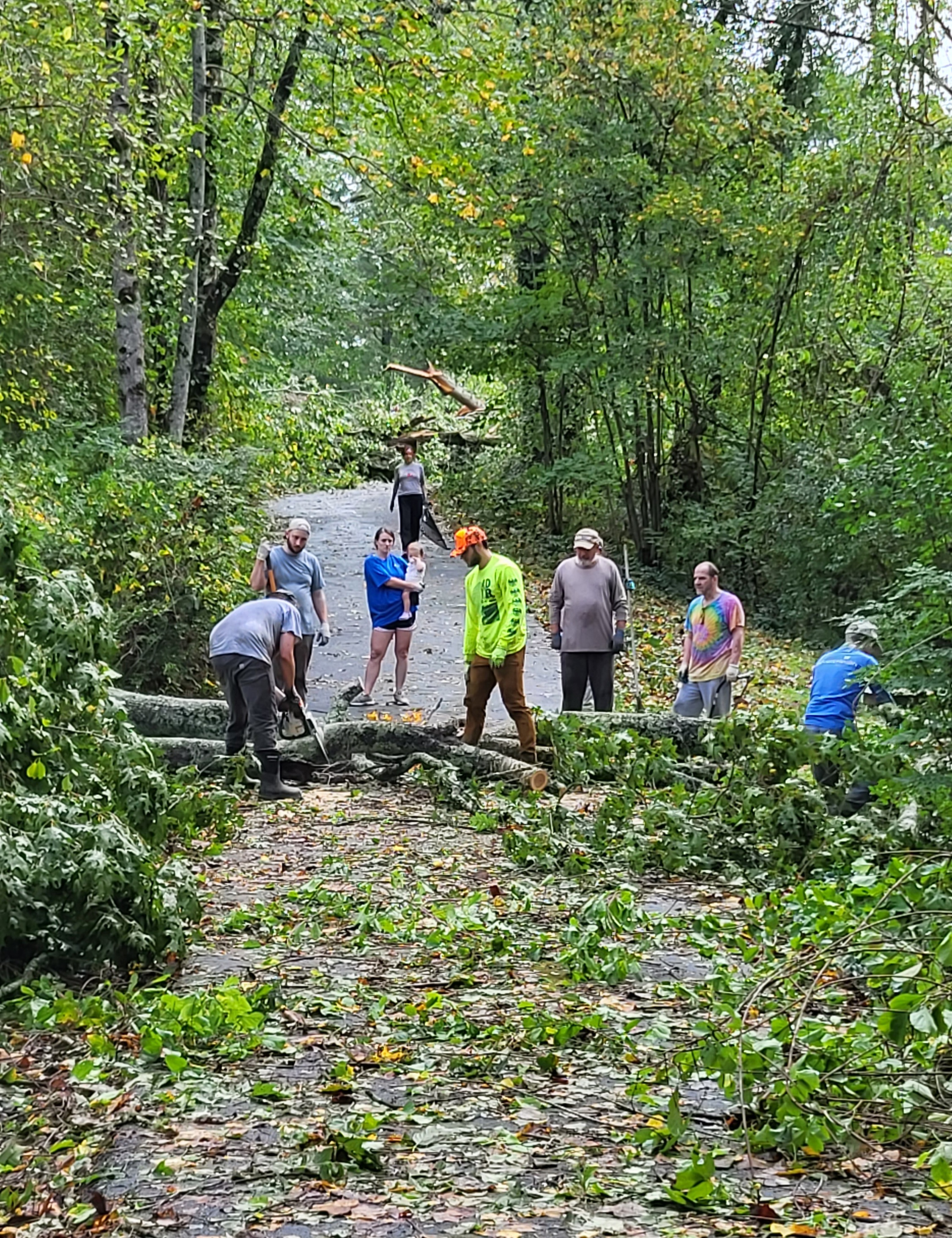
Neighbors Helping Neighbors–Photo by Katie Winkler

My hometown in Western North Carolina lay directly in the path of Tropical Cyclone Helene as it made its mad way through the Southeast. Never in my life did I think I would encounter the worst natural disaster in the state’s history here in the mountains. In my little neighborhood of two narrow dead-end roads, our neighbors joined together to remove six downed trees in less than half a day, so that we could get out of our neighborhood. For weeks we have shared news, food, water, the best roads to travel and when, where the best cell reception could be found. We have become better friends.

Over and over again in the almost four weeks since the storm hit, I have been astounded at the way our people have come together to care for each other and how people from all over the United States and Canada have joined to help us. My heart is full of gratitude.

And you know, none of us talked about politics.

I wonder, however, as we near the end of a contentious election season, if our togetherness during the crisis can withstand our political divisions, especially when it comes to education.

To me, in the race for the North Carolina Superintendent of Education, the choice seems to be amazingly clear, Mo Green, who has served North Carolina Public Schools as superintendent of Guilford County Schools and general consul for Charlotte-Mecklenberg Schools. Hands down! His knowledge of the public school system is extensive because of these positions. He is already intimately area of how our system works, its strengths and weaknesses. In addition, his mother, a special education teacher, instilled in Green a deep respect for teachers that his opponent, MIchele Morrow, lacks. She has in the past called schools “indoctrination centers” and its teachers “groomers.” A quick search of her well-documented past reveals even more alarming rhetoric, including calling for the public execution of President Obama and the overthrowing of the constitution.

However, the extremism is not only in the past. Michele Morrow simply can’t help herself. Although she has toned down her rhetoric during debates and public appearances, focusing on “safety,” her bias, especially against LGBTQIA+ individuals and immigrants, keeps cropping up as in her Sept. 16 post on X. Ironically, Morrow begins her post writing, “We must keep EVERY student safe in ALL our schools!” However, after criticizing her opponent Mo Green for winning the endorsement of Equality NC, a pro-LGBTQIA+ group, Morrow’s pre-campaign rhetoric comes out once again: “NEWSFLASH: the ‘+’ includes PEDOPH*L*A.” How such an untrue and inflammatory implication can serve to keep every student safe, especially non-binary ones, is unclear. 

Another attack on the LGBTQIA+ community occurred during Pride month (June) last year. Morrow made one of her frequent visits to the Wake County School Board meetings, and during a three-minute rambling statement said, “There is no pride in perversion.” One might say that Morrow is entitled to her opinion about queer people, which is certainly true, but her rhetoric clearly belies her concern for the estimated 10% of students who identify as non-binary according to a survey conducted by the Williams Institute at UCLA’s School of Law.

 Her statement is consistent with her continuing obsession with the “indoctrination” of our public schools by what she calls the far left. However, a 2021 national study by the conservative think tank The Heritage Foundation, revered by many Christian nationalists, found no evidence of the extremes and even concluded the following: 

The average teacher response was consistently more moderate than that of the average liberal in the nationally representative sample. We find little evidence that a large percentage of teachers are systemically imposing a radical political agenda in K–12 classrooms. We discuss implications of these results—including the possibility that teachers may often be allies, rather than opponents, of parents concerned about critical race theory, the 1619 Project, and other divisive ideologies in public schools.

Trees down in my neighborhood–Photo by Katie Winkler

My prayer is that unity and togetherness that came to us during the aftermath of Horrible Helene will remain with us as we go into the coming storm of one the most contentious elections in our nation’s history. May we make decisions based on respect for all teachers, students, and parents–not just those who hold a certain worldview.

https://twitter.com/i/status/1810263505536205206

https://youtu.be/xCxiCqInRRI?si=ymIgxsNwIQC6oXf- 

LGBT Youth Population in the United States – Williams Institute (ucla.edu) 
BG3672.pdf (heritage.org)

Back to School?

For the first time in 27 years, I did not go back to work today. July 28, I said goodbye to the community college where I developed curriculum for and taught, at one time or another, English composition, developmental reading and writing, creative writing, and business English as well as American and British literature. Some of my other duties over the years included advising and registering students each semester, regularly writing the weekly BRCC column that appeared in the local paper, serving as the faculty council chair for two years, writing plays, screenplays, and press releases as well as frequently appearing in productions for the college’s drama department. Those last few things were less responsibilities and more for the sheer joy of it.

I was also interested in online learning and one of the first instructors to teach online. Unlike many of my colleagues, I enjoyed engaging in new educational technology and preferred teaching some classes online. For about a ten year period, I frequently attended state and national conferences to share what I was learning about using technology more effectively in English classes.

Another thing that I did all those years was ask questions. I asked a lot of questions that were rarely answered, not to my satisfaction anyway, and led to me getting a reputation as a “trouble maker.” But honestly folks, I just asked questions. Honest questions.

Truth be told, since I’m still trying to be honest, although I felt many administrators’ displeasure, no one every really tried to overtly interfere with what I did in the classroom. I’m not sure why that is, except maybe I earned my high school nickname, Bulldog, for a reason. Hey, maybe I was just a really good teacher. I like to think I was. No, the pressure on me was much more subtle—patronizing condescension, gradual marginalization, simple avoidance.

Oh, well.

For the bulk of my career, I loved my work despite the occasional bureaucratic and administrative headaches because I felt like I was a vital part of the college, that I mattered more than a body to cover the classes that needed to be covered, record grades, or register students so the college could reach new statistical highs and claim bragging rights. Towards the end, and one reason I retired early, I just didn’t think I mattered anymore. Worse, I couldn’t continue to watch the people in power care less and less about my students beyond the data their presence produces.

So today, I begin again and go back to a different kind of school, one with a curriculum of my own design, that will guide these early years of my “refirement” (see my last blogpost) because I still have much to learn and many questions…so many questions.

Come back next week and see what questions Mrs. Winkler is asking now!

Questions

black and white business career close up

Photo by Pixabay on Pexels.com

Soon I will have time to write, but tonight, it is not to be, chéri.  No watching baseball with my hubby, either. Too much to do. But I don’t want any more time to go by without posting about one of my persistent concerns–high school students taking college classes.

Here is an interesting, balanced article from Joseph Warta, a homeschooled young man writing for the conservative educational think tank The James G. Martin Center for Academic Renewal: Dual-Enrollment: A Head start on College or Empty Credentialing?

Warta points out both positive and negative aspects of his Career and College Promise experience at a North Carolina community college with his primary complaint being that his college classes lacked rigor, which I had never heard before. The complaint I hear most often is that my classes are too difficult.

But, of course, not all colleges or instructors are the same, are they?

I turn grades in on Thursday, graduation is Saturday, and then the summer. I will be teaching online–a pilot eight-week freshman English course that I will certainly blog about because I truly love curriculum design.

It’s funny, isn’t it?

When I went to Auburn, the university was on a quarter system; then, it moved, with most of the rest of the college and university system, to a semester system, and now the move is back to quarters. What goes around, comes around.

Seems to be true of education especially, doesn’t it?


Teach. Write. Deadline Extended

Are you a writing teacher who loves to write? Do you write responses to your own writing prompts? Is writing for publication something you have done or dream of doing?

If your answer is yes to any of these questions, then I want to see your writing! The premiere edition of Teach. Write. : A Literary Journal for Composition Teachers is beginning to take shape. I have accepted several impressive creative non-fiction essays and poetry, but I would love to have more, especially flash or short fiction. Therefore, I have extended the submission period to August 1, 2017.

If you are teaching or have taught English composition at any level in any setting, then I want to read your work.

See the page Teach. Write. Submission Guidelines for more information and….

writerwritingframe-300px (2)

Lifelong Learning

One thing I hope to instill in my students is a love of learning, something that continues long after the semester is over, the year ended or the degree conferred. The drive to do this comes, even after almost 30 years of teaching, from my own love of being the student, not the teacher.

Right now, I am enjoying a  course through the state’s professional development system called “Technology Bootcamp II.” I wasn’t privileged to take the first six-week course, but now, in the third week of this second course, I have already learned some exciting new technologies to add spice to my seated and online classes. Here are some new things I’m learning as well as some older things I’m learning anew:

Blackboard–I used to teach using Blackboard until our college moved to Moodle. Although I am so used to Moodle now and happy with that learning platform, it’s gratifying to see that I have gotten back into the swing of things pretty easily. The interfaces are similar enough that I have easily adapted. I am glad, however, to learn the differences, so I can better prepare students who might transfer and encounter Blackboard or those who come to me more familiar with Blackboard than Moodle.

Prezi–I have used Prezi for several years now and prefer it to some other presentation software. In this course, however, I have learned to use some of the bells and whistles that I didn’t know and discovered some templates that I hadn’t seen before. I like Prezi’s dynamic animation that makes presentations almost cinematic. It is user friendly and easy for students to learn. Here is a link to the Prezi I created to introduce myself to the class. Educational accounts are free.

Prezi Introduction

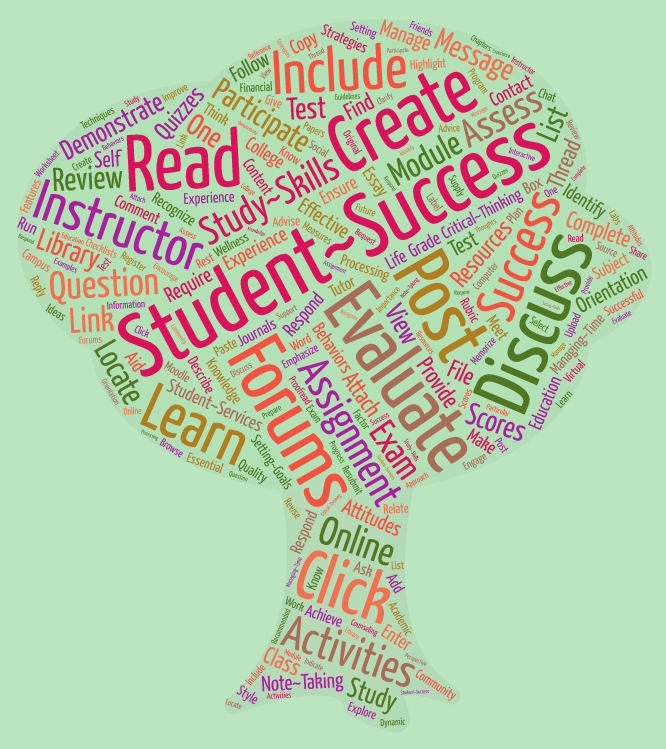
Tagul–This easy-to-use program was new to me, and it is fun!  I can see many uses for it in my classes because I think students will have fun with it too. Tagul allows you to easily produce Word Cloud Art just by uploading web content or adding your own text. Here is one of the first word clouds I created using words from my Study Skills class syllabus.

student-success

I was able to view a short tutorial, and then after a little trial and error, created this word tree that highlights some of the main ideas of the course. Word Cloud exercises could be used for vocabulary-building, learning key concepts and terms, for review purposes and a myriad of other uses. And, like Prezi, it’s free!

Here is a link to the animated version of the word cloud I created:  https://tagul.com/oo05cu2qlre9/student-success

Jing–Although I have used other screencast programs, Jing will be extremely useful for making short how to videos, five minutes or shorter. User friendly with helpful tutorial videos (I should hope so), Jing didn’t take long to get  the hang of and before I knew it, I had created a short tutorial video on how to use Tagul! Here’s a link to the video if you would like to see my first effort at using Jing! Free!

Jing Screencast

LiveBinders–This application helps instructors and students create digital three-ring binders. I haven’t finished working on this project yet, but so far I am quite impressed with LiveBinders. I’m able to download and organize websites, photos, videos, files, etc. that pertain to a particular topic, making them accessible for classroom use. Students can create a free account to create portfolios for class or keep all of their class project files together and easy to share, especially when working on group projects. Very useful.

I will also be learning classroom and online applications of Google Earth this week. Looking forward to it, and I will give you all an update on more useful education applications as I learn them.

I love being a lifelong learner!

Speaking of being a lifelong learner: Just a reminder that my literary e-zine, Teach. Write.,is open for submissions of short fiction, poetry and essays now through July 1, 2017. Anyone who has taught English composition is welcome to submit. See the guidelines  at this link for more information: Teach. Write Submission Guidelines. I would love to see your work!

Teach. Write. Again.

writer-605764_640-2

I have a dream. To publish a literary e-zine that celebrates the writing of composition teachers.

The one thing that has helped me most to become an effective composition teacher, besides twenty-seven years of teaching English composition of course, is writing and pursuing publication of my work. Such a process has certainly kept me humble (I quit counting when my rejections reached over two hundred.) and has never made me rich. However, a couple of years, I did make enough to be taxed. (Of course, that isn’t saying much, is it?)

On the other hand, with over two dozen short stories published in print and online publications, as well as over a hundred theater reviews and features for the local paper, five years as columnist for my college, two or three years as an arts columnist, and now approaching the production of my second full-length play, my writing avocation has also boosted my confidence as a writing  instructor and given me a certain credibility with my students, some of my students.

Above all, being a writer keeps me mindful of what it’s like to write for a critical audience–a critique group member, an editor, an agent, an audience.

3990049531_e1c94fdd9e_bBecause I’m a writer, I am reminded of what it’s like

  • to procrastinate.
  • to spend more time revising and editing than composing
  • to be uninterested, or lose interest, in a project
  • to be obligated to complete said project
  • to have a work criticized or rejected
  • to take that criticism or rejection as a personal attack
  • to be misunderstood

But it’s not all bad. Because I am a writer, I can truthfully inform my students that good writing, while hard, and often thankless, work is

  • a valuable skill
  • a confidence builder
  • actually can be fun
  • and sometimes, every now and then, absolutely glorious!

fun-1012681_640-2

So, the dream is to have this little online publication called Teach. Write. that will allow present and former composition teachers of all types to try their hands at writing out of their comfort zone, to make themselves vulnerable again to constructive criticism and rejection, to boost their confidence and support their colleagues–to write, and in so doing, become better teachers, better people.

The e-zine will be for writing teachers by writing teachers, specifically, but because the style and subject of essays, poetry and short stories will be open for the most part, the magazine should appeal to a general audience.

Although I will consider pieces that are on the subject of writing if they are unusual and compelling, I’m not particularly looking for work that is about writing or being a writing teacher. As I mentioned, this magazine is calling for teachers to move out of their comfort zones, so I would rather they write a literary short story or a flash piece, a sonnet or poem in blank verse, an essay about a night spent in jail–whatever they want to say. These will be the general submissions.

Because I want this e-zine to be useful to writing teachers, I also will have a regular feature called “Writing Your Own.” In this feature I will call for composition teachers to write pieces based on their own writing prompts. For example, the fantasy e-zine, Mirror Dance, published a flash piece called “Waiting for Beowulf” that I had written as an example for a creative writing assignment in my British literature I online class.  It is so helpful for instructors to write with their students–it can also be simply fun, yielding strong writing from students and publishable work from teachers.

I have set December 1 as the deadline for setting up the website. At that time, I will begin accepting essays and short fiction of 2,500 words or less, poetry of 100 lines or less (up to three poems accepted in one document), ten-minute stage and screenplays (ten pages), and pieces for the “Writing Your Own” feature (250-2,500 words).

All teacher-writers should include a short (100 words or less) biographical statement, which includes their present or past position as an English composition teacher. This statement is more important to me than publication credits. Of course, elementary and middle school language arts teachers, high school and college-level English teachers can submit, but if they have taught independently for business and industry or as part of a continuing education program, they are also eligible. If they have tutored in English composition professionally or as a volunteer, they may feel free to submit. They should simply mention composition teaching experience in the bio..

From  December 1 to June 30, I will accept submissions for the inaugural edition, which I hope to publish in the fall. My desire is to begin publishing twice a year, fall and spring, hoping that contributers who are working teachers can write and submit in the summer and winter, then enjoy, along with their students, their published work in the fall and spring.

I believe it is important to pay writers, but I don’t have much money, so I will be offering only a small honorarium here at the beginning of my venture, hoping that in the future I can offer more. I will let writers know the amount in December.

If anyone is interested in submitting  work to Teach. Write., start writing and look for an announcement on Hey, Mrs. Winkler with a link to Teach. Write. 

I have had this dream for a long time, but as it is has been with most of my dreams, they only happen when I find the time to do them and set to work.  The time is now.