Reflections on 9/11: A Teacher’s Experience

Photo by Malcolm Hill on Pexels.com

I was teaching English composition in the old Patton Building at Blue Ridge Community College in Flat Rock, North Carolina, when the first plane hit. I had no idea what was happening, no smart phones or classroom laptops connected to the internet notifying anyone of anything immediately, so I was just teaching an early morning class like any other day. When I dismissed the class, I walked down the steps, out the door, and down the sidewalk to the General Studies Building that no longer exists. (It was demolished on purpose a few years ago to make way for the bigger and better, they said.)

When I opened the door to GS, I almost ran into my boss. Normally easy going and laid back, he was barreling through the door, his eyes wide. We stopped and he told me what he knew, something had smashed into one of the Twin Towers in New York. He informed me that his radio was on in his office if I wanted to know more, then ran off to spread the news, a 21st Century Paul Revere.

Photo by Allan Lee on Pexels.com

I wasn’t truly comprehending his words, but remembering the look on his usually calm face led me directly to his office, my textbooks and student essays still in my arms. As I listened to the radio, the chaos and horror began to emerge as the reporters relayed detailed descriptions of the carnage and of the brave survivors and first responders who immediately came to rescue those they could. Observers had few answers at first, not even knowing exactly what had smashed into the tower. Was it a missle? A plane? How many people were injured? How many had died? Surely, it had been an accident. No one would do such a thing on purpose. Not here in America. My boss came back into his office. We listened in silence. Soon enough we knew the truth of what was happening when the second plane hit the other tower. We must be under attack.

Someone came by the office and said that the Spanish instructor had cable TV in her room, showing live reports from New York. We both went to her room. Every seat was taken and students lined the walls, some sat in the floor. I stood against a back wall, next to a young man, a non-traditional age student. Later I found out he was a veteran. As we watched, horrified, the first tower fell; gasps went up from the crowded room. Teachers and students began to weep. The student next to me said, quietly, calmly, Somebody is going to pay.

After that everything is muddled in my memory, but I know that I stayed in the room with my colleagues and students as reports came in that left no doubt the biggest terrorist attack in our nation’s history was playing out–the pentagon was hit, all aircraft were ordered to land, the second tower collapsed, and Flight 93 crashed in Pennsylvania.

Photo by Garrison Gao on Pexels.com

Widespread panic never set in at our college. Perhaps we were too shocked or simply didnt know what we could do or say. Some instructors canceled classes (I did). Others felt the best thing to do was continue the day as normal. I understand that, too. I might have done the same under other circumstances, but I had a young child. When I overheard that her elementary school had received a bomb threat (turned out to be a rumor), my mother bear instincts kicked in. I drove to the school, found out there was no threat, informed those on duty what had happened, and checked our daughter out from school anyway.

I just felt better having her safe with me.

As facts emerged and rumors flourished in the days, months, and years that followed, I would tell my students the story of what I heard and saw that morning in the very rooms where I taught — how we watched together, teachers and students alike, trying to make sense of the terror unfolding before us. I told them how our fear turned to anger at the harm done to innocent people, and how our sorrow deepened into respect for the men and women who risked or lost their lives to help their neighbors, without hesitation and without regard for differences. I remember how the world reached out to us, how for a time we stood unified in grief, in resolve, and in our shared humanity.

I find myself wishing we could return to that spirit. Lord, let us come together again and do what is right and good. Let our students learn from us what true bravery and courage look like — the courage to stand with one another, to protect what is just, and even when division feels easier, to choose unity instead.

Photo by New Yorker on Pexels.com

I’m Still Here!

Disappointed, unmotivated, a bit depressed, feeling like nothing I do really matters, but I’m still here. I mean, why not? What else am I going to do except write? I still like it. I feel better doing that than just about anything else, when I finally make myself sit down and do it. I do not have to please anybody when I write, as long as I keep it to myself, so why not keep writing? I am retired from teaching, so no papers to grade or meetings to attend, no students begging for just three points to make that C they do not deserve. No workdays packed with meaningless professional development and box-checking evaluations. No developing curriculum for other people to use.

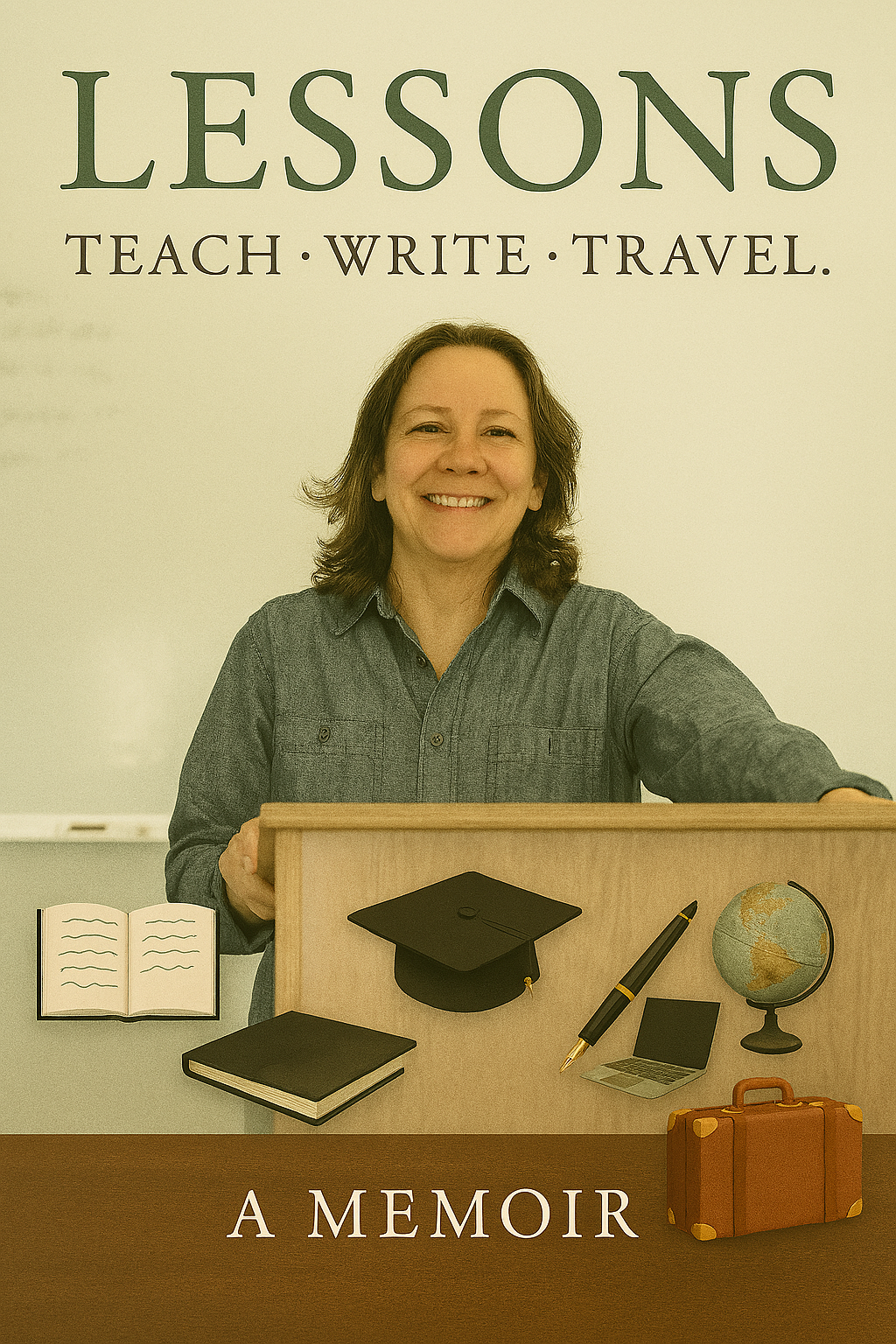
My cover idea that never made it to print

I suppose, too, that I have good reason to be disappointed. I was hoping that I would be starting to market my teaching memoir by now, that I would have published my first book, but it was not to be. My would-be publisher said that I am sure to get another publisher now that the book has been professionally edited. That is what she said in the short e-mail telling me that the company had decided they were pulling back on projects that did not offer the expected return. Sigh!

Such is my life.

It doesn’t really matter anyway. I chose the teaching memoir as my first major writing project upon retirement because my mother had given me the idea, and she was getting older and not in the best of health. I finished writing the memoir that first year and entered a memoir writing contest, submitting the first chapter of the book. I won and found out that one of the prizes, I thought, that came with winning was publication. It took a while, but I was finally assigned a wonderful editor who had always believed in me and my book. We worked well together. On October 31, 2025, she contacted me to let me know that she had finished editing the book. I was able to tell my mother, who had just been released home from rehab after dislocating her artificial knee and breaking her leg. A little good news on one of the roughest days in both of our lives.

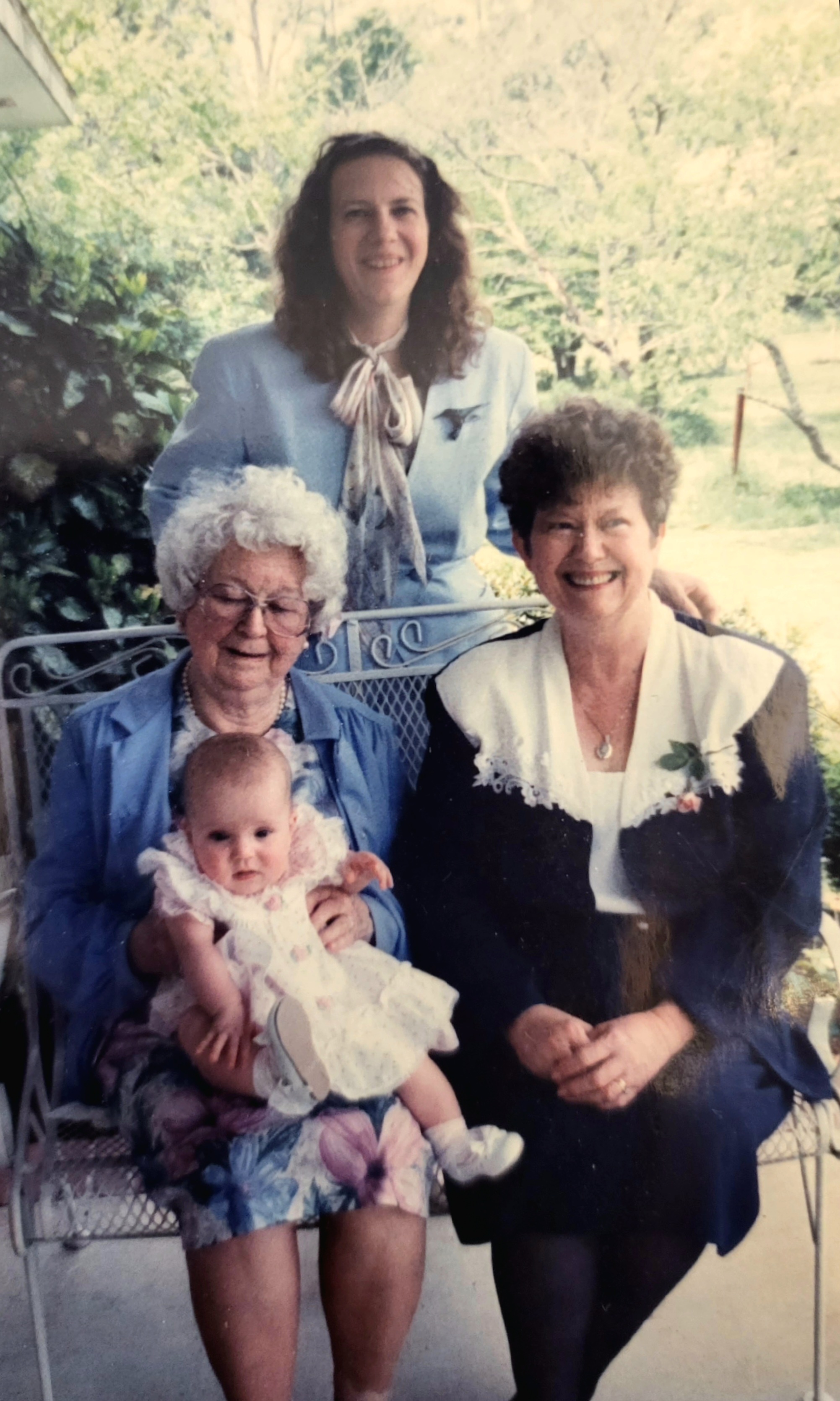
Four generations-me, standing, with my grandmother, Katherine Dabbs, mother, Jeanenne Whitlock, and daughter Hannah Winkler, photo by my late sister, Ronda Dalenberg

Ten days later, Mom died.

But I’m still here.

I have reason to be unmotivated. I will be 66 in a few days, and I sure do feel it as I recuperate from laparoscopic-robotic assisted abdominal surgery last Tuesday. It was outpatient surgery, so it should have been a piece of cake, right? I guess getting surgical mesh inserted robotically into one’s stomach takes some time getting over. Instead of using the time to be writing, I spend my days watching seven seasons of the eerily pertinent West Wing series, binging violent Norwegian mysteries, or falling asleep to the soothing voice of Penelope Keith as she travels through the hidden villages along the coast of England.

I could be spending time looking for a new publisher for my book. It’s ready to go, according to no-longer-my-publisher. It is hard to get motivated to face rejection when I had even been told to come up with some book cover ideas before I was unceremoniously dropped. I tell myself that now I have the opportunity to add back some things the editor wanted deleted. I can add them back and publish the book myself since it is relevant to this blog and my literary journal Teach. Write. Sure, I am better off on my own, I tell myself. Maybe so, but before people were waiting for me, helping me to stay on track. My publisher, my editor, my mom. Who is waiting for the book now?

I guess I’m still here.

I have reason to be a bit depressed, but I know me, and it will pass. My life, like the lives of most ordinary people, is more striving than succeeding, more valleys than victories. In the months since Mom died, and I lost the publisher to my book, I still managed to edit and publish another edition of Teach. Write. – 155 pages of poetry and prose by and for teachers. I also submitted a three-story chapbook, wrote and directed a short play for my church, started research on a new play. Yesterday, I downloaded a submission form from a local small publisher to see if there might be interest in a memoir from a 66-year-old retired English teacher who loved her job despite the crappy parts and by most accounts was pretty good at what she did for over three decades.

If nothing any of us does matters, then what do I have to lose?

Hey, Mrs. Winkler: A History

In 2014, I started this blog as a way to stay sane as I became increasingly alarmed about the state of things at my institution, a small community college south of Asheville, North Carolina. Since 1995, I had taught English composition, developmental English, British literature, and creative writing. During the first decade or so, I had enjoyed blessed autonomy, trusted to develop my own curriculum that followed limited state and institutional guidelines. I liked it that way, and by all indications, I and other English instructors were effective teachers, especially when preparing students to be successful when they transferred to four-year institutions. We collaborated on the required freshman English classes, using the same textbooks and study materials, but we were still considered the experts when it came to our individual classes and pretty much left to create our own curriculum and assessments.

Photo by cottonbro on Pexels.com

However, as online instruction and dual enrollment became more popular, the college administration as well as the state sought more and more standardization because, you know, it’s so much easier to collect data and dollars that way and aren’t those the only things that matter? I guess you can tell how I felt about the changes and my loss of academic freedom.

As that first decade of Hey, Mrs. Winkler moved on, I found myself feeling smaller and smaller as an employee, even though I was growing in my abilities and contributions to the college, including the development of four online literature classes—World Literature II (I believe the first online lit. in the state of North Carolina), British Literature I and II, and American Literature II. I also developed accelerated online classes for the two required freshmen English courses, making it possible for students dependent on financial aid to proceed through their courses more quickly.

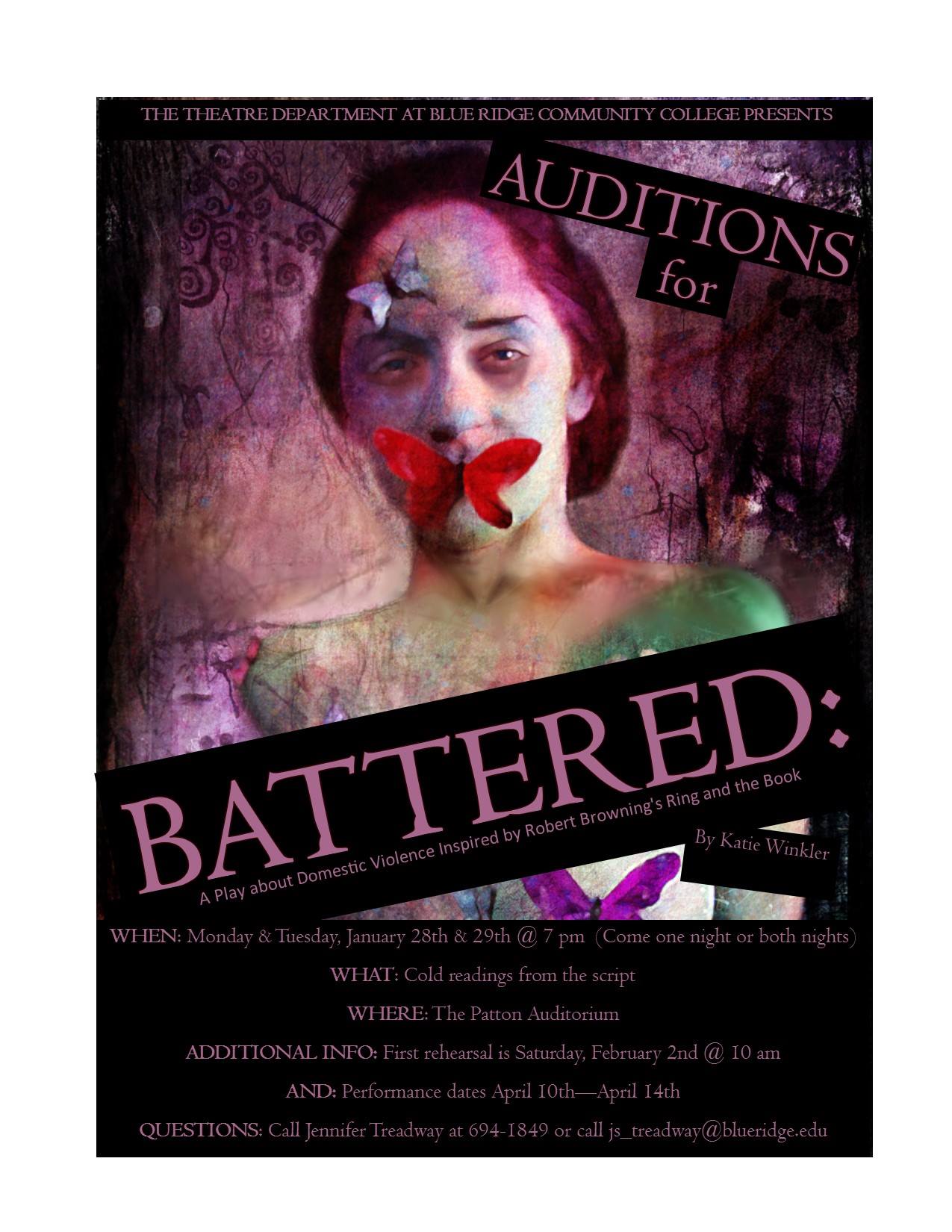
Even before 2014, I had become deeply involved in the theater department at my college as a writer, actor, director, dramaturg, and publicist. I also collaborated on writing screenplays for short films, one that won the 2008 Asheville 48-Hour Film Project Best Film called Serial Love. I wrote four plays that were produced at the college—a one-act comedy called Green Room, the musical A Carolina Story with music by a former student, Curtis McCarley, a faithful stage adaptation of Frankenstein by Mary Shelley, and a play about domestic violence inspired by Robert Browning’s The Ring and the Book called Battered. All four were fantastic teaching experiences as I collaborated with student actors and crew members when writing and revising the scripts.

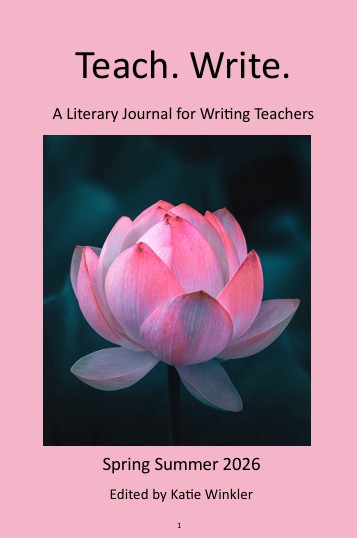
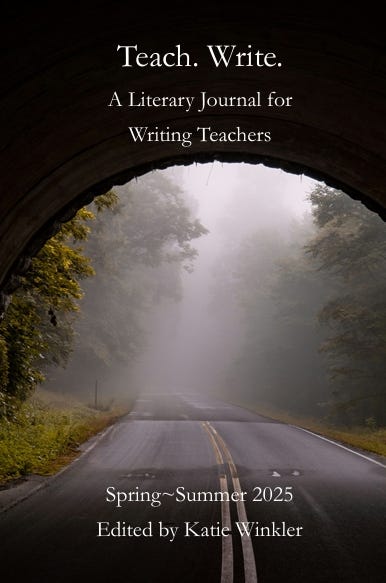
In 2017, I launched a literary journal called Teach. Write.: A Literary Journal for Writing Teachers, which now has its own website teachwritejournal.com and is a member of the Community of Literary Magazines and Presses. The latest edition is dedicated to the people of western North Carolina and those who came to help us following the devastation caused by Hurricane Helene.

So, you see, Hey, Mrs. Winkler was not only a place to rant, but also about the wonderful collaborations and incredible students I had over the years. I love teaching, and writing the blog, then editing the journal, gave me opportunities to express all the bad, good, and seriously screwed up things that were happening. It helped me survive those last years. Finally, however, I had to leave teaching, probably because I loved it too much. I just couldn’t take what was happening to it anymore. When the opportunity arose for me to retire a bit early, I took it, and I haven’t been sorry.

It’s been over a year and a half since I retired, and although I miss my colleagues and my students, I don’t miss the administrative hassles and definitely do not miss grading essays! In some ways, especially as I work on my memoir, Lessons: A Teacher’s Life, to be published this year or early next, I feel that I haven’t left. Also, my time as a Dramatists Guild Foundation Fellow helped me rewrite A Carolina Story, which had its beginnings at the college where I taught the bulk of my career. Next month, the new A Carolina Story will have a workshop reading at Hendersonville Theatre as part of their series New Works Readings: Page to Stage

The Beat Goes On.

The Power of the Expert Interview

I started requiring interview reports with local experts early in my career teaching freshman composition as part of the students’ major research project. I still think it is one of the best ways to help students focus their research. In more recent times, it has thwarted plagiarism and an overdependence on the internet for research. But the biggest reason I always leaned towards a local interview is that it helped students become more enthusiastic about their projects.

Photo by Sora Shimazaki on Pexels.com

I have written about my “process over plagiarism” approach before and included the example of my student from a poor background who became excited about his project after interviewing a florist at the Biltmore Estate, but I have numerous other examples of how students have benefitted greatly from interviewing a local expert.

There’s the time a non-traditional age student and mother wanted to write about breast feeding in public (this seems like a non-issue, but this was over a decade ago, and I live in the Deep South, nuff said). She was a great student and had a good, balanced argument supporting the importance of breast feeding and why women who choose to breast feed in public should not be shamed. For her interview, she contacted the director at the La Leche League in our county. The student was happy to report that not only did she come away from the interview with a more focused topic, she also received valuable print materials to use as sources, made important contacts with experts, and walked out with a job! That’s right, this pre-nursing student was getting help with her research paper as well as gaining invaluable experience.

Photo by RF._.studio on Pexels.com

Another student wanted to focus on forensics (I got a lot of that when CSI was at its peak of popularity), but she was having trouble finding someone to interview. I suggested she reach out to the county coroner, which she did. The coroner turned out to be a woman who was particularly interested in what could be discovered about cause and time of death by looking at skeletal remains. My student met her at her office in the county courthouse where the coroner shared book titles with her and allowed her to take notes and make copies from texts on her shelf. She also showed the student samples of bones, explaining what she could determine from examining them. The student narrowed the focus of her research paper and at the same time found a new interest in a career as a forensic anthropologist.

One of the most interesting stories of the face-to-face interview I had was with a student who wanted to do his research paper on Habitat for Humanity in our county because he was opposed to the organization, thinking the group in our area discriminated in favor of the Hispanic population. My student was a non-Hispanic and of a non-traditional age. His opinion at the beginning of his research was that too much aid was going to Hispanic people to the detriment of the white population. You may be surprised that I allowed the student to write on the topic; however, I warned him that he should not write about it unless he was not willing to change his mind if he found that his assumptions about the project were untrue. He agreed. It was risky but after talking to him, a risk I was willing to take. Sidebar: Being a good teacher involves taking calculated risks. It doesn’t always work, but it did that time.

Photo by Keith on Pexels.com

I can honestly say that in all my years of teaching, I have never seen a person so completely change after one interview. The thing is my student didn’t just interview one person who worked for Habitat for Humanity. Because he was a carpenter, he felt that the best way to find out what was really going on was to volunteer to work on a Habitat for Humanity project house within the Hispanic community of which he was suspicious. When he came to class after his first volunteer experience, he had a big smile on his face and admitted to me with no hesitation that he had been so wrong.

The idea of “sweat equity,” where the person who will receive the house works alongside those who have volunteered their skills, strongly appealed to my student’s work ethic, and he was impressed at how hard the people benefiting from the program worked on the house. After working with and talking to the future homeowners, he was convinced that Habitat for Humanity was an organization that gave a helping hand, not a handout. He became a long time Habitat for Humanity volunteer after that. One interview assignment had changed his attitude, and his life!

Photo by Alex Green on Pexels.com

Of course, not every interview has been a life-changing experience for a student, some were actually complete duds, but students learned from negative experiences as well. They also learned how to prepare appropriate questions, contact someone they didn’t know, meet with that person, record answers, and summarize the interview in a report, then integrate that information into their paper.

Even if students failed to satisfy the requirements of the assignment, I was alerted to the student’s difficulties and often able to avert problems with the researched essay itself. I would often address these issues in the student conferences that I held before the students began working on their rough drafts.

More about student conferences soon.

AI and the Changing Composition Classroom

Photo by Tara Winstead on Pexels.com

Many instructors are fearful about artificial intelligence and what it will do to student writing in freshman composition classes. I understand their concern, especially with the recent announcement about changes in Open AI’s leadership; however, it seems to be clear that AI is here to stay and is quickly changing the school and workplace landscape. Composition instructors, therefore, have a choice. Fight a losing battle or change the way they teach so as to meet the needs of students and their future employers.

If I were still in the classroom, I would seek to use AI in constructive ways. Indeed, AI may prove to be a boon to overloaded, overworked, and overwrought composition teachers, helping them deal with the heavy courseloads they are given. The answer, as indeed in most things, is engagement. Have a curious and playful attitude when using AI in the classroom, discussing the ethical implications along the way.

One assignment I thought might be useful is to introduce a common topic that students in general might find relevant to their lives. Work together as a class to come up with one or two paragraphs produced by Chat GPT. Then, discuss the positive and negative aspects of the paragraphs. Also, teachers might want to pursue a discussion of the ethical considerations of students using AI. When would it be appropriate to use it? When would it be harmful? Why would it be counterproductive to submit a purely AI-written essay in any college classroom?

Photo by Airam Dato-on on Pexels.com

I asked Chat GPT to come up with a couple of paragraphs on the topic of pros and cons of mandatory classroom attendance for college students. At first Chat GPT just gave me lists of pros and cons, which seems to be its favorite style of writing, so I asked it to write the pros and cons in paragraph form. Here’s what it gave me:

College Classroom Attendance: Striking a Balance

The debate over mandatory attendance in college classrooms revolves around finding a delicate equilibrium between engagement and autonomy. On the positive side, compelling students to attend classes can create an environment conducive to active learning. In-class discussions, real-time feedback from professors, and collaborative projects thrive when students are consistently present. The communal aspect of the classroom, where ideas are shared and debated, contributes to a rich educational experience. Furthermore, mandatory attendance fosters a sense of responsibility and discipline, essential skills that students carry into their professional lives. The structure imposed by attendance policies can guide students in time management and the establishment of a routine, skills that are beneficial beyond the college environment.

However, the cons of mandatory attendance are not to be overlooked. College is a time for individuals to explore their independence and learning styles. For some, this involves engaging with course material independently, through readings, research, and self-directed study. A rigid attendance policy may stifle this autonomy, impeding students from developing the self-discipline needed for lifelong learning. Additionally, external obligations such as work commitments or family responsibilities may clash with a strict attendance policy, putting undue stress on students. In such cases, the emphasis on attendance becomes a hindrance rather than a facilitator of learning. Moreover, there’s a risk that attendance policies incentivize mere compliance rather than genuine intellectual curiosity. Students might attend classes to fulfill a requirement, but the focus on attendance metrics does not guarantee a meaningful engagement with the subject matter. Striking the right balance between encouraging attendance and respecting individual learning styles and circumstances is a nuanced challenge for educators.

Photo by Yan Krukau on Pexels.com

I would hope some of the following points would come up in our discussion:

  • Paragraphs are well-written with few writing errors.
  • A strong thesis statement begins each paragraph.
  • The paragraphs are well-organized and uses effective transitions.
  • The paragraph is logical and makes good arguments for and against mandatory classroom attendance.
  • One issue is the phrase “there’s.” I teach my students to avoid contractions and the use of the expletive “there is.”
  • The diction in general is too formal and sounds rather pretentious for a college-level paper. Really need to get rid of “incentivize” in the second paragraph. Yuck!
  • The paragraphs need to be fleshed out with specific examples and details, preferably from the writer’s own experience, some things that show the pros and cons more clearly and make the paragraphs more interesting to read. With good examples, these two paragraphs could be the basis for an entire essay.
  • Use this opportunity to talk with students about the importance of developing their own unique voice.

Another great thing to do would be to see if any students disagree with Chat GPT. What do students think about the logic presented in these paragraphs? Encourage students to “argue” with Chat GPT or “defend” it. Maybe have a classroom debate about mandatory classroom attendance. What ideas did the classroom come up with that Chat GPT didn’t include?

Photo by Markus Winkler on Pexels.com

Another idea is to help students brainstorm ideas about topics that they are interested in, a process that is not always easy, I found. But asking relevant questions like how to pay for college without going into debt or managing mental health without medication might spark a student’s interest and inspire them to THINK FOR THEMSELVES.

How about even being brave and venturing into controversial topics, like the difference between banning and challenging books in public schools, transgender rights, universal health care, and Black history studies. Yes, I know, it can be scary, and administrators may not thank you, but remember that college is meant for adult learners, many of whom are already wrestling in the real world with all of these topics. Furthermore, using AI may help remove some of the fallacious reasoning some students use when writing about sensitive topics. In fact, try using Chat GPT to start a discussion about fallacies of logic.

The main idea is to get them to realize that all good writing needs their real-life experiences and their own critical thinking to add interest, for the reader, sure, but especially for themselves because writing that the writer doesn’t care about will be dry as toast and not worth anyone’s time. Give students confidence in their own ideas through lively, mediated debate, and then ask them to write, by hand, if possible, right there in front of you.

Photo by William Fortunato on Pexels.com

The old-fashioned way.

Comma Lessons

An excerpt from the rough draft of my upcoming book, Lessons: A Teacher’s Life:

Long story ahead, but it will relate to commas, eventually, I promise.

Photo by Smntha.Mntsr on Pexels.com

I know how incredibly blessed I am by having my education provided for me. When I went to a private, Christian university for undergraduate degrees in English and German, I went tuition free because both my parents worked for the university. My mother was a librarian, first in acquisitions and then in special collections, and my father, after he received his master’s in theology, became a representative, which basically meant that he was an itinerant preacher–moving around the southeastern states and visiting people who supported the ministry that supported the university. One of the benefits of working at the university for at least two years was free tuition for your children.

 My parents didn’t make that much money, so this benefit made it possibly for my older brother and me to go to college. For the first part of my time there, I lived at home with my parents, but when they moved back to Alabama to be closer to their own aging parents, I lived in the dormitory. My grandmother and great aunt paid for my room and board. I carried two jobs and paid for the upkeep on my vehicle, gas, and books, so I got off easy. 

Photo by Pixabay on Pexels.com

Then, when I went to Auburn University two years later, it was my grandmother and great aunt who paid my tuition. They had both been long time educators themselves who had risen from poverty because of their teaching degrees and knew better than most the value of an education; they helped all their grandchildren, nieces, and nephews at one time or other.  At Auburn, I once again lived with my parents, paid for my books by working horrible jobs (more about this later) and never had to take out a loan or apply for scholarships. 

My master’s in education at Western Carolina came quite a bit later, but once again, I was blessed. I had been applying for teaching jobs as soon as my husband John and I decided to move to North Carolina, and although I had already become certified to teach 8-12 grade English and German, I couldn’t get a job, even after John started working as an ultrasound technologist at a small hospital south of Asheville. I had several interviews in several counties but no go. 

On a whim, I decided to apply for graduate school at Western Carolina University in Sylva, about 60 miles from our home south of Asheville. I was accepted but didn’t think I would be able to go since we were newly married, newly moved–my husband with a new job fresh out of ultrasound school, and me without a job at all. I wouldn’t be able to afford the out-of-state tuition. We were hoping to buy a house soon on top of all of that. I had signed up to do some substitute teaching, $50 a day, and rarely worth it. You know how kids teach substitutes. 

Photo by Element5 Digital on Pexels.com

But, probably less than a week after I got my acceptance letter, I received another letter from the English department asking if I would come in for an interview. I guess my five years of high school teaching experience and the emergency need for freshman composition instructors made me a good candidate for receiving a graduate assistantship. My out-of-state tuition fees would be waived; my stipend was enough to pay my tuition, books, and the gas it would take to drive from Hendersonville to Cullowhee. 

It was settled. I was going to graduate school. 

Finally, we get to the commas. Well almost. 

The first semester I was required to take a course called “Teaching Rhetoric and Composition”–a down and dirty English composition teaching course. Despite my having taught for five years and having had several teaching courses at Auburn while I worked on my English Education degree, I had to take the course. All graduate assistants were required to take it, and although a bit miffed at first, I soon found the course useful and learned quite a bit.

One of the things I learned, I’ve written about at length in this blog–The Five Easy Ways to Improve Your Writing. Those ideas came from a visiting lecturer in the rhetoric course.

Photo by Polina Tankilevitch on Pexels.com

The other part of that first semester was working in the university’s writing center. My job was to tutor students as they came in to work on their essays. I stayed very busy in the center, especially because of Western’s CC program. I forget what CC stands for, but essays in any non-English class that did not meet basic college-level writing requirements received a CC. If students received two CC’s, they had to take a developmental English course that was notoriously hard to pass, and if the student did not pass, then they were suspended. Quite a few students, therefore, would come in to the Writing Center after the first CC to avoid that grammar class. 

The woman who ran the center was one of the best teachers I ever had. She taught by example. I would listen as she tutored students, helpful and patient but never overhelping, even when sorely tempted. Plus, she had all sorts of materials available to help students and gave me permission to take and use any materials as long as I credited the center. One of the most used handouts at the center was the director’s six simple comma rules. I used this handout as the base of my comma lecture for years because the rules were easy to understand, using little grammatical terminology, and the examples illustrated each rule well. 

Photo by Ivan Samkov on Pexels.com

I’m afraid that handout is only in my mind now, but I used some form of those basic rules throughout my tenure as a community college instructor. It was just always the easiest for my students to grasp in the triage-type grammar teaching that I found myself doing. I added the comma rules to my editing workshop worksheet that I gave to my students when they were preparing their final manuscripts for grading. Here’s what they boiled down to:

Use commas

  1. to separate items in a series of three or more
  2. to set off introductory material
  3. around words interrupting the flow of thought
  4. between complete thoughts joined with a conjunction (if two complete thoughts are joined with just a comma, the writer has a comma splice—major grammar error)
  5. with direct quotations
  6. with everyday material such as dates and addresses

Although I tried to keep grammatical terminology to a minimum, I did use some, so at the beginning of the lesson, I would remind students of some basic terms: 

  • Noun
  • Subject 
  • Verb
  • Coordinating conjunctions (FANBOYS)
  • Independent clause 
  • Dependent clause. 

After the review, I went through each of the six comma rules, giving examples of each. If time was short, I would just cover the first four. 

As a warmup to the lesson, I would try to engage students by using another cool example I learned in grad school.  At the beginning of class, without saying anything else, I would write the following sentence on the board: 

A woman without her man is nothing. 

I asked the students to write the sentence down and add two commas. I gave a minute to complete that and then would ask for volunteers. Often, here in the South at a small community college where sexism is alive and well, students, both male and female, would answer, “A woman, comma, without her man, comma, is nothing.” 

Of course, I would challenge them, tell them there was another solution: A woman, comma, without her, comma, man is nothing. One comma, one comma, I would say, totally changes the meaning of the sentence. That’s how important commas are, I said. 

Then I would begin. 

Rule #1 –Items in a series–First because it was usually the comma rule that students were most familiar with. 

I like apples, bananas, and oranges. 

I explained that if you have three or more items in a series, then you need to add commas between the items. 

I use the Oxford comma and only talked about the option of leaving that remaining comma out if a student brought it up. Commas are confusing enough to students, especially those in developmental classes, so I tried not to complicate things unnecessarily. 

Rule #2–Two independent clauses joined with a coordinating conjunction. I would give an example: 

The dog ran after the cat, but the cat held its ground and fought back. 

It is good to include a compound sentence that needs a comma and another coordinating conjunction that does not need to be separated from the rest of the sentence so that you can explain the difference. 

I explained that you have two independent clauses, reminding them that the only seven words that can join two complete sentences together are the FANBOYS, the coordinating conjunctions: for, and, nor, but, or, yet, so. In the case of this example, you have two complete sentences (independent clauses) joined with but, one of the fanboys, so you need the comma, I would tell them. 

I asked students if they see another conjunction. They would usually find the and. I asked, Why do we not use a comma here? Often times they didn’t answer, so I would ask if there were a complete sentence on either side of the conjunction. No. Then, there is no need for a comma. 

Rule #3–Commas after introductory material. I would explain that you need a comma after words, phrases, and clauses that come before the main clause and give examples:

  • Nevertheless, I left the room and never returned–nevertheless is a conjunctive adverb that modifies the whole sentence, so it needs to be set off by a comma.
  • In the middle of the night, Julia heard a loud bang. In the middle of the night are two prepositional phrases coming before the main clause, so you need a comma to notify the reader that the two phrases are coming before the main clause. 
  • As John was reading the book, he realized that he had read it before. As John was reading the book is a dependent clause–he realized that he had read it before is the main clause, so you need a comma after the dependent clause. 

Rule #4–Anything that interrupts the flow of thought. The next rule is super simplified, but usually this explanation helped students get the commas right without getting bogged down in too much grammar, especially restrictive and non-restrictive clauses. Oh, Lord, don’t go there. I explained that you need commas (most of the time) around words, phrases and clauses that interrupt the flow of thought in the sentence. Alternatively, I said that if you can pull the word, phrase, or clause out of the sentence and the sentence still makes sense, then you need commas around that word phrase or clause. Then, once again, I gave examples:

  • The new owners, sadly, declined to renew the flood insurance on their house.
  • The cat, along with its four siblings, were left in a box on the side of the road.
  • The man, who is standing over there in a red shirt, is my partner. 

Note: This lesson is most effective if spread over two class periods, so there is enough time to answer questions, show more examples, or put students into groups to practice. One exercise I liked to do with students is have them write sentences that use the different comma rules but leave the commas out, exchange papers, and correct each other’s sentences.

I guess, I’m weird, but I really loved comma lesson day. It was pure unadulterated, nobody-could-accuse me-of-indoctrination day, except for that “woman without her man” sentence, of course. Might be too engaging for today’s classroom.

Another reason I’m glad to be retired.

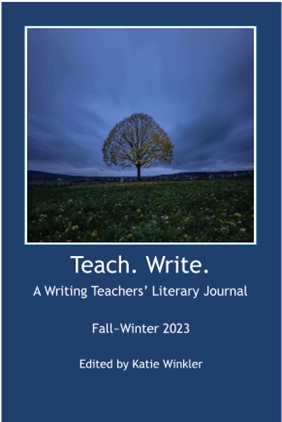
New edition of Teach. Write. out tomorrow

Since the fall of 2017, I have edited and published a literary journal designed specifically for composition teachers. Although I am open for submissions that follow the guidelines from anyone, anywhere, my emphasis has always been on writing that explores the art of teaching. I love to have the opportunity to build up teacher/writers like me, who have had limited time to write and market their own work because they are so busy helping their students learn how to write.

The 2023 fall~winter edition of Teach. Write. comes out tomorrow, continuing the tradition of showcasing the work of teachers and the art of teaching, along with other work that I hope simply inspires all to enjoy well-crafted and timely stories and poems. This edition, however, now that I have more time to work on improving the journal, has resulted in some changes:

  • Membership in the Community of Literary Magazines and Presses. See the journal’s page at clmp.org
  • New website–teachwritejournal.com–where you will be able to access the new edition tomorrow, October 1.
  • Largest edition ever, representing almost 50 regular and new contributors from around the country and the world.
  • More editing time has, I hope, resulted in a more polished and professional edition.
Photo by Susanne Jutzeler, suju-foto on Pexels.com

When I first started Teach. Write., the journal was primarily an escape from the pressures of teaching composition and literature at a small community college in an increasingly contentious bureaucratic environment where I was experiencing the slow erosion of the autonomy I had at first enjoyed. I’m not escaping anymore. I’m fighting.

Teach. Write. is my Sting.

It’s only a rusty dagger gripped by a little old warrior, but she is inspired and empowered by those, represented in her journal, who love words and stories, rhyme and rhythm, form and style. She is dedicated to those who care about sharing that love with others, especially students, in a world that is strangely hostile to their profession at times but one that needs those who practice the art of teaching more than ever.

Teaching, Writing, and Relationships

Photo by Mikhail Nilov on Pexels.com

I am writing a book about teaching. It’s non-fiction, but other than that, I’m not sure how to describe it. It’s part memoir and part teaching methods to begin with. In many ways, it is also like my blog–musings and mutterings about my life’s work.

I don’t mind telling you, I’m struggling. It’s not writer’s block. Oh, no. I’m not sure I believe in writer’s block anymore anyway. The only way I’ve ever written anything of any length is to write six days out of seven. The biggest excuse for not turning in work I heard over my years of teaching was some form of “I’ve got writer’s block, Mrs. Winkler.” It’s hogwash, I would tell them. Well, no, I wouldn’t say it that way. After 40 years of teaching, one learns how to spin. I would dress it up with the appropriate metaphor, analogy, etc., but in the end my student was more than likely procrastinating and not even trying to write.

Photo by Yan Krukau on Pexels.com

You can’t write anything, if you don’t write something. Hmmm, that’s pretty good. I wonder if I ever used that one in class.

So, again, no. It’s not writer’s block. The first day of my official retirement, August 1, I set a daily average quota for the book in order to finish a rough, rough draft by the end of the year. I’m well ahead of schedule in that regard; I haven’t had trouble writing pages and pages and pages. Because I’m not plotting (I’m a terrible plotter), the words, stories, feelings, and ragings about my life in teaching just pour out.

Photo by Mikhail Nilov on Pexels.com

Frankly, my struggle is having a point. But, no, it’s not that either–I have so many points, so many things I want to say about teaching, that the book is just a hodge podge of memories interspersed with my concerns (aka fears) about what is happening in education, especially higher education in America, especially here in North Carolina.

Sometimes, I think I’m writing two books, but if I want to keep the memoir part intact, the part that reflects who I was as a teacher, how I changed, and why teaching was more than a career, if I want to do that, then maybe this mishmash of a book is exactly what I want to write.

However, I still feel that the book needs to have a central theme, something on which to hang all the dangly pieces, and entice the reader to hear what I have to say. Also, even though it faces the truth about the educational perils of our time, I want the book to be, overall, positive in its outlook as it promotes the intrinsic value of education.

I think I’ve got it now–at least the germ of an idea.

Relationships.

Photo by Kampus Production on Pexels.com

Education begins and ends with relationships–between student and teacher, yes, but it doesn’t end there–also between student and family, family and teacher, teacher and other teachers, teachers and administrators, administrators and staff, staff and students, staff and teachers, and civic leaders, business owners, the community at large, and, okay, you get it. Success in education depends on the health of all these relationships. I think my book already reflects that, but I want to strengthen that theme in revision.

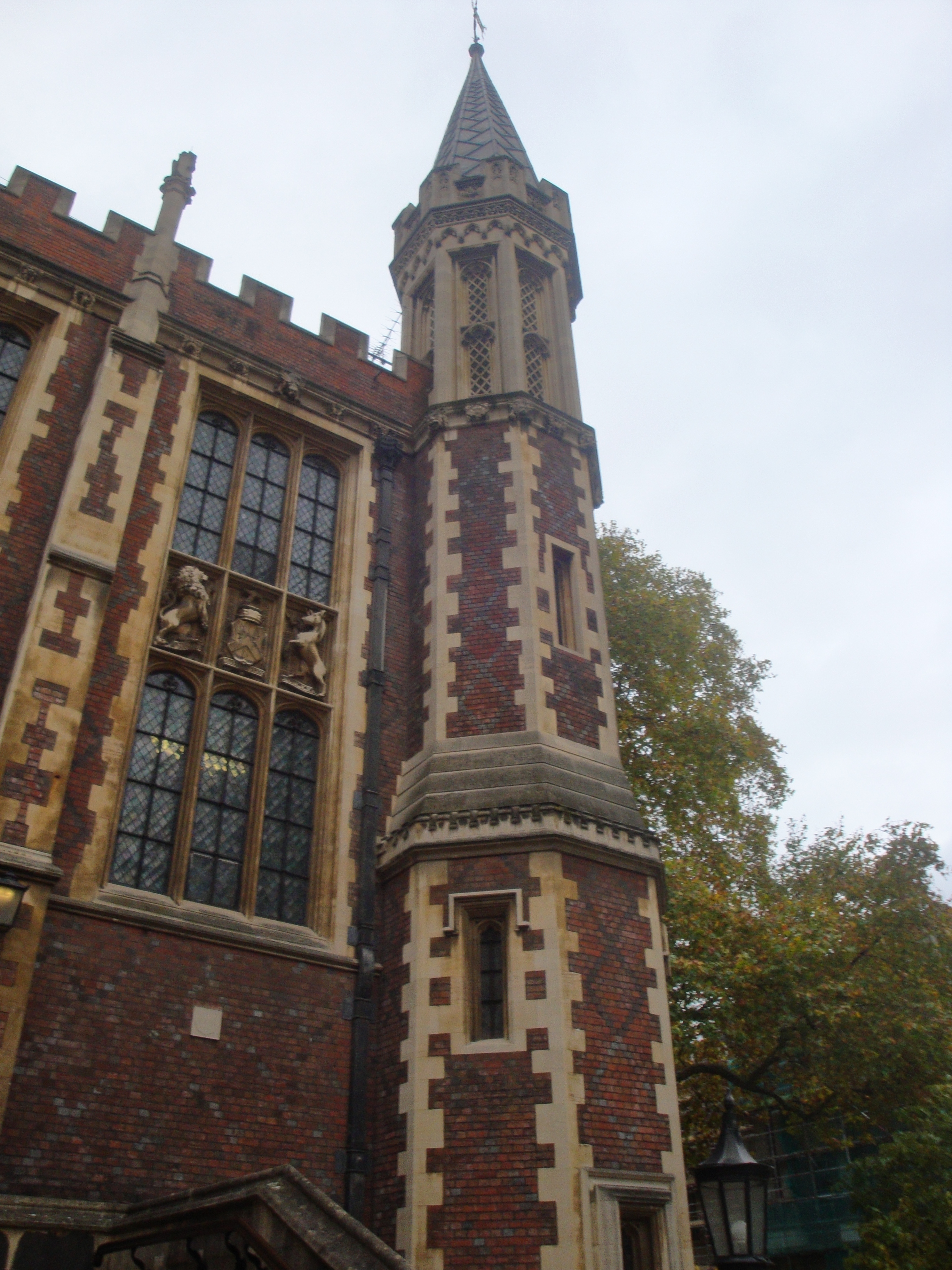
One of the spires of Lincoln’s Inn, London, October 2015 photo by Katie Winkler

So far, my book not only reflects some of these personal relationships, but also the relationships between events of my life and teaching. A large chapter in the book, for example, is showing how my travels in America and Europe reflected themselves in my teaching. I also want to talk about the relationship between socio/cultural shifts and the classroom, how I had to adapt my lessons to new trends (after I got over being furious about them).

I’m not sure. I’m still struggling, but I’m not blocked. I’m not discouraged. I am practicing what I preached all of those years: “Just get started. Vomit.” Yes, I said vomit–always got their attention. “Vomit it all out on the paper and then start cleaning up through revision and editing.” That’s where the heart of good writing lies.

More about that later.

Other than writing the book, I have also been putting together the fall/winter 2023 edition of Teach. Write.: A Writing Teachers’ Literary Journal, which will publish Oct. 1. As I mentioned in my last post, the journal has its own website now! The spring/summer edition is there as well as submission guidelines and some other information. Why not take a look? Just go to teachwritejournal.com.

Retiring?

Mrs. Winkler photo by Scott Treadway at Treadshots.com

So, it’s true. Retirement after almost 40 years of teaching English composition is, number 1, freaking awesome! Not having the constant class planning and paper grading has been true freedom for me. I guess I didn’t realize what a huge chunk of my life was wrapped up in doing those two things. Even in the summer when I wasn’t teaching, I was still spending on average a couple of hours each day tweaking old assignments, writing new ones, and updating online material (necessary but oh so tedious), among other college-related things I would just as soon forget.

The second true thing is that I have planned way too much for the first few months. So many people told me that I would be busier than ever when I retired, but I didn’t believe it could be true.

It is.

Here are a few of things I’m working on:

  • A teaching memoir–this is highest on my list because my 87-year-old mother suggested it, and I love the idea. I am ahead of schedule, even though I’m not writing at least six days a week as I promised myself I would. That said, when I do write, the words just flow out, and I’m averaging over my quota per day.
  • Writing blogposts more often. My goal is to write a post, on average, once a week. I am quickly learning that I won’t be able to write on the same day every week. My schedule is too unpredictable, but if I write four posts a month, I’m going to feel pretty darn good about myself.
  • Applying for membership in the Community of Literary Magazines and Presses (CLMP). I told myself that once I retire, I want to improve the quality of my literary magazine Teach. Write.: A Writing Teachers’ Literary Journal. Then, I discovered CLMP, and I knew becoming a part of this organization would help me reach my goal.
  • The first step in being approved for membership in CLMP is developing an independent website for Teach. Write. I have already launched the new site, but there isn’t much content yet, so I am taking some time several days a week to work on that project.
  • Launching the next edition of Teach. Write. on October 1. Still on schedule to launch the new edition on the new site!!
  • Writing and submitting new short fiction. I’ve written and submitted one new story for a contest already and submitted one other story that I love but still hasn’t found a home. I think it is important to keep submitting my shorter works while I’m working on this long non-fiction project.
  • Thinking about my next play project–just thinking about it. I have two plays in mind–one is an adaptation and the other is original. At this point, I’m just re-reading the novel I’m thinking of adapting and doing some minor research on the original play idea.

These are only my writing and teaching-related activities. Despite all I’m doing as a writer/teacher, I don’t feel as stressed because I know I don’t have to do them. Also, because those two huge responsibilities–planning classes and grading papers–are no longer looming, I have time to do all the things I’ve been able to barely do and do them better. At least, I’m trying to do them better.

Yes, retirement suits Mrs. Winkler very well.

Photo by Nathan Martins on Pexels.com

Back to School?

For the first time in 27 years, I did not go back to work today. July 28, I said goodbye to the community college where I developed curriculum for and taught, at one time or another, English composition, developmental reading and writing, creative writing, and business English as well as American and British literature. Some of my other duties over the years included advising and registering students each semester, regularly writing the weekly BRCC column that appeared in the local paper, serving as the faculty council chair for two years, writing plays, screenplays, and press releases as well as frequently appearing in productions for the college’s drama department. Those last few things were less responsibilities and more for the sheer joy of it.

I was also interested in online learning and one of the first instructors to teach online. Unlike many of my colleagues, I enjoyed engaging in new educational technology and preferred teaching some classes online. For about a ten year period, I frequently attended state and national conferences to share what I was learning about using technology more effectively in English classes.

Another thing that I did all those years was ask questions. I asked a lot of questions that were rarely answered, not to my satisfaction anyway, and led to me getting a reputation as a “trouble maker.” But honestly folks, I just asked questions. Honest questions.

Truth be told, since I’m still trying to be honest, although I felt many administrators’ displeasure, no one every really tried to overtly interfere with what I did in the classroom. I’m not sure why that is, except maybe I earned my high school nickname, Bulldog, for a reason. Hey, maybe I was just a really good teacher. I like to think I was. No, the pressure on me was much more subtle—patronizing condescension, gradual marginalization, simple avoidance.

Oh, well.

For the bulk of my career, I loved my work despite the occasional bureaucratic and administrative headaches because I felt like I was a vital part of the college, that I mattered more than a body to cover the classes that needed to be covered, record grades, or register students so the college could reach new statistical highs and claim bragging rights. Towards the end, and one reason I retired early, I just didn’t think I mattered anymore. Worse, I couldn’t continue to watch the people in power care less and less about my students beyond the data their presence produces.

So today, I begin again and go back to a different kind of school, one with a curriculum of my own design, that will guide these early years of my “refirement” (see my last blogpost) because I still have much to learn and many questions…so many questions.

Come back next week and see what questions Mrs. Winkler is asking now!