Teach. Write. Again.

writer-605764_640-2

I have a dream. To publish a literary e-zine that celebrates the writing of composition teachers.

The one thing that has helped me most to become an effective composition teacher, besides twenty-seven years of teaching English composition of course, is writing and pursuing publication of my work. Such a process has certainly kept me humble (I quit counting when my rejections reached over two hundred.) and has never made me rich. However, a couple of years, I did make enough to be taxed. (Of course, that isn’t saying much, is it?)

On the other hand, with over two dozen short stories published in print and online publications, as well as over a hundred theater reviews and features for the local paper, five years as columnist for my college, two or three years as an arts columnist, and now approaching the production of my second full-length play, my writing avocation has also boosted my confidence as a writing  instructor and given me a certain credibility with my students, some of my students.

Above all, being a writer keeps me mindful of what it’s like to write for a critical audience–a critique group member, an editor, an agent, an audience.

3990049531_e1c94fdd9e_bBecause I’m a writer, I am reminded of what it’s like
  • to procrastinate.
  • to spend more time revising and editing than composing
  • to be uninterested, or lose interest, in a project
  • to be obligated to complete said project
  • to have a work criticized or rejected
  • to take that criticism or rejection as a personal attack
  • to be misunderstood

But it’s not all bad. Because I am a writer, I can truthfully inform my students that good writing, while hard, and often thankless, work is

  • a valuable skill
  • a confidence builder
  • actually can be fun
  • and sometimes, every now and then, absolutely glorious!

fun-1012681_640-2

So, the dream is to have this little online publication called Teach. Write. that will allow present and former composition teachers of all types to try their hands at writing out of their comfort zone, to make themselves vulnerable again to constructive criticism and rejection, to boost their confidence and support their colleagues–to write, and in so doing, become better teachers, better people.

The e-zine will be for writing teachers by writing teachers, specifically, but because the style and subject of essays, poetry and short stories will be open for the most part, the magazine should appeal to a general audience.

Although I will consider pieces that are on the subject of writing if they are unusual and compelling, I’m not particularly looking for work that is about writing or being a writing teacher. As I mentioned, this magazine is calling for teachers to move out of their comfort zones, so I would rather they write a literary short story or a flash piece, a sonnet or poem in blank verse, an essay about a night spent in jail–whatever they want to say. These will be the general submissions.

Because I want this e-zine to be useful to writing teachers, I also will have a regular feature called “Writing Your Own.” In this feature I will call for composition teachers to write pieces based on their own writing prompts. For example, the fantasy e-zine, Mirror Dance, published a flash piece called “Waiting for Beowulf” that I had written as an example for a creative writing assignment in my British literature I online class.  It is so helpful for instructors to write with their students–it can also be simply fun, yielding strong writing from students and publishable work from teachers.

I have set December 1 as the deadline for setting up the website. At that time, I will begin accepting essays and short fiction of 2,500 words or less, poetry of 100 lines or less (up to three poems accepted in one document), ten-minute stage and screenplays (ten pages), and pieces for the “Writing Your Own” feature (250-2,500 words).

All teacher-writers should include a short (100 words or less) biographical statement, which includes their present or past position as an English composition teacher. This statement is more important to me than publication credits. Of course, elementary and middle school language arts teachers, high school and college-level English teachers can submit, but if they have taught independently for business and industry or as part of a continuing education program, they are also eligible. If they have tutored in English composition professionally or as a volunteer, they may feel free to submit. They should simply mention composition teaching experience in the bio..

From  December 1 to June 30, I will accept submissions for the inaugural edition, which I hope to publish in the fall. My desire is to begin publishing twice a year, fall and spring, hoping that contributers who are working teachers can write and submit in the summer and winter, then enjoy, along with their students, their published work in the fall and spring.

I believe it is important to pay writers, but I don’t have much money, so I will be offering only a small honorarium here at the beginning of my venture, hoping that in the future I can offer more. I will let writers know the amount in December.

If anyone is interested in submitting  work to Teach. Write., start writing and look for an announcement on Hey, Mrs. Winkler with a link to Teach. Write. 

I have had this dream for a long time, but as it is has been with most of my dreams, they only happen when I find the time to do them and set to work.  The time is now.


Good News!

Super busy with, well, teaching and writing, but had to stop to post this because it is GOOD NEWS FOR LIBERAL ARTS!!! Rare indeed. And not just liberal arts but for English majors!

Woot!

Here’s one of my favorite quotes from the article: “‘College shouldn’t prepare you for your first job, but for the rest of your life,” says John Kroger, president of Reed College in Oregon, the liberal-arts school that famously served as a starting point for Steve Jobs.”

Good News, Liberal Arts Majors!

I’ll be back soon with information about my Teach. Write. literary e-zine project. (I know I keep saying that, but I mean it this time!)

Teach. Write.

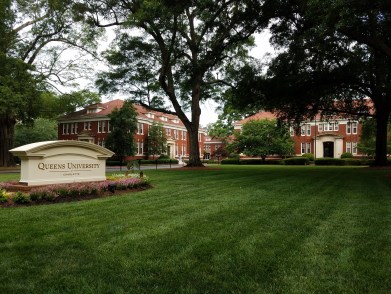
Queens Univ_CharlotteA couple of weeks ago, I attended a wonderful four-day writing workshop at Queens University in Charlotte, sponsored by the North Carolina Writers Network (NCWN), of which I am a member. I came away humbled but also encouraged, with new confidence in my work and with my writing spirit renewed. This long weekend convinced me that teachers of writing need to not only practice their own writing, but also put it out there! Go to workshops and critique groups, present at readings and literary open mic events. Teachers who write and open that writing up to criticism can come back into the classroom with a renewed sense of what it’s like to be a student. At least, that’s what happened to me.

Dinner at Fenwicks

Shrimp and Grits at Fenwick’s

The workshop began on Thursday afternoon. I arrived and was the first one to sign up for the open mic night. After I got settled, I had time to explore that area of Charlotte,  with many stately old homes and the impressive Queens University campus. Then, I found a nice little restaurant called Fenwick’s and had some scrumptious shrimp and grits with a nice chardonnay to start things off right. That evening Ed Southern, director of NCWN led us in a fun exercise to help us get to know one another followed by  a fascinating presentation on The Wall Poems of Charlotte, a grass roots public art project, which highlights the work of North Carolina poets. I think our college should consider a similar public art project at our college or in our town. Perhaps I will propose it.

One of the best things about the trip was that I was able to remember what it is like to be a student again–always good for a teacher to experience, especially if she’s been at it as long as I have.

At my age, I never thought to again be sharing the bathroom and showers in the dorm, seeking  out a friend in the dining hall at lunch or walking with some fellow students down to one of the local hangouts, but that’s what I did! The closeness and camaraderie I developed with the eight other fiction writers in the workshop as well as the other writers in the poetry and non-fiction workshops, helped take away the initial uncomfortable feelings I had at moving out of my middle-aged comfort zone and made it easier to accept the constructive criticism offered by the instructor and my fellow students.

Our marvelous instructor Sarah Creech, who teaches at Queens University, also helped us feel more comfortable by  doing some simple exercises that encouraged us to get to know one another better, but it wasn’t long before we were seriously critiquing the work that we had shared with each other in the weeks before the workshop began.

For some ungodly reason, I signed up to be the first person (again) to be critiqued, but Sarah facilitated the group with such finesse and my fellow writers were so kind and supportive, that it wasn’t hard to accept the criticism. In fact, I found it affirming and encouraging because most of the areas that needed improvement were areas that I myself targeted for revision. It sure didn’t hurt to hear the positive comments either.

In front of Chapel

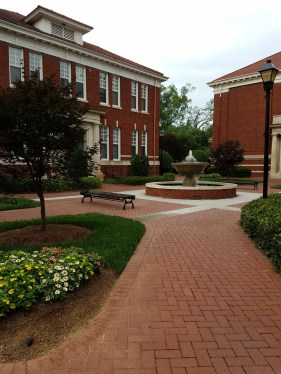
It was pretty hot, but in the morning and evening, I enjoyed walking around the beautiful campus or writing in one of the common areas.

We repeated the process of critiquing, beginning with what is working and what could use revision, for the other eight attendees. What I found especially interesting was the better I got to know the other people in my group, the more I wanted to offer truly helpful words of advice and not just give some throw away comments. I also found myself going back and re-reading their work, so I could give more in depth comments. In addition, my confidence grew in my own work. Here were other serious writers, good writers, but my work was on a par with theirs.

After the first day of critiquing each others’ work, Sarah concentrated on lecture and exercises to help bolster the class’s weaker areas that had been revealed from the critiques the day before. We emphasized character development and motivation, sensory details and setting, among other issues. The lectures were always targeted and blessedly short, followed by periods of writing. That evening we enjoyed our literary open mic event, which was a wonderful time to hear the work of writers in my own group as well as poets and non-fiction writers from the other group. a pizza party in the commons area of Sykes Learning Center ended the official events of the evening, but a few of us continued our discussion of the weekend at a local pub, just like in the old college days.

Sykes Learning Center

Sykes Learning Center

The last day we did more writing but also had time to share our work with the group, no critiquing this time–just enjoying each other as writers. As much as I missed my family and was glad to be going home, I truly was sad to say goodbye to my new writer friends but glad that I had a chance to meet them. I hope to continue sharing my work with them. It is amazing how quickly people can bond when they share a passion for storytelling.

It may be obvious what I learned and had affirmed about teaching composition during the workshop, but here is a list of a few things that come to mind:

  • spend time letting students get to know each other as people
  • build in time to socialize
  • celebrate your students’ writing
  • provide opportunities to share writing
  • keep any lecture relevant to the particular group of students you are teaching
  • keep lecture to a minimum
  • target areas that need work and tailor-make exercises to help improve weak areas
  • make exercises creative and fun
  • allow students to critique each other’s writing in small groups
  • begin with positive feedback but move on to areas that need improvement

Stay tuned for my next blog post when I present the details of my new project–an online literary magazine designed to showcase the work of those who teach writing.