
At our college’s tutoring center, a colleague and I struggled this past week to help a nursing student understand how to diagram sentences using traditional, Latin-based sentence diagramming methods. The student, a non-traditional-aged student coming back to work on a third degree, was frustrated on multiple levels because not only was she having difficulty with the concepts, especially having been away from anything close to grammar for several decades, she was also having difficulty understanding why she was being asked to diagram sentences in the first place as she sees no practical purpose for it. She’s not alone.
Even in my own composition classes, I have abandoned formal traditional diagramming of sentences in favor of a more informal approach, reminiscent of a structural linguistic method of diagramming, breaking a sentence up based on the functions of the words, phrases, and clauses with a minimum of grammatical terminology.
It is not, however, that I find traditional sentence diagramming a waste of time, and I support its use in the classroom for two main reasons:
- Diagramming helps students understand the functions of words separate from the appearance of the word, such as verbals, which look like verbs but do not function as verbs.
- Diagramming helps develop critical thinking skills, which is one of the primary functions of higher education
Kitty Burns Florey, author of Sister Bernadette’s Barking Dog: The Quirky History and Lost Art of Diagramming Sentences, eloquently explains the value of diagramming in her New York Times’ article from 2012, “Taming Sentences,” She writes that diagramming helps us think more clearly about what we are writing, and even if it doesn’t do a thing for our writing, it is at the very least, a puzzle that is good exercise for the brain, honing our critical thinking skills.
As a fascinating example, Florey diagrams a compound/complex sentence from Henry James’s The Golden Bowl:
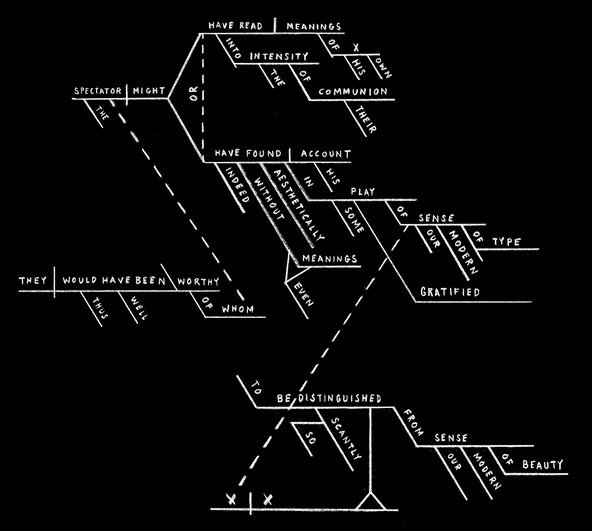
Of course, I find all of this exciting and interesting, not so our struggling nursing student, who sees diagramming as wasted effort because she sees no application for it. I tried to explain that it was like doing drills for an athlete–the athlete may not do the drill during a race or game or match but, by exercising, will be developing the muscles he or she needs to be competitive. My colleague tried to equate the student’s love of reading to the exercise of diagramming–the student does not NEED to read. What she reads has no immediate application to nursing, but reading exercises the brain, which will help her be a better writer, and a better nurse.
Our student didn’t buy it. But because she is a good student and wants to do well, she listened to our explanations and, I believe, we did help her understand better. She even said that she wanted to come back to the tutoring center to get more help on another day.
We’ll be there.
***
Here are some more articles I hope to share with our student that discuss how important it is for nurses to critically think and write well:
- Why Nurses Need Good Healthcare Writing Skills
- The Effect of Reflective Writing Interventions
- Writing as a Professional Nurse
- Why Writing is Important in the Nursing Profession
- Good Writing Skills Are Essential (allnurses.com)

 Hey, Mrs. Winkler!