Service is a dirty word You may have to Wipe inky hands On a blackened rag Beside a bottle Of disinfectant Left over From Covid’s mandatory cleaning days Long deemed Useless by scientists But not bureaucrats.
Service is a dirty word. You may have to Wipe down your desk Of ceiling tile flecks From above you As workers pound on the old roof Of a building That appears new To the press and politicians who don’t see you Back there, serving
Service is a dirty word. You chose this filthy bed you lie in You could have walked away. You could have stayed so much cleaner if You chose business or tech. You really deserve that net decrease in pay. For wanting, longing to serve.
Brad Briner, new NC state treasurer, said in his first newsletter to the constituents whom he is sworn to serve that he plans to raise premiums and implies there may be other changes to state employee health coverage before saying , “This isn’t the message I wanted to deliver in my first communication to Plan members….” Frankly, I don’t believe him. He has been quite animated in interviews during his campaign and after the election that he is eager to begin enacting his plan to cut drug benefits and raise premiums.
Maybe those things need to be done or maybe not, Mr. Briner, but to say you didn’t “want” to deliver this news as your first communication is disingenuous. This statement did not NEED to be your FIRST communication to us. Actually, your words reveal a definite lack of empathy for the human beings you are to be caring for. As a former English professor, I have some suggestions on how you might have better delivered this bad news.
How about praising state employees and retirees, thanking us for our hard work and dedication as your first communication, saving the bad news for your second, third, or fourth? How about telling us that you’re honored to serve us before delivering the bad news? This is a basic business writing technique I taught my community college students.
However, your very first words to the people you are about to deliver bad news to is not about honor and service or sorrow over how underpaid and overworked people are going to be asked to sacrifice even more. No, it’s about how “excited” you are to be in such an “impactful role.” So, I’m confused. You actually seem quite happy to deliver such news.You go on to support your argument by saying you “believe in transparency.” I do, too, but you can be transparent and still offer a little compassion for the thousands of state employees that will be affected by your actions. A bit of humility goes a long way, too.
August 1, 2023, was my first official day of retirement. I left after 27 years of teaching at a small community college in western North Carolina. Officially, I retired early, but I say I ended my career right on time. Some may say that I was burned out or that I had quietly quit years before, and perhaps both are true. All I know is that I loved teaching, what it really is supposed to be, too much to keep trying to do it with little academic freedom or shared governance. I couldn’t remain in a place that cared more about enrollment and data than individual students and their learning.
Writing and editing, separate from the scads of e-mails I wrote and student writing I graded, are the things that kept me going the last few years of my teaching career. This blog, started in 2014, was the first place I regularly vented my frustrations at the negative changes I saw at my institution. But I also kept my spirits up by writing about teaching itself, some of my victories in the classroom, my memories of great teachers and wonderful teaching experiences I had.
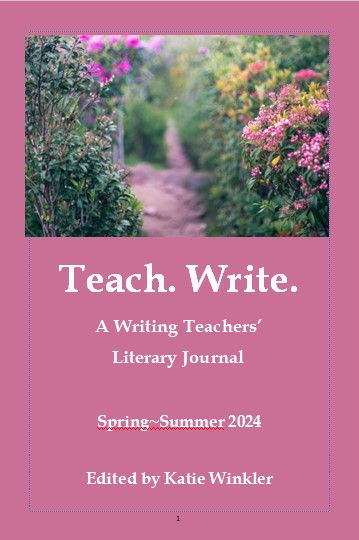
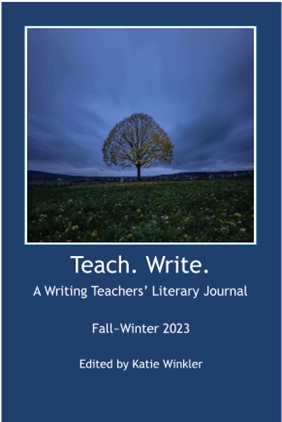
Then, in 2017, after publishing another short story and having published dozens of theater reviews and feature articles for the local newspaper, I realized that risking rejection and criticism by putting my work out into the world not only helped me be a better writer, but it also made me a better writing teacher. I wanted to offer a special kind of professional development opportunity to other writing teachers and Teach. Write. was born. Editing Teach. Write. has been one of the joys of my life and is even better now that I have time to devote to its improvement.
However, even with the blog and the journal, the pressure was getting to me. The worst part of all was realizing how powerless I was to effect any change as I witnessed the autonomy that I had enjoyed at the beginning of my career begin to erode. So, I turned to a writing project that began as a musical but had laid dormant for several years–a satire called CAMPUS.
When it started getting particularly rough, I turned back to CAMPUS and decided, I think with the help of my wonderful daughter, that I wanted to turn my musical into a novel and keep the musical element alive by podcasting it with music. How? How would I do it? First, my daughter, a sound technician, did research on the best podcasting equipment, told my sweet husband, who bought the equipment for me as a Christmas gift. It wasn’t long before I was podcasting this crazy, satirical story about higher education at a small college in western North Carolina.
But not just any college. This enchanted campus has elves, gnomes, moon people, fairy godteachers, vampires, zombies, and a boojum–kind of an Appalachian yeti–oh, and a nazi. CAMPUS is definitely out there, but its weirdness has allowed me to say things I never could have said out loud otherwise. I produced about 13 episodes.
You can go and hear them at most podcasting platforms. Just search CAMPUS: A Novel That Wants to Be a Musical and you will find them. Don’t get too excited–the production value is low because I have no idea what I’m doing, but you know, I’m kind of proud of those episodes. I’m proud of myself for completing them, taking a chance. They helped me survive those last few years of teaching and the isolation of teaching during the worst of the pandemic years.
I want to get back to completing CAMPUS when I finish the other big writing projects on my plate right now, but until then, I will leave you with one of my favorite scenes from CAMPUS, when the discouraged, burned-out faculty makes their debut “Down at the Diploma Mill.”
DOWN AT THE DIPLOMA MILL
At that, in true musical fashion, a slow droning chant arose from across the quad as “They” began to come in. The slow heavy beat of the prison blues, the stomping of feet like the striking of a heavy hammer on a stake. THEM, teachers in ragged clothes and carrying old worn-out books came onto the quad. And they chanted:
ONCE WE WERE SOME BRIGHT YOUNG TEACHERS
ONCE WE WROTE ENGAGING LESSON PLANS
ONCE WE LOOKED INTO THEIR SHINING FACES
OUR STUDENTS WERE OUR INNOCENT LITTLE LAMBS
BUT NOW
BUT NOW
BUT NOW
CHORUS
WE’RE WORKIN’ DOWN AT THE DIPLOMA MILL
LOOKIN’ FOR SOME BRAIN CELLS TO KILL
WE NEVER MEANT IT TO BE THIS WAY
BUT WE GOT NOTHIN’ LEFT TO SAY
DOWN AT THE DIPLOMA MILL
ONCE WE HAD SOME GOOD IDEAS
ONCE WE TRIED TO CHANGE OUR WAYS
WE ALL SHUNNED STANDARDIZED TESTS
TRIED OUR BEST
TO NOT BE LIKE THE REST
BUT NOW
BUT NOW
BUT NOW
WE’RE WORKING
AT THE DIPLOMA MILL
WE’RE WORKING DOWN AT THE DIPLOMA MILL
LOOKIN’ FOR SOME BRAIN CELLS TO KILL
WE NEVER MEANT IT TO BE THIS WAY
BUT WE GOT NOTHIN’ LEFT TO SAY
DOWN AT THE DIPLOMA MILL
ASK AN ESSAY QUESTION
DO A PROJECT INSTEAD
BUT THE DEAN SAID IT WASN’T ASSESSMENT
WE SHOULD GET RETURN ON OUR INVESTMENT
IF IT’S NOT SOMETHING WE CAN CALCULATE
OR THAT’S EASY TO REGURGITATE
THEN IT’S SOMETHING YOU CAN’T DO
DOWN AT THE DIPLOMA MILL
The group begins to hum as they mount the stage and form a line of disgruntled burned out teachers. An old professor in a ragged tweed jacket with torn leather patches on the shoulder, holding a pipe comes to the mic. There is no sign of Dr. DAG. He’s gone off to Dog Hobble to that expensive restaurant only a few residents and the tourists can afford.
The old professor takes the mic as the group hums on. He speaks:
I’ll tell you what I want. Huh, come to think of it, what, exactly, do I want? I used to want to be published in exclusive journals, solicited to speak at prestigious conferences, overseas…in Europe…in Paris, all expenses paid. I wanted to be so valuable to the college I could thumb my nose at the presidents and VPs and deans and especially department chairs like Dr. C. J. Hamilton, who just had to lord over me his award-winning dissertation, the title of which he doesn’t let anyone forget– The Reawakening of Chartism and the Writings of Thomas Carlylse in the Post-Victorian/Pre-Edwardian Epoch.
Do you know what he said when I told him that I had my students all meet me at that great vegan restaurant in Asheville? He said it was stupid! Yeah. My innovative idea! A lot better than sitting around on a bunch of hard chairs in straight little rows listening to Dr. Hamilton drone on and on about Sartor Resartus and Queen Victoria’s increasing seclusion and her fat son’s sickening perversions.
My idea was great! We had a good meal, raised a few organic brews, and it was off to search for the famous O’Henry plaque embedded in the sidewalk near the cafe. We found it. I didn’t tell them that when O’Henry came to Asheville, he was a penniless drunk. How could I tell a group of 20-somethings in a creative writing class that I knew all their dreams would come to nothing?
But then we all drove together over to the Grove Park Inn to find the F. Scott Fitzgerald room. They all wanted to see the place where Fitzgerald didn’t write while he waited for Zelda to slowly lose her mind. We found the room, but I think we had all underestimated the effect of that many beers, organic or not, on our critical thinking skills. We had a hard time finding the room, and when we did and got in there… How did we get in there?
The concierge wasn’t too happy that we barged in on those German tourists. At least one of them was German because I recognized certain select vernacular. Anyway, before the burly one threw us out, I did get a glimpse around the room, a nice room, but ordinary, nothing special about it at all really. I mean why should there be? Fitzgerald just sat there, day in and day out, not writing and drinking himself into mind- numbing oblivion. On second thought, although I can’t tell you what I want, I can tell you what I don’t want. I don’t want to do this anymore.
Twelve years ago, when my husband John and I took our daughter to freshman orientation at Converse College, then an all-women’s college, now a co-ed university, the administration, very wisely, oriented the parents as well as the students, together and in separate groups. When parents met with faculty, staff, and administrators, the first item on the agenda was viewing a little animated film about “helicopter” parents, you know, the ones who are overly involved in the lives of their children. These parents tend to be overprotective and cloyingly attentive, often micromanaging their children’s activities and decisions.
The video was followed by some tips for avoiding helicopter parenting. “Try,” said one administrator tentatively, “not calling or texting your daughter for the first week and limit contact after that.” I felt the collective gasp by the parents in the room. Even though, as an English instructor, I had been on the other end of helicopter parenting for many years, I felt a little quake in my heart. A week is a long time when I am used to talking with my kid almost every day, I thought. I like my kid. I want to talk to her.
But I knew the administrator was right. My daughter needed time to figure out things for herself, to feel the power of making her own decisions, good or bad, and the learning experiences that brings. To deny her that might satisfy me and keep me from worrying and empower me as the one she ran to with all of her questions–me, me, me–but that wouldn’t help her. So, as hard as it was, we kept our distance during that orientation week and thereafter. And guess what? She did just fine without us. SHE did more than fine, actually, even though she had to navigate some pretty rough waters, including loneliness, anxiety, and heartbreak, she also gained insight into herself, conquered some of her fears, and learned how to persist through it all.
Of course, we were still active in her life. We were fortunate enough to live close and were able to attend her recitals and other activities. I loved getting to hear her sing in choirs as well as operas and even watched her fence! She came home for special occasions, and we would go visit, often eating at her favorite place, the Monsoon Noodle House. We didn’t abandon her. When she needed help, she asked for it, and we helped her, but she rarely asked. She liked making it on her own, and we loved watching her mature.
If you are parents of college students, don’t miss out on the wonderful opportunities they have to grow by being too involved. Please! Stay out of their classrooms, leave their professors alone, let them fight their own battles, or not, and let them learn to solve their own problems. Not every obstacle should be removed. Not every path should be made smooth. If you have learned to listen to your children, you will know when you must step in to protect them. It’s scary, but it’s necessary.
And it’s normal.
Herein lies the problem of helicopter parenting, I think. It seems to have become much too common for parents to blame a child’s educational institution for normal human development. Simply put, your adult children, whether they go straight into the workforce or choose college, are going to be different than you imagined they would be. If you are one religion, they may choose another or at least a different denomination. Perhaps they will choose no religion at all. They will likely have a different lifestyle, outlook, or political ideology. This is natural.
It is also normal that loving parents will be concerned if they watch their children take different paths than they had desired for them, especially if they turn away from the belief system in which they were raised. However, I have seen students time and time again turn away from their parents and their values only to turn back again as they moved through the rebellious period of youth. That’s natural, too.
What isn’t natural and is inevitably harmful to students is when parents and some in society blame educational institutions, especially instructors and professors, for “indoctrinating” students one way or the other. Don’t misunderstand me. I know that there are many valid concerns about some educational institutions that stifle certain points of view or claim inclusion but only for certain races, religions, and ideologies. That is an argument for another day.
What I’m saying is much more basic than that. Increasingly, instructors and professors face interference and even harassment by parents who wish to micromanage their offspring’s education. For example, it is common for parents to not only question course grades but also grades for individual assignments, not just failing grades either. Some parents, especially those of younger, dual enrolled or early college students will demand that their child get an A instead of a B and claim, with no evidence, some wrongdoing by the teacher as a basis for their complaint. Sometimes, parents will question material that has long been part of an instructor’s curriculum, calling it “woke” or claiming that it violates their family’s beliefs. I know of one faculty member who was reprimanded for doing something that some parent told some board member who told someone high in the administration. The faculty member never found out what she said or did but was accused and now has a reprimand on her permanent record.
Educational institutions should value all students and be inclusive of all, no matter their race, religion, gender, or ideology, but if any student has an issue with an instructor or professor, that student should be the one to approach the faculty member, not a parent, regardless of the student’s age. At the college level, parents have important support roles, but the day to day, course to course, grade to grade issues should be up to the students and their teachers. Furthermore, barring serious ethical concerns, the teacher should remain the primary authority in the classroom for the sake of all students’ healthy intellectual and emotional growth–the goal of any college education.
We suffer from distractions. It’s not only the high tech, although that is definitely a problem – our phones and computers and endless entertainment sources and open AI and, and, and. More than anything else, we are distracted by our concerns. No, our worries. Perhaps it makes us feel virtuous to worry, to endlessly bemoan the failings of others and how they are leading us all down the path that leads to destruction. After all, if we can distract ourselves with how the world is going to hell in a handbasket, maybe we won’t have to look into our own souls and search for the true sources of our problems.
Lord knows I’m guilty. If I worry enough about how this current election will affect education and talk about it enough with friends, then I can distract from the fact that I promised myself I would finish my teaching memoir this first year of my retirement and that I would work diligently on making the most use of the Virtual Playwriting Fellowship the Dramatists Guild Foundation awarded me.
Of course, I don’t call it worrying; I am “concerned,” so my worry becomes something good, right? My other distractions, including social media, are being used, I tell myself, to help raise awareness and guide people toward good things. And it is good if I stay focused, but if I’m honest, I don’t. I start out with those good intentions and slip on down the road to you know where.
In Book XII of C. S. Lewis’s great satiric epistolary novel, The Screwtape Letters, the uncle demon Screwtape advises his nephew Wormwood about the value of distractions to keep the new Christian, no longer in danger of the fires of hell, from being too effective.
You can make him waste his time not only in conversation he enjoys with people whom he likes, but in conversations with those he cares nothing about on subjects that bore him. You can make him do nothing at all for long periods. You can keep him up late at night, not roistering, but staring at a dead fire in a cold room. All the healthy and outgoing activities which we want him to avoid can be inhibited and nothing given in return, so that at last he may say, as one of my own patients said on his arrival down here, “I now see that I spent most of my life in doing neither what I ought nor what I liked”. The Christians describe the Enemy as one “without whom Nothing is strong”. And Nothing is very strong: strong enough to steal away a man’s best years not in sweet sins but in a dreary flickering of the mind over it knows not what and knows not why, in the gratification of curiosities so feeble that the man is only half aware of them, in drumming of fingers and kicking of heels, in whistling tunes that he does not like, or in the long, dim labyrinth of reveries that have not even lust or ambition to give them a relish, but which, once chance association has started them, the creature is too weak and fuddled to shake off.
You will say that these are very small sins; and doubtless, like all young tempters, you are anxious to be able to report spectacular wickedness. But do remember, the only thing that matters is the extent to which you separate the man from the Enemy. It does not matter how small the sins are provided that their cumulative effect is to edge the man away from the Light and out into the Nothing. Murder is no better than cards if cards can do the trick. Indeed the safest road to Hell is the gradual one—the gentle slope, soft underfoot, without sudden turnings, without milestones, without signposts,
So, whether it be pleasure or worry that distracts us, in the end all that will matter is that we have not acted as we should have or wanted to. It is right that we be concerned about extremist candidates running for state superintendent, about school board meetings becoming violent, about indoctrination coming from the right or left, about unwarranted censorship or the lack thereof, but it is wrong of us to see problems where there aren’t any or to let our fears and worries distract us from what you (talking to teachers now) are supposed to do–TEACH.
Until the last two years of my teaching, I worried constantly about ambiguous mandates coming down from the administration. Often, they didn’t apply to me but nevertheless distracted from my teaching. I would get upset, argue, discuss whatever it was endlessly with my colleagues in their offices. The thing is I didn’t need to worry because most people in the administration were simply passing on what had been mandated to them, having little hope that, for example, yet another restructuring of developmental education would fix the problems that the previous restructuring just a few years before had not fixed or made worse.
All my “concern” did not help me teach those developmental classes effectively. The only thing that helped was buckling down and embracing any sound ideas and finding ways around the silliness, or simply ignoring it. For example, when the state mandated that instructors should not use fiction or essays written in first-person to teach reading and writing, I was flabbergasted, ready to fight this nonsense tooth and nail at the conference I went to explaining the new curriculum. However, low and behold, almost every session at the conference included sample readings that were either essays written in fir st person or fiction. These teachers were fantastic, and their lesson ideas were great. I adopted some of them. No one seemed to notice these teachers were ignoring the mandate, including the people who had cobbled together the new curriculum. I didn’t have to fight.
Now that I’m retired, I can see that I wasted a lot of time and caused myself undo stress by allowing myself to be distracted by administrative bloat and broad, ambiguous criticism. All I can do now is say to young educators, please don’t be like me: don’t turn your teaching world upside down with every pedagogical or andragogical wind that blows. It’s not worth it. Pick out the good ideas and incorporate them, change when you need to, learn new technical skills that enhance your teaching, use old ideas that have worked for you before, and trust yourself.
Teaching is a craft. You should always be open to improving it; however, teaching is also an art, most successful when it is creative and engaging, when it takes risks, when it moves onto the fringes and beckons students into the glorious realm of ideas.
I’ve probably written this in a post before, but it bears repeating. One of the best teaching professors I ever had said, “The goal of any good teacher is to become increasingly unimportant.” To me, that meant teachers are successful when they help students learn how to be independent, critical thinkers–self-starters who can be trusted to troubleshoot and problem solve yet still ask for assistance when needed–people who aren’t afraid of a challenge or obstacles or even failure. My goal was to give my students tools to meet those challenges and overcome obstacles, to learn from failure and become resilient. I wanted to equip students for all of life, not just work.
But here in North Carolina and elsewhere in our country, education has become more of a means to an end. The general attitude seems to be “get those general ed classes out of the way” (I heard that ALL the time). They seemed to say to me, “Those classes, especially English and math, are just annoying steps a person must take to be pumped into “the pipeline” and “enter the workforce.” Gaining an education that helps people live better lives, no matter what they do for a living, or if they choose to stay home and raise children or pursue their art, has been replaced with training for a particular, specific field with a goal of employment, not life-changing education.
So many of the intangibles that occur when students are truly engaged in an educational experience are lost when the emphasis is on training for local, narrowly focused workforce development based on current trends that will shift and change with every economic bubble that bursts. In the last few years of my teaching, I yearned for the days when so many of my students actually enjoyed going to school, who relished simply learning something they never knew about before. They built relationships with their classmates, studied and ate meals together, listened to music, played video games between classes and had spirited discussions in and outside of the classroom. I remember the days when students would work together, pouring hours of work into extra-curricular activities like producing a play, some of them spending hours in rehearsal on top of all of their classes and after school jobs, but they did it because they wanted to–they had a passion for it, even if they had other long-term vocational plans.
There was a time at the college where I taught when all students in the college transfer program were required to take a literature class. There they had a chance to stretch themselves by reading complex texts that are at the foundation of not only ours but the world’s culture and government. Now, a student can get either an Associate of Science or even an Associate of Arts degree without having to take a literature course at all. How can that be?
In addition, more and more in our community colleges, three disturbing trends have taken hold–asynchronous online learning for developmental English students, high school students earning high school and college English credit for the same college-level class, and so-called accelerated classes. I helped to develop some of these courses and taught them, so you would think that I would be a proponent, but in my defense, I was misled in all of these cases into thinking the situations were temporary or that only advanced students would be taking these classes. I feel like a fool. That’s an understatement.
In my and the college’s defense, the developmental co-requisite English class that I had developed, which was part of North Carolina’s third iteration of developmental education in less than a decade, was not intended to be an online program. The plan was that all developmental classes be taught in the classroom. Then, in March of 2020, when we were soon to roll out our new co-requisite English classes, the pandemic hit. All classes, including the co-requisite English courses, were forced to go online.
In North Carolina, as in many other states, those who teach in kindergarten through twelfth grade are required to meet certain qualifications to teach in the public schools. Being a certified teacher means
Receiving a bachelor’s degree, including certain courses in education, depending on the institution. Appalachian State University, for example, requires 44 credit hours of general education for its English Education (secondary) degree, plus 24 hours of education courses, including
Completing, in addition, three credit hours of a foreign language, and of course, to teach English a student teacher must have a significant number of courses in the subject area, 43 credit hours, including six hours of British literature, six hours of American literature, six hours of world literature, three hours of Shakespeare, three hours of literary criticism, genre studies, or creative writing, nineteen hours in language, writing, and pedagogy, as well as two cognate courses, Psychology Applied to Teaching and Reading Instruction in the Senior High School, for a total of 120 credit hours. All of these courses require a C or better to count towards the degree. The average cost of a degree at App State is close to $48,000.
Passing two national standardized tests including the Praxis Core Academic Skills Test (required to enter most education programs) and the Praxis II test for every subject area to be certified. These tests are administered by the very large, supposedly non-profit Educational Testing Service (ETS), which has been widely criticized for the monopoly it holds on testing for teachers and students and for its continued non-profit status despite its huge profit margin (OlixAlex) Potential teachers pay out of pocket $90 to $210 for each exam.
Maintaining Licensure is also required. Every five years North Carolina English teachers must have completed either eight Continuing Education Units (CEUs) or 80 clock hours of professional development to maintain their certification. Most teachers pay for CEUs out of pocket.
Question for the North Carolina Public School System:
Why does North Carolina require certification for K-12 teachers when there are two major groups of non-certified teachers, not counting private school teachers, who can teach freely in North Carolina but are not required to have the same qualifications as K-12 public school teachers?
Photo by Jessica Lewis ud83eudd8b thepaintedsquare on Pexels.com
A high school diploma or its equivalency, no minimum GPA is mentioned.
A notice of intent to operate a homeschool
Operation under either Part 1 or Part 2 of Article 39 of the G.S. 115C as a religious or non-religious school
Operation of the school on a regular schedule for at least nine calendar months, excluding reasonable holidays and vacations. Who checks this?
School disease immunization and annual attendance records for each student, although the parent is the one maintaining these records and there’s little oversight
Administration of a nationally standardized achievement test administered annually to each student. Parents get to choose which test from a recommended list, and not all of these exams require a proctor. There is no minimum score required.
Notification to DNPE when the school is no longer in operation
That’s it, folks! Oh, the state encourages those who homeschool to talk to professional educators from time to time, but this, of course, is voluntary, because, I mean, what do those certified teachers know?
The other group that is not required to achieve and maintain certification is community college instructors teaching dual-enrolled students. I was a relatively rare community college instructor who had taught at the high school level and been certified to teach grades 6-12. At one time or another I was certified to teach English and German in Alabama, Georgia, Ohio, Colorado, and North Carolina. Although instructors must have a minimum of a master’s degree in their subject area, few of them have had education courses or have studied adolescent psychology and classroom management because most of them never dreamed, not older faculty anyway, that they would be forced to teach 14-, 15-, and 16-year-old high school students.
And yet, more and more, not only are community college faculty expected to teach high school students within their classes on campus, but also online classes, and even in the high school itself. That’s right. More and more full-time college instructors are expected to leave the college campus and go to the high school to teach high school students exclusively, regardless of their level of training, experience, and comfort working with large groups of young teenagers in a high school environment. Believe me, teenagers in groups can be intimidating and even cruel. Not everyone can handle it. I couldn’t.
That’s one of the reasons I left teaching high school and got a job at a community college where I was happy until I was forced to teach large groups of young teenagers again. I retired early for a lot of reasons: teaching more and more high school students who were not prepared academically or emotionally for college-level work was one of the big ones. Don’t even get me started on the pressure from parents and administrators to lower academic standards for high school students.
One-on-one or in groups of two or three, I did just fine, they did just fine, especially if the parents allowed the students to navigate the course as a college student should, without interfering. I love teaching teenagers under those circumstances. However, I know my strengths, and teaching groups of teenagers is not one of them. Dealing with parents, no matter how well-intentioned, is also not one of my fortes. However, it didn’t matter how many times I talked to the administration about how faculty were more and more frustrated with teaching high schoolers in large numbers and having to go to the high school to teach. Because the college is making money, because high schools and parents are saving money, this dubious educational process continues. In the end, it’s the high school students who lose sometimes two years of life experience they could have had learning to be independent thinkers if society would only think about the students first and find better ways to lower the costs of higher education.
Do you see what the problem is? It’s the incongruity. The state puts so much emphasis on testing and licensure, so much seeming concern about the qualifications it has for teacher education. “We only want the best, fully vetted teachers for our kids,” they opine. Except when it’s politically or socially inconvenient for the powers that be to have standards and fully vet the teachers. Or fully pay them.
Side Note: Of course, certification isn’t the answer either. Little supervision happens with any licensure program because it’s mostly bureaucratic hoops to jump through to provide data so politicians, school administrators, and the public can pretend they care about the quality of instruction. In reality, very few people truly care about the quality of education students receive, says the cynical retired community college instructor.
I can see the political gears turning: “Oh, I know, more people are mad at the schools and teachers than ever. They think their kids are being indoctrinated, so let’s take money away from the public schools that require teacher certification and give it to parents so they can start homeschools that have few standards, where the “teacher” only has to have a high school diploma or equivalent and the students have no minimum score to reach on a yearly national exam that may or may not have an outside proctor to administer it.”
And then there are the dual enrollment programs, Career and College Promise in North Carolina, Again, because it’s convenient and saves money, got to save the money even if it is bad for education, let’s just throw our oh so important teacher education courses out the window and toss our unprepared college instructors into the high school classroom, those who never planned to teach high school and often resent having to teach an age group that they may not have the aptitude, or attitude, to teach.
Oh, we’re so worried about those big bad liberal high school teachers out there that we want to pull our kids out of the public school and homeschool them, but by golly, if I’m gonna save some bucks on the kid’s college education, then let the indoctrination by those free-wheelin’, gender pronoun talkin’ professors begin.
“If I don’t want my 15-year-old kid, who is going to bypass her first two years of real college, reading To Kill a Mockingbird, then I’ll just march down to that college and complain to the president.” Or “I don’t want my child feeling bad about slavery, so I’m just going to ask the professor not to make my baby read that slave narrative. The teacher just has to give him an alternate assignment. I mean, we just skipped all the history and literature that made us feel icky when we homeschooled him, and he still graduated.”
Of course, he did. Aren’t you so proud? Let’s just see how everything pans out when your baby wants to become a teacher (you should talk him out of it) and has to pay for and take the Praxis I exam and pass with a minimum score in order to get into the education program. Of course, I hear there are lots of Praxis prep courses he can take, only $399–a steal.
Okay. It’s time for all sides in the book banning debacle to simmer down. If people would just chill, the world would be a better place. (And I am the chief non-chill person, so I’m talking to myself here, too.) I do think that people throw around the word “banned” a bit too freely, especially where school classrooms and libraries are concerned.
Take Florida, for example, where people are justifiably concerned about House Bill 1467 that requires extensive review of classroom materials by members of school boards, most of whom are not educators nor librarians with no training in curriculum development. It also requires principals to take on onerous clerical responsibilities for materials. In addition, only certified librarians, who are already certified in Florida, must go through further training on what is considered “appropriate” before they can review material and if they do not comply completely with the new law, then they risk being disciplined or removed from their positions.
Therefore, the decision by some Florida school districts has been to remove any book that could possibly be considered inappropriate until the librarians can be trained, or indoctrinated, into seeing a book the way those of a particular political persuasion sees that book. On the other hand, people, again justifiably so, are upset when they read headlines about books being removed from the shelves and see photos of those empty school library shelves.
But, here’s my thing, those books that are being pulled from the shelves, they haven’t been banned. They are being pulled for review. Now, I know I don’t know nuthin bout the running of the government and I’m just a little ole retired English teacher, but I’m just gonna say it. This Florida law is stupid. The way I read it is that for political purposes, the Florida legislature has passed this law to placate extremist folks of all kinds, many who could not care less about the true education of children, which involves the continual development of their ability to discern what is right and true and good. Think John Milton’s great speech on censorship, the Aeropagitica.
In reality, all this bill is doing is creating a bureaucratic, unenforceable mess. Already, teachers don’t have enough time in the day to actually teach students much of anything, much less form relationships with them so teachers can match instruction to the individual student’s needs. Librarians don’t have time to lead students in instruction on how to complete research or help them find books that they WANT to read or encourage them to love reading. How is a school board that meets once a month, is not compensated for their time, and more than likely does not have the knowledge of curriculum for all of the different subjects, with usually no training in determining grade level, how are they supposed to review ALL instructional material for the school? AND as I understand it, the law indicates that school boards must do this review in public and allow for public comment and input. It’s a ridiculous notion to think that compliance with this law will be possible.
This is one reason why everybody needs to chill. This is bad law. What needs to happen is people standing up and having a conversation about why it’s bad and challenging it.
Perhaps I’m cynical. Perhaps I’m bitter. So, take my words with a grain of salt, but I just don’t think many people really care. In the end, the outrage on both sides will pass and teachers will be stuck with more rules to follow, forms to fill out, evaluations to be made, everything to take them away from what should be their focus, explaining, mentoring, encouraging, assessing, remediating–teaching.
To me, all of the bluster is intended to make people feel like they care about the education of children. To show that they are a true believer in either a religious or secular sense. “See, I go to school board meetings and speak out about showing pornography to our kids.” “Look at me! I go to school board meetings to speak out about freedom and against censorship.”
But the teachers and administration need to chill, too. There’s just too much reactionary activity on all sides. Florida passes a law. The admin and some teachers are worried about being sued or losing their jobs. I know there might be a chance of that happening, but life is risky. Look, I’m not trying to make light of that fear, but is a job at a school that consistently makes you go against your conscience really worth having?
Teachers, look at your situation. How likely is it that you will lose your job? How many times in your career has your job been threatened because of what and how you teach? I know there are some, but it is kind of like a police officer using a gun–many officers go through their whole career never firing their gun except on the firing range. A 2016 Pew Research Center study sponsored by The National Police Research Platform found that only 27% of officers fired their guns while on duty.
It seems to be even rarer for a teacher to be fired for cause. A fact check by 74 indicates that only 2.1% of American public school teachers are fired for cause, mainly for incompetence, not for their ideology, not for what they are teaching. I couldn’t find separate statistics for those directly fired because of the books they have on their shelves and in their curriculum, but it’s less than 2%.
I would never tell a teacher what to do, but I would encourage teachers everywhere at every level–stand up for yourself, stand up for what you believe, stand up for freedom of thought and against censorship. At the same time, admit when a book is inappropriate for your students. Avoid feeling threatened when a parent challenges a book. It’s their right. At the same time, encourage parents to come to you when they have a question about something you’ve said or about a book or some other aspect of the curriculum instead of going immediately to administration.
If you are an administrator or a school board member or a parent, please don’t leave the classroom teacher out. Ask them what’s going on. Have real discussions face to face with the teacher, instructor, or professor. Understand that what a student says about what a teacher says and does is not going to give anyone a complete picture of what is really happening in our classrooms. However, talk to our students about what is happening with book bans, challenges, and removals. They might surprise us with what they are able to “handle.”
So, let’s try not to overreact. Instead of leaping to review every book for any remote perception of something wrong, or more than likely to make our big important political statements, why don’t we allow teachers to make their own judgments while parents make theirs, recognizing that sometimes all we need to do is talk together about books and ideas and feelings, even if they make us uncomfortable. Sometimes, that’s when real education begins.
Poor college!!! Seems like every Tom, Dick, and Henrietta is taking a pot shot at you these days. I know, I know, you can be expensive, especially if people get sweet-talked into taking on college loans (Don’t do it unless you absolutely have to!). Also, some classes and professors will be really sucky at your place. People can be downright mean, too. Plus, students can get in a lot of trouble given the kind of freedom that you bring. Don’t forget, you forced me to question my core beliefs. Yes, I didn’t abandon those beliefs, but admit it, I did question them, loudly and a lot.
Is it just me, or did you, along with a supportive family and friends, help me find my way through my late teens and early twenties? Did you help me forge positive, meaningful relationships with people from other cultures and countries with varying backgrounds and values? I think it was you who qualified me for a fulfilling career as an English and German teacher at the high school and college level. During my working years, you helped me provide a strong high school education for my child and made it possible for me and my husband to pay for her now debt-free education (two degrees). You allowed me to contribute to a pension plan that means I can enjoy a financially secure retirement.
Because of you, in undergraduate school at a Christian university, I traveled to Europe for six weeks, studying German and history. I visited West Berlin when it was still trapped within a wall, but somehow still free because of what my country, along with England and France, did for that city. I laid hands on the graffiti-laden free side of that wall and was thankful to be a citizen of a nation that saw the value in maintaining the democracy of a country with which it had so recently been at war.
Because of you, I visited Christians in East Berlin who were trapped outside the wall by an oppressive communist regime that would not let them worship freely. Yes, older people could go to church, but their every movement was monitored by the Stasi, the East German secret police, and younger people were prevented, by law, from attending church. And yet, in those few hours in the East, I witnessed the bravery of those who longed for freedom–an old woman who shook the hands of every student and said in broken English, “Tell them we have no freedom here. Tell them we have no freedom here. Tell them we have no freedom here.” The young people in their teens and twenties who traveled two-by-two just to meet, in secret, a group of American Christians, tell them their stories, and fellowship with them.
Because of you, I was able to spend the second half of my German trip in Tübingen to visit my brother who was studying theology there. I lived in the international dorm and traveled into the city, learning the mass transit system (new to me), eating at the Mensa (student cafeteria), visiting the old castle where my brother preached his first sermon to an intimidating crowd of professors, and sitting in on lectures about biblical archeology, some of which I could actually understand! We punted flat boats on the Neckar River, took walks into the forests, and had picnics with my brother’s friends. We took a train to Munich to hear The Rolling Stones at the Olympic Stadium and hitchhiked the way back (not recommended these days but safe back then).
Only because of you could I have afforded this trip. You didn’t pay for it outright, but you supplemented it, enriched it with quality faculty members who had the knowledge to plan our trip in order to give us the best educational and personal experiences possible. I also learned how to work for what I wanted, taking on two jobs and saving to raise the funds.
I had so many other wonderful experiences during my college years because of the support you offered, and I have gotten so much more out of my experiences since then because of you, but you also gave me a chance to make a living doing what I love to do–teach. The data shows that you give many people that opportunity–people with a bachelor’s, master’s, professional, or doctoral degree still make more on average AND have lower unemployment than those with a two-year degree or less, according to the Bureau of Labor Statistics using 2022 data. You give so many of us so many opportunities we wouldn’t have without you.
I know you’re not perfect. Far from it. You have so many problems that more and more people are saying you’re not worth it. But you are!! Even though I realize you are not right for everybody–my own husband went to trade school to study x-ray and ultrasound technology, which has led to a great career for him. But for me, you made the difference despite the drawbacks. College, you have enriched my life more than I can say in one brief post. I can keep writing about you and the lessons you taught for at least the length of one book.
Oh, I think I will.
How about that for a segue? I hope to finish the rough draft of my educational memoir “Lessons” by the end of the year. I will keep you updated about the progress and maybe spin some more tales as I’m working on the book.
Also, the journal I edit and publish, Teach. Write., is open for submissions until March 1. The 2023 Spring/Summer edition is to be published on April 1. See the submission guidelines at teachwritejournal.com.
George Bernard Shaw’s 1903 play Man and Superman gave us the infamous saying, “Those who can, do; those who can’t, teach,” which has long been used to disparage teachers. Of course, it isn’t true. Many of the greatest thinkers and doers have been teachers: Albert Einstein, George Orwell, Alexander Graham Bell, and Robert Frost; Maya Angelou, Stephen King, and Steve Wozniak, co-founder of Apple. In addition, presidents John Adams, Lyndon Johnson, Jimmy Carter, and Barack Obama were also teachers.
Shaw’s maxim is silly, perhaps intentionally so, but the saying persists in more than a few people’s minds: teachers are those who have failed to reach their desired vocational goals and are forced, because of inability, to “settle” for teaching. For arguments sake, let’s say it’s true: Community college instructors are second rate. Most of them don’t even know their subject very well. They weren’t able to get a “real” job in what they went to school for, so they teach. Blah. Blah. Blah.
I hear all of that, and then, I get confused. I mean, during the pandemic, the hue and cry was open the schools back up! Students need in-class instruction with faculty in order to truly learn. Open the schools! Online classes aren’t good for students. We want teachers to find better ways to teach online. We want faculty to immediately pivot to effective, engaging online learning, even though many of them have never taught online because they know teaching face-to-face is more effective.
Then, after the pandemic, it was students want more online classes! It’s more convenient. Let’s severely limit the time in seated classes because that’s the demand, even though our faculty is telling us that we should go back to more seated classes, especially for developmental students. Or–we don’t want these liberals teaching us or our kids. We honored and trusted them during the pandemic, or said we did, but we don’t trust or honor them now. We want to tell teachers what and how to teach even though we know little or nothing about the subjects they are teaching or about the art and science of teaching itself. Of course, we don’t want to do the actual teaching because who wants to do that thankless, low-paying job? Only someone who can’t do, right?
So, if teachers can’t do, then why is the world asking them to do so much? I’ll tell you why–because teachers are willing to do it. Hell, some of them even love doing it!
Here is the thing about quality instructors and professors, even if they aren’t capable of being at the top of the professions they teach: they are willing to go into the classroom day in and day out to do their duty–helping students reach their personal and career goals. The classroom teacher is the grunt of the academic world, following orders and taking the risks for the sake of their students with little hope of reward. Yes, those who become tenured professors may see good salaries or if they are in a “high demand” area such as nursing or engineering, but many of the least paid general education instructors take the brunt of the criticism from students, parents, and administrators, even fellow instructors, because they teach the gateway classes like math and English that are often the hurdles that many community college students have trouble getting over.
Maybe teachers can’t do the one thing society values more than anything, making a lot of money, but the good community college teachers, the true teachers, do one thing that many are not willing to do these days. They show up.
Many are choosing not to stay, and who can blame them? Others are staying, but any passion they had has cooled. Teaching has just become a job. However, I have found that more than a few, dare I say many, soldier on and fight, wondering to what purpose–until that student comes along–the one who stops by the office to ask a question, who brings an essay in to be honestly reviewed, who stays in the writing center until the knowledge breaks through. Once and a while, a teacher can make a class smile or laugh and learn all at the same time. Then, it is a good day.
Why do they do it? Why do they keep on keeping on?
The good teacher answers: “I can’t do much, but tomorrow, I am willing to walk into that classroom again and teach, because that is something, by God, I can do.”


































 Hey, Mrs. Winkler!