CAMPUS

Photo by Pixabay on Pexels.com

My summertime project is to complete a rough draft of my new novel, CAMPUS: The Novel That Wants to Be a Musical. Full disclosure. It started out as a musical, but then it decided that it wanted to be a novel but one that wanted to be a musical.

I know. It’s incredibly weird, but so am I, so it seems fitting. I am afraid, too, that it might offend because it’s horribly, deliciously satiric, a social and political satire of higher education in the South.

Many of my colleagues already know about the book. Back when it was a musical, I shared some of the ideas and songs with them. I have worked on the project off and on again for several years already, especially when I became particularly infuriated with perceived obstacles blocking my path to providing my students with the best education possible.

Oh, my. I can be so pompous at times.

But

My attitude is changing. Perhaps it was attending the National Council of Teachers of English conference with five of my fellow English instructors, talking about our work and seeing how passionate we all our about our work, but also enjoying each other as human beings–as fathers and mothers, as friends, like family.

My attitude is changing. Perhaps it’s all the months teaching in isolation. Did it take that for me to value the roles of others in my institution? Perhaps. Not that I didn’t appreciate it before, but now, wow, I appreciate it more.

My attitude is changing.

But my convictions have not.

So the play wanted to become a novel, but the novel did not want to lose all of the biting satire of the play because it’s just so darn fun. So, it didn’t. Still a satire. A kinder, gentler satire, perhaps (It hasn’t decided yet), but a satire nonetheless. And I’m still keeping the “I want to be a Nazi” song. I can’t help it. I just want to. And it’s my book, so I will.

But you say, Katie, how can you have musical numbers in a novel?

Photo by Fröken Fokus on Pexels.com

And I say, how can I not? I know it’s weird and different and really out there. It may not work, but who cares? It makes me happy. It’s creative. It’s about work but not about work. It is helping me vent my frustrations so I will be less likely to take them out on my colleagues, supervisors, and students. Plus, it’s more than just satire. It’s also an Appalachian fantasy with gnomes, elves, the Moth Man, Moon-faced people, hellhounds, wizards, fairy godteachers (yes, really), vampires, zombies, and at least one boojum (aka Bigfoot). It’s also a love story (actually more than one) and a glimpse into the heart and soul of an aging teacher (guess who).

Photo by Gratisography on Pexels.com

Can you tell I love my book and don’t care that it’s goofy?

So, I’m writing this summer, and it’s time well spent.

Here is the first verse one of the songs:

BEAUTIFUL TRUTH

BY

KATIE WINKLER

    “Beauty is truth, truth beauty,—that is all Ye know on earth, and all ye need to know.” From “Ode to a Grecian Urn”~John Keats

Truth and Beauty

That’s all there is and ever will be

I see truth and beauty

When I look into her eyes

It’s been an amazing ride

Since I’ve met her.

My world has opened wide

I’ve only just met her

The Belle dame sans merci

This beautiful lady

And her eyes are wild.

Just to have her near

Just to see her face

Just her voice to hear

Just to feel her fingers brush my cheek

Nothing else remains but she

The belle dame sans merci

Have mercy, have mercy

Help me to see

    “Beauty is truth, truth beauty,—that is all/ Ye know on earth, and all ye need to know.”

But I feel it, but I know

Truth and Beauty

I see it when I look into your eyes

Truth is beauty.

I see it when I look into your wild eyes

Beauty is truth, truth beauty

That is all there ever will be

I see truth and beauty

When I look into those wild, wild eyes

Are you a teacher writing this summer? I would love to read your work and consider it for my literary journal Teach. Write. Submissions are open for the 2020 fall/winter edition until Sept.1 See submission guidelines for more information.

Encouragement

Photo by cottonbro on Pexels.com

One of the employees in our public relations department at our college had a great idea to encourage students during this difficult time by compiling short videos from faculty, staff, and administrators. I have been enjoying watching them as they’ve come out and was finally able to record my own, but alas, I was too late to be included in one of the compilations, so I decided to show it to you. I will also link this blog post to my students.

This video took only a few minutes to complete. I used the camera on my laptop, which automatically downloaded as an mp4 file, uploaded it to YouTube, copied the link, and pasted it on the blog. Wallah!

This little video may not make it to many students at my college to encourage them, but making it sure encouraged me for some weird reason.

Mrs. Winkler in Quarantine

If you haven’t had a chance to read the latest edition of Teach. Write., I encourage you to take a look:

Note: Edited version available for download. I will post the print version when it is available.

Teach. Write. Spring/Summer 2020

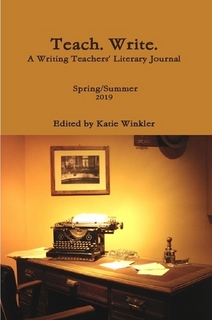
The 2020 Spring/Summer edition of Teach. Write.: A Writing Teachers’ Literary Journal is here! You can access the journal by clicking the Download button below:

The cover of this edition represents the theme of the one-room schoolhouse, which seems appropriate at this time when so many of us are teaching and learning from our own little rooms.

I hope reading this journal will provide you with a sense of unity and solidarity in the midst of our forced separation.

Until we meet again.

I will post the link when the print version of the journal is available.

Spring 2020 Teach. Write. Delayed

April 1 is supposed to be the day I roll out the new edition of Teach. Write., but as you may have guessed, Mrs. Winkler has been busy moving her seated classes to online, learning new skills, researching, endlessly grading, and writing many, many e-mails and messages.

I hesitate to give myself another deadline as things are changing moment by moment, but I do better with deadlines, so Tax Day (what was Tax Day) is my new goal–April 15.

It will be worth the wait. I have writers near and far, including two excellent examples of writing by my own students!!

So until April 15!

Pet Peeves

woman holding her head

Photo by David Garrison on Pexels.com

Not earth-shattering. Not life-destroying. Not important at all in the grand scheme of things, or even in the niggling scheme of things, but here are some of my pet peeves. I freely admit that I peeve myself at times, and I’m sure, others as well. But here goes anyway–for kicks and grins.

  • Using st, th, and nd when writing dates–Example–January 1st, 2020. In American usage, the convention has been, and will continue in my teaching, to be–write January 1, 2020 and say January 1st, 2020. The problem is that the British often use the endings when writing the dates, leading to understandable confusion. I am an anglophile from way back, so I’m not dissing the Brits, but I am also an American English teacher, so I will teach American standards. Here’s more about it from Daily Writing Tips: January 1 Doesn’t Need an “st” 
  • Placing the end mark outside the quotation marks–Example. She said, “We are in America, so we should use American punctuation conventions”. Yes, we should, and in American English the punctuation almost always goes INSIDE the quotation marks. “We should use American punctuation conventions.” Here is more on the subject from Grammarly: Does Punctuation Go Inside Quotation Marks?
  • Leaving out the possessive apostrophe OR adding an apostrophe with a simple plural. We need apostrophes, yet we don’t need apostrophes. The rules are simple:
      • Use an apostrophe with contractions or to show possession.
      • Do NOT use an apostrophe with a simple plural.
      • If the word ends in s, then generally the apostrophe comes after the s, but there are significant exceptions, such as when using irregular plurals.
    • It seems insignificant, and maybe it is sometimes, but not using the apostrophe when appropriate and using it unnecessarily can both lead to misunderstanding and also drives Mrs. Winkler crazy!
    • An example–I cant attend the New Years party, but I dont want to go to Sherrys house again because I dont like her childrens’  loud toys’ that company’s seem to love selling at this time of year.
    • Now my spell checker caught dont, Sherrys, and childrens’, but not the cant , Years, toys’, and company’s because although the spellcheck programs are more and more sophisticated, they are not (yet) sentient and can’t replace a writer’s own careful editing and revision.
    • Here’s more on the subject of apostrophes from Purdue University’s Online Writing Lab (OWL), one of the first and still one of the best: Apostrophe Introduction
  • It’s and its, a problem that gets its own category. Its own category–no apostrophe because it’s a possessive pronoun. It’s a possessive pronoun--I used an apostrophe because I am using the contraction It’s to mean It is. I think people understand the rule for the most part, but its an easy mistake to make (I did that one on purpose. I swear). Here are the rules again (not trying desperately to be clever this time):
    • It’s is the contraction for It is–Example–It’s snowing on January 5, 2020. The little trick I give my students is, “Can you say, It is in place of It’s? If so, then you have correctly used the apostrophe.
    • Its is the possessive pronoun–Example–The horse chewed on its hay. I understand why people get confused here: Its is a possessive pronoun. We hear the word possessive, and we immediately think apostrophe, but I tell my students, think of it this way– we don’t write hi’s car or his’ car do we? Nouns that show possession use apostrophes; pronouns that show possession do not. Here is an exercise to practice distinguishing between the two from one of my favorite grammar sites–Grammar Bytes: Word Choice–Exercise 13
  • Capitalizing when one shouldn’t and not capitalizing when one should. Okay, I get it that people don’t want to capitalize. It is sooooooooo much trouble to hit the shift key and type a letter, especially when writing with a smart phone. But increasingly I am seeing words that should NOT be capitalized being capitalized, especially doctor, lawyer, mother, father, even brother and sister, as well as a myriad of other words that should not be capitalized in academic writing. I am not too peeved by occasional unnecessary capitalization, often the person is just trying to show respect, but often capitalization errors show a lack of concern for proper writing, even when the person is writing assignments for a composition class! Here is more about capitalization from Grammar Girl: When Should You Capitalize Words?
  • I definitely get peeved when a person does not capitalize the personal pronoun “I” when emailing an English instructor. Come on, guys! Get with the program!

How much can an English teacher take?


cover_springsummer2019

I promise I won’t get peeved with you if you submit your best work for publication in my bi-annual literary magazine Teach. Write. Submissions are open for the 2020 spring/summer edition until March 1. See submission guidelines here. 

Publication of Fall/Winter Edition of Teach. Write. Delayed

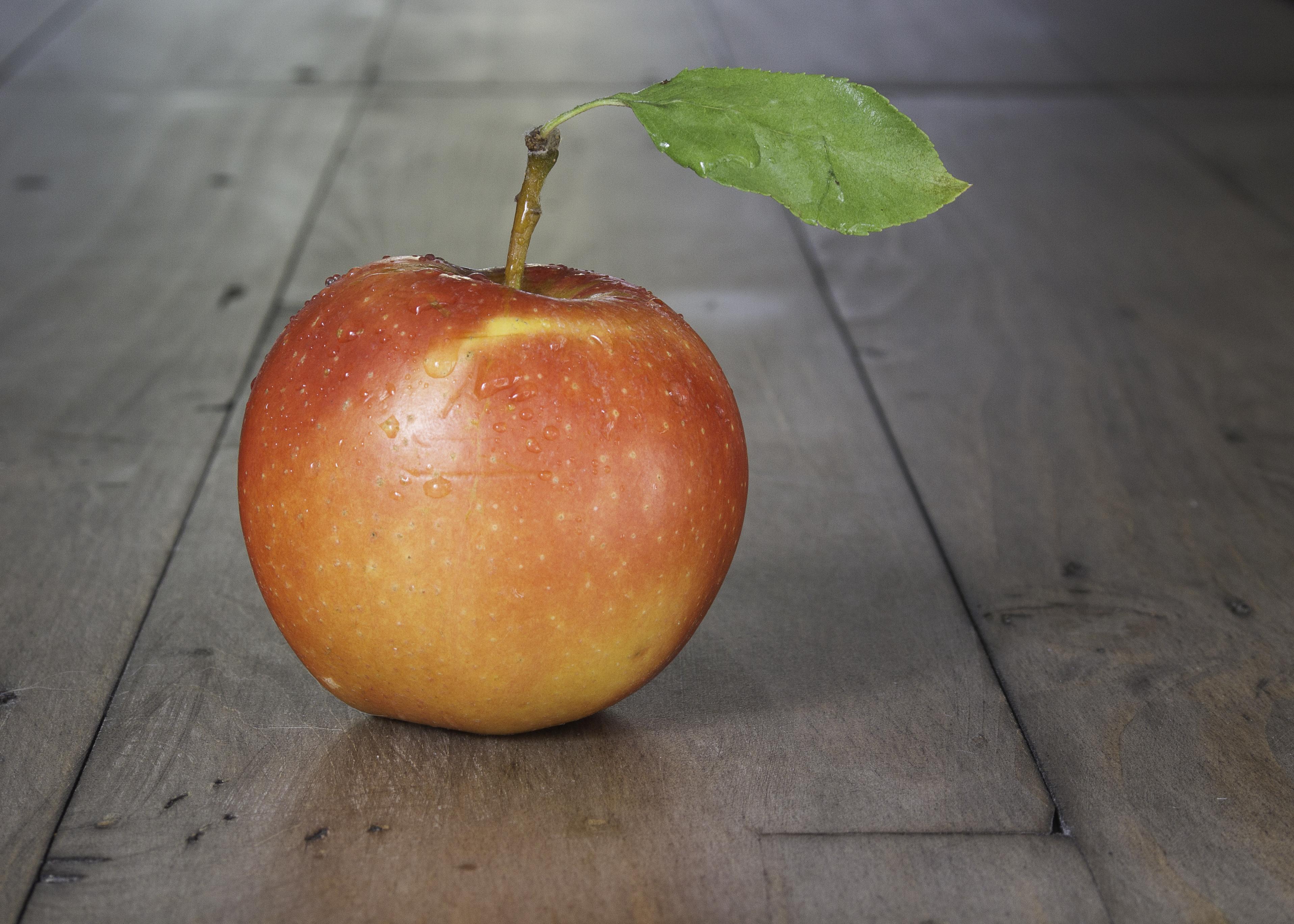
apple

Preview of Fall/Winter Cover by ttroslien via morguefile.com

Teach. Write. is a one-woman show, but it is important to me, and I have some wonderful writers whose works I want to share with you soon.

However, life is life, so although my publication date for the fall/winter edition of Teach. Write. is September 1, today, I know I am not going to make that deadline. My hope is to publish no later than September 15.

So, hang on, Sunday’s coming!


Too Long

blog icon information internet

Photo by Pixabay on Pexels.com

This is what I get for teaching in the summer—less time to work on my blog. I almost let all of June go by without a post, but I made it!

I am saying right now, while I am in the midst of it, that I will never teach a course in the summer again. What was I thinking? Those of you who know me understand how I can get during the school year–I’m kind of intense, let’s say. Summer has always been my time to work on myself—my writing and reading, my diet and exercise, my family, my friends. Oh, and my Scrabble online time.

Not that I haven’t been doing all that.

However, I should have anticipated that teaching a composition course in eight weeks instead of sixteen is naturally going to take up a big chunk of time. And it has. Yet, I’m not sorry that I have done it because even if I do not succumb to the allure of teaching in the summer again (oh, Lord, I hope not ), I have learned a great deal that I can apply when teaching my sixteen-week classes.

Here we go:

  • Streamline assignments–I found that with fewer assignments, students are getting an ample amount of writing practice. I have also found that I can assign less time for assignments and still get the same quality of work from students. Giving weeks of time to complete the major assignments doesn’t seem to help either. Plus, I don’t have weeks of time when teaching a sixteen-week composition course in eight weeks.
  • Compact assignments–I re-wrote assignments to get more information in a single assignment so that I could afford to streamline. It takes some work and creative thought, but I dig that kind of stuff. Hey, course design is one of the reasons I love teaching so much.
  • Add video and text resources but keep them well-organized–I always have included a myriad of video and text resources, but with our new clean-looking LMS interface, it is easy to use labels to keep all of the student resources organized and easier to access. One tip–add resources that come from highly respected institutions (a plagiarism quiz from Cornell, which covers just about every possible plagiarism situation my students stumble across) and those that involve technology (a video about how to use Survey Monkey, which students like to use when doing field research for their capstone project).
  • Spreading out due dates–Students would find it difficult to be successful if they tried to complete two weeks worth of work in one cram session right on the day assignments are due. We can say good students get started early all we want, but the reality is most students, strong or weak, wait until the due date to complete assignments. Spreading out due dates helps students manage their time and helps me keep up with grading.
  • Introduce and summarize assignments–I have always added an introduction to my assignments, including key concepts from the text that I want to reinforce, but I have rewritten the introductions to be more intentional. I have also added summaries that include ONLY a bulleted list of what the students actually must submit for the assignments. This seems to help a great deal in avoiding confusion. Aristotle’s old advice, tell them what you are going to say, say it, and then tell them what you just said, still holds true.
  • Create screencasts–It is relatively easy to create explanatory screencasts and upload them to YouTube with my ipad. I created a screencast just the day before yesterday that is about eight minutes long and takes students through the steps to find sources on my college’s website. YouTube has a feature that makes it easy to close caption in order for the video to be ADA compliant. All together, including upload, the screencast took me about one and a half hours to create. That would be more than I might want to dedicate during the school year, but since I have only one class this summer, and this screencast will be able to be used again, it was worth the effort.
  • Stay in touch–I have always tried to stay in touch with students, but I have made an even more concerted effort to communicate with students this summer since I have more time. I try to answer e-mails quickly and maintain a light and friendly tone with students. Last night I called a struggling student and spent about fifteen minutes offering some advice but mainly encouraging her. Fifteen minutes to save her from withdrawing a second time from English composition. Time well-spent. I know in the regular school year, with six classes, I will be unable to talk to all of my students this way, but I can certainly try to make a more personal connection to online students who are struggling.
  • Encourage strong students, too–This summer it has hit me harder than usual how much my strong students need me. They need to see not only a blanket “good work” on assignments, but also remarks on their essays about specific things they have done well. Sometimes the A students are lost in the shuffle. I don’t want to forget them this coming school year when I start getting busy putting out fires.
  • Empathize with difficulties–It doesn’t hurt to be human. I try to remember what it was like to work two jobs, be active in a campus club and be in student government while I was carrying a full load of classes. Some of my students have small children to care for as well. I can’t imagine. But I need to try.
  • However, don’t lower standards–While I try to show students compassion and make concessions where I can, I never want to lower my standards. I would not only be doing a disservice to the student but also to the college and society at large. Our students’ potential employers deserve workers who can read and write clearly, concisely, and persuasively. I have to be kind but firm.
  • Maintain a sense of humor–Much undervalued in education, I think. Having a sense of humor when communicating with students, when appropriate of course, eases tensions and humanizes me and the situation. It helps establish rapport with students like nothing else and helps them realize that, wildly successful or not, this intense eight-week English composition course will be just a blip in their lives, an important blip, but not the be all and end all of their existence.

Now, I had fun! I love writing this blog and hope someone reads it, but even if no one does, I have had a chance to pull together some interesting conclusions about my experience teaching this eight-week online composition class, and it is giving me some good, good, good vibrations. Sounds like summertime to me!

Anyone for a game of Scrabble?

letter blocks

Photo by Pixabay on Pexels.com

cover_springsummer2019

DON’T FORGET TO SUBMIT TO TEACH! WRITE! DEADLINE FOR THE FALL 2019 ISSUE IS AUGUST 1! CLICK HERE FOR SUBMISSION GUIDELINES. I WOULD LOVE TO SEE YOUR POETRY, SHORT FICTION, OR CREATIVE NON-FICTION! YOU DON’T HAVE TO BE A TEACHER OR A PUBLISHED WRITER TO SUBMIT!


Summertime

Carolina Coast_SU2011 022

North Carolina Coast–photo by Katie Winkler

Summertime and the livin’ is easy.

Sort of.

man using laptop on table against white background

Photo by Pixabay on Pexels.com

I have decided to teach an eight-week freshman composition course this summer that began yesterday. People have said it can’t be done, and perhaps they are right. Perhaps it is simply too difficult of a course to teach in eight weeks. We’ll see. However, I think it is worth trying because many of our stronger students could benefit greatly if they could get both freshman comp classes completed in one semester.

Despite taking on this experimental course this summer, I will still have some extra time that I hope to spend productively. First, I have been working on a novel for several years now and am determined to finish the rough draft this summer and have the work edited and ready to go out in the world to seek fame and fortune (Ha!) by the end of the year.

Second, I want to revise, edit, and polish some of my short stories that I have not found a home for yet. Last year, I totally reworked a story that had been rejected numerous times, and it soon, after some revision suggested by the editor, found a home with the Bethlehem Writers Roundtable. It’s called “Pilgrimage” 

Another goal is to continue seeking and reviewing submissions for my literary journal Teach. Write.  When I first started the journal, four editions ago, I only accepted work from teachers of writing, but now I accept work from students of writing as well.

cover_springsummer2019

If you are interested in submitting to Teach. Write. then see the submission guidelines for more details.  You can see the latest edition by clicking here. I love to see stories about teaching composition and learning to write, but I accept short stories, poetry, and essays on a variety of topics and themes. I would love to see your work!

As usual I keep busy, but never fear–I plan to do a great deal of sitting and reading on my deck with my feet up, sipping iced tea with lemon.

Ahhhhhh, summer.

I made it! Barely.

cover_springsummer2019

Glad to offer Volume II, Issue 2 of Teach. Write.: A Writing Teachers’ Literary Journal. Once again, producing this journal right during this busy time of the semester, right before the premiere of my fourth play, has nevertheless been a joy. I feel like I get to know all of the writers who contribute by reading their e-mails, bios, and most of all, their writing. I thank them all for contributing, and I hope you will all enjoy this newest edition of Teach. Write.

Here is a link to the journal: 2019 Spring_Summer_Teach. Write.


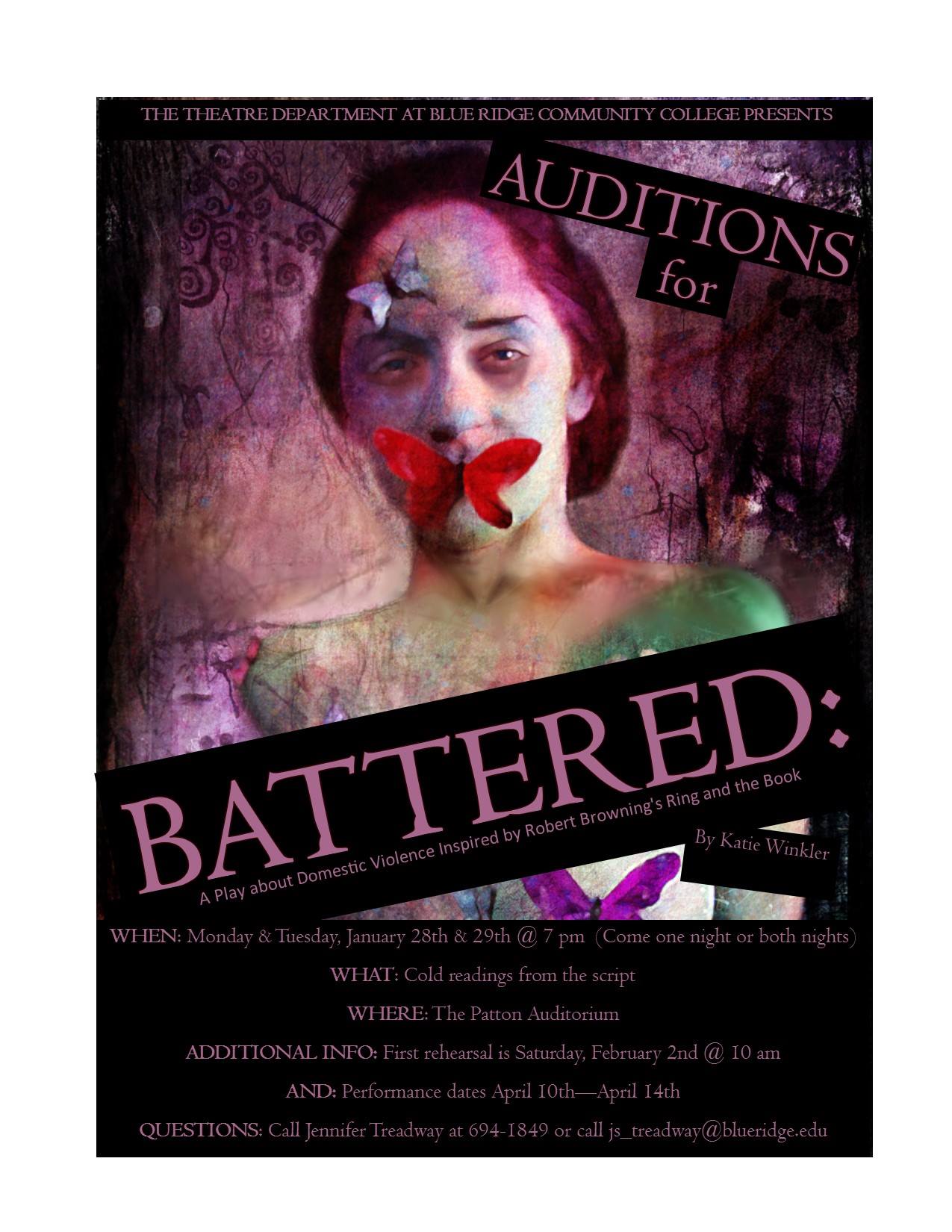
The world premiere of Battered, a play about domestic violence inspired by Robert battered posterBrowning’s The Ring and the Book, will appear April 11-14, at the Patton Auditorium of the Henderson County campus of Blue Ridge Community College in Flat Rock, North Carolina.

Over a period of two years, I have worked on the script along with the director and a hard-working cast and crew. My continuing collaboration with the head of the drama department allows us to provide real-world experiences for students, along with an opportunity to express themselves through their art.

At the latest professional development day, the keynote speaker talked about providing students with what he called peak moments, those educational experiences that provide lasting memories and shape our students’ future. My hope is that this production of Battered will provide such experiences for the cast and crew. I know it has for me.