It’s Worth It

Just looking purely pragmatically, it is still worth getting a four-year college degree. The Bureau of Labor Statistics shows that the higher the degree level, the lower the unemployment rate and the higher the median wages, with the exception of professional degrees garnering higher wages on average and lower unemployment than a Phd. The chart below shows the 2014 statistics:

More and more, however, I hear people, including former students and fellow educators, voice how working towards a four-year degree is virtually a waste of time and money.  I couldn’t disagree more. Even if a person never works in her or his degree field, the skills, life experience and connections made will not only help a person be more employable at a higher rate of pay, but can also help that person be a better informed partner, parent and citizen.

Of course, any acquired skills must be applied. Those who feel entitled to work their dream job at a high rate of pay soon upon graduation are never likely to feel that their education was “worth” anything. Also, there are many who do not get four-year degrees who have meaningful, prosperous careers. I know because my husband is one of them, although his time in training is comparable to a four-year degree in many ways.

I, on the other hand, have worked in my major field of study, English education, for most of my career, yet I have had the experience of not being able to find a teaching job. It was when my husband John was receiving his ultrasound training at Aultman Hospital in Canton, Ohio. Before moving to Ohio I had applied, tested for and been granted a 8-12 English and German teaching certificate. I had spent most of my last year teaching at Armuchee and Coosa High Schools in Rome, Georgia, applying for teaching jobs without a single bite.

We had saved enough money that I didn’t have to work, but things were going to be pretty tight if I didn’t land at least a low-paying position. I did have one interview at a high school, and although I don’t remember much about it, I do remember getting the impression that this little ole southern gal didn’t have a snowball’s chance getting a teaching job in Canton.

So I started looking outside of the education arena into places where my writing and teaching skills might be of use-copy editor, day-care worker, teacher assistant, tutor, but nothing doing. Then, one day I was looking through the want ads and saw that there was a position open for a job trainer at Goodwill Industries, Inc. The ad said that a background in education was a plus, so I called and set up an interview.

The very nice man who interviewed me was the vocational rehabilitation coordinator, Marc Manheim. He asked me about my educational background and also was interested in what kind of work I did unrelated to my degree. My list was long: Day care worker, cafeteria line worker, custodian, groom and exercise girl at an Arabian horse farm, riding instructor, restaurant hostess, dishwasher and secretary. I got the job.

While my experience working in the service industry was invaluable, I found that my teaching skills were absolutely necessary to be successful in my work. As a job trainer I was required to work side by side with my clients, helping them do the job and keep up their rate of production as they were learning the job and then slowly back away and help the client become more and more self-sufficient until I was not needed any more.

As a result I found myself doing many of the tasks I did as a classroom teacher, including mastering the skills I was going to teach my clients, creating a daily plan (in essence a lesson plan), instructing my clients in the numerous skills needed for their work as well as social skills, assessing their progress and the effectiveness of my instruction, then altering my instructional methods and re-assessing.

Because of my experience and the experience of as many as one-third of college graduates according to one study, who do not get jobs in their major area, I can better advise my current students and encourage them to study what they love, learn how to work hard and apply what they learn, developing dedication and tenacity.
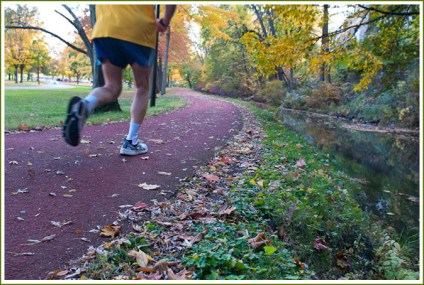
photo2_run

The park in Canton, Ohio, where I used to walk and jog.

Do that and they won’t need to worry about getting a job. They will either find one, it will find them, or they will create one for themselves.

England–Day Six

Had a fabulous day! I had bought croissants at the Tesco’s across the street yesterday. They tasted great with my morning coffee. The hotel coffee service is a bit different than in America because the main bevrage of choice is tea rather than coffee, so all the hotels have a little electric kettle and a tin (can) of teabags and instant coffee. I had been drinking tea, but today I decided to have coffee and, boy, that was the best instant coffee I ever had. I ate a few of the cocoa almonds I packed to give me some protein for my long hike ahead.

British hotel tea service

British hotel tea service

It was raining when I woke up, but by the time I did a little work and got dressed, I could see a few patches of blue. Then I checked google maps and planned my day. Since the rain had let up, I decided to go to Hyde Park as planned. I thought I might take the Underground, but I discovered that the line I needed was closed, so I decided to walk. The directions on Google maps were very good and I saw so much along the way.

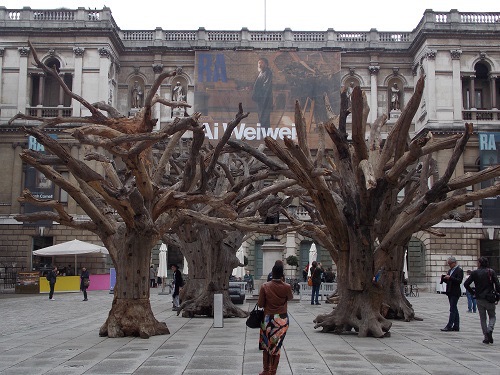
I stopped briefly at the courtyard of the Royal Academy of Arts to take a look at the interesting sculptured trees by Chinese artis Ai Weiwei. The trees, made of various pieces of driftwood bolted together, represent the ethnic diversity of China according to the academy’s website. I was also interested to see that the astronomical society and geograpical society are also housed around the same courtyard.

Ai Weiwei's Tree sculpture in the courtyard of the Royal Academy of Arts

Ai Weiwei’s Tree sculpture in the courtyard of the Royal Academy of Arts

I continued my walk and found myself eventually on Oxford Street, the longest stretch of my walk. I was stopped by a young woman collecting money for a group called Oxfam that helps communities in developing countries have access to clean water. Here is the website adress: http://www.oxfam.org.uk. We talked quite a while, and as she did I was reminded forceably of the tradition of reform and charitable spirit that weaves its way throughout British history and literature. After I said goodbye to Georgia and continued walking along, the sun kept peeking out from the clouds and by the time I got to Hyde Park, the sun came out. To get to the park I passed through the impressive Marble Arch. Then into the park!

Marble Arch near Hyde Park

Marble Arch near Hyde Park

I love Hyde Park, and I just saw a little of it. I took many pictures and walked to the lake. There is a little restaurant right by the lake and it was warm enough to sit at an outside table. I have been so good and exercised so much that I treated myself to fish and chips and a half pint of beer. I thoroughly enjoyed it. Then I walked it off by walking through Picadilly Circus where the famous statue of Wellington is, along with other war memorials. I kept walking to Leicester Square where I’ve been before.

The Serpentine Bar and Kitchen where I ate some great fish and chips.

The Serpentine Bar and Kitchen where I ate some great fish and chips.

I decided to watch another movie. This time I watched Spectre, the new James Bond flick, on the big, big screen at the Odeon Theatre that is famous for its premiers. In fact, Spectre had premiered there on Sunday when my friend and I saw The Suffaragette. It was a totally outrageous movie but I do love a good action flick. When I came out there was another premiere going on at another theater, but I couldn’t get close enough to see much, but I think I saw the top of Bradley Cooper’s head!

The Odeon Premiere Theater

The Odeon Premiere Theater

I took the Underground back and now I am once again safe in my room, watching, what else, Harry Potter! Tomorrow I plan to go to the British Museum and maybe a little museum called the Soane, which is close to the Thames. Then, I have tickets to see Imelda Staunton in Gypsy, my last big show! Many of you will recognize Staunton as Dolores Umbrage in Harry Potter. I’m very excited to see her as Rose in Gypsy. Looking forward to my last day in LONDON.

TTFN

England–Day Five–Rest

Taking a day of rest to catch up with some work and change hotels. I just moved next door, but I still had a lot to do. I advise taking a break like this, so you can rest. You will enjoy everything so much more.

I didn’t just rest, though. I graded papers, wrote announcements and, of course, writing this blog. Tomorrow I will resume my adventures, among them, a visit to Hyde Park!

image

BON VOYAGE!

Featured image

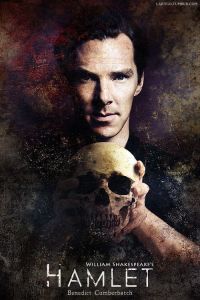
Professional development–It means different things to different people, I suppose, but in my mind, I will soon be experiencing the most wonderful professional development a teacher of British literature could ask for. I’m going to England! One of the highlights of the trip will be seeing Benedict Cumberbatch performing the leading role in Hamlet at the Barbican in London.

The timing is perfect because while I am there, seeing Hamlet live, my students will be reading Hamlet and watching a movie version of it. I wish I could take them with me, but I plan to do a video pre and post show in front of the Barbican and take as many pictures and videos as I can to use in my British literature classes.

I also plan to use my experiences to continue to refine the major capstone project in my online literature classes–the literary travel project that I have discussed in previous blogs. I have created sample literary travel projects, and now I can test out my own literary travel plans to further refine those samples, as well as the project directions, and help my students get the most out of their major research project.

Keeping up with all of my classes, seated and online, will be a challenge, but I thought one way to stay in touch with them, and with anyone who is interested in the value of international travel as professional development for faculty. will be interested in my blog posts over the week–STARTING ON FRIDAY, OCTOBER 23!

Some Weeks Are Good

I know I whine, but not always. Sometimes things work out. Some weeks are good. Last week was one of those. Classes went well. Real collegiality and collaboration took place. Respect was the watch word. Yes, it was a good week. In celebration, I’m printing the lyrics (rough draft) to one of my favorite songs in my new musical CAMPUS. This song is sung by the three “fairy godteachers.” Enjoy!

The Liberal Arts

Mrs. H (singing)
When I lived in Chicago.

Mrs. Mc and Mr. T.
You lived in Chicago?

Mrs. H
Back when I was a girl.
One thing I used to do

Mrs. Mc and Mr. T
What was it?

Mrs. H
I used to read.

Mr. T
Who would have guessed?

Mrs. H
I mean only read.
You’d think the teachers would agree
That reading was a great activity
But they would roll their eyes and give that look
When they called on me and my nose was in a book.
I read
The Three Musketeers in history.
I think Jane Eyre in PE
In Science it was Pride and Prejudice
Lord of the Rings I read in Math
I even got in trouble for reading
In English class.

Ms. M
Why was that?

Mrs. H.
I’m not sure of the cause
But I think it was
Because I was reading Judy Blume
Instead of Sylvia Plath

Mr. T
But what does this have to do
With signing up kids for class?
How do we make them move
Get up off their tiny…

Mrs. H
I’ll tell you.
And then there came a day
That wonderful, glorious day.

Mr. T
Here we go.

Mrs. H
When I knew
Without doubt
What learning was all about…
It was fifth grade and I was all alone
I had no friends to call my own.
Just only had my books
To keep me company
To keep away the looks
They gave to me.

Then we went to the art museum
The Chicago art museum
And walking down the staircase
I looked up and saw it fill the wall
A painting all in black

Ms. M and Mr. T
All in Black?

Mrs. H
Mainly black.
With a thin line of white running down the middle
And an orange line running down the side.
That was all

Then I walked down that massive stairway
Step by step
Moving closer
Moving nearer
To the truth.

Mr. T.
What truth?

Mrs. H.
There was something
In all the blackness
You couldn’t see it from afar
There was meaning
In the darkness
Shapes and form
And art

Ms. Mc
I love this little story
But I’m not sure what it means

Mr. T
That makes two of us
I just don’t see
What you’re trying to say.

Mrs. H
I’m trying to say
That after that day
I knew what school was all about
Giving me knowledge for my work
But teaching me so much more
Teaching me how to live and
What to live for.
Because you only know what truth is
When you get close enough to see
I learned that’s what the liberal arts
Could give to me.

The Liberal Arts
The Liberal Arts
Because you only know what truth is
When you get close enough to see.

Ms. Mc
Now I know what you mean
I’ve felt it too
I only cared about computing
When I was in school
And Chemistry was okay too
The calculations were somewhat challenging.

Then I went to a symphony with my class
Drug to hear a full orchestra on the lawn
Of an old mansion in downtown Tulsa.

Mr. T
Tulsa?

Ms. Mc
Downtown Tulsa on the lawn
With my 10th grade class
When I was just fifteen
I sat through some baroque
Didn’t really have a choice
And some other too straight forward
I can’t remember what it was
Then came The Moldau

Mr. T.
The what?

Mrs. H.
Bedrich Smetana’s The Moldau

Mr. T
Right.

Ms. Mc
I’d never heard anything like it before
It was a river
A river flowing through the music
Through my mind
Starting as a stream
Running through the strings
And I heard the poem
The musical poem
With structure and form

So I’m trying to say
That after that day
I knew that school was all about
Giving me knowledge for day to day
But teaching me so much more
Teaching me how to live and
What to live for.

Because you only know what truth is
When you sit still enough to hear
I learned that’s what the liberal arts
Could make so clear.

ALL
The Liberal Arts
The Liberal Arts
Because you only know what truth is
When you sit still enough to hear.

Mr. T
Well, you two can really get on my nerves
I just don’t like people it’s true,
But you’re really all right you two.
I see what you’re trying to say.
Because it happened to me one day.

Mrs H and Ms Mc.
It did?

Mr. T.
It did.
Actually it was one night.

Mrs. H.
Oh, no, not one night.

Mr. T
Well, yes there was a girl
A beautiful girl
With brown eyes and brown hair
Who wore lots of leather
If I remember right
In my acting class.
But she was different than the others
Didn’t want to be a star
She studied and studied
Wanted to be a doctor
But I didn’t care
I just wanted to get with her
Backstage.

Mr. H.
Oh, please.

Mr. T
Well, anyway,
She wanted to go on this field trip
I didn’t really want to go
To the planetarium in Pittsburgh.

Mrs. H.
I didn’t know you lived in Pittsburgh

Mr. T
There’s a lot you don’t know.

So I signed up for the field trip
Flirted with her on the bus.
But she wouldn’t sit next to me
In a darkened room with us
Boys. I guess she was right.
Not to sit next to us boys that night.

So I was bored out of my skull
As the show began to start.
Just about to go to sleep
Until it happened.

Mrs. H and Ms Mc
What happened?

Mr. T.
Out came the stars
In the center of the winter night
They said I could see a hunter.
A hunter I didn’t see
They said two stars mark his shoulders
And two stars mark his knees
Then they outlined his form
Standing with his arms upraised,
A hunter standing strong
I saw Orion.
I saw the Orion Nebula

I’m trying to say
That after that day
I knew what school was all about
Giving me knowledge for my work
But teaching me so much more
Teaching me how to live and
What to live for.

Because you only know what truth is
When someone points you to the light
I learned what liberal arts can do
That fine winter’s night.

ALL
The Liberal Arts
The Liberal Arts
Because you only know what truth is
When someone points you to the light

Mr. T
That’s the day I wanted to teach drama

Ms. Mc
That’s the day I wanted to teach math

Mrs. H
That’s the day I knew I could teach English

All
The day we finally understood
And knew we could

Teach the liberal arts

Who Are You?

California_09 007

“Who Are You?” –These are the words of a text message I received recently in response to a work-related request. I responded back, “Katie Winkler.” No message came back. It was a little thing and was not meant to offend. It’s not important in the grand scheme of things, but it is symbolic of the way I feel sometimes as an instructor at a community college.

Who are you to ask questions about the college’s policies and procedures developed by those with little or no educational background?

Who are you to request materials to support the recruitment of students at a college with declining enrollment?

Who are you to question the expenditure of nearly a quarter of a million dollars on an initiative that many studies show leads to little improvement in retention and completion rates?

Who are you, Katie Winkler?

I am an instructor who comes in early and stays late, even though I am not required to. I am an instructor who works on the weekends grading papers and writing instructional material for my online class because I’ve been interrupted throughout the week by non-instructional tasks, reports, and meetings when I wasn’t teaching and preparing for my seated classes. I am an instructor who tries to answer student e-mails within a few hours of receiving them, even on the weekend.  I am an instructor who works throughout the summer on my classes, even though I am not being paid because I want my students to have the best possible experience while keeping an insane grading load manageable. I am an instructor who cares.

Who are you, Katie Winkler?

Even though you have worked at an institution for over 20 years, people still ask you how many of those years were full-time as if your adjunct years were of no value. You are asked to take minutes as soon as you walk through the door for your first meeting on a new committee when the room is already full of other people. Your integrity is questioned concerning your instruction, your travel, your compensation and your intentions. You are accused of being uncooperative in open meetings by people who rarely communicate with you except to criticize you. You are frequently chastised by members of support staff for mistakes you make in filling out forms that have little to do with actual instruction, even though the procedures for filling out said forms are unclear. You are asked to make your own appointments when you have questions of support staff. You are often interrupted on a whim, without regard to students who might need your assistance. You are an instructor who is forced to send maintenance request to get toilet paper and hand soap in a bathroom frequented by students but no one else. You are a little person with little power who is considered to be of little worth and quite a thorn in the side of many because you demand to be heard on behalf of yourself, your colleagues and your students.

But who are you, really, Katie Winkler?

You are respected by your immediate supervisor, your close colleagues and your students. You are a gifted instructor in class and online who regularly holds 75% to 80% retention rates in online classes. You have made a positive difference in the lives of your colleagues and students. You are a good collaborator who is willing to learn and adapt to new methods and technologies for the sake of your students.

You are dedicated, determined, knowledgeable, well-read, kind, long-suffering, stubborn, assertive, whiny, strong-willed, caring, cooperative, impulsive, decisive, intelligent, self-effacing, witty, maternal, greatly flawed but self-assessing and driven to improve.

Who are you, Katie Winkler?

You are wife, mother, writer, actor, preacher, counselor, nurse, adviser, editor, chef, reviewer, director, mentor and friend.

You are a good teacher.

Sometimes I just have to remind myself.

Another Guest –Hey, I’m busy reaching my writing goals for the summer

thought-police-e1369141340932

I’m busy with my fiction and playwriting, but here’s another great guest article. This is from The Atlantic–“The Coddling of the American Mind” by Greg Lukianoff and Jonathan Haidt–interesting read. It comes through an organization I support called FIRE–Foundation for Individual Rights in Education. They support and promote free speech on college campuses–even speech the general college population doesn’t want to hear. I like that about them. They are quoted in the article, which is about the pervasiveness of political correctness on our campuses that is quenching free speech and maybe even harming the psychological well-being of students.

Here’s the link: http://www.theatlantic.com/magazine/archive/2015/09/the-coddling-of-the-american-mind/399356/

Guest Blogger James Hogan on the State of Education in North Carolina

I’m in Alabama visiting with my mother and brother and helping them get ready for my older brother and his family visiting from Germany, but this article by James Hogan, re-printed by Valerie Strauss of the Washington Post is worthy of a read.

Here’s the link:

http://www.washingtonpost.com/blogs/answer-sheet/wp/2015/08/07/north-carolinas-step-by-step-war-on-public-education/?postshare=7261439154188373

Katie Goes on a Tear

liberal arts

Classical Liberal Arts

Recently a posting about the cost of education in America compared to countries that offer “free” education got me really going on a tear for some reason. Some of the comments by people I know, like and admire, made me realize how many misconceptions people have about a liberal arts education. First of all, I understand people’s frustration with the current state of higher education in America–it’s a case of paying too much for too little. However, it isn’t entirely the learning institutions’ fault, though they certainly share the blame.

No, the biggest reason behind the failure of our high schools, colleges and universities is that we, as a people, do not understand the true nature of a liberal arts education and therefore devalue it. Listening to some administrators, students, their parents and the general public, I conclude that most people view getting an education as a means to an end–getting a job. Many people seem to think that when they, or the government, pay tuition that they are basically purchasing a diploma, certificate or degree that they need in order to become employed, like purchasing transportation or clothing or anything else that makes work possible.

See, I’m still on the warpath, but I’ll get over it. I’ll have to in order to keep my sanity. It did help to vent on the hapless people who commented on my comments on Facebook, and I thought some of my points were pretty darn good, actually, so I’m going to re-print them here.

Point #1–There is something to be said for providing high performing high school students with at least the first two years of college, like in Georgia. It’s not free–students have to work very hard in high school to maintain a B average to get a Hope Scholarship. Getting an education is the goal–not getting a job. We need citizens who know how to read and write well and most importantly how to think critically. We need to give people an incentive to truly learn something in high school, and we need to give parents an incentive to push their kids to do well in school. We could do this if we adopted something like what Georgia has.

Point #2–Getting an education is about more than getting a job–it’s about learning how to think critically and problem solve and be autonomous, not under anyone’s control except God’s. It’s power to the powerless, it’s learning how to appreciate art and literature and music. It’s about making life better for yourself and the people you love. We have lost our way; we have forgotten what a real education is, and we have substituted it with this paltry idea of mere job training. Show me a person who is truly educated–and I don’t mean has a degree–I’m not talking about degrees, and I’ll show you someone who has a career that fulfills him or her. And if that thinking person doesn’t have a job, then he or she doesn’t want or need one. (A bit hyperbolic but I was fired up)

Point #3–We need to start realizing that education is for everyone and start making our middle and high schools places of real learning again. I don’t think everyone needs a four-year degree. I think we need to start coming up with alternative ways for people to get their education, but the biggest concern should be helping people see the value of an education–of learning how to read with real comprehension, to write clearly and effectively, to use modern technology to do meaningful, practical research. Diplomas, degrees and certificates are meaningless unless people are learning skills like problem-solving that will benefit them no matter what they do for a living because more than likely they will be changing careers and jobs more than once in their lifetime, so they need to learn skills that will help them adapt to new work situations quickly–they need to learn how to critically think–we still have that in this country but it’s quickly being lost to this idea of utilitarian education that has been proven (just look at the results of the Industrial Revolution)–it’s called a liberal arts education and it works but only if the public understands the value of it, and right now liberal arts education is under fire and too many people don’t see its value. That is a crying shame.

William Eldridge Dabbs–My Uncle El

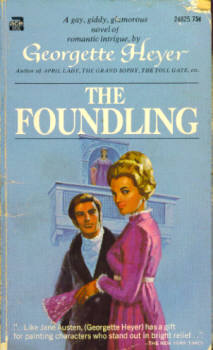
The Foundling

This is the edition that Uncle El gave me. I had to replace it a couple of years ago because I read and re-read it so much. I still have the copy, though.

My Uncle El, my mother’s only sibling, passed away over 25 years ago. He, like the rest of those in my mother’s family, was a teacher–at least for most of his life. He taught Spanish. After his first heart attack, even before really, he, like so many teachers before him, was experiencing some significant burn-out–totally understandable burn-out, but he never lost his teacher heart–his love for books and words and music–his yearning to travel and see new places.

He was a tolerant and patient uncle, up to a point. I think when I was about 10, my brother, sister and I learned just how far we could push him–my younger brother learned later. He was a kid’s dream uncle. He would take us to the movies in whatever cool car he had at the time (the convertible complete with 8-track player was my favorite). I remember one time after seeing Charlton Heston in a Sci Fi movie, riding around Columbus with the top down, hanging out the window and yelling, “Soylent Green is people!” And he let us do that! What a great guy!.

Always single with no family of his own, he was always there when we needed him. He drove mom to the hospital when she went into labor with my brother Rob. He took my sister and I to horse shows–staying with us in the heat of an Alabama summer day and late into the night. He accompanied our family across the country when my dad came home from Vietnam, and we wanted to meet Dad in California. He took us out for pizza and steak, ice cream ahd his favorite, Chinese food. He bought us fireworks (legal in Alabama at the time), something that Mom would not have done for sure. He would let us play while he stayed inside and read his books. He was always reading a book.

To satisfy his love of books on a public school teacher’s pay, he often frequented the big used book store in Columbus, Georgia and another one in Montgomery, Alabama–Auburn was still just a little college town and didn’t have too many places to shop in the 60s and 70s. He would go on these book trips and get dozens and dozens of books. He was very proud of them and kept them all in order. He would get detective novels, historical fiction, thrillers, and even romances. He never said that he got the romances for me, in fact, I often saw him reading them himself, but he always made it a point to show me the romances that he bought, and I felt that they were for me.

After one of these shopping trips, he showed me a box full of one particular romance author–Georgette Heyer, his favorite Regency romance writer. I had not started reading Jane Austen yet. She was still a bit difficult for me, so he told me that Heyer was a 20th Century author who wrote about the early 19th Century in England, just like Austen, but that Heyer would probably be easier for me to read. He had at least a dozen of her books in the box, and he challenged me to read them that summer. I took up the gauntlet and after the first book I was hooked! Heyer wrote with such wit–her characters were funny, heroic and honorable–just like Austen. Heyer’s heroines were not always the most beautiful or even the most clever, but they had courage and resilience, and I so wanted to be like them.

Uncle El made it a point to collect all of the Georgette Heyer Regency romances and mysteries. He would read them too, and we would talk about the wonderful characters and the funniest passages. Reading Georgette Heyer, and soon afterwards, Jane Austen, the Bronte sisters, Anthony Trollope, Charles Dickens, Elizabeth Gaskell and others, I became a true Anglophile and have remained one ever since, now teaching British literature, specializing in 19th Century British literature.

I don’t think my uncle was looking for a teachable moment when he introduced me to Georgette Heyer–he just shared his love of books with me, but his interest in me and in my literary education has had a profound and lasting impact on my life. He was a great teacher, a great man, and I miss him.

*   *   *

If you like witty, charming romantic novels, give Georgette Heyer a try. Here are a few of my favorites:

  • The Foundling
  • Friday’s Child
  • Cotillion
  • The Quiet Gentleman
  • The Unknown Ajax