The 2025 Spring/Summer edition of Teach. Write. is dedicated to the people of Western North Carolina and to those who have come to their aid in the aftermath of Hurricane Helene as well as the numerous wildfires that have devasted our area. The themes of resilience and courage weave their way through the poems, stories, and essays.
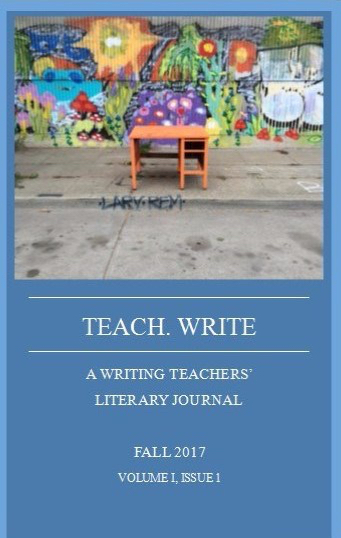
In 2017, I started publishing the literary journal Teach. Write: A Literary Journal for Writing Teachers to showcase the work of teachers. I found throughout my career that seeking publication for my writing, allowing myself to be vulnerable by exposing my writing to the world improved both my writing AND teaching. It’s been a joy.
Read for free online at the journal’s website–teachwritejournal.com or buy a print copy for $15.00 + shipping and handling by clickinghere. Submissions are open for the fall/winter 2025 edition until September 1. I would love to see your work, especially if you are a teacher, but I am open to all. See submission guidelines here.
A few years ago, when I was still working at a small community college in western North Carolina, I was visiting my mother who lives in rural Alabama. Often times towards the end of my almost 40-year teaching career, I would be discouraged and, I’m sad to say, spent a great deal of time bellyaching about the work environment when I was talking with my mother. But this time, I was happily explaining how a new teaching idea (I can’t remember what it was) had positively affected my students. “Sometimes this teaching stuff works,” I said.
My mom and me about ten years ago–photo by Hannah Winkler
Then, after a moment of silence, my mother said, “I know you’re too busy right now, but when you retire, you really ought to write a book about teaching. You’re such a good teacher, Katie.” I teared up then just like I am right now because those words coming from my mother started healing the wounds from a dysfunctional workplace and dwindling societal respect for educators in general. Slowly, the first writing project of my retirement began to take shape in my mind. I would write a memoir of my life as a teacher, and it would be dedicated to my mother.
I actually began writing the book in the last year of teaching but didn’t get very far. The composing process has never come easily to me, and I struggled. However, once I retired and was freed from the stresses of teaching, especially the heavy grading load, the words just seemed to tumble out of me. I had forgotten why I went into teaching in the first place, but now, no longer fixating on the heavy course loads, bureaucratic frustrations, and student apathy, I began remembering the joy of being in the classroom, the challenges I overcame, and the educational adventures I experienced. I had a rough, rough draft in six months, half the time I had given myself to finish.
Happy me at the awards banquet!
Even though I only had a draft of the book, when I saw the opportunity to enter a contest for a full-length memoir that only required the first 2,500 words, I decided to enter since all of the top three awards would cover the fee to the conference that was sponsoring the contest. I thought I had a shot at 3rd place, but never imagined that I would win the memoir category that came with an additional prize of publication!
So, it is happening! The publisher has assigned my book an editor who happens to be just right for me, someone with community college teaching experience who was the first person to greet me at the conference with the words, “I love your work!”
Unlike composing, editing is a joy for me. I would tell my students this; they would just give me that you’re-such-a-nerd look, but I would protest. “No, no, no! You don’t understand. Revision and editing are at the heart of good writing. That’s when you get to manipulate the words, sentences, and paragraphs–add and subtract until you make the writing sing!”
I doubted that many believed me, so I started saving my students’ diagnostic paragraphs in a folder and handing them back on exam day when they wrote a final reflection paper comparing that first faltering writing to the final essay. Sometimes they would audibly express their surprise with a “It is better.” or even just “Wow!”
I cherished those days just as much as I cherish revising and editing my first book: Lessons: A Teaching Life–coming to a bookstore near you, or online, from Martin Sisters Publishing.
***
Coming soon! The next edition of Teach. Write. I’m dedicating this edition to the indomitable spirit of those who have been impacted by the many natural disasters we’ve been experiencing around the world, especially those here in my region of Western North Carolina. Six months ago, Hurricane Helene tore through our area, causing massive damage and a loss of 106 lives. Now, due to the thousands of downed trees and dry weather, fires are blazing all over our region, including upstate South Carolina. And yet, the resilient spirit of our people stands.
The Spring/Summer 2025 edition of Teach. Write. will be up on my sister site on April 1. On that date, I will begin accepting submissions for the 2025 Fall/Winter edition, so take a look at my guidelines and send me your best work!
The Brandy Bar + Cocktails — Photo by usarestaurants.info
It’s getting real, y’all. This month I will begin the formal editing process of my teaching memoir, Lessons: A Teaching Life. If all goes well, the book will be published by the end of the year. I’ve been told it’s never too early to get the word out, so I signed up to read a short excerpt from the book at The Brandy Bar+Cocktails.
For the past several years, almost every month, the North Carolina Writers’ Network–Henderson County sponsors “In the Company of Writers” at The Brandy Bar. It’s great. The Brandy Bar is in an old building on historic 7th Avenue in Hendersonville, NC. Writers gather to hear a presentation by a local or regional poet, author, or playwright, followed by an open mic.
Last Wednesday, the evening began with signing up for the open mic and chatting with writer friends to the sound of blues tunes by guitarist Charlie Wilkinson and Hollywood Jonny. Next, came a marvelous presentation by local poet Tony Robles who read from his two volumes of poetry–Where the Warehouse Things Are and Thrift Store Metamorphosis. Tony moved us all as he read poems about the soul-healing power of physical work and the intrinsic value of everyday life and ordinary people. After the reading, Tony answered questions, offering insight into his work and telling us about the novel he’s working on, his first.
The Reading Room — Photo by usarestaurants.info
I was the first to read after Tony. A little nervous to follow such a great writer and eloquent speaker, but I felt so good afterward. One of the best things about reading a work in progress to an audience is when you get affirmation that your work has value. In my case, I also picked up on a few things I needed to revise, which I was hoping for. I used to tell my students to read their work aloud when they were revising and editing. One of the best ways to check for technical errors, sure, but also an opportunity to analyze word choice, sentence structure, and rhythm.
It was also a joy to hear the other readers. Some were writers I’ve come to know very well over my years of involvement with the Network, but I was happy to hear the fine work of writers I’d never met, including quite a few younger writers. In the company of writers is a good name for the event, one of my favorite places to be. Extra nice to be sitting in a comfortable chair sipping on a specialty of the house, Brandy Alexander.
Lava lamp collection by the bar–photo by usarestaurants.info
One of the most moving pieces came from a bearded man wearing a cap, tattoos covering his arms. He wrote about addiction and dealing with it. After the readings, he approached me and asked if I had ever taught at the University of North Carolina–Asheville. I said I had not, but I had taught at Blue Ridge Community College for 27 years.
His face brightened. He had been there, too. He asked about his teacher, my colleague who retired several years before me. I told him that I met with her regularly, that she was doing well and enjoying retirement. He wanted me to let her know that he was at UNCA finally finishing his degree, in English. “Tell her I’m a little late in getting it but I’m getting it.” I assured him I would let her know.
Once long ago, a student gave me a little wooden plaque shaped like a pencil that said, “Time and distance cannot erase the influence of a good teacher.” I think I’ll remind my friend of that when I tell her about meeting her grateful student while reading at The Brandy Bar.
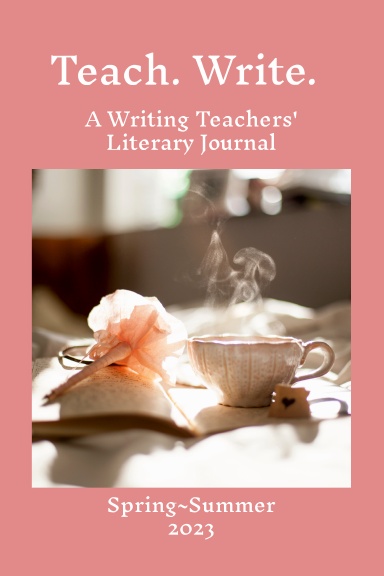
The print version of the 2023 spring~summer edition of Teach. Write.: A Writing Teachers” Literary Journal is available for purchase. Go to this link if you want to order a copy.
Also, an updated online version is also now available here.
I am currently seeking submissions for my first post-retirement edition of Teach. Write. Submissions will close on September 1, 2023. Click here for submission guidelines. I would love to see your work, especially if you are, or were, a writing teacher.
The print version of the 2022 spring~summer edition of Teach. Write.: A Writing Teacher’s Literary Journal is now available for purchase in the Lulu Bookstore.
Once again, I thank all of the fine contributors to this edition. I am so very grateful to them for entrusting me with their work.
I know I give myself so much more to do by publishing this journal, and my teaching, writing, and editing deadlines often collide, but I love editing Teach. Write. It allows me to be autonomous in my creativity. I don’t have to please anyone except myself in the end.
But, of course, I do hope this edition pleases you, too.
Here is the link to the online version if you missed it!
Michele Harper is an emergency room physician, and her book The Beauty in Breaking: A Memoir reminds me of how much teachers have in common with doctors. I’ve blogged about the similarities before. Harper offers more confirmation of my perceptions, especially in “Chapter Two: Dr. Harper: The View from Here,” when Harper describes her internship in internal medicine before completing her residency as an emergency room physician.
In the chapter, she describes one of her professors, Dr. Jaiswal, a “forceful character” (33) whom all the interns feared and loathed. Harper describes how Dr. Jaiswal was particularly cutting and brutal to Harper during the author’s first presentation and in front of the patient, berating Harper for not completing a thorough patient history and for being ill-prepared for her presentation.
Some people, me included, would have been tempted to give up or simply been angry and rejected anything Dr. Jaiswal said out of bitterness and contempt, but Harper learns from the “breaking.”
“I never forgot that encounter,” she writes. “For the entire intern year, I made sure to ask too many questions of my patients….To the best of my ability, I not only read about the topics I didn’t understand, I also read around them. I reviewed the history in my head and practiced my assessment and plan, making sure the reasoning led to a logical conclusion….That was the last time I was unprepared for Dr. Jaiswal’s rounds. What’s important was that in that very long year, she helped me become a better doctor because I saw the good in her, in the value she placed on meticulous preparation and critical thinking” (40-41).
I am not advocating being “deragatory and cruel” (41) as Harper describes Dr. Jaiswahl, but I don’t mind being tough. I don’t really think I am all that tough actually, but in today’s ultra-sensitive world, I am perceived as such by some students, parents, and administrators. I wish I could help them all understand that all I want to do when I challenge and push students is motivate them to stretch themselves–ask too many questions, read about the subjects, read around them. I want them to learn how to think!
Harper offers many stories of encounters with people in her work and personal life who break her or come to her broken, in need of healing. She writes of what she learned from them and how she has come to embrace not the brokenness itself but the lessons that inevitably come from it.
In Chapter Three, Harper writes, “We had all been broken in that moment–broken open by shock and grief and anger and fear. I didn’t know how or when, but this opening could lead to healing. After all, only an empty vessel can be filled by grace; but to get there, we had to help each other rise while we shed the same tears. We had to get up and start again” (68-69).
Another chapter in the book I liked was “Chapter Four: Erik: Violent Behavior Alert.” Harper laments the bureaucratic bull that she has to put up with on her job that does little to nothing to help her patients. Man, can I relate. She speaks about a 2011 study that exposes the myth that most ER patients are uninsured. Not true according to the study. Most are insured and come to the ER for various reasons, including, she says, because they feel “so entitled from unchecked privilege that even polite questioning causes them to blow a fuse” (77). Again, man can I relate.
Harper touches on other issues that doctors and teachers, especially women, experience similarly, including the inequity in how female professionals are treated in the workplace and false perceptions of doctors, but the positive aspects of her work are similar to mine too–helping people, challenging them to take action, to move forward into a new and better life.
The Beauty in Breaking: A Memoir is well-worth the read for anyone, not just doctors and educators; we’ve all been broken, and we all can learn from that breaking–something I want my students to understand.
Harper, Michele. The Beauty in Breaking: A Memoir, Riverhead, 2020.
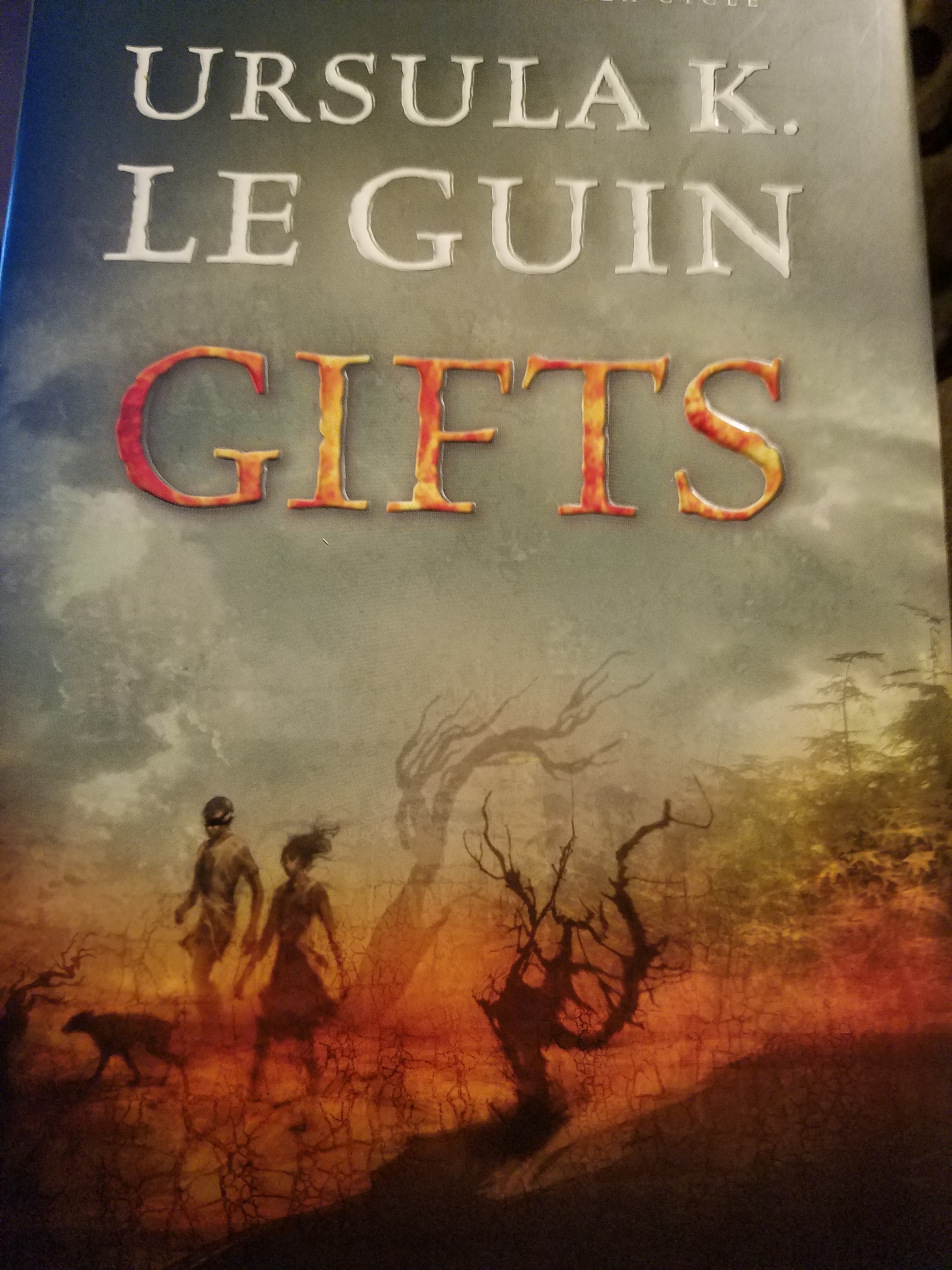
Photo of Cover by Katie Winkler
The next book I finished is the young adult fantasy novel Gifts by Ursula K. Le Guin. In this imaginary world, the people of the Lowlands are blessed, or perhaps cursed, with magical gifts–some seemingly benign, like summoning animals, and some dark and sinister, like the ability to twist limbs or melt flesh and bone.
Two young people, Orrec and Gry, friends all of their lives, must face the consequences when they refuse to use their gifts, refuse to take life only to help others retain power.
In the end, the true power lies in friendship, sacrifice, and love.
It also lies in storytelling.
One of my favorite passages in the novel is when the narrator discusses how storytelling empowers us:
“My blindfold and my mother’s illness worked together in one way that was good: we both had time to indulge our love of storytelling, and the stories carried us out of the dark and the cold and the dreary boredom of being useless” (194).
This is why I love to write. It carries me out of the dark and the cold. It gives me purpose.
Le Guin, Ursula K. Gifts, Harcourt, 2004.
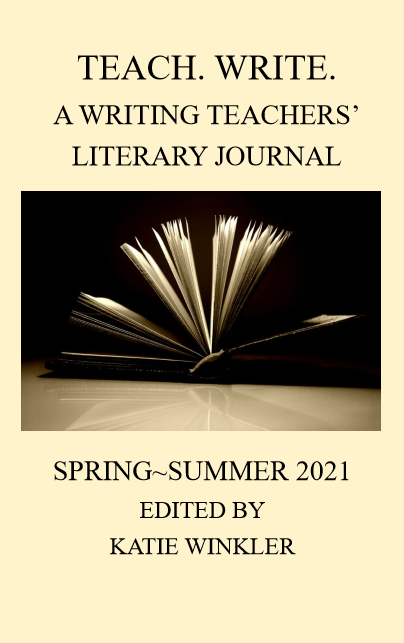
Most writers I know aren’t happy keeping their writing to themselves. That is why I started Teach. Write.: A Writing Teachers’ Literary Journal. I wanted to offer a place where other writers out there, especially writing teachers like me, could share their work. Until September 1, I am accepting short fiction, poetry, essays, and more for the 2021 Fall/Winter edition of Teach. Write., and I would love to consider your work. I am especially interested in the work of those who teach writing, but I am open to all. See the submission guidelines for more information.
ANOTHER EPISODE OF MY PODEL (PODCASTED NOVEL), CAMPUS: A NOVEL THAT WANTS TO BE A MUSICAL, IS COMING YOUR WAY THIS WEEK! NOW’S YOUR CHANCE TO LISTEN TO THE PREVIOUS EPISODES SO YOU WILL BE READY FOR EPISODE 10. IT’S GOING TO BE A DOOZY!
My summertime project is to complete a rough draft of my new novel, CAMPUS: The Novel That Wants to Be a Musical. Full disclosure. It started out as a musical, but then it decided that it wanted to be a novel but one that wanted to be a musical.
I know. It’s incredibly weird, but so am I, so it seems fitting. I am afraid, too, that it might offend because it’s horribly, deliciously satiric, a social and political satire of higher education in the South.
Many of my colleagues already know about the book. Back when it was a musical, I shared some of the ideas and songs with them. I have worked on the project off and on again for several years already, especially when I became particularly infuriated with perceived obstacles blocking my path to providing my students with the best education possible.
Oh, my. I can be so pompous at times.
But
My attitude is changing. Perhaps it was attending the National Council of Teachers of English conference with five of my fellow English instructors, talking about our work and seeing how passionate we all our about our work, but also enjoying each other as human beings–as fathers and mothers, as friends, like family.
My attitude is changing. Perhaps it’s all the months teaching in isolation. Did it take that for me to value the roles of others in my institution? Perhaps. Not that I didn’t appreciate it before, but now, wow, I appreciate it more.
My attitude is changing.
But my convictions have not.
So the play wanted to become a novel, but the novel did not want to lose all of the biting satire of the play because it’s just so darn fun. So, it didn’t. Still a satire. A kinder, gentler satire, perhaps (It hasn’t decided yet), but a satire nonetheless. And I’m still keeping the “I want to be a Nazi” song. I can’t help it. I just want to. And it’s my book, so I will.
But you say, Katie, how can you have musical numbers in a novel?
And I say, how can I not? I know it’s weird and different and really out there. It may not work, but who cares? It makes me happy. It’s creative. It’s about work but not about work. It is helping me vent my frustrations so I will be less likely to take them out on my colleagues, supervisors, and students. Plus, it’s more than just satire. It’s also an Appalachian fantasy with gnomes, elves, the Moth Man, Moon-faced people, hellhounds, wizards, fairy godteachers (yes, really), vampires, zombies, and at least one boojum (aka Bigfoot). It’s also a love story (actually more than one) and a glimpse into the heart and soul of an aging teacher (guess who).
Can you tell I love my book and don’t care that it’s goofy?
So, I’m writing this summer, and it’s time well spent.
Here is the first verse one of the songs:
BEAUTIFUL TRUTH
BY
KATIE WINKLER
“Beauty is truth, truth beauty,—that is all Ye know on earth, and all ye need to know.” From “Ode to a Grecian Urn”~John Keats
Truth and Beauty
That’s all there is and ever will be
I see truth and beauty
When I look into her eyes
It’s been an amazing ride
Since I’ve met her.
My world has opened wide
I’ve only just met her
The Belle dame sans merci
This beautiful lady
And her eyes are wild.
Just to have her near
Just to see her face
Just her voice to hear
Just to feel her fingers brush my cheek
Nothing else remains but she
The belle dame sans merci
Have mercy, have mercy
Help me to see
“Beauty is truth, truth beauty,—that is all/ Ye know on earth, and all ye need to know.”
But I feel it, but I know
Truth and Beauty
I see it when I look into your eyes
Truth is beauty.
I see it when I look into your wild eyes
Beauty is truth, truth beauty
That is all there ever will be
I see truth and beauty
When I look into those wild, wild eyes
Are you a teacher writing this summer? I would love to read your work and consider it for my literary journal Teach. Write. Submissions are open for the 2020 fall/winter edition until Sept.1 See submission guidelines for more information.
Before I was a full-time instructor, over twenty years ago, I presented at my first national conference–the National Conference of Teachers of English. It was in Denver that year, and I paid for the conference myself because I craved professional development, even though I was a lowly adjunct, only teaching three or four large college classes each semester.
In a round table session, I presented an exercise that I had created for my developmental English courses called “The Art of Writing.” The students took a reproduction of a famous piece of art (I had many pictures for them to choose from) and told them to brainstorm about what they saw, using a handout I gave them.
One side of the paper was marked “Concrete,” where they wrote what they saw in the picture or what they could imagine that they could experience with their other senses. On the other side of the paper, I wrote “Abstract,” where students wrote words and phrases that represented how the painting made them feel or what memories, or thoughts in general, the painting helped bring to the surface.
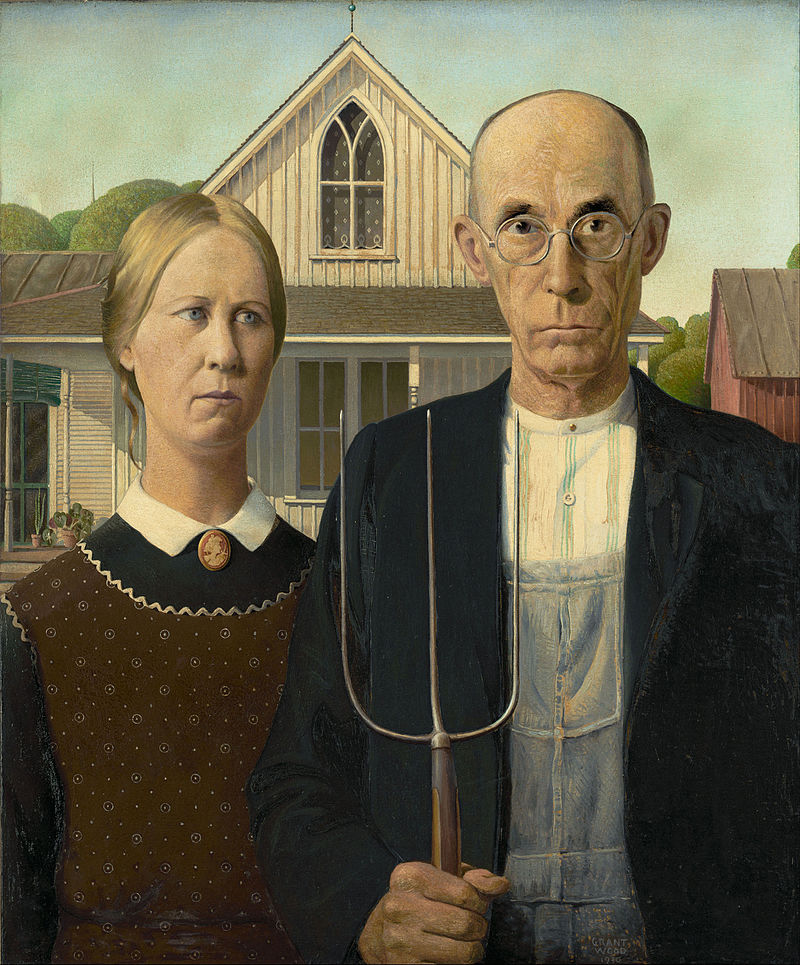
After they brainstormed, the would develop some sort of prose writing based on the art and their brainstorming, combining the concrete with the abstract. I used as an example a short piece I wrote that was based on the iconic painting American Gothic by Grant Wood. Here is the painting and the creative piece I wrote based on it:
American Gothic
I remember marrying him. We stood together in the country church, farmer’s son and farmer’s daughter, too poor for ought else–too much a part of the land anyway. My family sitting on those hand-hewn, hard-backed pews, witnessing.
That night I didn’t utter a word or a cry. Closing my eyes, I imagined I was lying in the distant fields of my home, daises tickling my face and hands and feet.
I worked hard, learning not to expect any praise for the clean floors or hearty food. My greatest joy, to get all of the chores finished in time to head for the fields, to hold the soil of our land in my hand, to feel its moisture and smell its mustiness.
He did praise me once. After three daughters, who were mine to raise, to teach, to find husbands for, I bore him a son. I sweat and strained and screamed no less, but somehow it was different, and he thanked me. Then, my son was gone, no longer mine. So soon he learned not to cry. So soon he became a man.
Now, in that same country church, as my youngest daughter gives herself to a farmer too poor to leave and too much a part of the land anyway, I sit in a hand-hewn, hard-backed pew, witnessing.
**
I quite like this little character study, which went on to be published by the way, but more importantly, the piece inspired my developmental students for over a decade. Some of my students’ writing was published in our yearly literary magazine–one even winning a cash prize as the top fiction piece in that year’s journal.
Another student picked a famous photograph of an American flag on a front porch and wrote an amazing creative non-fiction piece about the meaning of liberty. That student was attending our school under the GI Bill, having served during Operation Desert Storm. I’m telling you, he had a heck of a lot to say about liberty that the younger people in the class needed to hear.
Were they inspired to write or did the assignment just help them feel free to use their creativity? Did the painting give them something to write about, a story already there that they just fleshed out? It was more than likely a combination of things, but whatever it was, many of my students, developmental students, did their best writing when writing about art.
In recent years, the state where I teach has discouraged creative writing or the study of literature in writing classes, especially in developmental classes. The trend is towards more “practical” writing, utilitarian, without flair or heart or life. Surprise! I am bucking that trend. I don’t use my art assignment any more, but my students engage with and write about music, film, theater, literature and art, and their writing is better for it. They are better for it.
In 1938 Winston Churchill, said, “The arts are essential to any complete national life. The State owes it to itself to sustain and encourage them….Ill fares the race which fails to salute the arts with the reverence and delight which are their due.”
Maybe the State, as well as college administrators and curriculum developers, should listen to him.
If you are, or were, an English composition teacher, do you have a writing prompt that you have used in class and would like to share like I did at the conference? If so, I would love if you would submit it to my literary magazine Teach. Write.
In the magazine, I have a feature called “Write Your Own” where you do like I did and write your own creative piece using a prompt that you have once given your students. Accompany your piece with a brief explanation of the prompt or the purpose for the assignment.
I am also accepting general submissions of poetry, flash, short stories, and essays through March 1 for the spring edition. Click for complete submission guidelines. I look forward to reading your work!
A few months ago I was interviewed by flash fiction author Jim Harrington for his blog “Six Questions for…” which is focused on picking the brains of writers and editors to aid fiction writers in composing, revising, and marketing their work. Many thanks to Jim for the feature and for his interesting and informative blog.
The interview is now appearing on Jim’s blog. Hope you will take a look, and if you are now or have ever been a teacher of writing in any capacity, then please consider submitting to Teach. Write. Submissions for the spring edition are open until March 1.












 Hey, Mrs. Winkler!