Comma Lessons

An excerpt from the rough draft of my upcoming book, Lessons: A Teacher’s Life:

Long story ahead, but it will relate to commas, eventually, I promise.

Photo by Smntha.Mntsr on Pexels.com

I know how incredibly blessed I am by having my education provided for me. When I went to a private, Christian university for undergraduate degrees in English and German, I went tuition free because both my parents worked for the university. My mother was a librarian, first in acquisitions and then in special collections, and my father, after he received his master’s in theology, became a representative, which basically meant that he was an itinerant preacher–moving around the southeastern states and visiting people who supported the ministry that supported the university. One of the benefits of working at the university for at least two years was free tuition for your children.

 My parents didn’t make that much money, so this benefit made it possibly for my older brother and me to go to college. For the first part of my time there, I lived at home with my parents, but when they moved back to Alabama to be closer to their own aging parents, I lived in the dormitory. My grandmother and great aunt paid for my room and board. I carried two jobs and paid for the upkeep on my vehicle, gas, and books, so I got off easy. 

Photo by Pixabay on Pexels.com

Then, when I went to Auburn University two years later, it was my grandmother and great aunt who paid my tuition. They had both been long time educators themselves who had risen from poverty because of their teaching degrees and knew better than most the value of an education; they helped all their grandchildren, nieces, and nephews at one time or other.  At Auburn, I once again lived with my parents, paid for my books by working horrible jobs (more about this later) and never had to take out a loan or apply for scholarships. 

My master’s in education at Western Carolina came quite a bit later, but once again, I was blessed. I had been applying for teaching jobs as soon as my husband John and I decided to move to North Carolina, and although I had already become certified to teach 8-12 grade English and German, I couldn’t get a job, even after John started working as an ultrasound technologist at a small hospital south of Asheville. I had several interviews in several counties but no go. 

On a whim, I decided to apply for graduate school at Western Carolina University in Sylva, about 60 miles from our home south of Asheville. I was accepted but didn’t think I would be able to go since we were newly married, newly moved–my husband with a new job fresh out of ultrasound school, and me without a job at all. I wouldn’t be able to afford the out-of-state tuition. We were hoping to buy a house soon on top of all of that. I had signed up to do some substitute teaching, $50 a day, and rarely worth it. You know how kids teach substitutes. 

Photo by Element5 Digital on Pexels.com

But, probably less than a week after I got my acceptance letter, I received another letter from the English department asking if I would come in for an interview. I guess my five years of high school teaching experience and the emergency need for freshman composition instructors made me a good candidate for receiving a graduate assistantship. My out-of-state tuition fees would be waived; my stipend was enough to pay my tuition, books, and the gas it would take to drive from Hendersonville to Cullowhee. 

It was settled. I was going to graduate school. 

Finally, we get to the commas. Well almost. 

The first semester I was required to take a course called “Teaching Rhetoric and Composition”–a down and dirty English composition teaching course. Despite my having taught for five years and having had several teaching courses at Auburn while I worked on my English Education degree, I had to take the course. All graduate assistants were required to take it, and although a bit miffed at first, I soon found the course useful and learned quite a bit.

One of the things I learned, I’ve written about at length in this blog–The Five Easy Ways to Improve Your Writing. Those ideas came from a visiting lecturer in the rhetoric course.

Photo by Polina Tankilevitch on Pexels.com

The other part of that first semester was working in the university’s writing center. My job was to tutor students as they came in to work on their essays. I stayed very busy in the center, especially because of Western’s CC program. I forget what CC stands for, but essays in any non-English class that did not meet basic college-level writing requirements received a CC. If students received two CC’s, they had to take a developmental English course that was notoriously hard to pass, and if the student did not pass, then they were suspended. Quite a few students, therefore, would come in to the Writing Center after the first CC to avoid that grammar class. 

The woman who ran the center was one of the best teachers I ever had. She taught by example. I would listen as she tutored students, helpful and patient but never overhelping, even when sorely tempted. Plus, she had all sorts of materials available to help students and gave me permission to take and use any materials as long as I credited the center. One of the most used handouts at the center was the director’s six simple comma rules. I used this handout as the base of my comma lecture for years because the rules were easy to understand, using little grammatical terminology, and the examples illustrated each rule well. 

Photo by Ivan Samkov on Pexels.com

I’m afraid that handout is only in my mind now, but I used some form of those basic rules throughout my tenure as a community college instructor. It was just always the easiest for my students to grasp in the triage-type grammar teaching that I found myself doing. I added the comma rules to my editing workshop worksheet that I gave to my students when they were preparing their final manuscripts for grading. Here’s what they boiled down to:

Use commas

  1. to separate items in a series of three or more
  2. to set off introductory material
  3. around words interrupting the flow of thought
  4. between complete thoughts joined with a conjunction (if two complete thoughts are joined with just a comma, the writer has a comma splice—major grammar error)
  5. with direct quotations
  6. with everyday material such as dates and addresses

Although I tried to keep grammatical terminology to a minimum, I did use some, so at the beginning of the lesson, I would remind students of some basic terms: 

  • Noun
  • Subject 
  • Verb
  • Coordinating conjunctions (FANBOYS)
  • Independent clause 
  • Dependent clause. 

After the review, I went through each of the six comma rules, giving examples of each. If time was short, I would just cover the first four. 

As a warmup to the lesson, I would try to engage students by using another cool example I learned in grad school.  At the beginning of class, without saying anything else, I would write the following sentence on the board: 

A woman without her man is nothing. 

I asked the students to write the sentence down and add two commas. I gave a minute to complete that and then would ask for volunteers. Often, here in the South at a small community college where sexism is alive and well, students, both male and female, would answer, “A woman, comma, without her man, comma, is nothing.” 

Of course, I would challenge them, tell them there was another solution: A woman, comma, without her, comma, man is nothing. One comma, one comma, I would say, totally changes the meaning of the sentence. That’s how important commas are, I said. 

Then I would begin. 

Rule #1 –Items in a series–First because it was usually the comma rule that students were most familiar with. 

I like apples, bananas, and oranges. 

I explained that if you have three or more items in a series, then you need to add commas between the items. 

I use the Oxford comma and only talked about the option of leaving that remaining comma out if a student brought it up. Commas are confusing enough to students, especially those in developmental classes, so I tried not to complicate things unnecessarily. 

Rule #2–Two independent clauses joined with a coordinating conjunction. I would give an example: 

The dog ran after the cat, but the cat held its ground and fought back. 

It is good to include a compound sentence that needs a comma and another coordinating conjunction that does not need to be separated from the rest of the sentence so that you can explain the difference. 

I explained that you have two independent clauses, reminding them that the only seven words that can join two complete sentences together are the FANBOYS, the coordinating conjunctions: for, and, nor, but, or, yet, so. In the case of this example, you have two complete sentences (independent clauses) joined with but, one of the fanboys, so you need the comma, I would tell them. 

I asked students if they see another conjunction. They would usually find the and. I asked, Why do we not use a comma here? Often times they didn’t answer, so I would ask if there were a complete sentence on either side of the conjunction. No. Then, there is no need for a comma. 

Rule #3–Commas after introductory material. I would explain that you need a comma after words, phrases, and clauses that come before the main clause and give examples:

  • Nevertheless, I left the room and never returned–nevertheless is a conjunctive adverb that modifies the whole sentence, so it needs to be set off by a comma.
  • In the middle of the night, Julia heard a loud bang. In the middle of the night are two prepositional phrases coming before the main clause, so you need a comma to notify the reader that the two phrases are coming before the main clause. 
  • As John was reading the book, he realized that he had read it before. As John was reading the book is a dependent clause–he realized that he had read it before is the main clause, so you need a comma after the dependent clause. 

Rule #4–Anything that interrupts the flow of thought. The next rule is super simplified, but usually this explanation helped students get the commas right without getting bogged down in too much grammar, especially restrictive and non-restrictive clauses. Oh, Lord, don’t go there. I explained that you need commas (most of the time) around words, phrases and clauses that interrupt the flow of thought in the sentence. Alternatively, I said that if you can pull the word, phrase, or clause out of the sentence and the sentence still makes sense, then you need commas around that word phrase or clause. Then, once again, I gave examples:

  • The new owners, sadly, declined to renew the flood insurance on their house.
  • The cat, along with its four siblings, were left in a box on the side of the road.
  • The man, who is standing over there in a red shirt, is my partner. 

Note: This lesson is most effective if spread over two class periods, so there is enough time to answer questions, show more examples, or put students into groups to practice. One exercise I liked to do with students is have them write sentences that use the different comma rules but leave the commas out, exchange papers, and correct each other’s sentences.

I guess, I’m weird, but I really loved comma lesson day. It was pure unadulterated, nobody-could-accuse me-of-indoctrination day, except for that “woman without her man” sentence, of course. Might be too engaging for today’s classroom.

Another reason I’m glad to be retired.

Read. Write.

photo by Katie Winkler

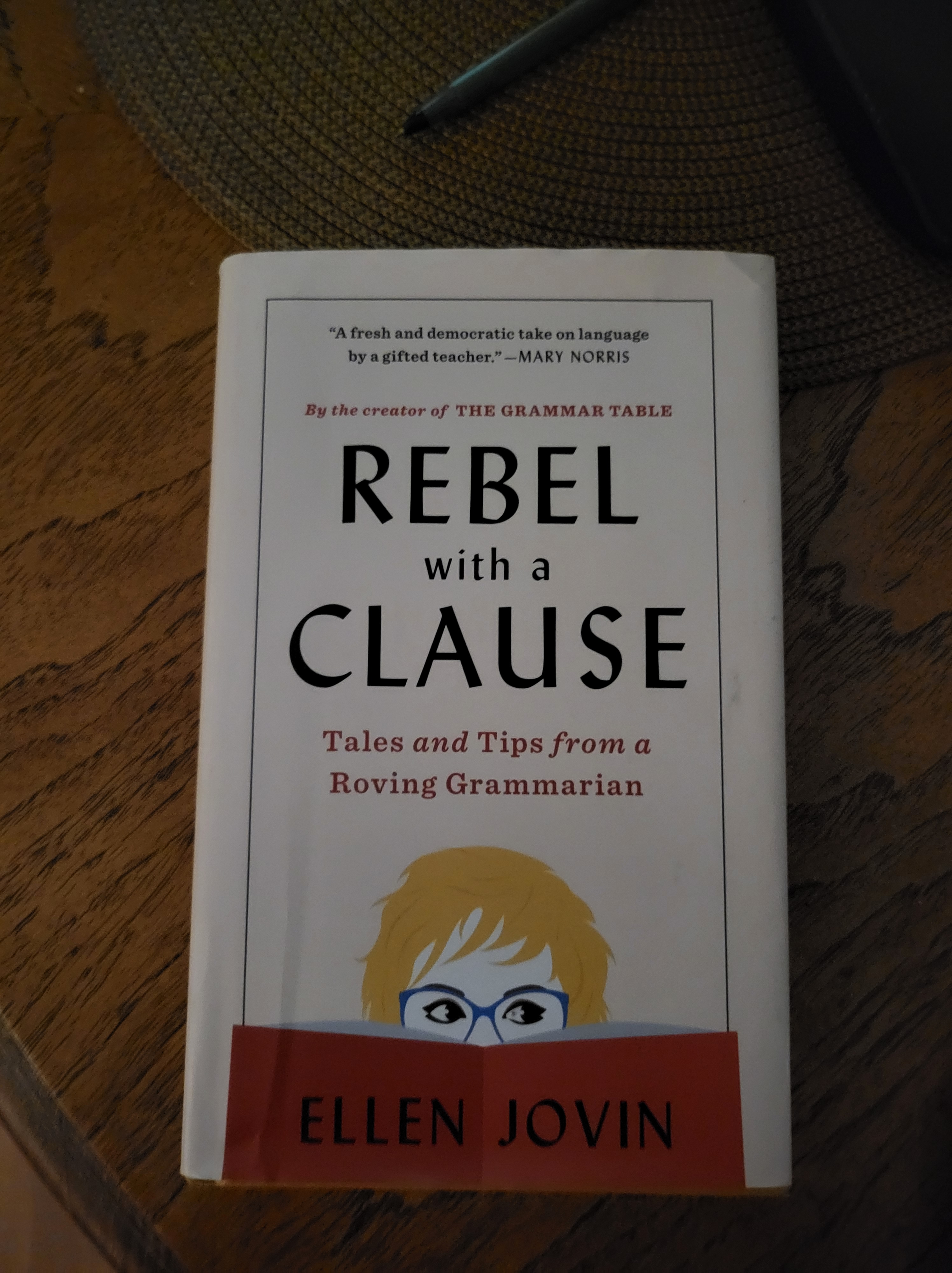
Just finished reading one of the gift books (pictured above) that a dear friend and former colleague gave me my last day at work. It is simply charming and a perfect choice for a woman who has retired from teaching English but will always love grammar.

That’s right. I said it. I love grammar, always have. I remember when I was in high school VOLUNTEERING to take an advanced grammar class because even then I felt drawn to grammar for some strange reason. Side note: Isn’t amazing that a high school in Jenks, Oklahoma, outside of Tulsa, would be able to fill an advanced grammar class?

With its in-depth discussion of parts of speech and detailed diagrams of complex sentences like the Preamble to the Constitution, that grammar class cemented my love and affinity for all aspects of language, including what I used to think most people found uninteresting and mundane. However, Ellen Jovin’s social experiment offers proof that many people find grammar not only interesting but often worth debating–seriously.

Jovin indicates in her introduction that she left her New York City home in the fall of 2018 armed with a folding table, a sign that reads “Grammar Table,” several English language handbooks, and a husband–to record each grammar session for a documentary that is now in post-production. By the time the book was published in 2022, the duo had visited 47 states, missing only Alaska, Hawaii, and Connecticut. I know what you’re thinking, why Connecticut? I mean, it’s right there! In the witty style that suffuses the book, Jovin explains that they were hungry for pizza, got caught up enjoying it, and called it a day without setting up the table. Then came Covid.

Jovin went ahead and wrote the book. Good for her! Each chapter discusses “hot” grammar topics at the table, beginning with one that scorches, the Oxford comma. You know the one–“eats, shoots, and leaves” or “eats, shoots and leaves?” Her measured response to even those who feel most strongly pro or con, mainly pro, is another hallmark of the book. I love the way that Jovin finds a way to smooth the ruffled feathers of even the staidest visitors to her table.

Some of my favorite topics include participles, gerunds, punctuation of all sorts, homophones, and possessive apostrophes. Foremost, I found validation as I was in agreement with this grammar expert in almost every case and can remember explaining concepts in a similar way to my students over the years. Jovin uses example sentences and draws little diagrams and simple drawings as aids, just like I did, and they work! Just like they did for me. To use a southernism–It just tickles me.

Photo by Vlada Karpovich on Pexels.com

Her style and organization have inspired me as I continue to work on my own writing project, a memoir of my career as an educator. Like her I don’t want to write in chronological order but topically, showing how my life experiences have impacted the classroom. I also want to infuse humor and introduce interesting, quirky characters into the work as she does. I want it to be entertaining as well as informative. I want to teach and write, just like I ask others to do.

~~~~~~~~~~~~~~~~

Speaking of Teach. Write., if you have anything you would like to submit for this edition, then the deadline is fast approaching–September 1. The fall/winter edition will publish on Oct. 1, and I will reopen for submissions at that time. I have some great pieces to share with you in this new edition, so stay tuned for more information.

Pet Peeves

woman holding her head

Photo by David Garrison on Pexels.com

Not earth-shattering. Not life-destroying. Not important at all in the grand scheme of things, or even in the niggling scheme of things, but here are some of my pet peeves. I freely admit that I peeve myself at times, and I’m sure, others as well. But here goes anyway–for kicks and grins.

  • Using st, th, and nd when writing dates–Example–January 1st, 2020. In American usage, the convention has been, and will continue in my teaching, to be–write January 1, 2020 and say January 1st, 2020. The problem is that the British often use the endings when writing the dates, leading to understandable confusion. I am an anglophile from way back, so I’m not dissing the Brits, but I am also an American English teacher, so I will teach American standards. Here’s more about it from Daily Writing Tips: January 1 Doesn’t Need an “st” 
  • Placing the end mark outside the quotation marks–Example. She said, “We are in America, so we should use American punctuation conventions”. Yes, we should, and in American English the punctuation almost always goes INSIDE the quotation marks. “We should use American punctuation conventions.” Here is more on the subject from Grammarly: Does Punctuation Go Inside Quotation Marks?
  • Leaving out the possessive apostrophe OR adding an apostrophe with a simple plural. We need apostrophes, yet we don’t need apostrophes. The rules are simple:
      • Use an apostrophe with contractions or to show possession.
      • Do NOT use an apostrophe with a simple plural.
      • If the word ends in s, then generally the apostrophe comes after the s, but there are significant exceptions, such as when using irregular plurals.
    • It seems insignificant, and maybe it is sometimes, but not using the apostrophe when appropriate and using it unnecessarily can both lead to misunderstanding and also drives Mrs. Winkler crazy!
    • An example–I cant attend the New Years party, but I dont want to go to Sherrys house again because I dont like her childrens’  loud toys’ that company’s seem to love selling at this time of year.
    • Now my spell checker caught dont, Sherrys, and childrens’, but not the cant , Years, toys’, and company’s because although the spellcheck programs are more and more sophisticated, they are not (yet) sentient and can’t replace a writer’s own careful editing and revision.
    • Here’s more on the subject of apostrophes from Purdue University’s Online Writing Lab (OWL), one of the first and still one of the best: Apostrophe Introduction
  • It’s and its, a problem that gets its own category. Its own category–no apostrophe because it’s a possessive pronoun. It’s a possessive pronoun--I used an apostrophe because I am using the contraction It’s to mean It is. I think people understand the rule for the most part, but its an easy mistake to make (I did that one on purpose. I swear). Here are the rules again (not trying desperately to be clever this time):
    • It’s is the contraction for It is–Example–It’s snowing on January 5, 2020. The little trick I give my students is, “Can you say, It is in place of It’s? If so, then you have correctly used the apostrophe.
    • Its is the possessive pronoun–Example–The horse chewed on its hay. I understand why people get confused here: Its is a possessive pronoun. We hear the word possessive, and we immediately think apostrophe, but I tell my students, think of it this way– we don’t write hi’s car or his’ car do we? Nouns that show possession use apostrophes; pronouns that show possession do not. Here is an exercise to practice distinguishing between the two from one of my favorite grammar sites–Grammar Bytes: Word Choice–Exercise 13
  • Capitalizing when one shouldn’t and not capitalizing when one should. Okay, I get it that people don’t want to capitalize. It is sooooooooo much trouble to hit the shift key and type a letter, especially when writing with a smart phone. But increasingly I am seeing words that should NOT be capitalized being capitalized, especially doctor, lawyer, mother, father, even brother and sister, as well as a myriad of other words that should not be capitalized in academic writing. I am not too peeved by occasional unnecessary capitalization, often the person is just trying to show respect, but often capitalization errors show a lack of concern for proper writing, even when the person is writing assignments for a composition class! Here is more about capitalization from Grammar Girl: When Should You Capitalize Words?
  • I definitely get peeved when a person does not capitalize the personal pronoun “I” when emailing an English instructor. Come on, guys! Get with the program!

How much can an English teacher take?


cover_springsummer2019

I promise I won’t get peeved with you if you submit your best work for publication in my bi-annual literary magazine Teach. Write. Submissions are open for the 2020 spring/summer edition until March 1. See submission guidelines here. 

The Second of Five “Easy Ways” for Students to Improve Their Writing

man using laptop on table against white background

Photo by Pixabay on Pexels.com

It’s been a busy time for me, and I haven’t had much time to work on the blog, but I had a good response from my first posting about five easy ways for students to improve their writing, so I didn’t want any more time to pass before the next installment.

The first of the five easy ways was to eliminate the use of first and second-person pronouns in academic writing. I can hear someone saying right now, “Just like an English teacher, not following her on rules,” but I tell my students that there is a time and place for using the first and second person; however, with so many bad writing habits around, eliminating them altogether for a time often helps people to control their use. The time, I tell them, lowering my reading glasses to peer at them, is in my classroom.

The same is true for the next of the five easy ways: Avoid beginning sentences or clauses with “There” and “It.” When community college students, many of whom are unfamiliar with the process of revision, are encouraged to find words and phrases that should be eliminated or avoided, what tends to happen is that they will often need, or even want, to change much more about the sentence than just the one word. Sometimes they make their overall sentence structure much stronger and clearer by recognizing one or two things that need to be avoided.

Therefore, I ask students to avoid beginning sentences with “There or “It” rather than eliminate them, but elimination is best. In the paragraph assignment described below, I ask students to eliminate the words “there” and “it.” But I begin with a curious request: I ask them to write a paragraph where every single sentence or clause begins with “there” and “it.”  What?

Take a look!

For the next paragraph assignment, I want each student to write a paragraph on one of the following subjects, but here is the trick–every sentence or major clause should begin with either “There” or “It”–that’s right–every sentence or major clause. Doing this should make sense when we do the next assignment

Begin with a topic sentence that contains the main idea, and write five to eight sentences that support that main idea and then write a concluding sentence.  Be sure to use specific sensory language to create a dominant impression as explained in the text and on the video.

In your paragraph describe one of the following

The lake at BRCC

The Patton Parking Lot

A classroom at BRCC or some other room

The Patton Building

The General Studies Building

Since you are online students, you may not be familiar with these places, so choose a room, building or other feature of any school that you attend, your home or the city or town you live in. It should be somewhere near Blue Ridge, though.

Example:

General Studies 115

     It is a plain room that, in the end, is quite remarkable. There are four white cement block walls. There is one blank wall, one wall with a bulletin board and two walls with white boards.  There is a bulletin board in the back that has been there for over five years, its blue background fading. It once had bright red trim, now pepto-bismol pink. It has old flyers from long ago events tacked here and there. There are tables and hard plastic chairs, a few broken ones. There is no sound except the hum of the ancient data projector and the rattle of the ceiling vents. It is a typical old classroom in one of the oldest buildings on campus. It is without life, until the first student, back pack slung over his shoulder, wanders in and takes his seat.

After the students have turned in that paragraph, I assign the following: 

You probably have guessed what I want you to do. I hope so, anyway.

I want you to take the paragraph you wrote for Assignment 2.2 and eliminate all uses of “there” and “it.” Might be harder than you think, but the exercise will hopefully make you more aware of how much we overuse these two words.

NOTE:  Don’t forget your first lesson–No first or second person pronouns either. 

Use my rewrite as an example (I begin with the original paragraph, so you can see the changes that I made). Notice that I took out words, added words and totally rewrote some sentences to better conform to good descriptive writing techniques. You should do the same.

Original Paragraph: 

General Studies 115

     It is a plain room that, in the end, is quite remarkable. There are four white cement block walls. There is one blank wall, one wall with a bulletin board and two walls with white boards.  There is a bulletin board in the back that has been there for over five years, its blue background fading. It once had bright red trim, now pepto-bismol pink. It has old flyers from long ago events tacked here and there. There are tables and hard plastic chairs, a few broken ones. There is no sound except the hum of the ancient data projector and the rattle of the ceiling vents. It is a typical old classroom in one of the oldest buildings on campus. It is without life, until the first student, back pack slung over his shoulder, wanders in and takes his seat.

Revised Paragraph

Student Name

Katie Winkler, Instructor

ENG 111.202

13 January 2018

The Old Classroom

     The plainest of rooms in one of the oldest buildings on campus is, in the end, quite remarkable. Standing in the front, listening to the ancient data projector and ceiling vents hum and rattle, the instructor, a 23-year veteran, faces a bulletin board, mostly blank, with just a few outdated event flyers tacked on its faded blue background, its once bright red trim now Pepto-Bismol pink. Brown tables and hard plastic chairs in conforming rows stand silent, or languish in the corner–broken and of little use. Then, the room, and all its occupants, like old, loyal soldiers, come to attention when the first student, backpack slung over his shoulder, wanders into the room.

Note: The two bold words (its) are being used as possessive pronouns in this paragraph and are therefore allowed. The contraction “It’s” would not be allowed. 

I have only used this assignment for the past two or three semesters, but I have had excellent results. Do students continue to have issues with overusing “There” and “It”? Of course, but, after this lesson, they have two easy things to look for when tackling the required revisions of rough drafts.

The third easy way will be coming your way soon!!!

NOTE: I neglected to mention in the last post that I am indebted to the classic little book on composition The Elements of Style by William Strunk, Jr. and E. B. White for the development of my Five Easy Ways series of lessons. One of the greatest, and most accessible, books on writing, The Elements of Style, practices what it preaches–be concise and clear, my dear.

cover

Do you teach English composition or have you had a positive writing experience with a gifted composition instructor? If so, please consider submitting a short story, poem, or essay to Teach. Write.: A Writing Teachers’ Literary Journal. Submissions are now being accepted for the Spring/Summer 2019 issue and will close on March 1, 2019. Click  here for submission guidelines.