English Lesson

(Lines Composed after a Bodaciously Bad Day)

by Katie Winkler

A comparative–

Better than before.

Better than this.

Better than that.

Better than some.

Use it in a sentence, please.

When will it be better?

I have been so much better.

Only you can make it better.

Only you

It’s an adjective, dear.

See, here–

Better times

Better rhymes

Better ways

Better days

Simply good is only an adjective.

And the Best is so superlative.

But

Better

Is

Comparative–

It is

Somewhere in Between.

******

I know my job gets me down sometimes, like today, but honestly, what do I have to complain about? I get to teach people how to be better writers, read, study and talk about great writers as well as write for my own pleasure–for a living. Is this a great country or what?

Then, there are days like today. But, the day is almost over, and I survived. I’m sitting with the ones I love the most, our little cat snoozing on the sofa. Plus, I just wrote a little poem. It’s nothing special, but I like it because I feel at peace now and better than I have all week. Better.

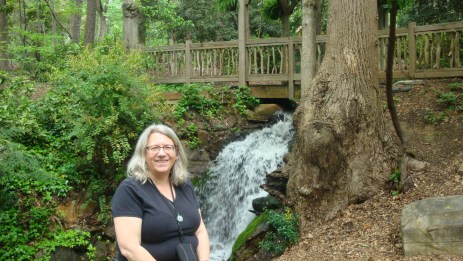
Hatcher Garden with Hannah 017

Me at Hatcher Gardens in Spartanburg, SC–April, 2015

******

Are you a writing teacher? Do you write when you have had a bad day, or is writing the last thing you want to do when you come home from work? I want to know! Please share with me your experiences as a writing teacher–the frustrations and the victories, the writing you do just for fun, to release the tensions of the day–whatever you have to share. If I think it’s right for my new online literary journal, Teach. Write. I will publish it in the Fall 2017 premiere.

Submissions are open now until July 1, so if you don’t have time to write during the school year, you’ll still have time to submit in the summer. Check out my submission guidelines, and I hope to hear from you soon!

Process, Not Plagiarism

my workI created a wiki on wikispaces for my professional development class. I call it Process, Not Plagiarism. Here is a link if you’d like to see it: Katie’s Wiki (My apologies for the Wiki not being open before. I have changed permissions, so you can now see the wiki.)

This is a subject I’ve thought a great deal about in my 27 years teaching and am convinced that the best way to prevent plagiarism is to engage students in the process and observe them throughout it.

The subject of plagiarism detection software came up on my wiki and this was my answer:

It is good to let students know about and learn how to use plagiarism detection software, but it is far from the answer to the plagiarism problem in higher education. First of all, more and more students are learning how to “beat” plagiarism detection software. Here is an article in Times Higher Education by Hannah Fearn from back in 2011 about how easy plagiarism software is to beat: “Plagiarism can be beat with simple tech tricks.”

I have never been a huge advocate for plagiarism detection services anyway because while the software does a decent job of detecting word-for-word plagiarism, it doesn’t do anything for the bigger problem–lack of proper attribution. Students often think that if they use quotation marks and cite quotes then they are home free, and sometimes they think if they re-write in their own words then they don’t need attribution because the software won’t pick up the plagiarism.

Secondly, and most importantly in my mind, emphasizing the process allows me the time I need to encourage students to choose a topic they are truly interested or even passionate about. When students become engaged in the process and truly want to learn about it instead of simply completing a project, then the results can be more than satisfactory–they can be life-changing.

More on this topic later. .

***

If you teach or have taught English composition at any level, please consider submitting to the premiere edition of Teach. Write, a literary journal for writing teachers. The submission guidelines can be found at Teach. Write. Submission Guidelines, and I will be accepting works of poetry and prose until July 1. The first edition will come out in September.

Lifelong Learning

One thing I hope to instill in my students is a love of learning, something that continues long after the semester is over, the year ended or the degree conferred. The drive to do this comes, even after almost 30 years of teaching, from my own love of being the student, not the teacher.

Right now, I am enjoying a  course through the state’s professional development system called “Technology Bootcamp II.” I wasn’t privileged to take the first six-week course, but now, in the third week of this second course, I have already learned some exciting new technologies to add spice to my seated and online classes. Here are some new things I’m learning as well as some older things I’m learning anew:

Blackboard–I used to teach using Blackboard until our college moved to Moodle. Although I am so used to Moodle now and happy with that learning platform, it’s gratifying to see that I have gotten back into the swing of things pretty easily. The interfaces are similar enough that I have easily adapted. I am glad, however, to learn the differences, so I can better prepare students who might transfer and encounter Blackboard or those who come to me more familiar with Blackboard than Moodle.

Prezi–I have used Prezi for several years now and prefer it to some other presentation software. In this course, however, I have learned to use some of the bells and whistles that I didn’t know and discovered some templates that I hadn’t seen before. I like Prezi’s dynamic animation that makes presentations almost cinematic. It is user friendly and easy for students to learn. Here is a link to the Prezi I created to introduce myself to the class. Educational accounts are free.

Prezi Introduction

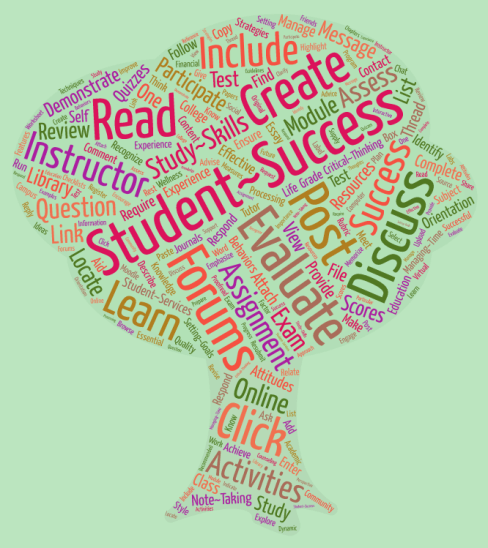
Tagul–This easy-to-use program was new to me, and it is fun!  I can see many uses for it in my classes because I think students will have fun with it too. Tagul allows you to easily produce Word Cloud Art just by uploading web content or adding your own text. Here is one of the first word clouds I created using words from my Study Skills class syllabus.

student-success

I was able to view a short tutorial, and then after a little trial and error, created this word tree that highlights some of the main ideas of the course. Word Cloud exercises could be used for vocabulary-building, learning key concepts and terms, for review purposes and a myriad of other uses. And, like Prezi, it’s free!

Here is a link to the animated version of the word cloud I created:  https://tagul.com/oo05cu2qlre9/student-success

Jing–Although I have used other screencast programs, Jing will be extremely useful for making short how to videos, five minutes or shorter. User friendly with helpful tutorial videos (I should hope so), Jing didn’t take long to get  the hang of and before I knew it, I had created a short tutorial video on how to use Tagul! Here’s a link to the video if you would like to see my first effort at using Jing! Free!

Jing Screencast

LiveBinders–This application helps instructors and students create digital three-ring binders. I haven’t finished working on this project yet, but so far I am quite impressed with LiveBinders. I’m able to download and organize websites, photos, videos, files, etc. that pertain to a particular topic, making them accessible for classroom use. Students can create a free account to create portfolios for class or keep all of their class project files together and easy to share, especially when working on group projects. Very useful.

I will also be learning classroom and online applications of Google Earth this week. Looking forward to it, and I will give you all an update on more useful education applications as I learn them.

I love being a lifelong learner!

Speaking of being a lifelong learner: Just a reminder that my literary e-zine, Teach. Write.,is open for submissions of short fiction, poetry and essays now through July 1, 2017. Anyone who has taught English composition is welcome to submit. See the guidelines  at this link for more information: Teach. Write Submission Guidelines. I would love to see your work!

Teach. Write. Again.

writer-605764_640-2

I have a dream. To publish a literary e-zine that celebrates the writing of composition teachers.

The one thing that has helped me most to become an effective composition teacher, besides twenty-seven years of teaching English composition of course, is writing and pursuing publication of my work. Such a process has certainly kept me humble (I quit counting when my rejections reached over two hundred.) and has never made me rich. However, a couple of years, I did make enough to be taxed. (Of course, that isn’t saying much, is it?)

On the other hand, with over two dozen short stories published in print and online publications, as well as over a hundred theater reviews and features for the local paper, five years as columnist for my college, two or three years as an arts columnist, and now approaching the production of my second full-length play, my writing avocation has also boosted my confidence as a writing  instructor and given me a certain credibility with my students, some of my students.

Above all, being a writer keeps me mindful of what it’s like to write for a critical audience–a critique group member, an editor, an agent, an audience.
3990049531_e1c94fdd9e_bBecause I’m a writer, I am reminded of what it’s like

  • to procrastinate.
  • to spend more time revising and editing than composing
  • to be uninterested, or lose interest, in a project
  • to be obligated to complete said project
  • to have a work criticized or rejected
  • to take that criticism or rejection as a personal attack
  • to be misunderstood

But it’s not all bad. Because I am a writer, I can truthfully inform my students that good writing, while hard, and often thankless, work is

  • a valuable skill
  • a confidence builder
  • actually can be fun
  • and sometimes, every now and then, absolutely glorious!

fun-1012681_640-2

So, the dream is to have this little online publication called Teach. Write. that will allow present and former composition teachers of all types to try their hands at writing out of their comfort zone, to make themselves vulnerable again to constructive criticism and rejection, to boost their confidence and support their colleagues–to write, and in so doing, become better teachers, better people.

The e-zine will be for writing teachers by writing teachers, specifically, but because the style and subject of essays, poetry and short stories will be open for the most part, the magazine should appeal to a general audience.

Although I will consider pieces that are on the subject of writing if they are unusual and compelling, I’m not particularly looking for work that is about writing or being a writing teacher. As I mentioned, this magazine is calling for teachers to move out of their comfort zones, so I would rather they write a literary short story or a flash piece, a sonnet or poem in blank verse, an essay about a night spent in jail–whatever they want to say. These will be the general submissions.

Because I want this e-zine to be useful to writing teachers, I also will have a regular feature called “Writing Your Own.” In this feature I will call for composition teachers to write pieces based on their own writing prompts. For example, the fantasy e-zine, Mirror Dance, published a flash piece called “Waiting for Beowulf” that I had written as an example for a creative writing assignment in my British literature I online class.  It is so helpful for instructors to write with their students–it can also be simply fun, yielding strong writing from students and publishable work from teachers.

I have set December 1 as the deadline for setting up the website. At that time, I will begin accepting essays and short fiction of 2,500 words or less, poetry of 100 lines or less (up to three poems accepted in one document), ten-minute stage and screenplays (ten pages), and pieces for the “Writing Your Own” feature (250-2,500 words).

All teacher-writers should include a short (100 words or less) biographical statement, which includes their present or past position as an English composition teacher. This statement is more important to me than publication credits. Of course, elementary and middle school language arts teachers, high school and college-level English teachers can submit, but if they have taught independently for business and industry or as part of a continuing education program, they are also eligible. If they have tutored in English composition professionally or as a volunteer, they may feel free to submit. They should simply mention composition teaching experience in the bio..

From  December 1 to June 30, I will accept submissions for the inaugural edition, which I hope to publish in the fall. My desire is to begin publishing twice a year, fall and spring, hoping that contributers who are working teachers can write and submit in the summer and winter, then enjoy, along with their students, their published work in the fall and spring.

I believe it is important to pay writers, but I don’t have much money, so I will be offering only a small honorarium here at the beginning of my venture, hoping that in the future I can offer more. I will let writers know the amount in December.

If anyone is interested in submitting  work to Teach. Write., start writing and look for an announcement on Hey, Mrs. Winkler with a link to Teach. Write. 

I have had this dream for a long time, but as it is has been with most of my dreams, they only happen when I find the time to do them and set to work.  The time is now.