Episode 10 of my podel (podcasted novel) CAMPUS: A Novel That Wants to Be a Musical is now available. This chapter features Dr. DAG, the chancellor of the Enchanted Campus, with its fairy godteachers, gnomes, dwarves, vampires, zombies and boojum (kind of like a yeti), among other assorted creatures, like teenagers, grumpy faculty members, and inept administrators. Dr. DAG has a regular afternoon liaison with his beautiful secretary Ms. Subowski, but it is NOT what you think.
If you have a poem, short story, or essay, why not submit it to my literary magazine, Teach. Write.: A Writing Teachers’ Literary Journal? You still have plenty of time! Submissions are open until September 1, for the Fall/Winter 2021 edition. See the submission guidelines for more information. I would love to read your work.
I love it when my summer reading plans fall into place almost magically. In April, for my birthday, my nephew Timothy, a total bibliophile (I love it!) who blogs at The Mugwump Diaries, gave me the book Austerlitz by W. G. Sebald. For one reason or another, I was unable to read the book until later in May.
Another thing that was put off was my correspondence with potential contributors to Teach. Write. Turned out that one of the writers, whose work you will read in the next edition, mentioned W. G. Sebald in his cover letter. In the acceptance email, I told him that I was reading Austerlitz; thus began a brief correspondence about the work and the author that helped solidify some of my thoughts about the work. He suggested that I read another of Sebald’s books, The Emigrants, which I have added to my very long reading list for this year.
In his excellent review of Austerlitz on the website The New Canon: The Best in Fiction Since 1985, Ted Gioia, music critic and book reviewer, writes that Sebald “has written a historical novel that appears to exist outside of history, yet this represents less an escape and more an exile. That dislocation is both the tragedy of Austerlitz the character, and the wonder of Austerlitz the book.” This statement reflects my understanding of the book as well.
Austerlitz is a displaced person, growing up in the UK from the age of five, feeling different and not understanding why until his adoptive parents explain his origins. As he travels through life, drawn more and more to the seemingly immutable architecture of Europe, he also explores his history and the trauma of his childhood. Further highlighting his isolation, Austerlitz tells his story not to a friend or relative but to the narrator, whom he meets by chance at a zoo in Antwerp. Their intermittent friendship develops slowly over the years when the narrator is invited to the various places Austerlitz lives, especially London, where the German-born Sebald lived and worked for a large portion of his life.
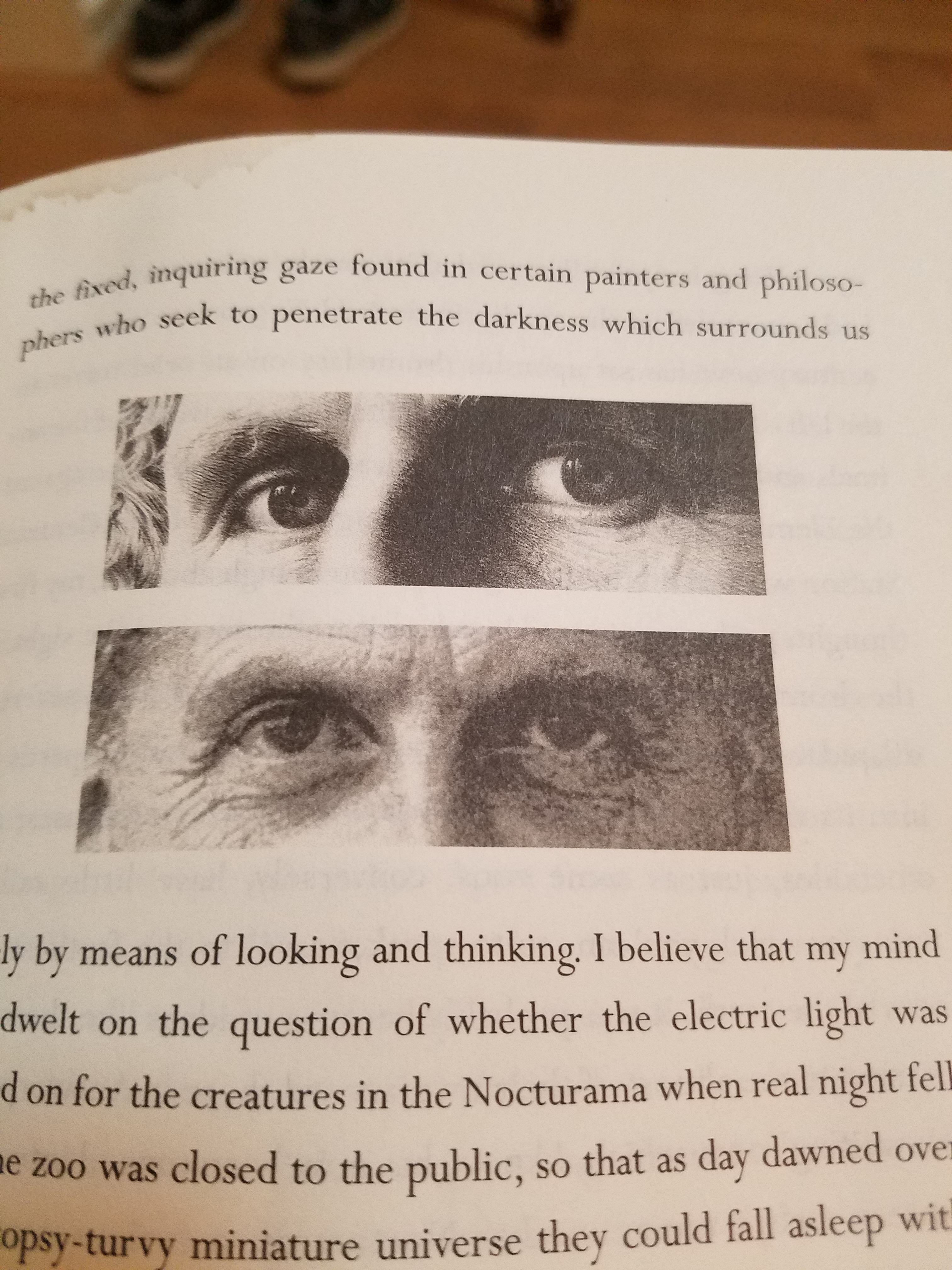
Page 5 of Austerlitz–photo by Katie Winkler
The unusual style of the book is part of its appeal. Like Nick Carraway, the narrator shapes our vision of Austerlitz. We only know what Austerlitz reveals to him and what we see in the various photographs like those below, displayed throughout the book. (You can see why I think of The Great Gatsby now, can’t you?) The long narrative passages with no chapters and very little paragraphing are often punctuated by the words “Austerlitz said,” reminding us that this is not the narrator’s story.
Also unusual are the long sentences and dialog without punctuation. The effect is not exactly stream-of-consciousness, but stream-of-conversation or narration, like when listening to an elderly relative recalling events from childhood, moving seamlessly from one memory to the next, digressing when the recollection leads to some topic of interest or area of expertise.
As a teacher and a writer, I find the digression from the story that speaks about the difficulties of writing particularly interesting. The narrator has come to visit Austerlitz at his home in Alderney St., London; photographs of architectural wonders from around the world are scattered all about, but before Austerlitz can begin taking up the story of his life once again, he explains how he, recently retired from teaching, now wishes to compile his thoughts and ideas about architecture but is having trouble focusing:
“All I could think was that such a sentence only appears to mean something, but in truth is at best a makeshift expedient, a kind of unhealthy growth issuing from our ignorance, something which we use, in the same way as many sea plants and animals use their tentacles, to grope blindly through the darkness enveloping us” (124).
I don’t know a writer who has not felt this way at some point and time. Austerlitz goes on:
“I could see no connections anymore, the sentences resolved themselves into a series of separate words, the words into random sets of letters, the letters into disjointed signs, and those signs into a blue-gray trail gleaming silver here and there, excreted and left behind it by some crawling creature” (124).
And so I hear the words of the reviewer Gioia again–Austerlitz’ tragedy is the wonder of the book, that the character’s growing displacement can bring all of us, not just writers, not just survivors of childhood trauma, but anyone who feels displaced, into a community, giving us a place to belong.
Citation
Sebald, W.G. Austerlitz, 10th Anniversary Edition, Modern Library, 2011.
I feel that I am developing my own community of writers through editing and producing Teach. Write.: A Writing Teachers’ Literary Journal. It is devoted to writing teachers who want to publish their writing, but you don’t have to be a teacher to contribute. I welcome writing from anyone.
Submissions for the Fall/Winter 2021 edition are open until September 1. Follow this link for submission guidelines. I would love to read your work.
My podel has gnomes and fairies, boojums and zombies, along with other outlandish characters, living ordinary, extraordinary lives.
And, no, I have not forgotten my podel (podcasted novel), but I am having some issues, not unlike those encountered by Austerlitz. I am tooling along ,though, and quite proud of the nine episodes I have produced so far and having fun, which is not the only point but a big one. If you would like to hear the podel so far, then follow this link: CAMPUS: A Novel That Wants to Be a Musical.
Episode 9 of CAMPUS: A Novel That Wants to Be a Musical is now available!
I had fun putting together this episode of my podel (podcasted novel)–CAMPUS: A Novel That Wants to Be a Musical. If you haven’t listened to all of the episodes, they are available all at the same place when you click on the link above. Many podcast platforms carry CAMPUS, so just search your favorite application.
If you like the show and are able, please consider becoming a supporter. I’m not looking to make any profit, but I would like to pay a composer and sound tech to help make the podcast better and maybe invest in some education (hey, there’s a novel idea), so I can improve my skills, just because. Wow! The support button is available on the podcast’s landing page at the link above.
In Episode 9, the plot thickens when we meet the villain of the piece. Oh, you thought it was Dr. DAG? What a lightweight! He’s nothing compared to Mr. M., who isn’t too pleased that the fairy godteachers have chosen Jack and Jill as their proteges and sprinkled them with fairy dust. He has his own plan for them, and it doesn’t include enlightenment or inspiration.
The Spring~Summer 2021 edition of Teach. Write. A Writing Teachers’ Literary Journal is available free online. If you would like a print copy, they are available as well.
Maybe you are a writing teacher on summer break and would like to work on a writing project of your own. Why not consider writing a short story, poem, essay, or ten-minute drama to submit to Teach. Write.? I am accepting work for the 2021 Fall~Winter edition until September 1.
Although I prefer to publish the work of writing teachers of any kind, at any level, I am open to all writers and most genres. If you are interested, see my submission guidelines.
I would love to read your work.
I am getting back into the reading groove as well. My nephew Timothy, whose blog, The Mugwump Diaries, I have mentioned in previous posts, gave me a book for my birthday that I am finally starting to read–Austerlitz by W. G. Sebald. I just started it so more about this interesting book that won the National Book Critics Circle Award in 2019 and has been listed as one of the top 100 novels of the 21st century.
I’m also reading a memoir, The Beauty in Breaking, by Michelle Harper for my Western Carolina University Alumni Book Club and Maranatha Road by my friend Heather Bell Adams. She has a second book out, so I need to get on the stick. I also sneak in a chapter now and then of one of my favorite British mystery writers books–Many Rivers to Cross by Peter Robinson.
I told everyone I would be mainly reading and writing this summer.
May 7 will be the last day of the spring semester for me, and I am looking forward to a summer of reading and writing. The last few weeks have been filled with taking care of my mother who was hospitalized in March and then getting caught up with school work after taking time to help her. I still managed to get the Spring~Summer 2021 edition of Teach. Write out, though. Yay me. You can find links to both the online free version and order copies of the print version here.
However, I have had to put off working on CAMPUS, my podel (podcasted novel). I just haven’t had the time, but I have seven episodes in the first season that you can listen to here. My plan is to have the first episode of the second season published no later than Sunday, May 9. That is if all goes well. I have a lot of grading to do between now and then.
CAMPUS: A Novel That Wants to Be a Musical features gnomes and fairy godteachers. Yes, it does.
It has been a strange semester for me, not just because of the pandemic, but also because I have had so few students. Most semesters in the past few years I have had over 100 students in five or six classes. This semester I have half that number, and I am finally able to be the kind of writing instructor I wish to be. I am taking a professional development course about improving online instruction and in the course, over and over again, the material emphasizes the importance of personal relationship when teaching online.
How can this kind of relationship be developed when teaching so many students? Only when we begin to value the individual student over sheer numbers can we really begin to help our most needy students. I don’t know if I will be able to finish out my career teaching fewer students, but I know that if I can, I will be a better teacher, and my students will truly reap the benefits.
Change the subject
My mother and I were able to talk quite a bit once she was home from the hospital and started feeling better. I was working on one of my classes and describing some of my my methods to her. She said I should write a book about my teaching methods when I retire.
I kind of like that idea.
I have a great many plans for my retirement.
Dreaming of what I might do when I’m free keeps me going.
I don’t know how much I will be able to write between now and May 7, but I’ll be back, and so will CAMPUS.
Last ten days of classes begin tomorrow. Summer can’t come soon enough.
Remember when I said my mother had gone to the emergency room but was sent home? Well, she had to go back a few days later and was admitted. I went to Alabama for a week to be with her while she was in the hospital and get her settled when she came home. I stressed over trying to get the spring/summer 2021 edition of Teach. Write. published by April 1 until I reassessed my priorities. I contacted my wonderful writers and let them know I would have the new edition out by April 10.
And it’s here!!! Thank the good Lord for Spring Break!
I hope you enjoy this edition of Teach. Write.: A Writing Teachers’ Literary Journal. Next, I will work on another long overdue episode of CAMPUS, my podcasted novel, available on Anchor, Spotify, and other podcast platforms.
HAPPY VALENTINE’S DAY! Another episode of CAMPUS: A Novel That Wants to Be a Musical is live on Spotify NOW!! And it includes, in true Valentine’s Day form, a love story!! Click here to access CAMPUS.
I am especially excited this week because I think this is my best episode ever! First of all, my daughter Hannah, who is a recent graduate of UNC-Asheville, earning her second degree, a BS in Music Technology, arranged, recorded, and performed Gabhaim Molta Brighde in Irish Gaelic for this week’s episode. Her BA was in Music with a Voice Concentration from Converse College’s Petrie School of Music. The value of her education, one in classic music and the other in advanced music technologies is truly apparent in her recording. I know what you’re thinking, but a mother gets to brag on her daughter on Valentine’s Day, and every other day, too, for that matter. Oh, by the way, she has a job IN MUSIC during a pandemic (not teaching), doing what she loves and was trained for. How do you like them apples?
I’m also hyped because it has been so much fun playing around with the technology that is making this dream of mine come true. This week, with the help of Audacity: free, open source, cross platform, audio software, I was able to record two songs and alter my soprano voice to sound first like a tenor and then a bass. It is a little freaky but totally cool. The second thing I did was download the sound effect of a shower running from freesound.org and add it to one of my recordings. I also laid down background music provided by Anchor, which calls itself the “easiest way to make a podcast,” and I believe it. Anchor is provided by streaming music giant Spotify as an open source podcasting platform. All of my episodes are published immediately on Anchor and Spotify as well as numerous other podcasting databases very easily and at no cost to me.
CAMPUS is my passion project, and I am doing it for fun, but I can also see all sorts of educational applications of the open source technology I am learning to use. I hope you will listen and tell others about my podel (That’s my word for podcasted novel.)
Don’t think I’ve forgotten about the other ongoing project I love, my literary journal Teach. Write. I have already accepted some incredible poetry and flash fiction for this issue, but there is still time to submit for the spring/summer 2021 edition. Submissions close on March 1, and the journal will be published on April 1. See the link above for submission guidelines.
So don’t stop thinking about tomorrow. Okay, enough with the Fleetwood Mac allusions. I’m getting a little bit punchy. It’s been a whirlwind start after a quiet summer without the usual activities. Sad? Yes, in some ways. I miss being with my friends and extended family but also very healing–a time to focus on exercising, cooking, reading, and writing–for myself!!!
I did work a great deal on my classes, taking my knowledge of new technologies and integrating them into my already strong online classes. (No brag, just fact) Our distance learning staff has been doing a lot of course redesign training, and I am trying to put their ideas into practice. So far, students seem to be responding well to the changes.
Speaking of students, I need to get to it, but I will leave you with a link to a great article from Inside Higher Education about the positive side of remote learning and the incredible job some inspired faculty with a passion for education, like the people I am blessed to work with, are doing.
It was gratifying to read Meagan Lucas’ debut novel Songbirds and Stray Dogs because Ms. Lucas contributed her story “Daisy Mae Returns” to the Spring 2018 edition of Teach. Write (43-45). Something special about that for me as an English teacher, especially since Ms. Lucas is one as well.
Taking place in the early ’80’s, the novel tells the story of Jolene, who finds herself, pregnant, alone, and abandoned in a small coastal town. She makes her way to the mountains of Western North Carolina, where she encounters more loneliness and hostility until she meets someone as lonely and broken as she and learns to trust, love, and hope again.
I liked the way the story develops with the distinctive alternating perspectives of a woman and a man. Ms. Lucas effectively captures the struggle of how two ordinary people find a way despite loneliness and despair. Our world needs more of their spirited perseverance.
The book is published by Main Street Rag. Hope you will buy it and support a promising new voice in Southern fiction.
A very different book I finally finished is an extraordinary biography of Johann Sebastian Bach by German musicologist Christoph Wolff.
I started reading this book quite a while ago, but it is difficult reading for me because I am not that knowledgeable about music, and the book goes into great technical detail about Bach’s compositional style.
I am, however, knowledgeable about scholarly research and can recognize the incredible achievement this book is, giving readers a detailed look at Bach as performer, composer, scholar, theologian, husband, and father. Also, even though I didn’t understand it all, I was fascinated when Wolff explains Bach’s music in detail.
Well worth the time.
At the end of the last chapter, Wolff quotes from another Bach biography, the New Bach Reader, relating an anecdote about Mozart upon his first hearing of the motet Singet dem Herrn, ein neues Lied:
“Mozart knew this master more by hearsay than by his works, which had become quite rare; at least his motets, which had never been printed, were completely unknown to him. Hardly had the choir sung a few measures when Mozart sat up, startled; a few measures more and he called out ‘What is this?’ And now his whole soul seemed to be in his ears. When the singing was finished he cried out, full of joy: ‘Now there is something one can learn from!'”
And I did!
The text, in translation, of the aria:
God, take us to Yourself from now on! For without You we can accomplish nothing with all of our belongings. Therefore be our protection and light, and if our hope does not deceive us, You will make it happen in the future. Happy is the person who strictly and firmly abandons himself to You and Your mercy!
Now listen, dear reader, to Vocalconsort Berlin singing Sing to the Lord a New Song:









 Hey, Mrs. Winkler!