The print version of the 2022 spring~summer edition of Teach. Write.: A Writing Teacher’s Literary Journal is now available for purchase in the Lulu Bookstore.
Once again, I thank all of the fine contributors to this edition. I am so very grateful to them for entrusting me with their work.
I know I give myself so much more to do by publishing this journal, and my teaching, writing, and editing deadlines often collide, but I love editing Teach. Write. It allows me to be autonomous in my creativity. I don’t have to please anyone except myself in the end.
But, of course, I do hope this edition pleases you, too.
Here is the link to the online version if you missed it!
Episode 13 of my podel (podcasted novel) is now available. Why not take a listen to it and the other twelve as well? I hope it won’t be so long between episodes again. Episode 13: Mrs. Whittakers 7,360th Class
CAMPUS: A Novel That Wants to Be a Musical has gnomes and fairy godteachers among other magical creatures.
Also, coming up April 1 is the Spring~Summer 2022 edition of Teach. Write.: A Writing Teachers’ Literary Journal. It’s gonna be a great issue, y’all! Mrs. Winkler’s on a roll!!
I stated in my last blog that I would review the book my daughter gave me for Christmas, but I’m going to put that off. Recent events at work have caused me to revisit some “teachable moments” in my past that have shaped me as an educator and a human. But come back for the review. The Dictionary of ObscureSorrows is a little book packed full of wistful wisdom.
My parents on their honeymoon in New Orleans–December 1955
And now, here’s a little bit more about Mrs. Winkler back when she was Ms. Whitlock.
I was born in 1960, towards the end of the Baby Boomer generation. Kinda awkward I’m finding, especially as a woman. Unlike some women born in the ’40s and ’50s, I inherited some of the privileges that had been denied them but still had, and have, a long way to go, baby.
At least I could open a bank account.
Yes, that’s right.
Writing for the financial website Spiral, LeBach Pham writes that although women had been financiers in America throughout its history, it was not until the ’60s that banks could no longer legally keep a woman from opening an account. (Pham). I was 14 when women obtained the right to open a credit card account or to take out a mortgage on their own thanks to the Equal Credit Opportunity Act, although I wasn’t ready to have a credit card until I was well into my 20’s.
I suppose in my early years, I took for granted some of the privileges that many women, especially college-educated women, had fought so hard for. Part of the reason, I suppose, is because my wonderful parents were both fierce supporters of education. I remember one of my favorite family pictures before my younger brother was born is my father, smiling, seated in the middle of the picture with me, the youngest at the time, about two or three I think, on his knee, then, my gap-toothed brother and my sister, the oldest, standing on either side of him. Behind my father, arms reaching out and resting on her children’s shoulders as if to cover her whole family, is my mother, in her full regalia, having just graduated with her BA in English from Auburn University.
After graduating from Lanett High School in Lanett, AL, my mother, who wanted to see a bit more of the world than the little cotton mill town where she was widely known as the principal’s daughter, headed out to Shawnee, OK, to attend Oklahoma Baptist University. For her day, it was a bold move, I think, to attend a university over 800 miles west of her protective home.
My mother tells the story of how she arrived by train that first year and walked with her bag toward the campus to see it covered in black. As she got closer she realized what she was seeing a giant swarm of locusts. Big black and gold locusts. She said she couldn’t move without stepping on one. I couldn’t imagine anyone staying after that introduction, but mom did and went back the next year, even after falling in love with my dad, whom she had known all through school but never dated until that summer after her first year in college.
She had promised my grandparents she would go back one more year and she did. But it wasn’t until after marriage and the birth of her first three children that my mother finished her degree at Auburn University, with my dad’s full support and encouragement
I remember going far away from home, too, when I was right out of undergraduate school. I went to Oral Roberts University during the 900-foot Jesus years. You had to be there. Nevertheless, I feel I got a good education at ORU. Yes, I had to take a course called Holy Spirit in the Now, but I also took Survey of the Old Testament and Survey of the New Testament. Those two courses have served me well as a student and teacher of literature, especially at a community college in the buckle of the Bible belt.
My first teaching assignment was at a small church-affiliated school in Aliquippa, PA, outside of Pittsburg. Until I was flown up to the school for an interview, I had never been anywhere near Pittsburg, had no relatives there, and knew no one, but, just like my mother, I saw it all as a grand adventure. The school was small, and I taught three levels of English and two levels of German.
Turned out it was rather out of the mainstream theologically, but I did not become aware of this until after I took the job, even though I asked specifically about the church’s and school’s doctrine during the interviews. For example, although I had hauled all my German Christmas materials with me and moved them into my little attic apartment, I wasn’t able to use them because the church was vehemently anti-Catholic and did not believe in practicing any of the “pagan” holidays, so I just kept my copies of “Stille Nacht” in my files at home.
At the very first faculty meeting I attended, soon after I was introduced, our principal announced that he wanted all of the teachers to incorporate into our curriculum the support of prayer in public schools. He looked at me and the one other English teacher and said, “You will have your students write letters to their congressmen in support of prayer in schools. I will give you a sample letter I want them to follow”
Without hesitation, I said, “No, I won’t be able to do that.” He looked shocked. I looked around the room and the other teachers, especially the women, seemed shocked as well. I felt that I needed to explain. “I will discuss writing persuasive letters to our congressmen and create an assignment, but I want my students to write about the issues that are important to them and formulate their own letters.”
“Of course, if they want to write and send letters to their congressmen about prayer in schools, then I will assist them in editing the letters, but I can’t require them to write those letters.”
Silence.
A silence that spelled trouble for me from then on.
And yet, several of my fellow teachers, all women, came up to me after that faculty meeting and thanked me. They called me brave. It was my turn to be surprised. I didn’t feel particularly brave, just strong in my convictions that teaching writing didn’t have anything to do with religion or politics, no matter where I was teaching.
I remember speaking up again a few months later when I found out that the single male music teacher was making more money than I was. He had let it slip when he was hitting on me. I was appalled (at both) He had less education, fewer responsibilities–I had five preps in two disciplines, morning duty, lunchroom and afternoon duty as well as serving as assistant soccer coach and theater director. He had his classes, four I think, including band and choir practice.
I marched down to the principal’s office and just asked him–Why is so-and-so making more money than me? The answer–“Some day he will have a family to provide for.”
My turn to be shocked.
I may have been able to open a bank account when I taught in PA at that small private school, but I certainly didn’t make much money to put into one.
I did go back another year, believe it or not, partly because I had been promised a raise (although it never materialized), and partly because I had a long talk with my very wise daddy who had seen growth in me that first year and just felt I should go back. He wasn’t sure why. Always trust the instincts of someone who loves you, I thought then and still do. But the biggest reason I went back was pure orneriness, I reckon. Yeah, I thought, you fellers are going to have to deal with an uppity southern woman one more year.
At the end of that year, after I faced the fact that I couldn’t afford to live on the salary I was making, I began to enjoy the fruits of my labors. I started dating, Mr. Winkler–the best man that I know and as wise as my sweet daddy.
I came back South to get my second degree at Auburn University. Mr. Winkler, followed me down South a year later, and after I finished my degree and started working for Floyd County Schools in Rome, GA, I became Mrs. Winkler and have never regretted it one bit almost thirty-three years later.
However, while I was still Ms. Whitlock, teaching English and German at two high schools in the county, I still felt that “in-between” feeling, although I did enjoy some privileges denied me at the private school –being paid on a state teaching salary schedule at least. This meant I was supposed to be paid as much as a man, but I noticed that most of the male teachers also had paid coaching positions at the school, while I was assigned assistant soccer coach as one of my regular duties–no extra paycheck came with that.
But, I was making a decent salary at least, enough to even open a credit card account and take out my first loan to buy a new car. This time the inequities were more subtle, but very much there. For example, at one of the high schools where I taught, I had the star football player in my class–he was the kicker for the team. Now, I am no football expert, but my father had played football for Auburn and been a football coach so I knew enough to know, after watching a couple of games, that this kid was, well, not very good.
However, he and the administration felt differently about his abilities I guess.
One day in class, the students were working on an assignment, and I looked up to see that our star football player was putting a small paper cup under his desk. I walked toward him, and the cup fell over, spilling out a disgusting black liquid. Tobacco usage of any kind, including chew, even in that rural part of a Georgia county, was strictly forbidden; the faculty had been strongly reminded of that in a recent memo from the principal. So, I called the kid on it. He claimed it wasn’t his cup. “I saw you put the cup under your desk,” I said and wrote him up for detention.
Later that day, I was summoned to the principal’s office. The principal had barely spoken to me before that day. “You’re new here,” he said, “so you may not know that so-and-so is our starting kicker and an important member of the team.”
“Oh, I’m aware that he’s on the team, but I saw him put a cup full of tobacco spit under the desk. It fell over, and he refused to clean it up, so I wrote him up for a detention.”
“Did you actually see so-and-so spit in the cup?”
“No, I suppose I didn’t.”
“He says he didn’t spit in that cup. That he was covering for his buddy.” I tried to continue my argument but was cut short. The principal said, “I’m going to rescind this detention because you didn’t actually see so-and-so spit in the cup, and if he gets one more detention, he will have to sit out a game, and he’s too important to the team.”
I knew it would be better for me to say nothing, and I knew it probably would do no good at all to say anything, but just like in PA, I couldn’t help it, I spoke out. “Okay, I suppose you are going to do this no matter what I think, but I will tell you that word is going to get around quickly that I have no authority in my own classroom, and I am going to have more and more trouble.”
That my prediction came true has never given me any comfort.
And yet, over thirty years later, I am still speaking out about the dangers of administrators ignoring the ramifications of taking authority away from the teacher in the classroom. I’m still predicting how that loss of authority is chipping away at the academic integrity of our schools, colleges, and universities.
But who am I? A little, mouthy Southern woman–just another boomer on the verge of retirement.
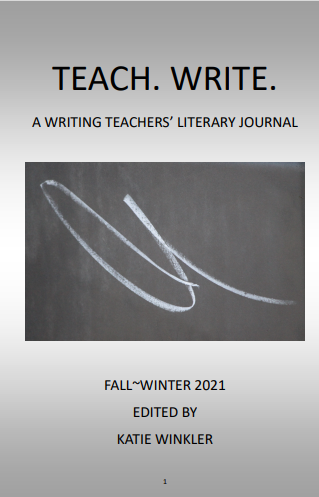
Once again I pushed things to the limit, but I am publishing the Fall~Winter 2021 edition of Teach. Write. on October 1, as promised. Wonderful work by frequent contributors and new writers as well. I am constantly amazed and humbled at the quality of the work that is sent my way and honored to publish the work of these fine writers, most of them teachers.
I started Teach. Write. because I know how much teaching composition has helped me improve as a writer and how writing for publication has helped me become a better teacher. I am so glad to offer opportunities for writing teachers, and students too, to see their work in print. So satisfying.
I will be talking about Teach. Write., my blog, podcast, and more during my workshop for the North Carolina Writers’ Network. It is an online workshop taking place Tuesday, October 19. Click here to see more information: The Big Share.
Another writing opportunity I have enjoyed is writing two screenplays for the anthology of short films being produced at my college–one comedy and one musical. The premiere of Haunted Hendo will be October 28 and afterwards the films will be streaming online. Don’t worry. I will be sure you all get the link!
I have a vision that every community college board of trustees member and administrator, from the president on down, would take a freshman composition class from a master teacher who has been at the same college for ten years or more. The board member or administrator could choose a seated or online class, but they should take it in its entirety, complete the work by the due dates, and submit their work for evaluation. Of course, the faculty member should be informed and agree to the process. There should be agreement that there will be no retaliation if the administrator does not receive an A. (That last line was a joke–I think so, anyway.)
To get the full experience, each individual should agree to be evaluated by the instructor and receive non-degree seeking credit, but auditing would at least help administrators see what the course is like and what the demands are on the English instructors as well as the students. Imagine if every board member and administrator had on their official transcripts an A or B in an English class at the college where they serve!
I have a vision.
If those in power see what truly happens in a college English composition classroom conducted by a veteran instructor, perhaps they would become partners with the English faculty, smoothing out so many of the adversarial relationships that have developed during these difficult times that have divided us so much along socio-political lines. For this to work, however, the instructors must be allowed the academic freedom to conduct the courses as they see fit within the parameters of each college’s academic freedom policy and the guidelines of national organizations such as the American Association of University Professors. In return, the instructors must treat all members of the class honestly and with the respect that all students are due.
If we, all of us, believe what we say, that we are tired of the division and that we want what is best for the students, all students, not just those who believe the way we do, then don’t we need to start understanding what it is that students and the faculty who teach them are actually doing in their classes? Relying on hearsay, no matter where it comes from, is not the best way to gain that knowledge, is it?
I have a vision.
Imagine what could happen if board members and administrators were able to express their own opinions about topics important to their own lives and their important work at the colleges through their writing assignments. I have been teaching at my college for over 26 years, if you count my adjunct years. In that time, I have rarely been given an opportunity to share my work with board members or administrators or to find out what they do, what it is important to them, how they feel about education, or how we could work together to better serve our students, school and its employees, local businesses, the community at large, as well as the colleges and universities our transfer students will go to. I want to know what the board and the administrators think, so I can support them in their important work. I admit, I haven’t always wanted this, but I have repented my past attitudes, and now I truly want to know.
I have a vision.
I see me getting a chance to talk to those in power, to put aside the things that divide us and let them know how much I care about all my students, no matter what their career goals or lack thereof, that caring, as an English instructor, means not accepting work or behavior that is non-standard or inappropriate, that there are consequences at school and in the real work world for tardiness, absences, not following directions, sub-standard performance, negligence, sloppiness, and most of all, not submitting to the authority in the classroom or at the workplace.
But I also want to show them that there are real rewards, going beyond a pat on the back and a “good job,” when students work hard to improve their writing by revising and editing their work, leaving behind the “wait to the last minute, one and done” mentality so many of them have when it comes to writing academic essays and professional reports. My students, the ones who are teachable, truly do become better writers and communicators in school and in the workplace, and they know it. They know that it is largely their effort bringing them there, and it empowers them. Isn’t that our collective goal?
I want so much to let the board members and administrators understand the passion that I have for my work, that it is not just a job for me–as a devout Christian, I consider it my calling–a sacred honor to help my students communicate better, even those, maybe especially those, who malign me or do not go through the college’s grievance policies to lodge complaints about me and other instructors. These students need me, and I want to help them. I want the administrators to know that if they will only send the students back to the faculty members, or at least talk to us before instantly believing an upset or angry student, that many problems might be resolved before any escalation can occur.
I pledge that at my college, if any board member or administrator reads this, that I will be the first volunteer. I invite you to take one of my classes and actually complete the assignments by the due dates, bravely subject your writing to be evaluated, just as my courageous students do. Then, at the end, let’s talk, as equals, just two people who want what is best for our students.
It’s good to have a vision, I think, even for old English teachers like me.
Episode 9 of CAMPUS: A Novel That Wants to Be a Musical is now available!
I had fun putting together this episode of my podel (podcasted novel)–CAMPUS: A Novel That Wants to Be a Musical. If you haven’t listened to all of the episodes, they are available all at the same place when you click on the link above. Many podcast platforms carry CAMPUS, so just search your favorite application.
If you like the show and are able, please consider becoming a supporter. I’m not looking to make any profit, but I would like to pay a composer and sound tech to help make the podcast better and maybe invest in some education (hey, there’s a novel idea), so I can improve my skills, just because. Wow! The support button is available on the podcast’s landing page at the link above.
In Episode 9, the plot thickens when we meet the villain of the piece. Oh, you thought it was Dr. DAG? What a lightweight! He’s nothing compared to Mr. M., who isn’t too pleased that the fairy godteachers have chosen Jack and Jill as their proteges and sprinkled them with fairy dust. He has his own plan for them, and it doesn’t include enlightenment or inspiration.
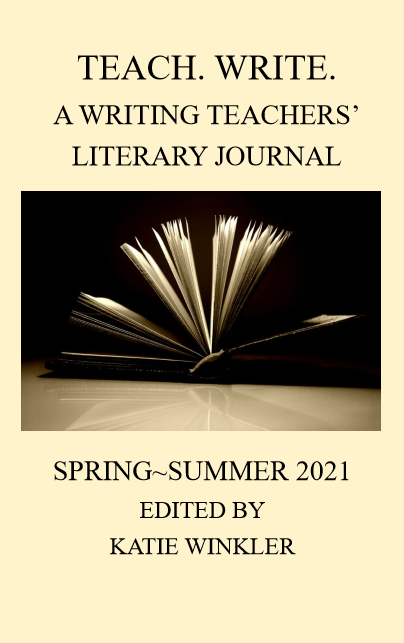
The Spring~Summer 2021 edition of Teach. Write. A Writing Teachers’ Literary Journal is available free online. If you would like a print copy, they are available as well.
Maybe you are a writing teacher on summer break and would like to work on a writing project of your own. Why not consider writing a short story, poem, essay, or ten-minute drama to submit to Teach. Write.? I am accepting work for the 2021 Fall~Winter edition until September 1.
Although I prefer to publish the work of writing teachers of any kind, at any level, I am open to all writers and most genres. If you are interested, see my submission guidelines.
I would love to read your work.
I am getting back into the reading groove as well. My nephew Timothy, whose blog, The Mugwump Diaries, I have mentioned in previous posts, gave me a book for my birthday that I am finally starting to read–Austerlitz by W. G. Sebald. I just started it so more about this interesting book that won the National Book Critics Circle Award in 2019 and has been listed as one of the top 100 novels of the 21st century.
I’m also reading a memoir, The Beauty in Breaking, by Michelle Harper for my Western Carolina University Alumni Book Club and Maranatha Road by my friend Heather Bell Adams. She has a second book out, so I need to get on the stick. I also sneak in a chapter now and then of one of my favorite British mystery writers books–Many Rivers to Cross by Peter Robinson.
I told everyone I would be mainly reading and writing this summer.
Remember when I said my mother had gone to the emergency room but was sent home? Well, she had to go back a few days later and was admitted. I went to Alabama for a week to be with her while she was in the hospital and get her settled when she came home. I stressed over trying to get the spring/summer 2021 edition of Teach. Write. published by April 1 until I reassessed my priorities. I contacted my wonderful writers and let them know I would have the new edition out by April 10.
And it’s here!!! Thank the good Lord for Spring Break!
I hope you enjoy this edition of Teach. Write.: A Writing Teachers’ Literary Journal. Next, I will work on another long overdue episode of CAMPUS, my podcasted novel, available on Anchor, Spotify, and other podcast platforms.
I am a Type II diabetic. My husband is a health care worker. He has been fully vaccinated for over a month but is aware that working where he does he still might be a carrier of Covid-19. I had my first vaccination, made possible by my workplace, for which I am grateful, over a week ago. I will receive the second dose on March 30.
Because of my medical condition, I have been allowed to teach asynchronous and synchronous online classes this semester. I did not request this but am thankful that the dean in my division saw to it that I, as a person vulnerable to complications of Covid-19, had the choice to telework if I did not feel safe coming to campus.
In the fall of 2020, I worked from home most days, only going onto the campus to serve an hour in the Student Success Center to relieve my colleague so that she could have a lunch break. I volunteered to go on campus for that time. This semester, I have volunteered to work two days in the Student Success Center. I voluntarily treat these days as normal work days, usually arriving around 8:30 or 9:00 am.
Yesterday was one of those days. I came in later than I usually do, around 11:00 to serve a scheduled office hour, then in the Student Success Center, then mentoring a new faculty member, grading papers, a trip to the mailroom to pick up the posters for advertising this semester’s theater production. A break for lupper (lunch and supper) at 4:30ish and then back to my office for grading at 5:20 until rehearsal for the play (I play Shakespeare and the Duke of Ephesus–you should see my costume) until around 8:00pm.
During that time, one of my colleagues, who works in marketing, came to take pictures of all of the actors in costume. I was released after I and my fellow Shakespeare/Duke were photographed. (Our director double casts when needed so all who audition can have a chance to act). Other student and community actors, crew, director, and photographer were still there. I got home around 8:35 and talked to my husband a few minutes, but he was on call at the hospital, so he called it a night, hoping not to get called in. I stayed up a while longer to do my daily yoga routine, and check student e-mail one more time. I also have decided to learn Italian! I am using duolingo, a popular language-learning ap, to do so and also use the ap to brush up on my German. (I have a degree in German, but use it or lose it, they say).
Thursday, March 18, 2021–Today is a day I telework.
7:00 am–Rise, washed some dishes I was too tired to wash last night, made breakfast for my husband and me. We were both glad that he didn’t get called in last night.
7:50am–Ate breakfast and drank coffee while my husband read the weather and some amusing news to me. We chatted and laughed some. He always can make me laugh.
8:03 am–Started checking work e-mail. Answered two student messages made late last night. Skimmed a New York Time’s article by Judy Batalion called “The Nazi-Fighting Women of the Jewish Resistance.” Batalion lives in London and did her research for the article in The British Library. Oh. Tie into British Literature II. Filed the article to read more in depth later, knowing that I probably will not ever have time. Until summer.
8:10–My husband read a snippet of news about a man buying a porcelain bowl for $35 and how it sold at auction for $720,000. Lesson learned–Don’t underestimate anybody’s value, including your own. Continued checking mail.
8:20–Started checking in on my professional development class–a microcredential provided by the State of North Carolina through the Association of College and University Professors to faculty teaching the new RISE (Reinforced Instruction for Student Excellence) courses. I and a colleague have volunteered to take the course. No cost to the college, no cost to us. Plus, even though the course has just started, I am learning a great deal about improving online teaching for the special demographic of developmental students that I teach.
As I started checking this course, I got the idea for this blog post, so I took the time to set up the blog post, and write up my notes so far.
9:13–Break to walk up and down the stairs (to satisfy the fitbit monster), get some more coffee (to satisfy the caffeine addiction), and do other necessary things, like get dressed, make the bed, and clean my C-Pap equipment (I have severe sleep apnea–another reason I am high risk for complications due to Covid-19).
9:31–Checking in with my prof. dev. course will have to wait, but I have completed most assignments already and have until March 21 to complete the remaining two, so all is well. Good to know how my online students feel, though.
9:32–Checking e-mail again and prepping for my co-req courses.
9:47–All seems to be in order for today’s classes. I have two synchronous online classes on Tuesdays and Thursdays. I like working from home on these days because I can save time not having to get ready and drive to work. Then, there are the unavoidable frequent interruptions and distractions while at work. On these days when a big chunk of my day is in the virtual classroom, it just is more efficient for me to be at home.
During the few minutes of uninterrupted time, I was able to see that we are covering how to write sentences more concisely–ah, efficiency seems to be the word of the day, doesn’t it? I was also able to send a reminder through course announcements about the Collaborate session today and what we will be covering.
9:53–Checking my 11:00am class’s grades. The course I teach at 11:00 is ENG011–Writing and Inquiry Support. This class is relatively new and part of the Reinforced Instruction for Student Excellence (RISE) program that is offering the professional development class I’m taking. I think it’s a great idea, but it is too early to tell if RISE will work or not. I am seeing good results early on. (This is only the second time I’ve taught the co-requisite class, which is a support class for first-semester freshman composition students.) I am grateful to my immediate supervisor and my colleague who is the RISE coordinator for allowing me latitude to use my many years of experience with developmental education to develop, assess, revise, and re-assess the course, using my best judgment as a composition teacher for over thirty years while in accordance with the requirements of the State’s expectations. This is the fourth redesign of developmental classes since I began teaching at the college where I now work, all state-mandated.
I see that none of my students in ENG 011 are in danger of failing my class. I have been concerned about the performance of two students, however. I met with their instructor on Monday of this week to see how they are doing and to discuss strategies for their improvement. This is a best practice, according to the RISE training provided by the RISE coordinator at my college.
10:04–Checking to be sure that all grades, including zeros for work not attempted, have been recorded.
10:10–All looked good, so I will take another short break to walk up and down the stairs and put in a load of laundry.
10:22–Checking the grade book for my other ENG 011 class that will be at 2:00pm today.
10:30-Checked and saw that two students I have been concerned about continue to struggle. I talked with the instructor of one student earlier this week. After my 11:00 class, I will check the system to see who is English instructor is and shoot him or her an e-mail to set up a time to discuss the student’s performance in the ENG 111 class. Will take one last short break before logging on to class. As a diabetic, I need to have a snack at this time to keep my blood sugars regulated.
10:45–Logging onto the Collaborate session for my 11:00am class. Some students arrive early, so I like to be in the session to greet them. This class lasts until 12:20.
12:20–Class went well. We discussed the importance of writing concisely, which is a common issue with developmental English students who are often reluctant to write and will “pad” their writing in order to meet minimum word or page numbers. I like to use a handout I have found from UNC-Chapel Hill’s writing center to aid in my instruction: Writing Concisely. Then, I showed the students how to format their documents correctly using MLA8 formatting, which is standard in our English classes at Blue Ridge. I have found that developmental students often struggle with some of the details like this because they don’t see their relevance to their everyday lives, so while I am showing them how to format, I am also giving them my explanation of how following directions precisely and paying attention to detail is an important “soft skill” no matter what courses they study or profession they enter.
12: 21–Checked my e-mail and answered a long e-mail from a disgruntled student. It took some time to find the right tone to rectify the situation. As always, I offered to meet with the student, virtually or in person, to discuss the situation further. I find that this is a good way to avoid the “e-mail wars.” Sent an e-mail to that student’s ENG 111 instructor to be sure all was well in his class and to inform him of the student’s issue.
1:00–lunch break
1:25–Checked e-mail again. Read the newsletter from the president of the college and other e-mail. Walked up and down the stairs a few times. Put clothes in the dryer.
1:40–Texted my daughter to see if she wants to go walking at the park this afternoon since the rain stopped and the sun is out.
1:45–Launched the Collaborate session and waited for students to arrive. Prepared to withdraw an ENG 011 student who was dropped from ENG 111 as required. I’m sorry about that. I think he was getting something out of my class. He was one of my most faithful attendees. One of my student’s who has been struggling came into class first and said he was thinking of withdrawing, that he is having trouble engaging in the online format. We discussed his options. I have heard this often from my students over the past year. Online learning is not for everyone. On the other hand, I have many students who never thought they would like online learning who are thriving–one of the main perks is the flexibility. Also, because of the pandemic, students are improving the skills necessary to be successful in an online environment.
2:00–Began the Collaborate session. I only have a few students in this Collaborate class, but we had an excellent class with true engagement. All explanations were made and students completed the work during the class time allotted, which is one of the State’s requirements for the co-requisite class. I like this because the support class should not add an inordinate amount of work to students who are already struggling to complete work in their ENG 111 class.
3:20–Drove to the park to walk with my daughter. It was wonderful. She is a delight. Just the break I needed.
4:45–Returned home and checked e-mail. Returned an e-mail from a student and one from a colleague.
5:00–Called the theater instructor to tell her that my daughter had volunteered to help with some of the short videos mentioned at rehearsal yesterday. She said she was just finishing up doing some re-writes of the script to eliminate the need for the videos that seemed like a good idea but were just going to be too time-consuming. I and the other Shakespeare/Duke will be doing some of the interludes she needs between scenes. She will discuss it some more with us during rehearsal on Monday.
5:26–Checked e-mail again. Nothing new. Prepared supper–Because it was pretty out and lighter later, I grilled some chicken, summer squash, and zucchini. My husband came home while I was grilling. While he relaxed a little, I finished grilling the food and completed some German exercises on the duolingo ap while I watched over the food. John and I enjoyed the dinner and a little time together.
CAMPUS: A Novel That Wants to Be a Musical
7:25–Checked e-mail again. Noticed that I have more notifications for postings for my professional development course. Decided to grade some papers before I look at the postings by my fellow students.
8:40–Called my mother in Alabama. She had to go to the emergency room on Friday and still didn’t have tests back when I called earlier in the week, so I called to check up on her. She is better, thank goodness, but doctors still haven’t gotten down to the root of her problems. I hope when she sees her doctor on Monday they will be able to find out what’s going on.
9:30pm–Made an appointment with a friend to go walking. Checked work e-mail one last time. No e-mails from students. Going to check on my professional development course in the morning. Tuckered out, as my Great Aunt used to say, and going to bed.
10:12pm–I lied. I wanted to finish up this blogpost, and so it is now almost 45 minutes later. I also started thinking about my podcast. I had hoped to put out an episode a week, but now that I have started the two new 8-week courses, the grading load is just too heavy for me to get the work completed during normal working hours. I know I will have to grade some tomorrow and over the weekend, but I don’t have rehearsal on Saturday, so maybe I can squeeze in working on an episode of CAMPUS and get it out by Sunday evening.
This is what I get for teaching in the summer—less time to work on my blog. I almost let all of June go by without a post, but I made it!
I am saying right now, while I am in the midst of it, that I will never teach a course in the summer again. What was I thinking? Those of you who know me understand how I can get during the school year–I’m kind of intense, let’s say. Summer has always been my time to work on myself—my writing and reading, my diet and exercise, my family, my friends. Oh, and my Scrabble online time.
Not that I haven’t been doing all that.
However, I should have anticipated that teaching a composition course in eight weeks instead of sixteen is naturally going to take up a big chunk of time. And it has. Yet, I’m not sorry that I have done it because even if I do not succumb to the allure of teaching in the summer again (oh, Lord, I hope not ), I have learned a great deal that I can apply when teaching my sixteen-week classes.
Here we go:
Streamline assignments–I found that with fewer assignments, students are getting an ample amount of writing practice. I have also found that I can assign less time for assignments and still get the same quality of work from students. Giving weeks of time to complete the major assignments doesn’t seem to help either. Plus, I don’t have weeks of time when teaching a sixteen-week composition course in eight weeks.
Compact assignments–I re-wrote assignments to get more information in a single assignment so that I could afford to streamline. It takes some work and creative thought, but I dig that kind of stuff. Hey, course design is one of the reasons I love teaching so much.
Add video and text resources but keep them well-organized–I always have included a myriad of video and text resources, but with our new clean-looking LMS interface, it is easy to use labels to keep all of the student resources organized and easier to access. One tip–add resources that come from highly respected institutions (a plagiarism quiz from Cornell, which covers just about every possible plagiarism situation my students stumble across) and those that involve technology (a video about how to use Survey Monkey, which students like to use when doing field research for their capstone project).
Spreading out due dates–Students would find it difficult to be successful if they tried to complete two weeks worth of work in one cram session right on the day assignments are due. We can say good students get started early all we want, but the reality is most students, strong or weak, wait until the due date to complete assignments. Spreading out due dates helps students manage their time and helps me keep up with grading.
Introduce and summarize assignments–I have always added an introduction to my assignments, including key concepts from the text that I want to reinforce, but I have rewritten the introductions to be more intentional. I have also added summaries that include ONLY a bulleted list of what the students actually must submit for the assignments. This seems to help a great deal in avoiding confusion. Aristotle’s old advice, tell them what you are going to say, say it, and then tell them what you just said, still holds true.
Create screencasts–It is relatively easy to create explanatory screencasts and upload them to YouTube with my ipad. I created a screencast just the day before yesterday that is about eight minutes long and takes students through the steps to find sources on my college’s website. YouTube has a feature that makes it easy to close caption in order for the video to be ADA compliant. All together, including upload, the screencast took me about one and a half hours to create. That would be more than I might want to dedicate during the school year, but since I have only one class this summer, and this screencast will be able to be used again, it was worth the effort.
Stay in touch–I have always tried to stay in touch with students, but I have made an even more concerted effort to communicate with students this summer since I have more time. I try to answer e-mails quickly and maintain a light and friendly tone with students. Last night I called a struggling student and spent about fifteen minutes offering some advice but mainly encouraging her. Fifteen minutes to save her from withdrawing a second time from English composition. Time well-spent. I know in the regular school year, with six classes, I will be unable to talk to all of my students this way, but I can certainly try to make a more personal connection to online students who are struggling.
Encourage strong students, too–This summer it has hit me harder than usual how much my strong students need me. They need to see not only a blanket “good work” on assignments, but also remarks on their essays about specific things they have done well. Sometimes the A students are lost in the shuffle. I don’t want to forget them this coming school year when I start getting busy putting out fires.
Empathize with difficulties–It doesn’t hurt to be human. I try to remember what it was like to work two jobs, be active in a campus club and be in student government while I was carrying a full load of classes. Some of my students have small children to care for as well. I can’t imagine. But I need to try.
However, don’t lower standards–While I try to show students compassion and make concessions where I can, I never want to lower my standards. I would not only be doing a disservice to the student but also to the college and society at large. Our students’ potential employers deserve workers who can read and write clearly, concisely, and persuasively. I have to be kind but firm.
Maintain a sense of humor–Much undervalued in education, I think. Having a sense of humor when communicating with students, when appropriate of course, eases tensions and humanizes me and the situation. It helps establish rapport with students like nothing else and helps them realize that, wildly successful or not, this intense eight-week English composition course will be just a blip in their lives, an important blip, but not the be all and end all of their existence.
Now, I had fun! I love writing this blog and hope someone reads it, but even if no one does, I have had a chance to pull together some interesting conclusions about my experience teaching this eight-week online composition class, and it is giving me some good, good, good vibrations. Sounds like summertime to me!
Anyone for a game of Scrabble?
Photo by Pixabay on Pexels.com
DON’T FORGET TO SUBMIT TO TEACH! WRITE! DEADLINE FOR THE FALL 2019 ISSUE IS AUGUST 1! CLICK HERE FOR SUBMISSION GUIDELINES. I WOULD LOVE TO SEE YOUR POETRY, SHORT FICTION, OR CREATIVE NON-FICTION! YOU DON’T HAVE TO BE A TEACHER OR A PUBLISHED WRITER TO SUBMIT!














 Hey, Mrs. Winkler!