First edition of Teach. Write. to launch September 1

writerwritingframe-300px (2)

It is the perfect time for Teach. Write. to launch. As I begin my 23rd year of teaching at a small community college in North Carolina and work on producing the first edition of my first foray into producing a literary journal, I am reminded of how much I love my chosen professions. Since I was a little child I have wanted to be a teacher and soon after that dream was born, thanks to a marvelous English teacher named Mrs. Riskind, I have wanted to be a writer.

Now I am both.

To add editing to those two honored vocations exceeds all my expectations. It is modern technology that makes this journal possible and gives voice to those who deserve to be heard–English composition teachers. These are unique voices–surprising and refreshing. I can’t wait for you to read the short stories, essays and poetry of some special writing teachers.

It won’t be long now, so stay tuned!

From Prompt to Publication

writerwritingframe-300px (2)

My first stab at producing and editing a literary journal–Teach. Write. -is taking shape.

I have accepted quite a few wonderful submissions, but I am hoping to get some more before the August 1 deadline. If you are, or ever have been, a teacher of writing in any capacity, then I would love to see your work–prose or poetry–doesn’t have to be about writing, just writing by a teacher or former teacher. See the submission guidelines for more information.

I was inspired to start Teach. Write. because I have witnessed how writing for publication has enriched my teaching. I am more attune to the power of the revision process, more gentle with my criticism and more accurate, too. Because I am a working writer, I work better with writers who are just learning the process–it keeps me closer to them.

One feature included in Teach. Write. will be called “Write Your Own.” In this feature I would like to highlight writing prompts that  teachers have used successfully in class. To do that, I would like the teacher to not only include and explain the prompt, but also to write something based on their own prompt and submit that piece along with the prompt and explanation.

Here is an example of an explanation, prompt and flash piece that I created for my online British Literature I class:

I’m always trying to find ways to engage online students more effectively. It isn’t always so easy to do. A couple of years ago, however, I came up with a prompt for a discussion forum on Beowulf that has proved to be most successful. I wrote my own response to the prompt when I first posted as an example for my students and liked it so much that I tweaked it a little and sent it out into the cold, cruel world. After a couple of rejections, an online fantasy publication–Mirror Dance–accepted it for publication. I was quite pleased. See the results here: Waiting for Beowulf

The Prompt

The early Anglo-Saxon people were great storytellers. The story of Beowulf, as you saw in the BBC film this week, began as oral tradition, told and re-told around campfires and in great halls for decades, even centuries, before it was finally written down in the form we know it.

Americans are great story-tellers, too, especially here in Appalachia where many of us, including me, have Anglo-Saxon and Celtic blood coursing through our veins. For this assignment I’m going to let you tell part of the Beowulf story your way. Let’s get started:

Directions:

  • Choose one of the scenes you read in Assignment 2.1:
    • First Attack
    • Fight with Grendel
    • Fight with Grendel’s Mother
    • Fight with the Dragon
    • Beowulf’s Funeral
  • Review the scene so you are sure of the plot.
  • Rewrite the scene or a part of the scene from a specific character’s point of view–For example–write the scene of the first attack from one of the surviving men’s point of view or tell it from one of the women’s point of view. Your scene should be one or two well-developed paragraphs in length (seven to ten sentences per paragraph). It may be longer if you are inspired.
  • Post your scene, illustrated by an internet picture you’ve found. See my post to get an example of what to do.
  • Post a thoughtful response to either my sample post (if you are the first one to post) or one of your fellow students’ posts. Take a look at my sample response to get an idea of what I mean by thoughtful response. Also, look at the grading rubric in the Joule Gradebook to see how I will be grading this assignment.
  • Have fun with this assignment!

    The Post and Sample Response

  • stories_of_beowulf_water_witch_trying_to_stab_beowulf

    By J. R. Skelton [Public domain], via Wikimedia Commons


    Waiting for Beowulf

    by

    Katie Winkler

    Come my beauties, writhing sea dragons and serpents, monsters with milky eyes, slouching on slopes by the cliff. Come greet our visitors–the loathsome King Hrothgar and his fiendish followers. And Beowulf, the son-killer, watch him don his war-gear, showing no fear. I will give him cause to tremble, cause to repent how he rent the arm of the monster-child, left him to die like a dog, denying a god the honor of a swift death.

    See the man take up Hrunting, the fool, thinking he will be victorious, boasting to his lord of its great strength as he comes to meet me in my own abode. He will swim to me through the depths, with great and mighty strokes, swim to my home some call a hellish turn-hole. Here he will sling the mighty sword. Its decorated blade will come down singing and ringing. Singing and ringing. But it will not touch the swamp-thing from hell. It will refuse to bite, and then this hag, this witch, shall take her revenge.

  • Response:
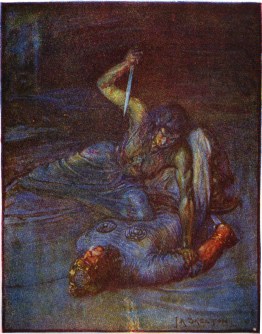
    • This creative response shows a good understanding of the scene in Beowulf that depicts the fight with Grendel’s mother. The author includes references to the description of Grendel’s mother in the original work as well as the underwater cave in which she lives. Also interesting is the use of kennings–compound words like war-gear, son-killer and turn-hole. Kennings are common in Anglo-Saxon poetry. Finally, it is interesting to see the story from the creature’s perspective. She is portrayed more as a vengeful mother who has lost her beloved son than a fiendish monster. The illustration is appropriate as well, showing that the illustrator obviously read and/or studied the original work before creating the artwork. Note: I used a different illustration in my post but could not include it here due to copyright issues.

Student Response to the assignment has been positive.

Most students respond well to Beowulf anyway. It is just such an exciting “action hero” story, but this prompt has helped many students take their studies a step further and start to explore the style and artistry of the poem as well as plot and character.

So if you have a prompt you really love, Write Your Own, and submit it and share your good idea with other teachers and writers.

Shameless Plug


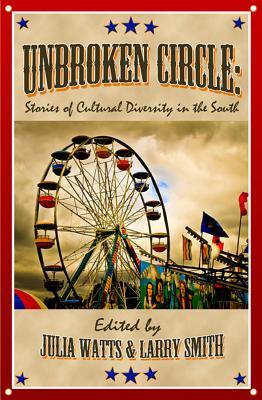
unbrokencircleOne more thing before I say good bye. I have a story in this marvelous little anthology: Unbroken Circle: Stories of Cultural Diversity in the South edited by Julia Watts and Larry Smith, published by Bottom Dog Press. You can buy a copy at the Bottom Dog Press website or on Amazon. Print and Kindle editions are available.

Here is what Karen Salyer McElmurray, author of Surrendered Child, said about the book: “In turbulent times, what we need is possibility, and in this rich gathering of diverse voices, Watts and Smith give us just that….These are stories and essays about the blues, about poverty, about families lost and made. Unbroken Circle is about broken and unbroken lives, and ultimately, hope.”


Proverbs

Mom and Dad

Mom and Dad on their honeymoon in New Orleans–December, 1955

I miss my dad. He died three years ago, May 6, at age 80. He always said he would make it to 80, and he did. Dad did most things he put his mind to.  Sometimes I called this characteristic stubbornness, especially when I, like all children, became fiercely angry at him. Other times, like in the last years of his life when he was fighting the debilitating effects of type I diabetes, I called it persistance. Now I call it courage.

By profession, my father was a soldier, a preacher, a singer, a teacher, but above all, a courageous leader.  Here are some memories, things he did, said and wrote, in no particular order, that have helped shape me into the person, the teacher, I am today.  Some of them may seem cliche, but when I heard them from Dad, they were fresh and new because his actions and his character stood behind them.

  • Once, when I was about 13 or so, my dad hit a dog and killed it. He went across the road and knocked on doors until he found the owner of the dog to let them know, apologize and help in any way he could. Afterwards, climbing into the truck to drive away, he said, “You have to go through your problems. Meet them head on. You can’t go around.”
  • “I’m not going to retire. I’m going to refire.”
  • “Do everything you do out of love, and you can’t go wrong.”
  • In answer to the question, “What word best describes your life?” Dad wrote this:
    • Integrity. I believe that we all need to be people of our word. I don’t believe we can go wrong if we adopt this word to live by. I heard of on Indian. A banker was once asked how much money he would loan that Indian. “I’d loan him as much as he wants,” said the banker, “because he will die rather than not pay it back.” That’s integrity. That’s what I want. I want to live by that word.
  • “It’s hard to be a Christian–a true Christian.”
  • “The three most fantastic changes that have taken place in my life time are
    • 1. The advances in medical science. If we had not had the advances in medical science , I would be dead because of my diabetes.
    • 2. The advances in education. If we had not had the advances in education, and I had not taken advantage of my opportunities, I would have been retired from the cotton mill by now.
    • 3. The advances in technology. If we had not had the advances in technology, my children and grandchildren would not be having this abundant life, being blessed and being a blessing to others.
  • I describe success as
    • S–Sharing
    • U–Unity
    • C–Cooperation
    • C–Compassion
    • E–Endurance
    • S–Speaking the Word
    • S–Suffering long
  • ” Love is ever ready to believe the best in others.” Dad said he learned this from my mother, one of the other great teachers in my life. (I will write another blog post about her in the near future.)
  • “That’s the name of the game–helping people.”

    Dad and Rob

    Dad helping my brother Rob tie his shoes, mid-70’s

  • “I like to travel. Travel is a part of education. Learning about different peoples, countries, children, religions is a part of education. I’m glad that all of our children have gotten to travel. I believe all of it has contributed to the positive attitudes they have now about different countries, cultures and peoples.”
  • “Never do anything half-ass.” Mom taught me this too. She just said it in a more refined way: “Anything worth doing is worth doing well.” Same sentiment and one that has served me well.
  • After Dad retired from working as a representative of a large ministry, he went back to teaching. He worked for the county office, taking long-term substitute assignments. This was in the 80’s at the beginning of the AIDS epidemic when there was still a great deal of fear and misinformation about the disease in the country. There was a little boy with hemophilia who had contracted AIDS from a blood transfusion. The school would not let the little boy attend school and could find no one to teach the boy at home–until my dad volunteered. He taught the boy until he was too sick to study, but Dad became more than a teacher to that boy and his family–he was a friend. Years later, the boy’s mother posted under Dad’s obituary, “Mr. Whitlock was a wonderful man….He meant the world to us.”
  • Dad was principal of a Christian school in Georgia. Although the school was started as a dodge around integration, my dad did not pay any attention to the racist’s views of some board members and enrolled the first African-American student. “Do what you know is right,” Dad said, and did.
  • Some of Dad’s favorite scriptures that he counted as important lessons he learned in life:
    • I can do all things through Christ who strengthens me.
    • Whatsoever you do in word or deed, do it all for the glory of God.
    • All things work together for good to those who love the Lord, to those who are called according to his purpose
  • Dad recorded ideas on what it takes for a husband and wife to maintain a healthy marriage:
    • Love each other
    • Pray together
    • Be in unity
    • Put Jesus first
    • Attend church and have all of the family go together
    • Have a spirit of forgiveness toward each other
    • Be patient with each other
    • Build each other up, not tear each other down.
  • “I love everything about your Mom.” Dad called Mom his “little hummingbird.” He loved her fiercely, and their relationship has taught me more about having a successful marriage than anything else could ever do. When two fallible people can live together, for the most part happily, for 58 years, they must have done something right.
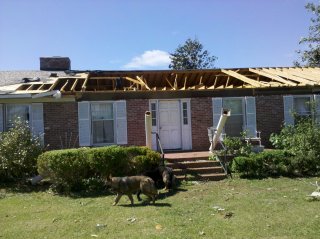
    house after tornado

    My parents’ home after the tornado in April, 2011. My brother Rob endured and persisted during this time. His efforts made it possible for my parents to move back in less than a year after the tornado. 


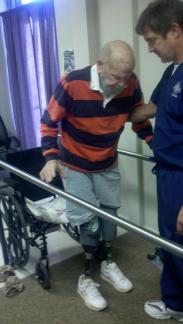
  • Although it was so hard to watch Dad go through what he went through the last years of his life, I learned so much about perseverance, determination and courage from him during that time. Through the death of his oldest child, a devastating tornado, his own failing health, leading to two amputations and eventually succumbing to heart failure, Dad endured much discomfort, pain and embarrassment but rarely complained, usually about not being able to have salt on his food. He continued to be an inspiration to those around him by learning how to walk again with one prosthetic, losing the other leg, then learning to walk on two prosthetic legs. Knowing how athletic and active Dad had been most of his life made it even harder to watch as he struggled to do basic tasks,
    Dad on Prosthetics

    Dad, learning to walk again–December 2012

    but Dad persisted and endured with courage and dignity. The last time I was with Dad, about a week before he died, his heart severely weakened from the effects of diabetic neuropathy, I watched as he tested his own blood sugar and gave himself his own insulin shot. The last thing he ever said to me was, “I love you.”

Two weeks after my dad died, I was diagnosed with Type II diabetes. It was hard to hear as my doctor spoke of possible nerve damage leading to blindness or amputation, especially after watching my dad go through what he did.

But I am his child, so I have determined that this disease won’t lick me. Dad, I’ll do what’s right, won’t do a half-ass job, won’t try to go around.

Life is worth doing, so I’m going to do it well.

Teach. Write. Deadline Extended

Are you a writing teacher who loves to write? Do you write responses to your own writing prompts? Is writing for publication something you have done or dream of doing?

If your answer is yes to any of these questions, then I want to see your writing! The premiere edition of Teach. Write. : A Literary Journal for Composition Teachers is beginning to take shape. I have accepted several impressive creative non-fiction essays and poetry, but I would love to have more, especially flash or short fiction. Therefore, I have extended the submission period to August 1, 2017.

If you are teaching or have taught English composition at any level in any setting, then I want to read your work.

See the page Teach. Write. Submission Guidelines for more information and….

writerwritingframe-300px (2)

School’s Out for the Summer!

school's out

School’s out for summer! Back in June of 1972, I never would have believed that I would see Alice Cooper singing his anthem of teen rebellion with a bunch of muppets? But look!

https://youtu.be/vmewc2Uqon4

I’m just enough of a rebel to kind of like this, even as a teacher of English, although I don’t think anyone has ever exactly seen me as a typical English composition teacher. I know I haven’t.

And yet, I might be more ordinary than I like to think because I can’t stop writing and revising and editing. That’s why I’m here at the computer on my first official work day off for the summer — writing.

Yes, it is going to be a writing summer that’s for sure, and I’m starting it out with a bang! First of all, later this week I will attend the Looking Glass Rock Writers Conference at Brevard College. My instructor is Pulitzer Prize-winning novelist, Jane Smiley. I’m, to put it mildly, stoked.

lookingglassrockfrompilotzoom

Secondly, one of my stories is officially on sale tomorrow in an anthology put out by Bottom Dog Press called Unbroken Circle: Stories of Cultural Diversity in the South. I am pleased that this story, “I Have Not Yet Returned,” about a young woman coming to grips with her father’s mental illness, has finally found a home.

unbrokencircle

The process from writing to publication, or being accepted to writing residences, has never been easy for me. I was doing some rough calculating in my head, and I have published about two dozen stories in print and online publications since I have started seriously seeking publication. Sounds like a lot until you consider that I sent my first work into the world in August of 1995–24 pieces in 22 years and hundreds, yes hundreds, of rejections in that time.

Listen to me. I sound like I’m bragging. Perhaps I am. Perhaps I should. 22 years of being mostly rejected, but not always, 22 years of not giving up on my dreams of being a writer, has made me a better one. Failure has made me a better teacher, too, even a better person. Not always failing has helped me to survive the process.

What I have learned about persistence has been invaluable to me as a writer and a person, and it is the attribute I most want to pass on to my writing students. Our society makes giving up so easy, why should anyone persist? I can tell them.

I have 24 reasons why.

Because I value so highly what I have learned through seeking publication, I am now accepting submissions for my own literary publication–Teach. Write.  It is specifically targeted to English composition instructors, any level, whether actively teaching or retired. Submissions are open now until July 1. The first issue will come out in September. Complete submission guidelines can be found at this link: Teach. Write.

I look forward to reading your work! Have a writing summer!!

***

If you would like to purchase a copy of Unbroken Circle: Stories of Cultural Diversity in the South, you can do so at Bottom Dog Press, Inc or at Amazon.com

What happens when liberal arts are devalued in the community college?

5653093-steve-jobs-liberal-arts-quoteThere seems to be an increasing hostility in the world today towards the study of the liberal arts. This is not a new subject to readers of my blog. As a community college instructor teaching English, I have grave concerns about how this hostility is affecting many of my students at the college where I teach.

If students don’t value the liberal arts, especially the humanities, they often become resentful of having to complete assignments that appear, to their uninformed minds, to have no practical value. This resentment can turn to inattentiveness and a lack of participation, which sometimes turns to more serious inappropriate behavior, and even to open hostility and violence, according to a 2008 study by educational counselors Dr. Robert Dobmeier and Joseph Moran (“Dealing with the Disruptive Behavior of Adult Learners”).

The feeling that students’ time studying in the humanities classroom is somehow wasted is often times reinforced by negative attitudes within the home, among peers and in the wider community. For example, former Governor Pat McCrory of North Carolina said in a 2013 radio interview referring to certain humanities courses, including gender studies and an African foreign language

“So I’m going to adjust my education curriculum to what business and commerce needs to get our kids jobs as opposed to moving back in with their parents after they graduate with debt,” McCrory said, adding, “What are we teaching these courses for if they’re not going to help get a job?”

If the governor of a state with a rich tradition of superb institutions of higher education feels free to make such uninformed statements, it is logical to assume that some students are hearing similar ones at home and among their peers.

I can attest that this lack of respect has led to disrespect for not only the disciplines I teach, but also for myself. Furthermore, I am not alone. Students are becoming more and more critical of instructors’ assignments, teaching styles and assessments. I don’t mean legitimate questions respectfully asked, which leads to explanations that help students understand the material better, but criticism that is increasingly uncivil, including sleeping, texting or talking in class, posting inappropriate comments in online discussion forums, as well as e-mailing rude and even obscene comments to instructors.

Worse, community college instructors are increasingly confronted with angry and hostile students in the classroom and in our offices. These students are often upset that an instructor has carried out a policy that is stated clearly in his or her syllabus or there is some disagreement about a grade. Sometimes these encounters are upsetting and even frightening to the instructor, his or her colleagues, other students, staff and administrators.

I have been teaching a long time, and I know that incidents like these have been happening since the first classrooms were created, but I have never, in my whole almost 30-year career, had so many adult students with such unhealthy attitudes toward learning for learning’s sake, that inexplicable passion for learning, which leads to all of the things so many people say they desire out of higher education–citizens who can think critically, communicate well, solve problems and adapt to new situations quickly.

Something needs to be done. But what? There are no easy answers, but I am going to begin with educating myself with specific information that supports my belief that the study of the liberal arts should be the bedrock of all our institutions of higher learning.

**********

I found this incredible essay posted on the Academy of Arts and Sciences website, along with a great article entitled, “The Vitality of the Humanities in U.S. Community Colleges,” that reiterates my thoughts on the importance of all students studying the arts and humanities in our community colleges:

January 19, 2015

Community College Students and the Humanities: New Opportunities for Learning and Growth

posted by Martha J. Kanter

Martha J. Kanter, Ed.D., is a Distinguished Visiting Professor of Higher Education at New York University and former U.S. Under Secretary of Education from 2009 through 2013.

More than 40 percent of our nation’s adults are unable to read, write, or compute at the competency level expected of America’s high school graduates, so it’s hardly a surprise, even if it is gravely disappointing and frustrating, to inform policy makers, and the public about the worth of the humanities.1 But what better way to elevate the discussion than with facts and policy strategies?

That is why the light that the American Academy of Arts and Sciences is shining on community colleges and the humanities is critical in this endeavor. Even today, too many Americans aren’t aware that the community colleges are the gateway to higher education for more than 40 percent of our nation’s undergraduates. A generation ago the United States was first in the world in the number of college graduates with two-year and four-year degrees. According to the Organisation for Economic Co-operation and Development (OECD), we are now eleventh in the world, tied with Israel.2 The good news is that we are moving in the right direction: we were ranked sixteenth 16th in the world in 2009. It’s a national imperative that we provide Americans the best quality education so we must look to the community colleges and state universities where the middle-class and low-income majority is seeking higher education. (my accent)

Educational improvements and financial support are sorely needed. Sadly, public colleges and universities were hit hard by the recession and lost, on average, about 20 percent of their state support. We need our private universities to join with their colleagues in the community colleges and state universities in a shared vision to reimagine and redesign general education in the years ahead. In doing so, we will ensure that all of our students have access to the fundamental ideas, knowledge, skills, and capacity to learn that will advance greater numbers of students with undergraduate and graduate degrees for America’s prosperity in the 21st century.

Looking at the facts, more than a third of associate’s degrees are awarded in subjects that require a significant humanities course load.3 Exposure to the humanities in the first two years of college as a significant component of general education provides the intellectual framework for students to compare and contrast the viewpoints of those different from themselves and to delve into the learning spheres of analytical reasoning, problem solving, and decision making to tackle the very real problems facing their communities and the greater society.

In a recent survey, the American Association of Colleges and Universities found that 93 percent of CEOs want to hire individuals who demonstrate the “capacity to think critically, communicate clearly and solve complex problems,” capabilities “more important than their undergraduate major. More than nine in ten of those surveyed say it is important that those they hire demonstrate ethical judgment and integrity; intercultural skills; and the capacity for continued new learning.”4  (accent is mine) 

Unfortunately, the collaboration so urgently needed between the arts, humanities, sciences, and business has fragmented into ever more disparate pieces over the last decade when their interaction and integration should be encouraged to spur innovation, entrepreneurship and creativity to drive our nation forward. In the decades ahead, our nation will need more Americans with college degrees who are well versed in the histories and opportunities to address the major societal challenges of our democracy and the world, not the least of which include the education levels of children, income inequality, the social, economic and civic needs of diverse communities, globalization, innovation, and American competitiveness. Interdisciplinary thought leadership and collaboration will be more important than ever in crossing boundaries to address the local, regional, national, and global problems ahead of us.

When Tom Ehrlich spoke about the pathways to ethical and engaged citizenship at Miami Dade College in 2009, he said, “college learning must be about much more that [sic] knowledge—knowledge that may be obsolete in just a few years. Most important, it must be about learning how to learn and to keep on learning. At its core, that is what a liberal education does, it liberates our minds to learn.”5  (accent is mine) 

We should look to the evidence, embrace the liberal arts as a necessary foundation for postsecondary education in all fields of study, and figure out how to give our students the best possible opportunities to discover themselves, their place in the world, and how they can contribute to improving their own lives and the lives of their communities. In doing so, we will be part of the American dream we wish to realize for ourselves and future generations. (accent is mine)

ENDNOTES
1 U.S. Department of Education, Institute of Education Sciences, National Center for Education Statistics, 1992 National Adult Literacy Survey (Washington, DC: U.S. Department of Education, 2000), http://nces.ed.gov/pubsearch/pubsinfo.asp?pubid=199909; and U.S. Department of Education, Institute of Education Sciences, National Center for Education Statistics, “Percentage of adults in each prose, document, and quantitative literacy level: 1992 and 2003,” in 2003 National Assessment of Adult Literacy (U.S. Department of Education, 2003), http://nces.ed.gov/naal/kf_demographics.asp#2.
2 OECD, Education at a Glance 2014: OECD Indicators (Paris: OECD Publishing, 2014), http://dx.doi.org/10.1787/eag-2014-en.
3 American Academy of Arts and Sciences, “Associate’s Degree Completions in the Humanities as a Percentage of All Associate’s Degree Completions, 1987–2013,” in Humanities Indicators, 2014.
4 Hart Research Associates, It Takes More than a Major: Employer Priorities for College Learning and Student Success (Washington, DC: Hart Research Associates, 2013), http://www.aacu.org/sites/default/files/files/LEAP/2013_EmployerSurvey.pdf.
5 Tom Ehrlich, “Ethical and Engaged Citizens: Whose Responsibility?” (talk delivered at Miami Dade College, Miami, FL, May 21, 2009).

English Lesson

(Lines Composed after a Bodaciously Bad Day)

by Katie Winkler

A comparative–

Better than before.

Better than this.

Better than that.

Better than some.

Use it in a sentence, please.

When will it be better?

I have been so much better.

Only you can make it better.

Only you

It’s an adjective, dear.

See, here–

Better times

Better rhymes

Better ways

Better days

Simply good is only an adjective.

And the Best is so superlative.

But

Better

Is

Comparative–

It is

Somewhere in Between.

******

I know my job gets me down sometimes, like today, but honestly, what do I have to complain about? I get to teach people how to be better writers, read, study and talk about great writers as well as write for my own pleasure–for a living. Is this a great country or what?

Then, there are days like today. But, the day is almost over, and I survived. I’m sitting with the ones I love the most, our little cat snoozing on the sofa. Plus, I just wrote a little poem. It’s nothing special, but I like it because I feel at peace now and better than I have all week. Better.

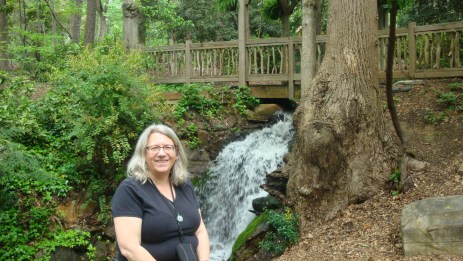
Hatcher Garden with Hannah 017

Me at Hatcher Gardens in Spartanburg, SC–April, 2015

******

Are you a writing teacher? Do you write when you have had a bad day, or is writing the last thing you want to do when you come home from work? I want to know! Please share with me your experiences as a writing teacher–the frustrations and the victories, the writing you do just for fun, to release the tensions of the day–whatever you have to share. If I think it’s right for my new online literary journal, Teach. Write. I will publish it in the Fall 2017 premiere.

Submissions are open now until July 1, so if you don’t have time to write during the school year, you’ll still have time to submit in the summer. Check out my submission guidelines, and I hope to hear from you soon!

Got to Get Ourselves Back to the Garden

Woodstock
by
Joni Mitchell
I came upon a child of God
He was walking along the road
And I asked him, where are you going
And this he told me
I’m going on down to Yasgur’s farm
I’m going to join in a rock ‘n’ roll band
I’m going to camp out on the land
I’m going to try an’ get my soul free
We are stardust
We are golden
And we’ve got to get ourselves
Back to the garden
Joni Mitchell did not play at Woodstock. She wasn’t even there. Reportedly, she penned this homage to one of the most important musical events of the 20th Century from a hotel room as she watched clips of the festival on TV. Nevertheless, she caught the spirit of that time, experienced it in a true way and wanted to return to it–knew that it would be  necessary to go back to the place where the spark became flame, built up and roared.
I was nine-years-old when Woodstock happened. My father was a major in Army Intelligence, serving in Vietnam; nevertheless, the country’s division over the war was not a part of my life then. My wonderful parents protected us as best they could from the reality of my father’s situation. Woodstock came and went while I was playing Kick-the-Can in my grandmother’s backyard, waiting for my little brother to be born and my daddy to come home.
I didn’t really start listening to Mitchell’s music much until college. I attended a rather conservative Christian university, and because I’ve always been a contrary soul, probably to get attention more than anything, I subscribed to Rolling Stone magazine and carried each issue  around with the cover always carefully arranged to show off the title. Oh, what a rebel.
joni_wild

Joni Mitchell painted a self-portrait for the cover of Wild Things Run Fast

I did, however, truly read Rolling Stone and often times bought albums that were reviewed favorably in the magazine. Joni Mitchell’s 1982 album Wild Things Run Fast was reviewed (Review), and I liked what I read, so I bought the album. It moved me, especially  the final track, based on the beautiful “Love” chapter in the Bible–I Corinthians 13.

But not until I took my first teaching job in Aliquippa, PA, working at a private Christian school that paid me a pittance (less than the male teachers with equal or less experience), did I hear Mitchell’s “Woodstock.”
In PA, one of the things I did to amuse myself was go to the nearby mall and “shop,” rarely buying anything unless I had gotten a little care package from home or pushed paying a bill back a little. In the mall was a record store that also sold cassette tapes (CDs were not a thing yet). I was single then, and there was this good-looking young man who frequently worked there, so I would always take time to visit and linger if he was working, looking through the used and discounted cassette tape bin (I couldn’t afford a record player), searching for something that looked interesting.
One day I found something of value to me–Joni Mitchell’s third album–Ladies of the xladiesCanyon. Even then the “Woodstock” track on that album didn’t appeal that much to me. I preferred the rock version by Crosby, Stills and Nash. Other tracks resonated with my single, 20-something self–“Big, Yellow Taxi” and “Conversation,” especially.
I was lonely then. Still am in many ways, whenever I’m away from my family and close friends. Then as now,  I just never seemed to fit in anywhere else. Southerner from Alabama living in dying northern steel town. Liberal in the conservative world–conservative in the liberal world. Devoutly Christian yet disillusioned with institutionalized religion. But whenever I listened to Mitchell’s songs, I just felt better. Her distinctive voice would waft over me, soothing away the frustrations of the day–the loneliness, the isolation, the otherness.

Life got much better and infinitely less lonely when I started dating the man who would become my wonderful husband. After we moved from PA and settled in North Carolina, I still listened to Joni Mitchell, now on CD, but different songs began to resonate with me–my daughter was born and “The Circle Game” became my favorite, but now when I listened to “Woodstock,” Mitchell’s piano and poetry began to sink in: “We are stardust. We are golden.” Yes, yes we were.

6c9a21a22275faf54018dbcb55f1db46-2

by seriousfun@Morguefile.com

Then we come to yesterday–twenty years later–over twenty years doing what I love to do and in which I always thought I excelled. “Perhaps you’re not as good as you think you are,” I thought as I drove home after a particularly disheartening day, not of teaching, but of listening to how my colleagues, my friends, are being dismissed, belittled and even harassed by people who are supposed to have their best interest at heart, and worst of all, hearing an administrator, who has never taught an online class, denigrating our students in an open roundtable discussion about distance learning.
Feeling empty, I drove. Then, as if mystically planned all along, I tapped the CD player button. “Ladies of the Canyon,” the song, “Woodstock” was playing–the second verse. Joni’s voice soothed me again and started bringing me back.
Then can I walk beside you
I have come here to lose the smog
And I feel to be a cog in something turning
Well maybe it is just the time of year
Or maybe it’s the time of man
I don’t know who l am
But you know life is for learning
We are stardust
We are golden
And we’ve got to get ourselves
Back to the garden

Thanks to Joni, I’m on my way back.

wildflowers

photo by hmjmiller@morguefile.com

I have decided to add a creative non-fiction category to Teach. Write: A Literary Journal for Teachers of Writing. Send me creative non-fiction pieces about your experiences as a writing instructor. I will also be accepting poetry and short fiction. See Submissions Guidelines here.  I will be accepting submissions until July 1, 2017 for the first edition of the journal.

Lifelong Learning

One thing I hope to instill in my students is a love of learning, something that continues long after the semester is over, the year ended or the degree conferred. The drive to do this comes, even after almost 30 years of teaching, from my own love of being the student, not the teacher.

Right now, I am enjoying a  course through the state’s professional development system called “Technology Bootcamp II.” I wasn’t privileged to take the first six-week course, but now, in the third week of this second course, I have already learned some exciting new technologies to add spice to my seated and online classes. Here are some new things I’m learning as well as some older things I’m learning anew:

Blackboard–I used to teach using Blackboard until our college moved to Moodle. Although I am so used to Moodle now and happy with that learning platform, it’s gratifying to see that I have gotten back into the swing of things pretty easily. The interfaces are similar enough that I have easily adapted. I am glad, however, to learn the differences, so I can better prepare students who might transfer and encounter Blackboard or those who come to me more familiar with Blackboard than Moodle.

Prezi–I have used Prezi for several years now and prefer it to some other presentation software. In this course, however, I have learned to use some of the bells and whistles that I didn’t know and discovered some templates that I hadn’t seen before. I like Prezi’s dynamic animation that makes presentations almost cinematic. It is user friendly and easy for students to learn. Here is a link to the Prezi I created to introduce myself to the class. Educational accounts are free.

Prezi Introduction

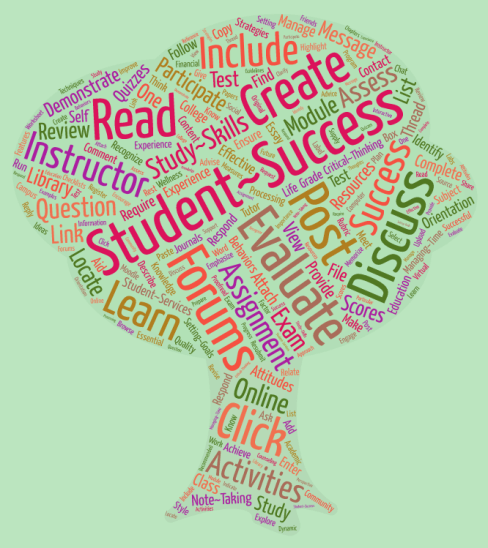
Tagul–This easy-to-use program was new to me, and it is fun!  I can see many uses for it in my classes because I think students will have fun with it too. Tagul allows you to easily produce Word Cloud Art just by uploading web content or adding your own text. Here is one of the first word clouds I created using words from my Study Skills class syllabus.

student-success

I was able to view a short tutorial, and then after a little trial and error, created this word tree that highlights some of the main ideas of the course. Word Cloud exercises could be used for vocabulary-building, learning key concepts and terms, for review purposes and a myriad of other uses. And, like Prezi, it’s free!

Here is a link to the animated version of the word cloud I created:  https://tagul.com/oo05cu2qlre9/student-success

Jing–Although I have used other screencast programs, Jing will be extremely useful for making short how to videos, five minutes or shorter. User friendly with helpful tutorial videos (I should hope so), Jing didn’t take long to get  the hang of and before I knew it, I had created a short tutorial video on how to use Tagul! Here’s a link to the video if you would like to see my first effort at using Jing! Free!

Jing Screencast

LiveBinders–This application helps instructors and students create digital three-ring binders. I haven’t finished working on this project yet, but so far I am quite impressed with LiveBinders. I’m able to download and organize websites, photos, videos, files, etc. that pertain to a particular topic, making them accessible for classroom use. Students can create a free account to create portfolios for class or keep all of their class project files together and easy to share, especially when working on group projects. Very useful.

I will also be learning classroom and online applications of Google Earth this week. Looking forward to it, and I will give you all an update on more useful education applications as I learn them.

I love being a lifelong learner!

Speaking of being a lifelong learner: Just a reminder that my literary e-zine, Teach. Write.,is open for submissions of short fiction, poetry and essays now through July 1, 2017. Anyone who has taught English composition is welcome to submit. See the guidelines  at this link for more information: Teach. Write Submission Guidelines. I would love to see your work!

Anti-Higher Education Sentiments Run High These Days

canon

Iconic Photo from the Cover of Ken Burns’ Civil War Series

“Why do you have to keep paying different lecturers to teach the same course? You get one solid lecturer and put it up online…. If you want to teach the Civil War across the country, are you better off having, I don’t know, tens of thousands of history teachers, who, you know, kind of know the subject? Or would you be better off popping in 14 hours of Ken Burns’ Civil War tape and having those teachers proctor based on that excellent video production already done? You keep duplicating that over all these different subject areas” (The Denver Channel).

These are the words of U.S. Senator Ron Johnson of Wisconsin (R), who is running for re-election this year, spoken at a Q&A session in Milwaukee last Thursday. He was discussing, not K-12 education as you would think by the comments, but rather ways that we could decrease the costs of a college education.

I hope I don’t insult anyone’s intelligence by pointing out what is wrong with this statement, but I would like to highlight a few words as examples of the continuing anti-intellectual, anti-higher education sentiment that is running rampant in our utilitarian-minded culture.

  1. “Why do you have to keep paying different lecturers…”  Once again, money is at the heart of most conservative moves to re-define higher education. “Education is a privilege, not a right–a privilege that few can afford. Keeping cost down is the primary goal.” Keep in mind that Johnson was not being questioned about K-12 or even community colleges. His suggestion is for keeping costs down at four-year colleges and institutions.
  2. “You get one solid lecturer and put it up online,” Johnson said–Oh, what I, with almost 30 years experience teaching composition, could do with just a few minutes alone with this guy. One thing for sure, he wouldn’t leave my office with this major pronoun problem he’s rocking. I might have a thing or two to teach him about rhetoric, too
  3. “If you want to teach the Civil War across the country, are you better off having, I don’t know, tens of thousands of history teachers, who, you know, kind of know the subject? Or would you be better off popping in 14 hours of Ken Burns’ Civil War tape and having those teachers proctor based on that excellent video production already done?”  Oh my, where to begin?
    • “Tens of thousands of history teachers, who, you know, kind of know the subject?” Did you know, Senator, that only about 1.68% of Americans have PhDs at all and only a little over 2% of those people have PhDs in history? (Reference.com). To put that in perspective, consider that a person’s chances are better in landing a position as a professional football player (about 1.9% of football players go pro) than in being granted a doctorate at all much less than in being awarded the highest possible academic credential in the discipline of history (NCAA). These scholars, Senator, deserve better than your flippant derision. They deserve your respect and admiration for contributing to the liberal arts educational tradition that has for so long kept our country great until it began to be gutted by those searching for the quickest and cheapest way to get the largest number of people into jobs that pay well enough to keep them quiet but don’t offer much room for advancement–the utilitarian mindset of short-term training programs offering limited choices, rather than robust liberal arts programs offering opportunities for students to advance in their careers through the stimulation of critical and creative thought–the very lifeblood of innovation that has heretofore kept our country competitive with the rest of the developed world.
    • Ken Burns, while a brilliant documentary filmmaker, is not a teacher nor a scholar. He turned down decreased tuition at the University of Michigan to attend Hampshire College, an alternative school, where students are assessed through writing personal narratives and working on a “self-directed” course of study instead of majoring in a subject, like, I don’t know, something that would prepare a person for making historical documentaries, like history, let’s say.
    • Ken Burns’ primary source, cited numerous times in the course of the series, is Shelby Foote. Now I love me some Shelby–that accent is great, and he’s so Southern, but Foote, by his own admission, was a novelist first and historian second (“Shelby Foote: The Art of Fiction, No. 158”) When some scholars criticized Foote for leaving out footnotes and other forms of documentation in his work, he said: “I have left out footnotes, believing that they would detract from the book’s narrative quality by intermittently shattering the illusion that the observer is not so much reading a book as sharing an experience” (qtd. in Reddit Ask Historians).
    • But, really, Ronnie, are you serious? “Popping in” a 14-hour video “tape”? To educate millennials, digital natives who live in an educational world filled with instructional techniques such as gamification, Learning Management Systems like Moodle and Blackboard, math manipulatives, open-source software, project-based learning, and personal learning networks, you need to stay current with technology and contemporary instructional methods–oh, wait, that’s part of a professor’s job. Even in online classes, educators are beginning to recommend only short videos because today’s students, indeed students have always needed, interaction with each other and with their professors in order to truly learn. We have always learned by doing and today’s innovative colleges and universities are moving further and further away from static, passive lectures and long videos to more interaction through the methods mentioned above, along with a myriad of other ever-changing techniques that require ongoing professional development.
  4. “and having those teachers proctor based on that excellent video production already done.”
    • Yes, already done–25 YEARS AGO! Lovingly restored but not otherwise altered, with some questionable and controversial material debated hotly by scholars, especially concerning interviews with novelist and historian Shelby Foote, who died over ten years ago. Where have you been, Ronnie? Certainly not in any college-level classroom.
    • Now concerning teachers proctoring “based on that excellent video production.”  Senator, this word proctor, I do not think it means what you think it means. In North America proctor means to monitor students during an examination. What exactly does one do if one proctors based on a video? I think that maybe, just maybe, you mean teach based on the video. Oh, teach what? I thought the old video shown in high school history classes all over the United States for decades is the only thing college students needed to further their education about the Civil War. No expert in the Civil War whose job it is to update students on the latest scholarship is needed to bring in other views or expand on important issues or correct mistakes that appear in the film. Of course not.

I’m not bashing the use of film and video in the classroom, not at all.  I use these mediums frequently myself, but not without discussion and critique, not separate from analysis because documentaries can be biased just like any other literary work, and to think students can learn everything there is to know from one historical viewpoint of any one film, especially one that was first aired in 1990, no matter how popular that film may be, is a very poor way to educate anyone. (BTW, Ronnie, we don’t use tapes anymore–most of us don’t even use DVDs. Where ya been?) Ken Burns himself implies in an interview coinciding with the recent restoration and updating of his classic documentary, that history, like any discipline, progresses and morphs as time goes on–our vision of it changes: “ The Civil War made us what we became, that is true. But we are in the process of becoming always” Burns said. “The Civil War …is not only still going on, it still can be lost, which is a hugely important thing” (qtd in Rosenberg).

However, the use of video in the classroom, no matter what the form, is not really Ronnie’s point is it? Perhaps he isn’t even too concerned about paying for education, since it is more of a function of the states rather than the federal government and is a relatively small expense compared to Social Security, Medicare, and military spending (National Priorities Project). What he is truly expressing is his contempt for higher education–his belief that intellectuals are somehow suspect because they tend to disagree with his political opinions and are known for seeking and demanding their personal, intellectual, and academic freedom.

Oh, one last thing, Senator, it’s a bit ironic that you champion Ken Burns’ work–a liberal who has donated thousands of dollars to the democratic party and has broken his non-partisan public persona to denounce Republican presidential candidate Donald Trump. Huh, funny what a few research skills learned in college can do for a person.