I am happy to present the Spring~Summer 2022 edition of Teach. Write.: A Writing Teachers’ Literary Journal. It continues to amaze me how things come together despite my fumbling and failing in the midst of all the planning, teaching, and grading, grading, grading. Oh, my, the grading.
Don’t get me wrong. I still love my work, but editing my fellow writers’ stories, poems, and essays isn’t the same. These writers have made the process a joy–a source of pleasure and relief from the daily routine of over 30 years. I only hope that my efforts do justice to my contributors’ work.
So here it is! Enjoy! And thank you so much, dear contributors!
FYI–A link where those who are interested can purchase a print version will be available soon, usually takes me about a week.
Episode 13 of my podel (podcasted novel) is now available. Why not take a listen to it and the other twelve as well? I hope it won’t be so long between episodes again. Episode 13: Mrs. Whittakers 7,360th Class
CAMPUS: A Novel That Wants to Be a Musical has gnomes and fairy godteachers among other magical creatures.
Also, coming up April 1 is the Spring~Summer 2022 edition of Teach. Write.: A Writing Teachers’ Literary Journal. It’s gonna be a great issue, y’all! Mrs. Winkler’s on a roll!!
Haunted Hendo: An Anthology of Short Films Featuring Mountain Mysteries and Local Lore premiered last night on YouTube. Some of the 50, yes 50, cast and crew gathered at the college for a pot luck supper. We enjoyed watching the films and seeing all our hard work come together. We kept saying over and over again, “I can’t believe we pulled it off.”
It’s been a wild ride.
At the end of the spring semester last year, Jennifer Treadway, the head of the theater department, and I conceived of a series of short films focusing on local ghost stories and legends. In the summer, the director called together a core group of faculty, students, alumni, community members, and actor/producer/writer Z. Joseph Guice, our artist-in-residence, to write the scripts for the films to be included in the series. By the end of the summer, the scripts were written.
Early in the semester, Jennifer held group auditions for all films, casting students and community members, as well as assigning people to various filmmaking roles, including directors, assistant directors, cinematographers, editors, and general crew. With limited resources, including film equipment, the schedule for filming was carefully planned and all took on multiple roles. The schedule was tight and sometimes we didn’t think we would make it, but we did.
Although sometimes frustrating and difficult, what a wonderful learning opportunity for all of us, especially the students in the Acting for Film class and those in the Film and Video Production program. The end result is eight short films connected by some ghostly introductions.
Below is a link to the BRCC Theatre YouTube Page. There, you will find the playlist for Haunted Hendo. I wrote the screenplays for Boojum: The Musical and The Tourist. I directed the film my daughter wrote and edited called The Siren of the French Broad.
This summer is very different than last, which is not a bad thing, of course. However, I am getting out more and doing more that is keeping me away from working on the podel (podcasted novel), but I have episode one of the second season for listening pleasure (I hope).
Also, if you have something to submit to Teach. Write.: A Writing Teachers’ Literary Journal, then I will welcome it. Submissions of the fall/winter 2021 edition are open until September 1. See the submission guidelines for more information
The promised book reviews will be coming tomorrow. I hope.
Working things out takes time. Here I am at 61, still trying to wrap my mind around exactly who I am and why I’m here. I thought that was something young people did. On the way to figuring that out, I got caught up in creating this crazy podcasted novel that I call a podel. CAMPUS: A Novel That Wants to Be a Musical. is a social satire about higher education in the South, and it’s a blast to do. I’m learning so much, screwing up a lot, but not caring, probably offending Lord knows how many people and not caring about that either.
I like it.
Last episode, one of my characters did a highly unusual striptease. Yes, HE did. In Episode 11, The Spooky Cat Head Biscuits, a Zombie band, perform at the club rush/advising/registration day, and during the performance, two of the fairy godteachers have to rescue Jack Spratt, a student who thinks math is beautiful, from the wiles of the devil, or rather a vampire, who tries to trick Jack into drinking hallucinogenic mushroom tea.
So, sometimes I’m a novelist/playwright/actor/singer/podcaster, writing about being a teacher, which I also am. And sometimes I am the editor of Teach. Write.: A Writing Teachers’ Literary Journal. It’s a little more normal, I think. I also like doing this work and would love to read your writing, especially if you are a teacher or you write about teaching. But I publish other types of work, too. Why not give it a whirl? I am accepting work until September 1 for the Fall/Winter 2021 edition. You will find the submission guidelines here,
Next time, I will be a blogger/book reviewer and talk about my latest summer read,
Michele Harper is an emergency room physician, and her book The Beauty in Breaking: A Memoir reminds me of how much teachers have in common with doctors. I’ve blogged about the similarities before. Harper offers more confirmation of my perceptions, especially in “Chapter Two: Dr. Harper: The View from Here,” when Harper describes her internship in internal medicine before completing her residency as an emergency room physician.
In the chapter, she describes one of her professors, Dr. Jaiswal, a “forceful character” (33) whom all the interns feared and loathed. Harper describes how Dr. Jaiswal was particularly cutting and brutal to Harper during the author’s first presentation and in front of the patient, berating Harper for not completing a thorough patient history and for being ill-prepared for her presentation.
Some people, me included, would have been tempted to give up or simply been angry and rejected anything Dr. Jaiswal said out of bitterness and contempt, but Harper learns from the “breaking.”
“I never forgot that encounter,” she writes. “For the entire intern year, I made sure to ask too many questions of my patients….To the best of my ability, I not only read about the topics I didn’t understand, I also read around them. I reviewed the history in my head and practiced my assessment and plan, making sure the reasoning led to a logical conclusion….That was the last time I was unprepared for Dr. Jaiswal’s rounds. What’s important was that in that very long year, she helped me become a better doctor because I saw the good in her, in the value she placed on meticulous preparation and critical thinking” (40-41).
I am not advocating being “deragatory and cruel” (41) as Harper describes Dr. Jaiswahl, but I don’t mind being tough. I don’t really think I am all that tough actually, but in today’s ultra-sensitive world, I am perceived as such by some students, parents, and administrators. I wish I could help them all understand that all I want to do when I challenge and push students is motivate them to stretch themselves–ask too many questions, read about the subjects, read around them. I want them to learn how to think!
Harper offers many stories of encounters with people in her work and personal life who break her or come to her broken, in need of healing. She writes of what she learned from them and how she has come to embrace not the brokenness itself but the lessons that inevitably come from it.
In Chapter Three, Harper writes, “We had all been broken in that moment–broken open by shock and grief and anger and fear. I didn’t know how or when, but this opening could lead to healing. After all, only an empty vessel can be filled by grace; but to get there, we had to help each other rise while we shed the same tears. We had to get up and start again” (68-69).
Another chapter in the book I liked was “Chapter Four: Erik: Violent Behavior Alert.” Harper laments the bureaucratic bull that she has to put up with on her job that does little to nothing to help her patients. Man, can I relate. She speaks about a 2011 study that exposes the myth that most ER patients are uninsured. Not true according to the study. Most are insured and come to the ER for various reasons, including, she says, because they feel “so entitled from unchecked privilege that even polite questioning causes them to blow a fuse” (77). Again, man can I relate.
Harper touches on other issues that doctors and teachers, especially women, experience similarly, including the inequity in how female professionals are treated in the workplace and false perceptions of doctors, but the positive aspects of her work are similar to mine too–helping people, challenging them to take action, to move forward into a new and better life.
The Beauty in Breaking: A Memoir is well-worth the read for anyone, not just doctors and educators; we’ve all been broken, and we all can learn from that breaking–something I want my students to understand.
Harper, Michele. The Beauty in Breaking: A Memoir, Riverhead, 2020.
Photo of Cover by Katie Winkler
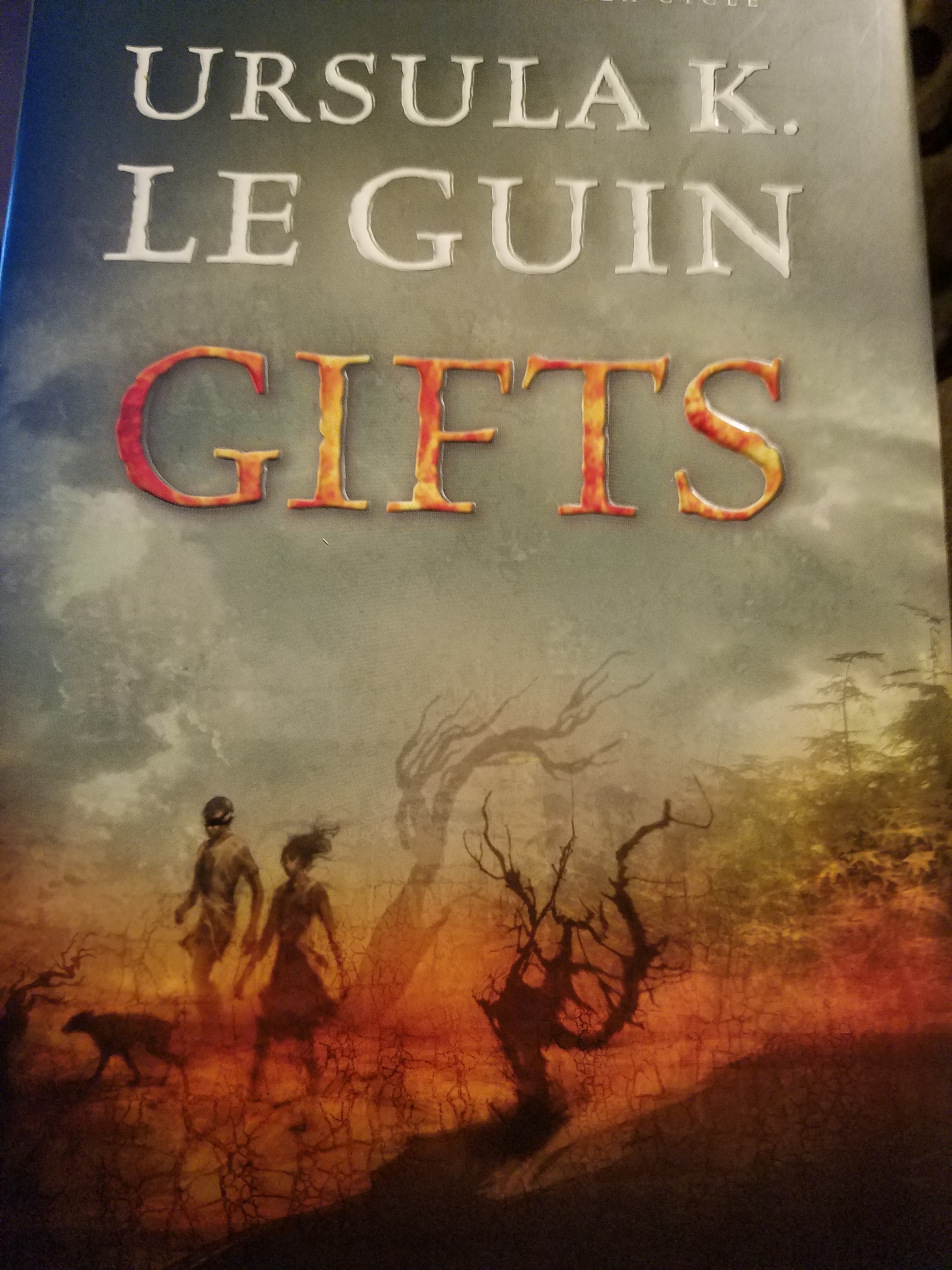
The next book I finished is the young adult fantasy novel Gifts by Ursula K. Le Guin. In this imaginary world, the people of the Lowlands are blessed, or perhaps cursed, with magical gifts–some seemingly benign, like summoning animals, and some dark and sinister, like the ability to twist limbs or melt flesh and bone.
Two young people, Orrec and Gry, friends all of their lives, must face the consequences when they refuse to use their gifts, refuse to take life only to help others retain power.
In the end, the true power lies in friendship, sacrifice, and love.
It also lies in storytelling.
One of my favorite passages in the novel is when the narrator discusses how storytelling empowers us:
“My blindfold and my mother’s illness worked together in one way that was good: we both had time to indulge our love of storytelling, and the stories carried us out of the dark and the cold and the dreary boredom of being useless” (194).
This is why I love to write. It carries me out of the dark and the cold. It gives me purpose.
Le Guin, Ursula K. Gifts, Harcourt, 2004.
Most writers I know aren’t happy keeping their writing to themselves. That is why I started Teach. Write.: A Writing Teachers’ Literary Journal. I wanted to offer a place where other writers out there, especially writing teachers like me, could share their work. Until September 1, I am accepting short fiction, poetry, essays, and more for the 2021 Fall/Winter edition of Teach. Write., and I would love to consider your work. I am especially interested in the work of those who teach writing, but I am open to all. See the submission guidelines for more information.
ANOTHER EPISODE OF MY PODEL (PODCASTED NOVEL), CAMPUS: A NOVEL THAT WANTS TO BE A MUSICAL, IS COMING YOUR WAY THIS WEEK! NOW’S YOUR CHANCE TO LISTEN TO THE PREVIOUS EPISODES SO YOU WILL BE READY FOR EPISODE 10. IT’S GOING TO BE A DOOZY!
I love it when my summer reading plans fall into place almost magically. In April, for my birthday, my nephew Timothy, a total bibliophile (I love it!) who blogs at The Mugwump Diaries, gave me the book Austerlitz by W. G. Sebald. For one reason or another, I was unable to read the book until later in May.
Another thing that was put off was my correspondence with potential contributors to Teach. Write. Turned out that one of the writers, whose work you will read in the next edition, mentioned W. G. Sebald in his cover letter. In the acceptance email, I told him that I was reading Austerlitz; thus began a brief correspondence about the work and the author that helped solidify some of my thoughts about the work. He suggested that I read another of Sebald’s books, The Emigrants, which I have added to my very long reading list for this year.
In his excellent review of Austerlitz on the website The New Canon: The Best in Fiction Since 1985, Ted Gioia, music critic and book reviewer, writes that Sebald “has written a historical novel that appears to exist outside of history, yet this represents less an escape and more an exile. That dislocation is both the tragedy of Austerlitz the character, and the wonder of Austerlitz the book.” This statement reflects my understanding of the book as well.
Austerlitz is a displaced person, growing up in the UK from the age of five, feeling different and not understanding why until his adoptive parents explain his origins. As he travels through life, drawn more and more to the seemingly immutable architecture of Europe, he also explores his history and the trauma of his childhood. Further highlighting his isolation, Austerlitz tells his story not to a friend or relative but to the narrator, whom he meets by chance at a zoo in Antwerp. Their intermittent friendship develops slowly over the years when the narrator is invited to the various places Austerlitz lives, especially London, where the German-born Sebald lived and worked for a large portion of his life.
Page 5 of Austerlitz–photo by Katie Winkler
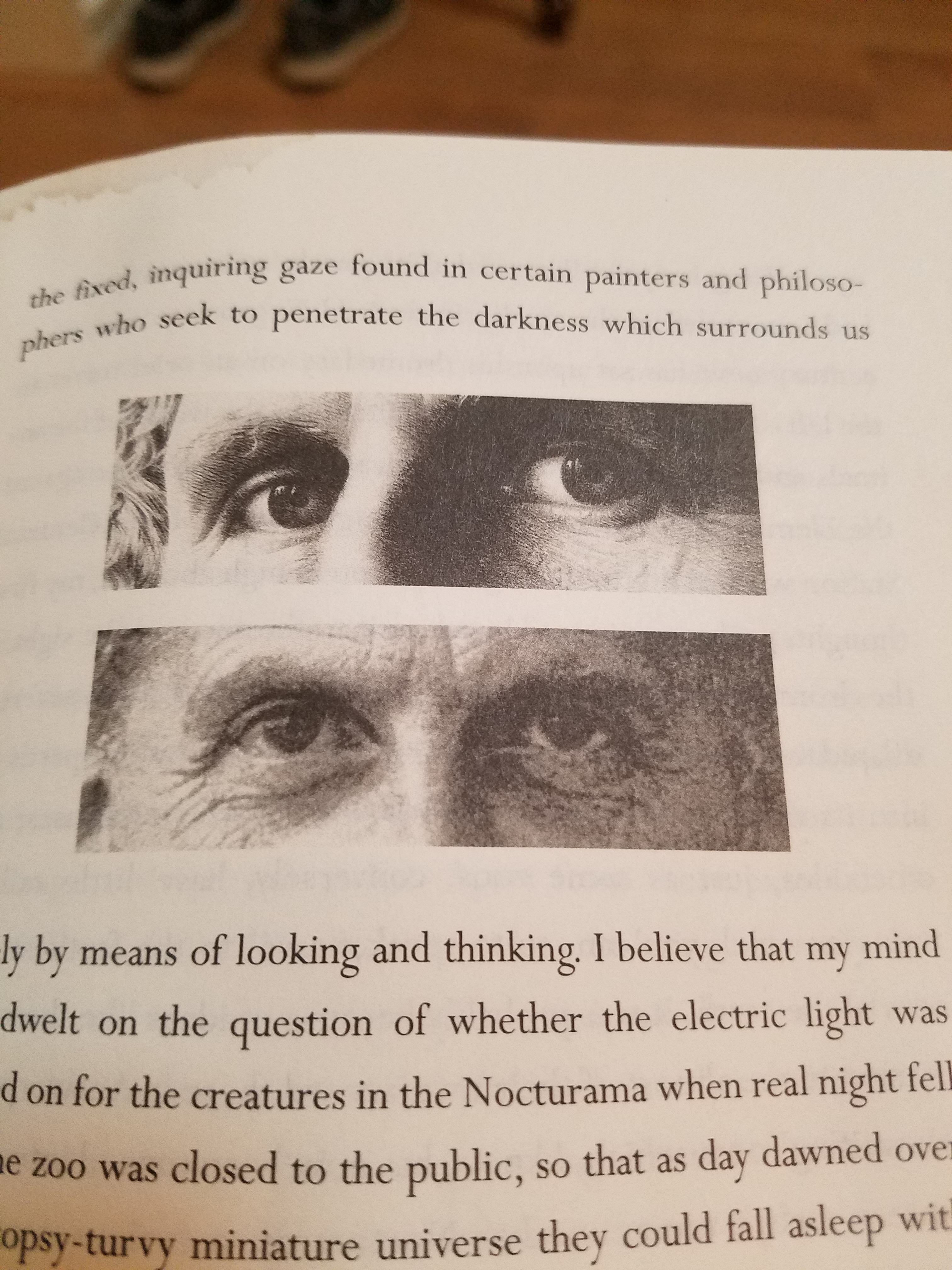
The unusual style of the book is part of its appeal. Like Nick Carraway, the narrator shapes our vision of Austerlitz. We only know what Austerlitz reveals to him and what we see in the various photographs like those below, displayed throughout the book. (You can see why I think of The Great Gatsby now, can’t you?) The long narrative passages with no chapters and very little paragraphing are often punctuated by the words “Austerlitz said,” reminding us that this is not the narrator’s story.
Also unusual are the long sentences and dialog without punctuation. The effect is not exactly stream-of-consciousness, but stream-of-conversation or narration, like when listening to an elderly relative recalling events from childhood, moving seamlessly from one memory to the next, digressing when the recollection leads to some topic of interest or area of expertise.
As a teacher and a writer, I find the digression from the story that speaks about the difficulties of writing particularly interesting. The narrator has come to visit Austerlitz at his home in Alderney St., London; photographs of architectural wonders from around the world are scattered all about, but before Austerlitz can begin taking up the story of his life once again, he explains how he, recently retired from teaching, now wishes to compile his thoughts and ideas about architecture but is having trouble focusing:
“All I could think was that such a sentence only appears to mean something, but in truth is at best a makeshift expedient, a kind of unhealthy growth issuing from our ignorance, something which we use, in the same way as many sea plants and animals use their tentacles, to grope blindly through the darkness enveloping us” (124).
I don’t know a writer who has not felt this way at some point and time. Austerlitz goes on:
“I could see no connections anymore, the sentences resolved themselves into a series of separate words, the words into random sets of letters, the letters into disjointed signs, and those signs into a blue-gray trail gleaming silver here and there, excreted and left behind it by some crawling creature” (124).
And so I hear the words of the reviewer Gioia again–Austerlitz’ tragedy is the wonder of the book, that the character’s growing displacement can bring all of us, not just writers, not just survivors of childhood trauma, but anyone who feels displaced, into a community, giving us a place to belong.
Citation
Sebald, W.G. Austerlitz, 10th Anniversary Edition, Modern Library, 2011.
I feel that I am developing my own community of writers through editing and producing Teach. Write.: A Writing Teachers’ Literary Journal. It is devoted to writing teachers who want to publish their writing, but you don’t have to be a teacher to contribute. I welcome writing from anyone.
Submissions for the Fall/Winter 2021 edition are open until September 1. Follow this link for submission guidelines. I would love to read your work.
My podel has gnomes and fairies, boojums and zombies, along with other outlandish characters, living ordinary, extraordinary lives.
And, no, I have not forgotten my podel (podcasted novel), but I am having some issues, not unlike those encountered by Austerlitz. I am tooling along ,though, and quite proud of the nine episodes I have produced so far and having fun, which is not the only point but a big one. If you would like to hear the podel so far, then follow this link: CAMPUS: A Novel That Wants to Be a Musical.
Remember when I said my mother had gone to the emergency room but was sent home? Well, she had to go back a few days later and was admitted. I went to Alabama for a week to be with her while she was in the hospital and get her settled when she came home. I stressed over trying to get the spring/summer 2021 edition of Teach. Write. published by April 1 until I reassessed my priorities. I contacted my wonderful writers and let them know I would have the new edition out by April 10.
And it’s here!!! Thank the good Lord for Spring Break!
I hope you enjoy this edition of Teach. Write.: A Writing Teachers’ Literary Journal. Next, I will work on another long overdue episode of CAMPUS, my podcasted novel, available on Anchor, Spotify, and other podcast platforms.