The Art of Writing

conventioncenter-day_creditscottdresselmartin_580

Before I was a full-time instructor, over twenty years ago, I presented at my first national conference–the National Conference of Teachers of English. It was in Denver that year, and I paid for the conference myself because I craved professional development, even though I was a lowly adjunct, only teaching three or four large college classes each semester.

In a round table session, I  presented  an exercise that I had created for my developmental English courses called “The Art of Writing.” The students took a reproduction of a famous piece of art (I had many pictures for them to choose from) and told them to brainstorm about what they saw, using a handout I gave them.

One side of the paper was marked “Concrete,” where they wrote what they saw in the picture or what they could imagine that they could experience with their other senses. On the other side of the paper, I wrote “Abstract,” where students wrote words and phrases that represented how the painting made them feel or what memories, or thoughts in general, the painting helped bring to the surface.

After they brainstormed, the would develop some sort of prose writing based on the art and their brainstorming, combining the concrete with the abstract. I used as an example a short piece I wrote that was based on the iconic painting American Gothic by Grant Wood. Here is the painting and the creative piece I wrote based on it:

Grant_Wood_-_American_Gothic_-_Google_Art_Project

American Gothic

I remember marrying him.  We stood together in the country church, farmer’s son and farmer’s daughter, too poor for ought else–too much a part of the land anyway.  My family sitting on those hand-hewn, hard-backed pews, witnessing.

That night I didn’t utter a word or a cry.  Closing my eyes, I imagined I was lying in the distant fields of my home, daises tickling my face and hands and feet.

I worked hard, learning not to expect any praise for the clean floors or hearty food. My greatest joy, to get all of the chores finished in time to head for the fields, to hold the soil of our land in my hand, to feel its moisture and smell its mustiness.

He did praise me once.  After three daughters, who were mine to raise, to teach, to find husbands for, I bore him a son.  I sweat and strained and screamed no less, but somehow it was different, and he thanked me.  Then, my son was gone, no longer mine.  So soon he learned not to cry.  So soon he became a man.

Now, in that same country church, as my youngest daughter gives herself to a farmer too poor to leave and too much a part of the land anyway, I sit in a hand-hewn, hard-backed pew, witnessing.

**

I quite like this little character study, which went on to be published by the way, but more importantly, the piece inspired my developmental students for over a decade. Some of my students’ writing was published in our yearly literary magazine–one even winning a cash prize as  the top fiction piece in that year’s journal.

Another student picked a famous photograph of an American flag on a front porch and wrote an amazing creative non-fiction piece about the meaning of liberty. That student was attending our school under the GI Bill, having served during Operation Desert Storm. I’m telling you, he had a heck of a lot to say about liberty that the younger people in the class needed to hear.

Were they inspired to write or did the assignment just help them feel free to use their creativity? Did the painting give them something to write about, a story already there that they just fleshed out? It was more than likely a combination of things, but whatever it was, many of my students, developmental students, did their best writing when writing about art.

In recent years, the state where I teach has discouraged creative writing or the study of literature  in writing classes, especially in developmental classes. The trend is towards more “practical” writing, utilitarian, without flair or heart or life. Surprise! I am bucking that trend. I don’t use my art assignment any more, but my students engage with and write about music, film, theater, literature and art, and their writing is better for it. They are better for it.

In 1938 Winston Churchill, said, “The arts are essential to any complete national life. The State owes it to itself to sus­tain and encour­age them….Ill fares the race which fails to salute the arts with the rev­er­ence and delight which are their due.”

Maybe the State, as well as college administrators and curriculum developers, should listen to him.

cover

If you are, or were, an English composition teacher, do you have a writing prompt that you have used in class and would like to share like I did at the conference? If so, I would love if you would submit it to my literary magazine Teach. Write. 

In the magazine, I have a feature called “Write Your Own” where you do like I did and write your own creative piece using a prompt that you have once given your students. Accompany your piece with a brief explanation of the prompt or the purpose for the assignment.

I am also accepting general submissions of poetry, flash, short stories, and essays through March 1 for the spring edition. Click for complete submission guidelines. I look forward to reading your work!

Happy New Year!!!

And Merry New Semester!


Battle Cry

Knight-800px (2)

Knight on Horseback by Firkin (freeclipart.com)


My last post was December 1. That seems like a long time ago. The normal end of the year rush, trying to do my best by my students, and then the additional hassle of dealing with the politics and bureaucracy of the job that is my least favorite aspect of teaching.

But then comes Christmas! A chance to get away and not think about work at all except for tinkering with the web-based material of my classes a little and musing about my profession. After a rest and time with the people who love me and whom I love, I know that I am up for the battle that is ahead.

I will fight for the integrity of my institution of higher learning. Yes, it is just a small community college, but it has always been a place where I have been proud to work–where students have been expected to meet certain levels of competency before receiving a passing grade. Period.

MedievalDesign-800px (2)

Medieval Design by Firkin (freeclipart.org)

Therefore, I resolve to put on my armor and fight the good fight. Too many are giving in to the pressures of administrators and parents who are data-driven down a road to nowhere. Not me. Not now. Not ever. I hope all teachers will follow me.  It won’t be easy. Our arsenal is dwindling–decreased respect for academia, no tenure, dwindling academic freedom as well as the autonomy college-level faculty have so long enjoyed.

However, we still have at least one mighty weapon–a free press, who knows for how long, so let’s make the most of it. National Public Radio, that bastion of fake news, along with American University Radio (WAMU), has been reporting, if you can believe those bleeding hearts, on a high school in Washington D.C. that boasted of having all of its graduates accepted to college. Sounds great? Not really.

The report states that not only did the majority of the graduates miss more than six weeks of school, but also only 57 students met graduation requirements. Yet somehow all 164 students graduated and 164 students were accepted into college. Faculty members testified that administrators frequently asked them to give students who missed an assignment a 50 instead of a zero. One faculty member was called while on maternity leave and asked to change a grade for a student she previously failed.

A few months later, NPR has published a follow-up article with voices of faculty around the country facing similar circumstances–being pressured to change grades and pass students who can’t, or won’t, meet minimum requirements, witnessing the falsifying of attendance and other records but not saying anything out of fear of losing their jobs.

Here’s the article:  “Teachers Around the Country React to Investigation at Ballou High School”

Interesting, but disturbing, especially because it’s no fake news. The things I have seen and heard this long month of December prove it’s all too real.

But I’m rested.

I’m ready.

Bring it on.


joanofarc-800px (2)

Joan of Arc by j4p4n (freeclipart.org)

Job 39:19-25 

King James Version (KJV)

19 Hast thou given the horse strength? hast thou clothed his neck with thunder?

20 Canst thou make him afraid as a grasshopper? the glory of his nostrils is terrible.

21 He paweth in the valley, and rejoiceth in his strength: he goeth on to meet the armed men.

22 He mocketh at fear, and is not affrighted; neither turneth he back from the sword.

23 The quiver rattleth against him, the glittering spear and the shield.

24 He swalloweth the ground with fierceness and rage: neither believeth he that it is the sound of the trumpet.

25 He saith among the trumpets, Ha, ha; and he smelleth the battle afar off, the thunder of the captains, and the shouting.


Thanksgiving at the Pagoda

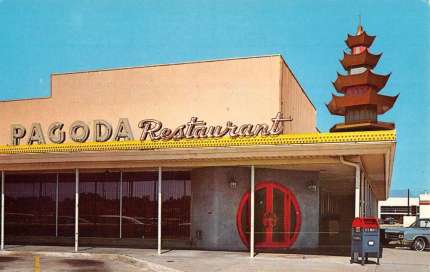
L4b77bf7ebf16aa15a52a4ad03b49010fike many college students that I teach today, when I was in college, not only was I a full-time student, but I also had two jobs. I worked as a secretary in the German department (I majored in English and German), but I also worked as a hostess and cashier at my friend’s parents’ Chinese restaurant–The Pagoda, where I received an education of a totally different sort, but equally as important, to me anyway.
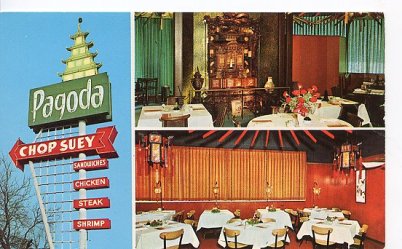
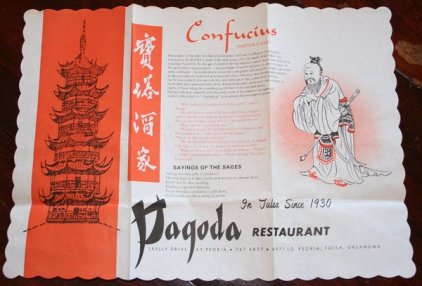
The Pagoda was a truly American Chinese restaurant, built and owned for years by a Chinese-American family, then, after it was already an established and popular eatery, bought by my friend’s father, a Puerto Rican-American,.  The chefs were from Hong Kong primarily; the fry cooks, bussers, and dishwashers were mostly Puerto Rican. Some of them spoke English, but many of them did not. Then there was the wait staff, which included a myriad of varying ethnicities, including Japanese, Laotian, Vietnamese, Cambodians, Oklahomans,  and me–a little bitty, painfully shy girl from Alabama.

pagoda

It was quite a place! Who would have thought, at a Chinese restaurant in the heart of Tulsa, Oklahoma, that I would have tasted such a rich variety of cultures and traditions but always with a distinctly American flavor? This true melting pot extended to the menu, where patrons could feast on traditional dishes like Moo Goo Gai Pan or Chicken Chop Suey, more Americanized fare like Garlic Chicken (garlic-flavored fried chicken) or Steak Kew (thick chunks of sirloin stir-fried with Chinese vegetables in a savory sauce), or all-out All-American eats, including hamburgers, French fries, and Chicken-Fried Steak with White Gravy. (One customer regularly came all the way from Fort Smith for that dish.)

When I first started working at Pagoda, I was so shy, so naive. My parents had moved us to Tulsa when I was still in high school–I graduated from Jenks High School in Jenks, Oklahoma–but I stayed in college at Oral Roberts University, living at home for my first three years in college. Then, about the time I started working at Pagoda, my parents moved back to Alabama, and I moved into the dormitory.

Before that time, I had relied mainly on my family members, my best friend, and her boyfriend for companionship, but now my family was gone, my best friend had moved to a college out of town, and her boyfriend worked a great deal, and I did too, especially at Pagoda.  But my bosses and fellow workers reached out to me, engaged me, joked with me, even protected me, as if they knew I was lost and lonely in a world where I didn’t always fit in.

pagoda-placemat-60-thumbOh, so many memories of that time–

  • The time the Japanese servers refused to work unless they could put a TV up in the waitresses’ alcove so they wouldn’t miss a single episode of Shogun
  • The old Chinese chef, who spoke little English but gave us all pet names off the menu–one friend was Fried Won Ton, another was BBQ Rib, and I was, to my consternation, Sweet and Sour Pork.
  • The huge strong chef, who looked like an Asian Mr. Clean, with his bald head and bulging biceps. One day he was tossing fried rice in a gigantic wok over a searing flame and called me over as I walked by. I motioned I was in a hurry, but he insisted, so I went over. He communicated to me that he wanted me to toss the rice. I looked at him, my eyes narrowing, suspecting a setup, but his was a face of stone. So I took hold of the massive spatulas, more like tiny shovels shoved into the mounds of rice, steeled myself and tried to lift them. They didn’t budge–I heard a tiny sputter from the big man. Tried again, nothing–he sputtered a bit louder–then at the third attempt, he could contain it no longer and burst out with a big-bellied laugh at my expense. Then, after he wiped his eyes, he started tossing the rice with an ease and abandon, laughing all the time. I laughed too–unashamedly.
  • There was the tiny Japanese waitress who had been married like four or five times, who came up to me almost every single time I came into work, looked me in the eye and said, “Smile if you got a little last night.”  Of course, I never got any and of course, I always laughed. Oh, how I loved her.
  • Giving a sweet Cambodian couple some English lessons. In thanks, they cooked me a huge turkey at Christmas time, such a generous gesture that I didn’t have the heart to tell them that I lived in a dorm and had no place to put it. I can’t even tell you what I did with the thing, but I remember their kindness to me. I will never forget that.
  • Then there was the self-proclaimed Okie from Muskogee, who smoked like a chimney and spent her free time traveling to Vegas for gambling weekends with one of the other Japanese waitresses. She had lived a hard life, and nobody messed with that woman, but she had raised children too and knew when they needed to be loved. She cursed and complained about many things, but she never had a harsh word for me. Bless her, she knew I needed a little tenderness, so far away from my own mama.

I especially remember sitting down for special meals during holidays and other special occasions, especially Thanksgiving. Everyone celebrated it–all races, nationalities, and creeds. At Pagoda, Thanksgiving meals became times for friendly competition between the two major groups of cooking employees, so when the restaurant would close before Thanksgiving Day, we would have a spread, all the traditional fixin’s with a spicy twist, including two turkeys–one was cooked in a Chinese style, brined with the skin crisped on the outside and the other one in a spicy Puerto Rican style with adobo spices and oregano. (I’m guessing based on what I know now–I only knew the food was delicious back then.)

Both groups would try to get all of the diners, myself included, to declare their favorite, but I never did. I just smiled, laughed, said I had to get another helping before I could be any judge, and headed back to the table for seconds or thirds. I always tried to find my way back in a corner. I was young. I was shy. I didn’t speak their languages, but I ate their perfectly spiced food, watched them, listened, laughed when they did, and longed to understand them more.

Thus was born one of the key tenants of my educational philosophy.  So I tell my students–get out of the classroom. Put yourself in new and uncomfortable situations and listen for that song you’ve never heard before. Go into every situation with a mind open to learning about things and food and cultures and people you never dreamed you would. If you want to truly, deeply learn—then go out and live.

9f3b5a24ef334aa4354bde332a7f3adb--pagoda-restaurant-oklahoma

Caring

writer-605764_640-2I am beginning to put more emphasis in my teaching on caring.
First of all, I want to care more, about how I teach, what I teach, yes, but what I really want to care more about is each and every student–not just the ones who need me most, either. I want to care about them all–the gifted student, the one who seems to have it all together as well as the one who has dissolved into tears in my office. All my students need earnest praise, constructive criticism, encouragement–attention. They deserve it.

I want to care enough to take the time to let the struggling student know what he or she is doing right as well as what needs improvement. It is so tempting to only mark what needs to be improved. I want to care enough to take the time let them know how much I like that creative spark or this interesting fact they found through careful research.

I want to care enough to put away my petty concerns, there are so many, to concentrate on one of the two things I know in my heart I was born to do–teach writing.

Secondly, I want my students to learn to care. When they start caring about their work, amazing things can happen. The process begins when picking a topic. I spend much more time with this part of the process than I ever have before, and I am seeing results.

It isn’t easy for my students to care about writing for a myriad of reasons:

  • They don’t like writing. Many meaningless “busy work” assignments over the years have soured a large number of my students to writing.
  • They don’t think writing is important. Even though my students write all the time in their daily lives, they often don’t see the relevance of learning to communicate well in the written word. Somehow they seem to think they write well enough to be understood and that’s good enough, so why spend time on it, especially if they are going into a STEM career
  • They don’t make time for revision and editing. I am convinced that if students would leave themselves enough time to revise and edit, they would have time to develop, if not a passion for writing, at least a more thoughtful attitude towards it because they would see how caring improves the writing, which begets pride in one’s work, which begets a desire to leave more time for revision and editing. It’s hard to care about something if rushing to keep a deadline.

One tactic I use to instill a little more thoughtful attitude towards writing is to require my freshman composition students to pick a research topic with a local focus. We spend time exploring topics that concern their everyday lives on and off campus. We brainstorm about the issues they care about, which often leads to a willingness to search even harder for solutions to the not so hypothetical questions they are asking.

Doesn’t always work, of course, but for some of my students, learning to care has not only helped them write better papers, but it also has helped them become advocates for change in their communities, making their lives better, too.

***

cover

The spring/summer 2018 edition of Teach. Write.: A Writing Teachers’ Literary Journal is open for submissions until March 1. See submission guidelines for more information


Man, That Is So Great! Thanks, Mom!

Mom in NC 004

Mom along the Blue Ridge Parkway on a visit to North Carolina in 2015

A while back, I wrote about my father’s influence on me as a person and an educator. I’ve also written about my grandmother, great aunt, uncle and sister.

Now it’s Mom’s turn.

I quoted Mom in class today, again. I frequently do that because Mom has had so many things to say…wait…that didn’t come out right. I mean in a good way, so many good things to say. Today, I was talking to my students about the importance of learning research skills and remembered one of my favorite Mom sayings: “The secret to a getting a good education,” she said, “is learning how to find things.”

Man, that is so great!

And Mom knew what she was talking about–for the bulk of her career she was a high school librarian–teaching students how to find things. But Mom had been an English teacher, too. She was actually my English teacher one year. I know what you’re thinking. What a nightmare! And occasionally it was indeed, but totally NOT Mom’s fault. She was a wonderful English teacher because she is so well-read and is such a good story teller.

One story I frequently tell my students is how Mom was teaching us about writing introductions and the importance of grabbing people’s attention. Now, you must realize that I was in eight grade at the time and attending a Christian school, a conservative Christian school, in Augusta, Georgia, where my father was principal and my mother an English teacher.

So Mom gives an example of an attention-getting opening. She told us about the best first sentence she ever heard, often attributed to Agatha Christie (origin is not clear), that truly reaches out and grabs you–“Damn!” said the duchess.

When Mom said “Damn!” everybody stopped their daydreaming or passing notes or whatever and looked at Mom. Did the principal’s wife just say, “Damn!”? Once Mom made eye contact with all of us, she just smiled and said, “See? Got your attention, didn’t I?” Man, it was so great. I have never forgotten that lesson. Write something different, unexpected when you write an introduction, and you will have your reader eating out of your hand.

I quoted Mom a few weeks ago when I was explaining the concept of soft skills to my students and how hard it is to teach them in any formal way, but we need to learn them if we hope to be truly successful in our careers and in lives. I explained how my mom was constantly looking for ways to teach us these important soft “life” skills, like when she explained the importance of having good manners. “You know,” she said one day, “having manners is nothing but being kind to people. That’s really all it is” Man, that is so great.

Mom likes to quote, especially scripture and poetry, so I have my favorite Mom quote that I quote to my students. It is from the poem “A Farewell” by Charles Kingsley, which my mother learned from my grandmother, another teacher-mother, and so on it goes:

Be good, sweet maid, and let who will be clever;
Do noble things, not dream them, all day long:
And so make life, death, and that vast for-ever
One grand, sweet song.
Man, that is so great. I love you, Mom.
Mom and me

Mom and Me in front of the Jule Collins Smith Art Museum in Auburn, Alabama Summer 2015

First edition of Teach. Write. to launch September 1

writerwritingframe-300px (2)

It is the perfect time for Teach. Write. to launch. As I begin my 23rd year of teaching at a small community college in North Carolina and work on producing the first edition of my first foray into producing a literary journal, I am reminded of how much I love my chosen professions. Since I was a little child I have wanted to be a teacher and soon after that dream was born, thanks to a marvelous English teacher named Mrs. Riskind, I have wanted to be a writer.

Now I am both.

To add editing to those two honored vocations exceeds all my expectations. It is modern technology that makes this journal possible and gives voice to those who deserve to be heard–English composition teachers. These are unique voices–surprising and refreshing. I can’t wait for you to read the short stories, essays and poetry of some special writing teachers.

It won’t be long now, so stay tuned!

An Exciting Summer

writerwritingframe-300px (2)

Submissions are closed for the premiere edition of Teach. Write. Thanks to all who submitted. I will be getting in touch with contributors as the month progresses. Tomorrow I will begin putting together the journal of poetry, prose and essays that will launch on September 1, 2017.

It has been a busy summer, and although I did not complete my two major writing goals, I have made progress on both and am looking forward to continuing that work while I begin teaching. The teaching will always come first, of course, but I am determined that I will use my time wisely and work on my writing projects each day. I want my students to be disciplined writers, so I need to make every attempt to be disciplined in my craft as well.

d8ce6a5e9ae0d888f860fbcc01dc04d2By the end of November, I will have completed the rough draft of my novel, Flood, a mystery/thriller set in Alabama during the early days of Obama’s first presidential run. The idea for the novel started as a short story for my unpublished novel Mordecai Tales, but on the advice of some of my writer friends, I decided to turn the idea into a novel. Portions of the book were workshopped at two different conferences this summer, and the feedback I received from fellow writers as well as two excellent instructors, Jane Smiley and Sheryl Monks, has encouraged me to complete the work.

223_4324I also will have completed several drafts of my new play, an adaptation of Robert Browning’s The Ring and the Book. I have spent many hours this summer re-reading and studying the The Ring and the Book, which has re-kindled my interest in this novel-length poem that is considered Browning’s crowning achievement but is little read today.
To prepare for writing the play, I also read Dared and Done: The Marriage of Elizabeth Barrett and Robert Browning, which includes fascinating biographical sketches of both writers as well as excerpts from their vast correspondence that is extremely helpful as I write the play. A third helpful source I completed reading early in the summer is Derek Parker’s non-fiction book Roman Murder Mystery: The True Story of Pompilia, an informative re-telling of the factual details surrounding the 17th Century Italian murder case on which Browning’s magnum opus is based. 

I am excited to complete both of these very different works and am truly enjoying the process of writing, something I hope to pass on to my students this semester.

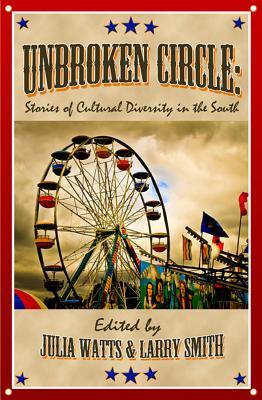
My other big writing event was the publication of a short story “I Have Not Yet Returned” in the anthology Unbroken Circle: Stories of Cultural Diversity in the South published by Bottom Dog Press as part of their Appalachian series. You can purchase a copy of the book with its 26 stories and essays about the modern South through the publisher’s website or at amazon.com.

unbrokencircle


From Prompt to Publication

writerwritingframe-300px (2)

My first stab at producing and editing a literary journal–Teach. Write. -is taking shape.

I have accepted quite a few wonderful submissions, but I am hoping to get some more before the August 1 deadline. If you are, or ever have been, a teacher of writing in any capacity, then I would love to see your work–prose or poetry–doesn’t have to be about writing, just writing by a teacher or former teacher. See the submission guidelines for more information.

I was inspired to start Teach. Write. because I have witnessed how writing for publication has enriched my teaching. I am more attune to the power of the revision process, more gentle with my criticism and more accurate, too. Because I am a working writer, I work better with writers who are just learning the process–it keeps me closer to them.

One feature included in Teach. Write. will be called “Write Your Own.” In this feature I would like to highlight writing prompts that  teachers have used successfully in class. To do that, I would like the teacher to not only include and explain the prompt, but also to write something based on their own prompt and submit that piece along with the prompt and explanation.

Here is an example of an explanation, prompt and flash piece that I created for my online British Literature I class:

I’m always trying to find ways to engage online students more effectively. It isn’t always so easy to do. A couple of years ago, however, I came up with a prompt for a discussion forum on Beowulf that has proved to be most successful. I wrote my own response to the prompt when I first posted as an example for my students and liked it so much that I tweaked it a little and sent it out into the cold, cruel world. After a couple of rejections, an online fantasy publication–Mirror Dance–accepted it for publication. I was quite pleased. See the results here: Waiting for Beowulf

The Prompt

The early Anglo-Saxon people were great storytellers. The story of Beowulf, as you saw in the BBC film this week, began as oral tradition, told and re-told around campfires and in great halls for decades, even centuries, before it was finally written down in the form we know it.

Americans are great story-tellers, too, especially here in Appalachia where many of us, including me, have Anglo-Saxon and Celtic blood coursing through our veins. For this assignment I’m going to let you tell part of the Beowulf story your way. Let’s get started:

Directions:

  • Choose one of the scenes you read in Assignment 2.1:
    • First Attack
    • Fight with Grendel
    • Fight with Grendel’s Mother
    • Fight with the Dragon
    • Beowulf’s Funeral
  • Review the scene so you are sure of the plot.
  • Rewrite the scene or a part of the scene from a specific character’s point of view–For example–write the scene of the first attack from one of the surviving men’s point of view or tell it from one of the women’s point of view. Your scene should be one or two well-developed paragraphs in length (seven to ten sentences per paragraph). It may be longer if you are inspired.
  • Post your scene, illustrated by an internet picture you’ve found. See my post to get an example of what to do.
  • Post a thoughtful response to either my sample post (if you are the first one to post) or one of your fellow students’ posts. Take a look at my sample response to get an idea of what I mean by thoughtful response. Also, look at the grading rubric in the Joule Gradebook to see how I will be grading this assignment.
  • Have fun with this assignment!

    The Post and Sample Response

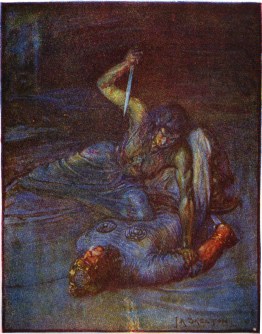
  • stories_of_beowulf_water_witch_trying_to_stab_beowulf

    By J. R. Skelton [Public domain], via Wikimedia Commons


    Waiting for Beowulf

    by

    Katie Winkler

    Come my beauties, writhing sea dragons and serpents, monsters with milky eyes, slouching on slopes by the cliff. Come greet our visitors–the loathsome King Hrothgar and his fiendish followers. And Beowulf, the son-killer, watch him don his war-gear, showing no fear. I will give him cause to tremble, cause to repent how he rent the arm of the monster-child, left him to die like a dog, denying a god the honor of a swift death.

    See the man take up Hrunting, the fool, thinking he will be victorious, boasting to his lord of its great strength as he comes to meet me in my own abode. He will swim to me through the depths, with great and mighty strokes, swim to my home some call a hellish turn-hole. Here he will sling the mighty sword. Its decorated blade will come down singing and ringing. Singing and ringing. But it will not touch the swamp-thing from hell. It will refuse to bite, and then this hag, this witch, shall take her revenge.

  • Response:
    • This creative response shows a good understanding of the scene in Beowulf that depicts the fight with Grendel’s mother. The author includes references to the description of Grendel’s mother in the original work as well as the underwater cave in which she lives. Also interesting is the use of kennings–compound words like war-gear, son-killer and turn-hole. Kennings are common in Anglo-Saxon poetry. Finally, it is interesting to see the story from the creature’s perspective. She is portrayed more as a vengeful mother who has lost her beloved son than a fiendish monster. The illustration is appropriate as well, showing that the illustrator obviously read and/or studied the original work before creating the artwork. Note: I used a different illustration in my post but could not include it here due to copyright issues.

Student Response to the assignment has been positive.

Most students respond well to Beowulf anyway. It is just such an exciting “action hero” story, but this prompt has helped many students take their studies a step further and start to explore the style and artistry of the poem as well as plot and character.

So if you have a prompt you really love, Write Your Own, and submit it and share your good idea with other teachers and writers.

Shameless Plug


unbrokencircleOne more thing before I say good bye. I have a story in this marvelous little anthology: Unbroken Circle: Stories of Cultural Diversity in the South edited by Julia Watts and Larry Smith, published by Bottom Dog Press. You can buy a copy at the Bottom Dog Press website or on Amazon. Print and Kindle editions are available.

Here is what Karen Salyer McElmurray, author of Surrendered Child, said about the book: “In turbulent times, what we need is possibility, and in this rich gathering of diverse voices, Watts and Smith give us just that….These are stories and essays about the blues, about poverty, about families lost and made. Unbroken Circle is about broken and unbroken lives, and ultimately, hope.”


Proverbs

Mom and Dad

Mom and Dad on their honeymoon in New Orleans–December, 1955

I miss my dad. He died three years ago, May 6, at age 80. He always said he would make it to 80, and he did. Dad did most things he put his mind to.  Sometimes I called this characteristic stubbornness, especially when I, like all children, became fiercely angry at him. Other times, like in the last years of his life when he was fighting the debilitating effects of type I diabetes, I called it persistance. Now I call it courage.

By profession, my father was a soldier, a preacher, a singer, a teacher, but above all, a courageous leader.  Here are some memories, things he did, said and wrote, in no particular order, that have helped shape me into the person, the teacher, I am today.  Some of them may seem cliche, but when I heard them from Dad, they were fresh and new because his actions and his character stood behind them.

  • Once, when I was about 13 or so, my dad hit a dog and killed it. He went across the road and knocked on doors until he found the owner of the dog to let them know, apologize and help in any way he could. Afterwards, climbing into the truck to drive away, he said, “You have to go through your problems. Meet them head on. You can’t go around.”
  • “I’m not going to retire. I’m going to refire.”
  • “Do everything you do out of love, and you can’t go wrong.”
  • In answer to the question, “What word best describes your life?” Dad wrote this:
    • Integrity. I believe that we all need to be people of our word. I don’t believe we can go wrong if we adopt this word to live by. I heard of on Indian. A banker was once asked how much money he would loan that Indian. “I’d loan him as much as he wants,” said the banker, “because he will die rather than not pay it back.” That’s integrity. That’s what I want. I want to live by that word.
  • “It’s hard to be a Christian–a true Christian.”
  • “The three most fantastic changes that have taken place in my life time are
    • 1. The advances in medical science. If we had not had the advances in medical science , I would be dead because of my diabetes.
    • 2. The advances in education. If we had not had the advances in education, and I had not taken advantage of my opportunities, I would have been retired from the cotton mill by now.
    • 3. The advances in technology. If we had not had the advances in technology, my children and grandchildren would not be having this abundant life, being blessed and being a blessing to others.
  • I describe success as
    • S–Sharing
    • U–Unity
    • C–Cooperation
    • C–Compassion
    • E–Endurance
    • S–Speaking the Word
    • S–Suffering long
  • ” Love is ever ready to believe the best in others.” Dad said he learned this from my mother, one of the other great teachers in my life. (I will write another blog post about her in the near future.)
  • “That’s the name of the game–helping people.”

    Dad and Rob

    Dad helping my brother Rob tie his shoes, mid-70’s

  • “I like to travel. Travel is a part of education. Learning about different peoples, countries, children, religions is a part of education. I’m glad that all of our children have gotten to travel. I believe all of it has contributed to the positive attitudes they have now about different countries, cultures and peoples.”
  • “Never do anything half-ass.” Mom taught me this too. She just said it in a more refined way: “Anything worth doing is worth doing well.” Same sentiment and one that has served me well.
  • After Dad retired from working as a representative of a large ministry, he went back to teaching. He worked for the county office, taking long-term substitute assignments. This was in the 80’s at the beginning of the AIDS epidemic when there was still a great deal of fear and misinformation about the disease in the country. There was a little boy with hemophilia who had contracted AIDS from a blood transfusion. The school would not let the little boy attend school and could find no one to teach the boy at home–until my dad volunteered. He taught the boy until he was too sick to study, but Dad became more than a teacher to that boy and his family–he was a friend. Years later, the boy’s mother posted under Dad’s obituary, “Mr. Whitlock was a wonderful man….He meant the world to us.”
  • Dad was principal of a Christian school in Georgia. Although the school was started as a dodge around integration, my dad did not pay any attention to the racist’s views of some board members and enrolled the first African-American student. “Do what you know is right,” Dad said, and did.
  • Some of Dad’s favorite scriptures that he counted as important lessons he learned in life:
    • I can do all things through Christ who strengthens me.
    • Whatsoever you do in word or deed, do it all for the glory of God.
    • All things work together for good to those who love the Lord, to those who are called according to his purpose
  • Dad recorded ideas on what it takes for a husband and wife to maintain a healthy marriage:
    • Love each other
    • Pray together
    • Be in unity
    • Put Jesus first
    • Attend church and have all of the family go together
    • Have a spirit of forgiveness toward each other
    • Be patient with each other
    • Build each other up, not tear each other down.
  • “I love everything about your Mom.” Dad called Mom his “little hummingbird.” He loved her fiercely, and their relationship has taught me more about having a successful marriage than anything else could ever do. When two fallible people can live together, for the most part happily, for 58 years, they must have done something right.
    house after tornado

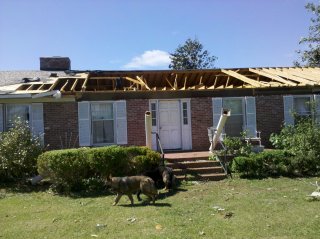
    My parents’ home after the tornado in April, 2011. My brother Rob endured and persisted during this time. His efforts made it possible for my parents to move back in less than a year after the tornado. 


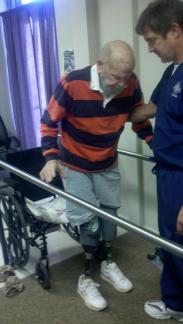
  • Although it was so hard to watch Dad go through what he went through the last years of his life, I learned so much about perseverance, determination and courage from him during that time. Through the death of his oldest child, a devastating tornado, his own failing health, leading to two amputations and eventually succumbing to heart failure, Dad endured much discomfort, pain and embarrassment but rarely complained, usually about not being able to have salt on his food. He continued to be an inspiration to those around him by learning how to walk again with one prosthetic, losing the other leg, then learning to walk on two prosthetic legs. Knowing how athletic and active Dad had been most of his life made it even harder to watch as he struggled to do basic tasks,
    Dad on Prosthetics

    Dad, learning to walk again–December 2012

    but Dad persisted and endured with courage and dignity. The last time I was with Dad, about a week before he died, his heart severely weakened from the effects of diabetic neuropathy, I watched as he tested his own blood sugar and gave himself his own insulin shot. The last thing he ever said to me was, “I love you.”

Two weeks after my dad died, I was diagnosed with Type II diabetes. It was hard to hear as my doctor spoke of possible nerve damage leading to blindness or amputation, especially after watching my dad go through what he did.

But I am his child, so I have determined that this disease won’t lick me. Dad, I’ll do what’s right, won’t do a half-ass job, won’t try to go around.

Life is worth doing, so I’m going to do it well.

Looking Glass Rock Writers’ Conference–Day One, continued

What a great start! Last evening, before and during dinner I was privileged to have casual conversations with two great writers whom I greatly admire–Robert Morgan and Jane Smiley, both so pleasant and unassuming.

Then, after dinner, Sy Montgomery, the non-fiction group facilitator, joined the other two writers for an incredible discussion of the conference’s theme, a sense of place. Here are a few highlights–

  • Robert Morgan read from an article he recently wrote for Epic Magazine about growing up in the Green River Valley in Western North Carolina and how that physical landscape pervades his work
  • He also talked about the “landscape of language” and how it the luster of language is equally important to a work
  • Sy Montgomery is a writer I haven’t read but now definitely plan to and share with my nature-loving friends. She is a naturalist and writes often about ocean life. She spoke about discovering new languages when encountering new landscapes often alien to humans–like breathing underwater. She spoke eloquently about the transformative power of her underwater experiences.
  • Jane Smiley spoke about learning of the importance of place when reading David Copperfield and how truly great novels are often dependent, at least in part, to setting, which is tied to theme.
  • Robert Morgan mentioned the paradox of writing that can be regional, even local, that is at once extremely specific and accessible to readers universally.
  • Robert Morgan also spoke about how it is sometimes counterproductive to actually visit or re-visit the place of which one is writing–sometimes better to let it live in one’s imagination.
  • Sy Montgomery talked about seeking out people who have lived in a place and interacted with it to discover new things about it.
  • She also said, “Pour yourself out like water and feel yourself with place.”
  • Robert Morgan mentioned that it is important to include details but just enough to accomplish what you need to accomplish

All that and more in just an hour! I am certainly getting my money’s worth.

That was day one. I have much more to say about today–Day Two, but it will have to wait. Tonight we have the banquet, reception and Jane Smiley ‘s reading. Stay tuned!