Guest Blog–David Brooks on Being a Good Person

david_brooks_road_to_characterI want to write sometime this weekend about yesterday’s professional development day at our college, but today I have too much else to do, so I’m going to give you a wonderful New York Times article by one of my favorite columnists–David Brooks, from back in April 2015. He is not an educator, officially, but I want to become more like the people he describes–a teacher who builds not “resume virtues,” but “eulogy virtues.”

Please read this. Great stuff.

http://www.nytimes.com/2015/04/12/opinion/sunday/david-brooks-the-moral-bucket-list.html?_r=0


Another Idol

Governor McCrory and the Bulk of Politicians in Raleigh,

I will never believe you when you say you care about the Middle Class of North Carolina.

I will never believe you when you say you take action for the benefit of all North Carolinians.

I will never believe you when you say you are concerned for family values when you seek to take away spousal medical insurance coverage from state employees, limit their options and possibly drastically increase out-of-pocket expenses for standard care.

I will never believe you if you say you care about any average North Carolinian. And you certainly don’t care about the poor–that lazy, undeserving rabble. Your actions ever since you have been in office scream that you care about one thing and one thing only–the Almighty Dollar. You worship it but you choose to sacrifice others–rarely yourselves. I imagine your spouses have their health care covered. I imagine your political aides’ jobs have not been cut. I imagine you still receive regular wage increases.

It seems, Governor McCrory, that your salary is ranked 20th in the nation. Do you know where the median salary of a North Carolina educator ranks? 47th, according to National Center for Education Statistics, the U.S Census Bureau, the U.S. Bureau of Labor Statistics and other groups. That’s right. 47th.

What you have been doing to educators, while sacrificing other state employees that you claim to care about, including law enforcement personnel, is nothing short of punitive. You punish us because our goal is to educate, even those who cannot afford it (how dare we?). You punish us because we cost you money and do not add gold to your coffers. You punish us because we tend to be liberal in our politics. You punish us because we speak out for the sake of students as well as ourselves. You punish us because your real wish is to privatize education–to make yet another social institution a money-making machine. You don’t care about quality education. There is something else that rules your hearts.

Maybe you did care about the people of this state at one time, but things have obviously changed. And so, what Belle said to her former fiance, Ebeneezer Scrooge, I say to you:

“Another idol has displaced me; and if it can cheer and comfort you in time to                      come, as I would have tried to do, I have no just cause to grieve.”

“What Idol has displaced you?” he rejoined.

“A golden one.”

Herman Melville, Lincoln’s Inn and Serendipity

Lincoln’s Inn–London (photo courtesy of Honourable Society of Lincoln’s Inn)

One of the things I love doing as a teacher is creating opportunities to become a student again. It renews the love of learning that is at the heart of my profession but sometimes gets lost under the mind-numbing bureaucratic tasks and pointless political pandering that has become so much a part of what it means to be an educator.

It’s at times like these that I most need to remember how exciting it is to learn something new, to read and study a work I’ve never encountered before, to visit places I’ve never been. My trip to London in the fall of last year provided me with many such opportunities.

Like the day I discovered Lincoln’s Inn.

I say discovered because I hadn’t gone looking for Lincoln’s Inn. I didn’t know it was there. I didn’t know anything about it. I certainly didn’t know that a month later I would be writing a lesson on Herman Melville for my new online American Literature I class and encounter Lincoln’s Inn once again.

It happened this way:

I woke up the first day that I was alone in London, finally free to do some serious walking and exploring. I planned out a trip that I had been longing to take ever since I developed a sample travel project for my British Literature II class several years ago. I decided to walk from my hotel in Russell Square to the Sir John Soane Museum at Lincoln’s Inn Fields. Sir John Soane was a famous and wealthy Regency Era architect who designed the Bank of England and other famous landmarks, including his own house that he willed to his country.

Not knowing how long it would take me to walk there, I sat out rather early, clutching my google map instructions tightly in my hands. I made quick work getting there, too quick in fact. The museum was not yet open. With more than 20 minutes to wait, I decided to cross e street to Lincoln’s Inn Fields and walk around. Although it is a beautiful little park with its trees at their peak of Autumn foliage, I still had about 15 minutes to spare after walking the perimeter.

I decided to explore just a little further, and noting the street names began to head towards the most interesting brick building. As I approached, I realized that there were other similar buildings. Then, I passed through what looked to be a very old tower gate, and I realized I was in some sort of compound–beautifully landscaped and tended–the large main building almost like a church with beautiful stone accents and stained glass windows. I saw that there was a library  in the building and got a hint to its use when I saw a man traditionally dressed in barrister’s robes walking up the sidewalk towards the building.

I returned to the Morton Hotel after many more wonderful adventures, including the Sir John Soane Museum that I finally got to see (it was magnificant), an outdoor art display by Ai Weiwei at the Royal Academy of Arts (incredible), lunch at a classic London Pub (tasty onion and mushroom pie) and a trip to the British Museum (I love that place). Even though I visited the British Museum on my first trip to London, I went to rooms I didn’t get to see that first time–my favorite being the Ancient European room and the clock room.

After a bite to eat from the little Tesco down the street and a hot shower, I settled in to find out what exactly that incredible building was. I quickly discovered that what I had been looking at and admiring was none other than Lincoln’s Inn, one of the four Inns of Court, which are the professional organizations for all barristers in England and Wales. I researched and read until late in the night, fascinated and excited to learn something new that would help me read, study and teach more effectively as well as humbled, feeling that I, as a teacher of British literature, should have known more about these things already.

When I returned home, I immediately found ways to incorporate what I had learned in my British Literature I class. That goes without saying, but I had no idea how my experience of discovering Lincoln’s Inn would enhance my teaching in American Literature until I read Melville’s “A Paradise of Bachelors.” The setting is one of the Inns of Court where the main character in this highly autobiographical story goes walking through the streets of London just as I did and is impressed with the beauty and grandeur of the grounds around the Temple Bar, just as I was.

IT lies not far from Temple-Bar.

Going to it, by the usual way, is like stealing from a heated plain into some cool, deep glen, shady among harboring hills.

Sick with the din and soiled with the mud of Fleet Street — where the Benedick tradesmen are hurrying by, with ledger-lines ruled along their brows, thinking upon rise of bread and fall of babies — you adroitly turn a mystic corner — not a street — glide down a dim, monastic way flanked by dark, sedate, and solemn piles, and still wending on, give the whole care-worn world the slip, and, disentangled, stand beneath the quiet cloisters of the Paradise of Bachelors. Sweet are the oases in Sahara; charming the isle-groves of August prairies; delectable pure faith amidst a thousand perfidies: but sweeter, still more charming, most delectable, the dreamy Paradise of Bachelors, found in the stony heart of stunning London.

Melville’s description spoke to my experience so completely. His observations so piquant that I immediately found renewed admiration for this, one of the greatest of American writers.

“Found in the stony heart of stunning London.”

It’s Worth It

Just looking purely pragmatically, it is still worth getting a four-year college degree. The Bureau of Labor Statistics shows that the higher the degree level, the lower the unemployment rate and the higher the median wages, with the exception of professional degrees garnering higher wages on average and lower unemployment than a Phd. The chart below shows the 2014 statistics:

More and more, however, I hear people, including former students and fellow educators, voice how working towards a four-year degree is virtually a waste of time and money.  I couldn’t disagree more. Even if a person never works in her or his degree field, the skills, life experience and connections made will not only help a person be more employable at a higher rate of pay, but can also help that person be a better informed partner, parent and citizen.

Of course, any acquired skills must be applied. Those who feel entitled to work their dream job at a high rate of pay soon upon graduation are never likely to feel that their education was “worth” anything. Also, there are many who do not get four-year degrees who have meaningful, prosperous careers. I know because my husband is one of them, although his time in training is comparable to a four-year degree in many ways.

I, on the other hand, have worked in my major field of study, English education, for most of my career, yet I have had the experience of not being able to find a teaching job. It was when my husband John was receiving his ultrasound training at Aultman Hospital in Canton, Ohio. Before moving to Ohio I had applied, tested for and been granted a 8-12 English and German teaching certificate. I had spent most of my last year teaching at Armuchee and Coosa High Schools in Rome, Georgia, applying for teaching jobs without a single bite.

We had saved enough money that I didn’t have to work, but things were going to be pretty tight if I didn’t land at least a low-paying position. I did have one interview at a high school, and although I don’t remember much about it, I do remember getting the impression that this little ole southern gal didn’t have a snowball’s chance getting a teaching job in Canton.

So I started looking outside of the education arena into places where my writing and teaching skills might be of use-copy editor, day-care worker, teacher assistant, tutor, but nothing doing. Then, one day I was looking through the want ads and saw that there was a position open for a job trainer at Goodwill Industries, Inc. The ad said that a background in education was a plus, so I called and set up an interview.

The very nice man who interviewed me was the vocational rehabilitation coordinator, Marc Manheim. He asked me about my educational background and also was interested in what kind of work I did unrelated to my degree. My list was long: Day care worker, cafeteria line worker, custodian, groom and exercise girl at an Arabian horse farm, riding instructor, restaurant hostess, dishwasher and secretary. I got the job.

While my experience working in the service industry was invaluable, I found that my teaching skills were absolutely necessary to be successful in my work. As a job trainer I was required to work side by side with my clients, helping them do the job and keep up their rate of production as they were learning the job and then slowly back away and help the client become more and more self-sufficient until I was not needed any more.

As a result I found myself doing many of the tasks I did as a classroom teacher, including mastering the skills I was going to teach my clients, creating a daily plan (in essence a lesson plan), instructing my clients in the numerous skills needed for their work as well as social skills, assessing their progress and the effectiveness of my instruction, then altering my instructional methods and re-assessing.

Because of my experience and the experience of as many as one-third of college graduates according to one study, who do not get jobs in their major area, I can better advise my current students and encourage them to study what they love, learn how to work hard and apply what they learn, developing dedication and tenacity.

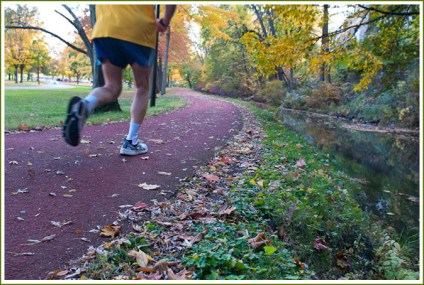
photo2_run

The park in Canton, Ohio, where I used to walk and jog.

Do that and they won’t need to worry about getting a job. They will either find one, it will find them, or they will create one for themselves.

Again, No Time But Must Post Something

Prop poster

Mock Propaganda Poster Inspired by Ray Bradbury’s Fahrenheit 451 (Pinterest)

I’m in the midst of grading my brains out here at the end of the semester, but I don’t want to let any more time go by without posting something because the current state of liberal arts education, especially at the community college level in my state, demands it. Thank goodness there are others who feel the way I do. So until I’m able to do some more research, I’m posting this great article by Gary Saul Morson, professor of Slavic Languages and Literature at Northwestern University.

As a literature instructor I was a bit taken aback at first, and a little insulted, but then I read on, and he has some great things about the importance of college level literature studies as well as sensible ways to engage students in literature classes.

Article by Gary Saul Morson from Commentary Magazine

England–Days Seven and Eight

Large Day of the Dead Statue--British Museum-October 2015

Large Day of the Dead Statue British Museum-October 2015

Happy Halloween, Everybody!

It’s Halloween, and I made it back late last night. I was hoping to work on my blog while I was waiting in the airport, but I couldn’t connect to the Heathrow WiFi. I’m one of those throwbacks who doesn’t have a smart phone. And that’s my first word of advice for my literary travelers is GET A SMART PHONE and pay for short term international use if you are going to be out of the country. What few problems I had during the trip would have been helped if I had been able to communicate better. I have some serious jet lag today, but I have the weekend to recuperate and have time to catch up with my classes.

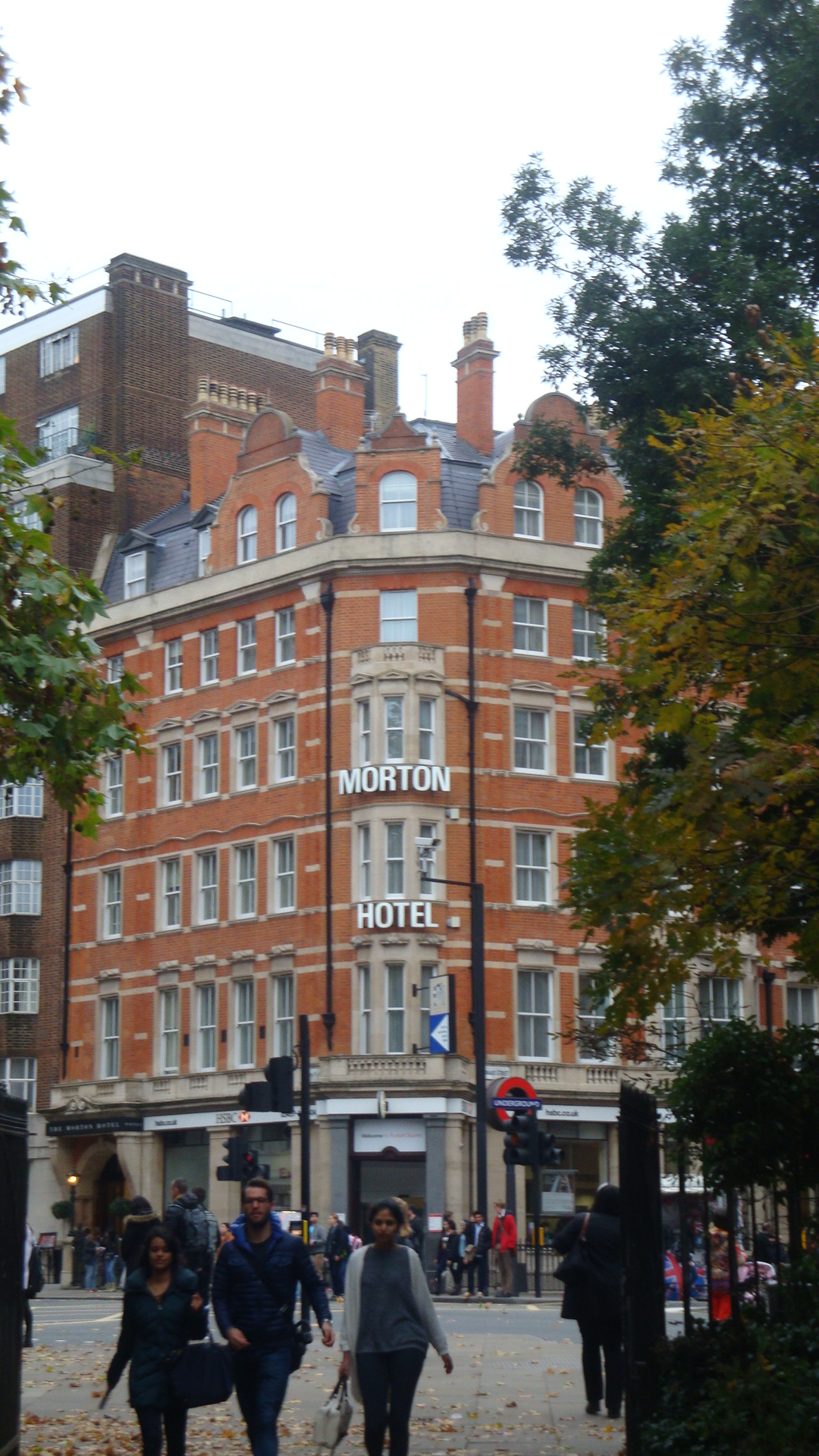
The Morton Hotel on Russell Square October 2015

The Morton Hotel from Russell Square
October 2015

My last full day in London was simply marvelous. I had a grand continental breakfast at the hotel–quite a spread. There were all kinds of pastries, including real English muffins, not the kind we eat–they are more of a spongy type of bread– and all kinds of fresh fruit, plus a variety of cold meats and cheeses. I lingered over my coffee and got caught up on some correspondence with family, students and colleagues.

The hotel has a pleasant sitting room, which serves several purposes–reception, general seating, bar and breakfast room, all decorated for Halloween, which originated as the Celtic festival of Samhain. As with Christmas, eventually the pagan traditions blended with the Christian All Hallow’s Eve, the day before All Saints Day. Both pagan and Christian traditions commemorate the changing of seasons and passage from life to death, to be renewed again in the spring, with Easter, another holiday with combined Christian and pagan elements.

The Brits seem to love to celebrate Halloween just as much as we do, and like in the States, Halloween seems to be becoming increasingly popular with adults, with all sorts of announcements about parties at different restaurants, hotels and pubs. In fact, the Morton Hotel is slated to have a Halloween High Tea today.

After breakfast I started off towards the first stop on my agenda–The Sir John Soane Museum. When I wrote my first sample travel project a few years ago on Georgette Heyer and her Regency novel “The Foundling,” I discovered a little gem of a museum in the house of the eccentric Sir John Soane, best known as the architect of the Bank of England, who adored his wife Eliza and was heart-broken after her death, which fits in so well with the spirit of the Regency romances written by Georgette Heyer and, of course, Heyer’s inspiration, Jane Austen.

I was going to take the Underground to the Soane, but once again, the line was shut down temporarily where I needed to go, so I  hoofed it, but it felt good to walk and soak in yet another area of London I had not yet explored, so I didn’t mind. I got there early and enjoyed strolling around Lincoln’s Inn Fields, London’s largest public square, across from the museum.

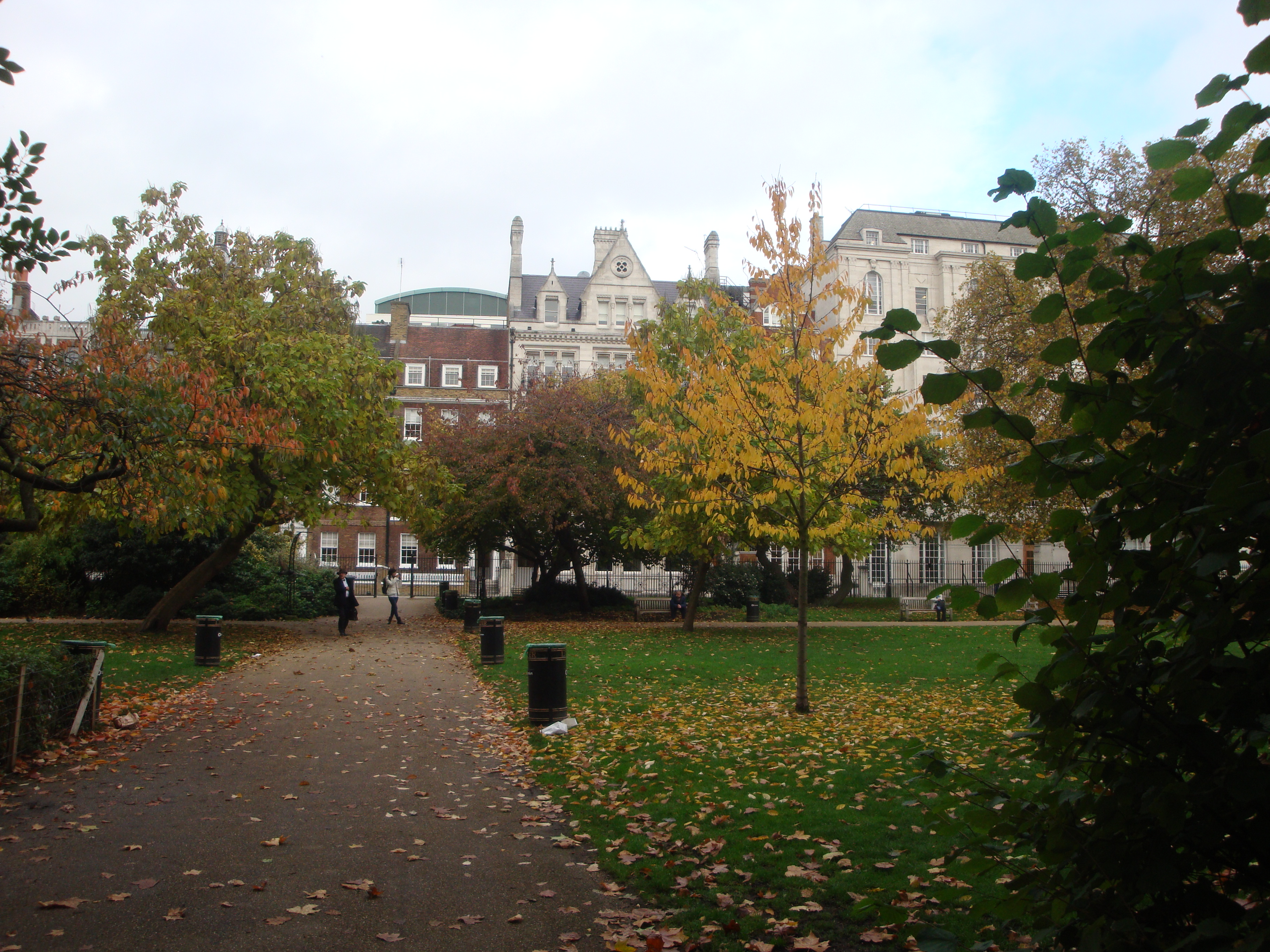
Lincoln's Inn Fields October 2015

Lincoln’s Inn Fields looking toward the Soane Museum–October 2015
October 2015
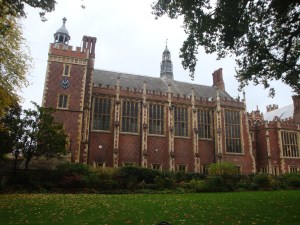
Lincoln's Inn October 2015

Lincoln’s Inn
October 2015

I took pictures there and then walked around some more and found Lincoln’s Inn itself. This incredible building is not what you think of when you hear the word inn. Lincoln’s Inn is the name and location of one of four legal associations that developed in the 13th and 14th Centuries, making this a good place to visit for anyone basing their literary tour on Chaucer. I could imagine the Man of Law from the Canterbury Tales being a member of this association even if the actual Lincoln’s Inn buildings weren’t built until later. Because the buildings were built in the 16th and 17th Centuries, this would also make a great place to visit if studying Shakespeare or Marlowe. The architecture is marvelous.

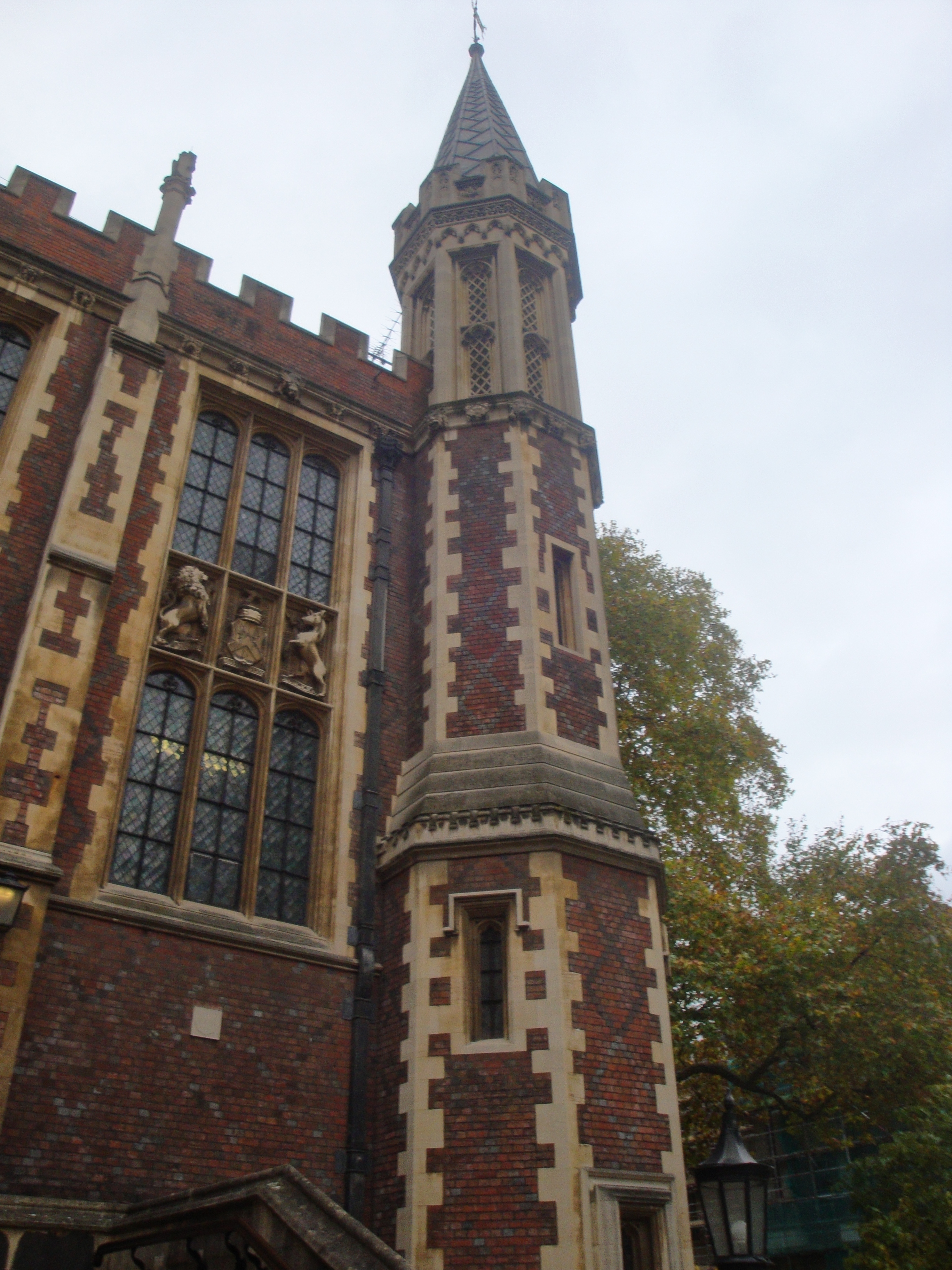
One of the spires at Lincoln's Inn October 2015

One of the spires at Lincoln’s Inn
October 2015

Today, Lincoln’s Inn houses the offices of many London barristers (lawyers) and includes an extensive law library. I saw one barrister going to work dressed in the traditional legal garb that British men and women of law have been wearing for centuries, although the dress code is now somewhat relaxed. The man I saw was dressed much like David Tennant in the picture below from the movie The Escape Artist.

DavidTennantEscapeArtist

When I made my way back to the Soane Museum, there was already a short queue forming as the hallways in the house are narrow and there are only a few people allowed in at a time. But I didn’t wait long. Entrance to the museum is free, but I bought the more detailed guide book to use as a source for my sample itinerary (I’m going to do an update sometime soon).

Sarcophagus of Seti Sir John Soane Museum London, October 2015

Sarcophagus of Seti
Sir John Soane Museum
London, October 2015

With the book I was able to just roam around and spend as much time as I wanted in this fascinating place. Soane ran his architectural business from his home, so there was a tiny office and rooms full of architectural artifacts for himself, his clients and students to study. He was also quite a collector and one of the most fascinating things at the museum is a sarcophagus, a huge stone coffin, that once housed the remains of Seti, the father of Ramses the Great.

One of my favorite places in the museum was the picture room. It’s a small room, so I had to wait to make my way in there. Each room has a guide who can answer questions about Soane and the house. The guide in the picture room was particularly helpful. He showed us how Soane built the room with pull out panels to hold more of his art collection in a smaller space, very clever.

My favorite pieces were another series by the British painter William Hogarth, called The Election. I had seen a similar series by Hogarth in the National Gallery, and his paintings do a marvelous job satirizing life in England during the 18th Century, with that mixture of humor and pathos that is my very favorite style of writing, seen here in picture form. The guide described the series as one of the first “graphic novels” and pointed out details of the pictures and explained their historical context–really an early form of the political cartoon.

Soane’s house is the perfect place for anyone who is interested in what England was like during the Georgian age–late 18th to early 19th Centuries. I had no idea when I included the museum in my first sample literary tour itinerary several years ago that I would get to visit the museum one day. It is delightful! Here’s a link to the museum’s website: http://www.soane.org/

The British Museum October 2015

The British Museum
October 2015

After leaving the Soane Museum, I made my way to the British Museum, not far at all from my hotel. Although it was not yet noon, I was hungry, so when I passed by The Plough, a typical British pub with a plaque outside remarking how it has been frequented by British writers through the years, I decided to have lunch there. I had another typical British pie, but this one vegetarian–mushroom and onion–washing it down with a lager. It came with chips (French fries) and some tasty veggies. Hit the spot. Now it was on to the museum.
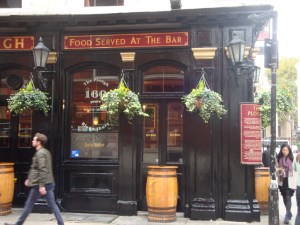
The Plough Restaurant October 2015

The Plough Restaurant
October 2015

I went to the British Museum, also free admission, on my trip in the summer of 2011, but the place is so huge that it would take many visits just to see the permanent collections. I was greeted by huge skeletons like the one above in the courtyard and a big skull along with a skeleton in the atrium area where the Rosetta Stone is displayed, but I passed quickly by them. I wanted to focus my visit this time on the literary and old European collections, and I’m glad I did. Anybody doing any literary tour about a British author should plan to include the British Museum in the itinerary because it covers all aspects of British history and because so many authors have been influenced by items in the museum.

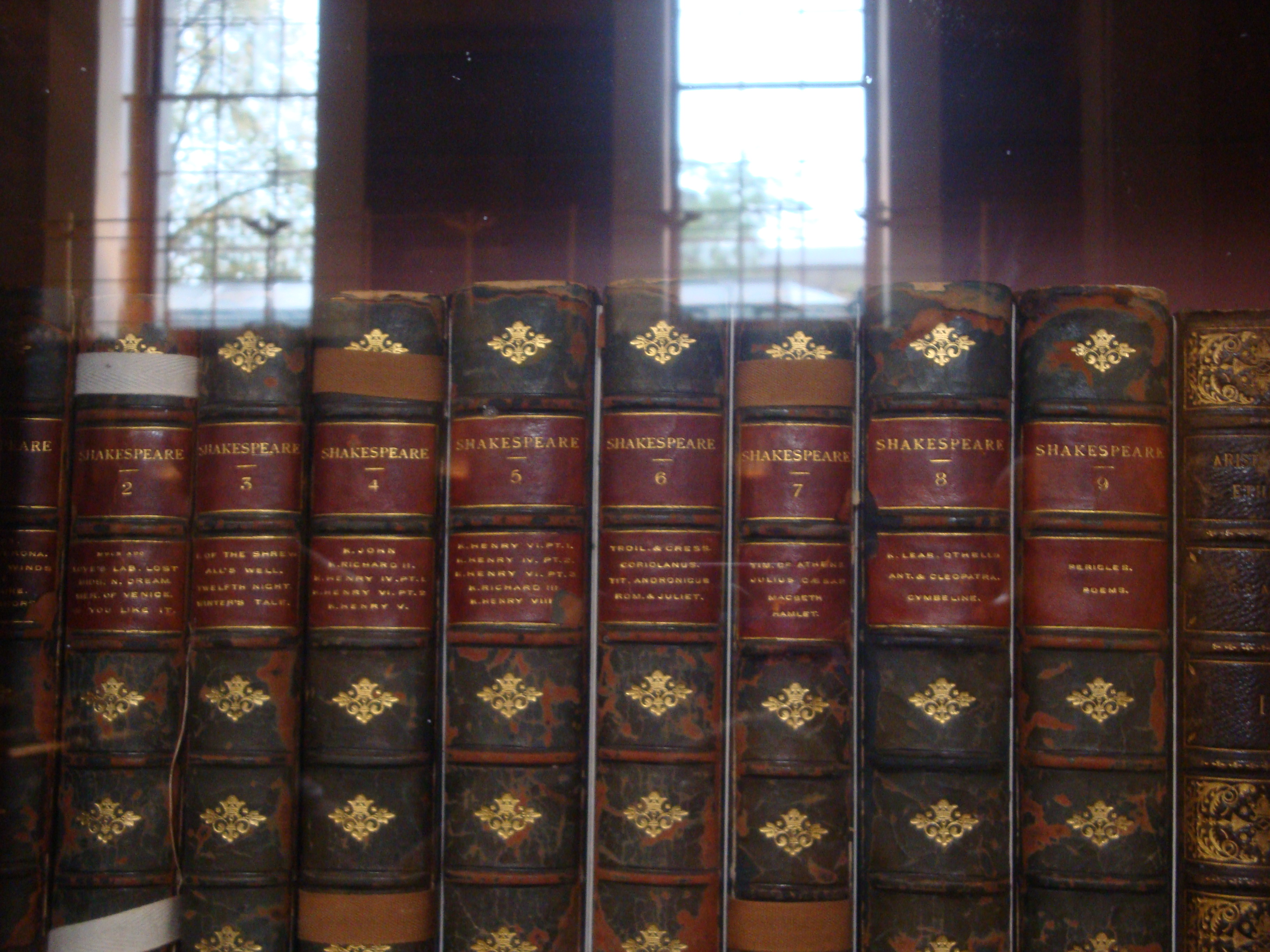
One of the first rooms I went in includes selections of hundreds and hundreds of old books, including the beautiful editions of Shakespeare seen here.

Old Volumes of Shakespeare's Work British Museum, October 2015

Old Volumes of Shakespeare’s Work
British Museum, October 2015

Then, in the old European room, I hit the jackpot, finding and photographing many artifacts from the burial ship found unearthed at Sutton Hoo, believed to date back to the time of Beowulf. Most fascinating to me were the helmets, swords and shields.
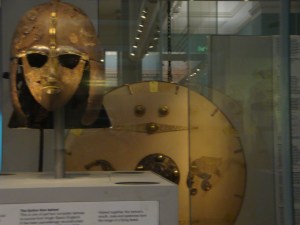
Helmet and shield found in the burial ship at Sutton Hoo British Museum, October 2015

Helmet and shield found in the burial ship at Sutton Hoo
British Museum, October 2015

Could Beowulf's Sword looked like this?

Could Beowulf have used a dagger like this?

Celtic Brooches and Sword British Museum, October 2015

Celtic Brooches and Sword
British Museum, October 2015

In another room were marvelous examples of Celtic art, including crosses and the large ornamental brooches seen to the right. Anyone doing a project on Dream of the Rood, Beowulf, Lanval or any of the early British works would appreciate these rooms.

I could have spent hours and hours at the British Museum, but I was getting a bit weary and had a big night ahead, so I went back to the hotel, caught up on some more work and took a nap. Good move. Naps, if not too long, can really help travellers get the most out of their visits.

I had some tea and a biscuits (shortbread cookies) in the room and headed out early to get to the Savoy Theatre, next to the famous Savoy Hotel on the Strand, another vibrant section of England that was really hopping that night, even though there was a steady drizzling rain. Londoners and tourists alike have learned to adapt to the rain, which comes and goes frequently. As I passed through Covent Garden on my way to The Strand, I noticed people sitting outside under canopies, seated around these little outdoor fire grates, laughing, talking and ignoring the rain.

Covent Garden at Night

Covent Garden at Night

I arrived at my destination early, so I walked up and down the Strand, soaking in the atmosphere (no pun intended, but I did forget my umbrella the one time I needed it). I bought a soda at a little kiosk and headed back to the theater to wait some more, but boy, oh, boy, was it worth the wait.

I’ve seen Gypsy several times, and I was an assistant stage manager for a community theater production of it, so I know the show very well, but this was hands down the best production of it I have ever seen or been a part of, mainly because of Imelda Staunton as Rose, who was simply astounding. Some of the best acting I’ve ever seen and the lady has pipes!

Imelda Staunton as Rose Savoy Theatre, London, October 2015

Imelda Staunton as Rose
Savoy Theatre, London, October 2015

The final scenes between Gypsy and Rose were everything they were meant to be and the final number, Rose’s Turn, was the final release of all the pent up anger and resentment of a woman who has spent too long living her life for and through her children, not realizing the damage she was doing to herself and all the ones she loved. It was heartbreaking and triumphant. It was so real. I don’t know how anyone can act like Imelda did that night. Simply amazing! Then, in the final scene, Gypsy comes on stage and Rose breaks down again–finally humbled and remorseful, a broken woman as she leaves the stage, and her daughter’s last gesture, a simple arm over her mother’s stooped shoulders, just said it all.

I was also thrilled to see Peter Davison, who played the role of Herbie, Rose’s friend and would be husband, who loves Rose despite everything but has to leave her in the end. It was a special treat seeing Davison, whom I had a crush on when I was a teenager and loved to watch him play Tristain in the British TV series All Creatures Great and Small. He also was one of the many actors to play Dr. Who (the 5th doctor).

It was a great way to end my last night in London. I didn’t even mind the walk back in the rain and the crowded subway as I made my way to Russell Square. I stopped one last time at the Tesco’s and bought supplies for a midnight snack and some breakfast before going to my room. They were still showing all the Harry Potter movies, so I watched Imelda Staunton again as Dolores Umbrage in the final Potter movie while I had my snack and checked e-mail.

What a great day!

The final day was all about travel.

I left the hotel pretty early after getting all packed up because I also like to arrive early and wait rather than rush and worry about missing my plane. I discovered that because I had an oyster card and had bought an extension to London when I arrived that I didn’t have to pay any more. I also discovered that I had paid a 5 pound deposit that can be returned with any money you do not spend when traveling, if any. If you prefer, you can keep your Oyster card, and it is still good when you return to London. I definitely recommend an Oyster card if you are going to spend any time in London.

English Breakfast at Heathrow before I Boarded the Plane October 2015

English Breakfast at Heathrow before I Boarded the Plane
October 2015

Once I got to the airport, checked in and got to the correct terminal, I had my last meal in England, a traditional English breakfast washed down with an English lager. This time I had the beans but still didn’t try the black pudding. I’m not that English!

The trip was uneventful from then on out. It was a long trip back, but it was totally worth it, and gave me a better understanding of the country, people, history and literature of England, which is important to all Americans because we share a language and England is our mother country, one of our best friends in the world today.

I hope you have enjoyed my blog posts about my trip to London. I have learned so much and am so looking forward to using what I have learned to improve my instruction of not only my British literature courses, but all of my classes.

Cherrio and Mind the Gap!!!!

England–Day Six

Had a fabulous day! I had bought croissants at the Tesco’s across the street yesterday. They tasted great with my morning coffee. The hotel coffee service is a bit different than in America because the main bevrage of choice is tea rather than coffee, so all the hotels have a little electric kettle and a tin (can) of teabags and instant coffee. I had been drinking tea, but today I decided to have coffee and, boy, that was the best instant coffee I ever had. I ate a few of the cocoa almonds I packed to give me some protein for my long hike ahead.

British hotel tea service

British hotel tea service

It was raining when I woke up, but by the time I did a little work and got dressed, I could see a few patches of blue. Then I checked google maps and planned my day. Since the rain had let up, I decided to go to Hyde Park as planned. I thought I might take the Underground, but I discovered that the line I needed was closed, so I decided to walk. The directions on Google maps were very good and I saw so much along the way.

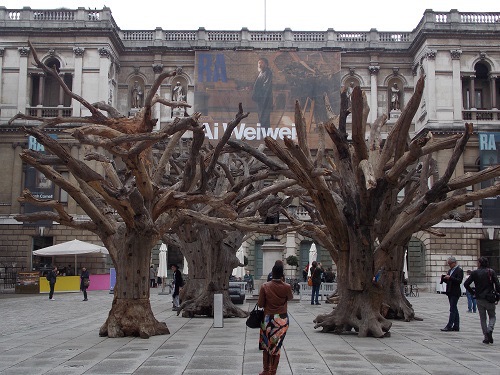
I stopped briefly at the courtyard of the Royal Academy of Arts to take a look at the interesting sculptured trees by Chinese artis Ai Weiwei. The trees, made of various pieces of driftwood bolted together, represent the ethnic diversity of China according to the academy’s website. I was also interested to see that the astronomical society and geograpical society are also housed around the same courtyard.

Ai Weiwei's Tree sculpture in the courtyard of the Royal Academy of Arts

Ai Weiwei’s Tree sculpture in the courtyard of the Royal Academy of Arts

I continued my walk and found myself eventually on Oxford Street, the longest stretch of my walk. I was stopped by a young woman collecting money for a group called Oxfam that helps communities in developing countries have access to clean water. Here is the website adress: http://www.oxfam.org.uk. We talked quite a while, and as she did I was reminded forceably of the tradition of reform and charitable spirit that weaves its way throughout British history and literature. After I said goodbye to Georgia and continued walking along, the sun kept peeking out from the clouds and by the time I got to Hyde Park, the sun came out. To get to the park I passed through the impressive Marble Arch. Then into the park!

Marble Arch near Hyde Park

Marble Arch near Hyde Park

I love Hyde Park, and I just saw a little of it. I took many pictures and walked to the lake. There is a little restaurant right by the lake and it was warm enough to sit at an outside table. I have been so good and exercised so much that I treated myself to fish and chips and a half pint of beer. I thoroughly enjoyed it. Then I walked it off by walking through Picadilly Circus where the famous statue of Wellington is, along with other war memorials. I kept walking to Leicester Square where I’ve been before.

The Serpentine Bar and Kitchen where I ate some great fish and chips.

The Serpentine Bar and Kitchen where I ate some great fish and chips.

I decided to watch another movie. This time I watched Spectre, the new James Bond flick, on the big, big screen at the Odeon Theatre that is famous for its premiers. In fact, Spectre had premiered there on Sunday when my friend and I saw The Suffaragette. It was a totally outrageous movie but I do love a good action flick. When I came out there was another premiere going on at another theater, but I couldn’t get close enough to see much, but I think I saw the top of Bradley Cooper’s head!

The Odeon Premiere Theater

The Odeon Premiere Theater

I took the Underground back and now I am once again safe in my room, watching, what else, Harry Potter! Tomorrow I plan to go to the British Museum and maybe a little museum called the Soane, which is close to the Thames. Then, I have tickets to see Imelda Staunton in Gypsy, my last big show! Many of you will recognize Staunton as Dolores Umbrage in Harry Potter. I’m very excited to see her as Rose in Gypsy. Looking forward to my last day in LONDON.

TTFN

England–Day Five–Rest

Taking a day of rest to catch up with some work and change hotels. I just moved next door, but I still had a lot to do. I advise taking a break like this, so you can rest. You will enjoy everything so much more.

I didn’t just rest, though. I graded papers, wrote announcements and, of course, writing this blog. Tomorrow I will resume my adventures, among them, a visit to Hyde Park!

image

England–Day Four–The Day

I did not eat the black pudding or baked beans

I did not eat the black pudding or baked beans’

I’m a day late posting because it was such a big day yesterday. We started off having a traditional English breakfast, just a bit modernized to be healthier. I had bacon, more like smoked ham, with veggie sausage, a poached egg, cooked tomatoes, mushrooms and a pastry. Yum!

Next was a solo trip to Trafalger Square and the fabulous National Gallery of Art where I saw artwork by Titian, Rembrandt, Michelangelo, DaVinci–the British masters, like Turner, Gainsbourgh, Stubbs–and my favorites–the Impressionists–Manet, Monet, Renoir, Degas and Van Gogh. One of my favorites was Van Gogh’s Sunflowers. I also liked Geoge Stubbs famous horse paintings. One of my favorite paintings was by an artist I did’t know of a tall, thin knight who had a wounded foot and knee, so he couldn’t fight anymore. Just the look on his face and all the details. It was magnificent.

Wounded Knight by Meroni

Wounded Knight by Meroni

I saw too much to write it all here, but the eras that the gallery spans makes this a great place to visit for just about any book in the English canon that my students might want to make the subject of their travel project. And entrance is free! After I wandered the halls with my trusty audio guide (very helpful and easy to use–only a few pounds), I went down to the gallery cafe and had a pastry pie, a traditional favorite. Then bought a few gifts in the gallery store.Then I wandered around the square a little while, taking in all the sights. I especially enjoyed the musicians playing in the squares and the character actors–Yoda, the wicked witch and tin man.

After I made my way back on the Underground, we rested a while, and it was off for the big night! We took a cab to the Barbican, which is a modern entertainment complex, away from the main theater district. Our seats were fantastic, about five rows back.

When the curtain came up, there was Benedict Cumberbatch, right in front of us, and he was strong the whole way through. The whole cast was good, but my favorites,other than Cumberbatch, were Horatio, Ophelia, and Polonius. The gravedigger always brings some needed comic relief.

Stage early in the first act

Stage early in the first act

The staging was also fantastic. Everything was stylistic, ranging from Victorian Era through the 60’s. The main set was like an Old Victorian Mansion that continued to decline during the first act. At the end of the third act when Hamlet is banished and Cladius is alone on stage, all this sooty material blows through the doors. When the second act begins, there are just piles of rubble allover. It was impressive–one of the best night’s at the theater. I’ve ever had.