Nonpecuniary

Economists and lawyers like using words like “nonpecuniary.” Perhaps to keep from falling into cliche; however, if the cliche fits…and when it comes to education, it certainly does–Education should not be all about money. Amazing thing is, even economists (those trusted above all others in our society these days) frequently do studies on the benefits of various aspects of our lives that do not involve money but make our lives better.

One such study, “Priceless: The Nonpecuniary Benefits of Schooling” appears in the Winter 2011 edition of the Journal of Economic Perspectives. Philip Oreopoulos and Kjell G. Salvanes, economists at Toronto University and Norwegian School of Economics respectively, explore the nonpecuniary benefits of schooling in a well-researched article (32 pages with 142 citations) that offers compelling empirically-based evidence that the more schooling  individuals receive not only benefits them economically (p. 159), but also in a myriad of other ways, including

  • higher employment prestige ratings (p. 163)
  • higher job satisfaction (p. 163)
  • higher O*Net (Occupational Information Network) achievement scores (p. 163)
  • lower unemployment (p. 163)
  • better physical and mental health (p. 167)
  • lower divorce rates (p. 167)
  • lower smoking rates (p. 170)
  • very low arrest rates (16+ years of schooling) (p. 170)

All of the tables including relevant data show statistics before and after conditioning for income with the same result of increased rates in these various areas as education increases.

Oreopoulos and Salvanes do report some predictable negative effects of higher levels of education, including time constraints and increased stress (p. 171). However, these aspects of higher education are greatly mitigated by the numerous positive effects, including those mentioned above, as well as less tangible benefits, including improved parenting (p. 167), higher levels of trust (p. 167), increased patience (p. 170), and even higher levels of happiness (161).

The authors conclude that more qualitative research needs to be done concerning pecuniary and nonpecuniary benefits to higher education, but their research indicates, as these two lauded economists say far better than I could, that the non-tangible benefits of a higher education beyond a two-year degree exceed even the economic benefit:

In our opinion, the estimated returns are too large to support
the theory that most students are optimally trading off costs and benefits when deciding how much education to acquire.  Some people are missing out on significant welfare-increasing opportunities (p. 181).

Many students may be myopic. Parents with teenagers can attest that
youth are particularly predisposed to downplaying or ignoring future consequences…. When teenagers and young adults make their choices about school attainment, it may be especially easy to see the immediate costs and harder to grasp fully the long-term benefits. Exploring these issues more thoroughly would shed further light on the overall education attainment decision-making process and help identify ways to make individuals recognize the large returns from schooling. Large amounts of money appear to be lying on the sidewalk. Of course, money isn’t everything. In the case of returns from schooling, it seems to be just the beginning (p. 181).

unbrokencircle

On a more celebratory note, I have mentioned in my blog before that I had a piece published in the anthology Unbroken Circle: Stories of Cultural Diversity in the South. Since publication last May, several colleges have begun to use the anthology as a text in courses on Southern literature and culture.

Several months ago, writers included in the anthology were asked if they would like to participate in a panel discussion at the 40th Annual Appalachian Studies Association Convention. I am happy to report that the proposed panel session was accepted by the association, so four of the 26 writers, including yours truly, as well as editors of Bottom Dog Press in Huron, OH will travel to Cincinnati to attend the conference. I will be reading from my story,  as well as discussing the meaning and inspiration for it. Of course, I will be part of the Q&A after all writers have completed their readings.

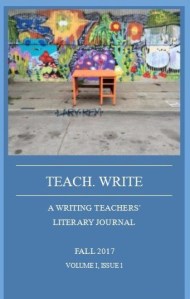
The conference is during our spring break in April, so my intention is to take along some copies the new edition of Teach. Write. to share with editors and publishers, so there isn’t a better time to submit to the spring edition. Submissions are open until March 1.

cover


The Art of Writing

conventioncenter-day_creditscottdresselmartin_580

Before I was a full-time instructor, over twenty years ago, I presented at my first national conference–the National Conference of Teachers of English. It was in Denver that year, and I paid for the conference myself because I craved professional development, even though I was a lowly adjunct, only teaching three or four large college classes each semester.

In a round table session, I  presented  an exercise that I had created for my developmental English courses called “The Art of Writing.” The students took a reproduction of a famous piece of art (I had many pictures for them to choose from) and told them to brainstorm about what they saw, using a handout I gave them.

One side of the paper was marked “Concrete,” where they wrote what they saw in the picture or what they could imagine that they could experience with their other senses. On the other side of the paper, I wrote “Abstract,” where students wrote words and phrases that represented how the painting made them feel or what memories, or thoughts in general, the painting helped bring to the surface.

After they brainstormed, the would develop some sort of prose writing based on the art and their brainstorming, combining the concrete with the abstract. I used as an example a short piece I wrote that was based on the iconic painting American Gothic by Grant Wood. Here is the painting and the creative piece I wrote based on it:

Grant_Wood_-_American_Gothic_-_Google_Art_Project

American Gothic

I remember marrying him.  We stood together in the country church, farmer’s son and farmer’s daughter, too poor for ought else–too much a part of the land anyway.  My family sitting on those hand-hewn, hard-backed pews, witnessing.

That night I didn’t utter a word or a cry.  Closing my eyes, I imagined I was lying in the distant fields of my home, daises tickling my face and hands and feet.

I worked hard, learning not to expect any praise for the clean floors or hearty food. My greatest joy, to get all of the chores finished in time to head for the fields, to hold the soil of our land in my hand, to feel its moisture and smell its mustiness.

He did praise me once.  After three daughters, who were mine to raise, to teach, to find husbands for, I bore him a son.  I sweat and strained and screamed no less, but somehow it was different, and he thanked me.  Then, my son was gone, no longer mine.  So soon he learned not to cry.  So soon he became a man.

Now, in that same country church, as my youngest daughter gives herself to a farmer too poor to leave and too much a part of the land anyway, I sit in a hand-hewn, hard-backed pew, witnessing.

**

I quite like this little character study, which went on to be published by the way, but more importantly, the piece inspired my developmental students for over a decade. Some of my students’ writing was published in our yearly literary magazine–one even winning a cash prize as  the top fiction piece in that year’s journal.

Another student picked a famous photograph of an American flag on a front porch and wrote an amazing creative non-fiction piece about the meaning of liberty. That student was attending our school under the GI Bill, having served during Operation Desert Storm. I’m telling you, he had a heck of a lot to say about liberty that the younger people in the class needed to hear.

Were they inspired to write or did the assignment just help them feel free to use their creativity? Did the painting give them something to write about, a story already there that they just fleshed out? It was more than likely a combination of things, but whatever it was, many of my students, developmental students, did their best writing when writing about art.

In recent years, the state where I teach has discouraged creative writing or the study of literature  in writing classes, especially in developmental classes. The trend is towards more “practical” writing, utilitarian, without flair or heart or life. Surprise! I am bucking that trend. I don’t use my art assignment any more, but my students engage with and write about music, film, theater, literature and art, and their writing is better for it. They are better for it.

In 1938 Winston Churchill, said, “The arts are essential to any complete national life. The State owes it to itself to sus­tain and encour­age them….Ill fares the race which fails to salute the arts with the rev­er­ence and delight which are their due.”

Maybe the State, as well as college administrators and curriculum developers, should listen to him.

cover

If you are, or were, an English composition teacher, do you have a writing prompt that you have used in class and would like to share like I did at the conference? If so, I would love if you would submit it to my literary magazine Teach. Write. 

In the magazine, I have a feature called “Write Your Own” where you do like I did and write your own creative piece using a prompt that you have once given your students. Accompany your piece with a brief explanation of the prompt or the purpose for the assignment.

I am also accepting general submissions of poetry, flash, short stories, and essays through March 1 for the spring edition. Click for complete submission guidelines. I look forward to reading your work!

Happy New Year!!!

And Merry New Semester!


Rocking the Boat

Frontispiece from Prophets of Dissent–A Collection of Essays Published in 1918 (Wikimedia)

In a 2003 LA Times article, entitled “The Power of Dissent,” Harvard law professor Cass R. Sunstein, makes a reasonable argument about how a dangerous culture of conformity within NASA helped aid and abet the Columbia shuttle disaster that took the lives of the shuttle’s seven-member crew. At the conclusion of the article, Sunstein summarizes the stunning conclusions of the Columbia Accident Investigation Board that well over a decade later should give today’s administrative-heavy educational institutions with a top-down leadership mentality pause:

The Columbia Accident Investigation Board emphasized the need for NASA to develop a distinctive kind of culture, one that discourages deference to leaders, sees dissent as an obligation, promotes independent analysis and insists on a wide range of voices. The broadest lesson is simple. Well-functioning organizations discourage conformity and encourage dissent — partly to protect the rights of dissenters but mostly to promote interests of their own.

Discourage deference to leaders? See dissent as an obligation? Insist on a wide range of voices? Isn’t that against THE CODE? Yes, sisters and brothers, it is, and God bless it.

The suppression of dissent, no matter from what political, social or religious perspective, is dangerous for higher education, leading to meaningless bureaucracy, rote learning, demoralized faculty, and unmotivated students, who care, or are encouraged to care, more about their minimum wage  after-school jobs than they do about their educations. It also breeds the unreal expectation of what a piece of paper, without symbolizing true learning, can give them in life.

Conformity is anathema to college education. Standardizing for the sake of the nebulous “giving the students the same exposure to the same material” is not the point. If college is supposed to be preparing students for real world experiences, how does requiring all faculty to teach the same curriculum prepare students? Will all of their bosses be the same, having the same expectations, assessing their performance in the same way, promoting for the same reasons? And if our students become the bosses, heaven help us if they seek to suppress opposing viewpoints or disallow any honest debate.

At a community college, even if its mission is only to train the local workforce (of course it is much more ), then that community college fails if it does not offer students a rich and diverse curriculum, introducing them to multiple educational methodologies, personalities, disciplines, attitudes and expectations, teaching them one of the most important and desirable of all skills in the workplace–adaptability, the ability to conform, yes, but to a reasonable degree, while dissenting when necessary, when it could be hurtful, if not fatal, to just shut up and do the job.

Therefore, I will continue to dissent, against those things that violate my academic freedom–the freedom to be the kind of teacher I was called to be. No, I will not dissent for dissent’s sake, but yield to reasonable requests and accept constructive criticism. But I will fight against any pettiness that threatens to derail almost thirty years of quality teaching–even if I am a bit strange, excitable, stubborn, even insubordinate and obnoxious. I may be those things in some people’s eyes, even in my own sometimes, but mainly I choose to see myself as unique, passionate, steadfast, questioning, and if some people find my demeanor obnoxious, I can live with that, and sleep at night.

anne-hutchinson

Anne Hutchinson–Puritan Dissenter

As Sheryl Crow sings,

I was born in the South
Sometimes I have a big mouth
When I see something that I don’t like
I gotta say it.


Dissent is not the dirty word some seem to think it is. Don’t rock the boat, they say. Why not? Because it might turn over? So what if it does? We might learn to swim.


Blog Post Not Quite Ready, but I Can’t Wait

My newest blog post, about the importance of dissent in the community college, is not quite ready to publish, but in the meantime, I found this quite interesting article on the dangers of classroom observation. It seems obvious to me that college instructors and university professors cannot be evaluated in the same way that K-12 instructors are evaluated. At the very least, faculty members should have some say in how they are evaluated, shouldn’t they?

Anyway, here is a link to the article from “Inside Higher Ed.”

“Observations of Professors: Tread Lightly” by Jonathan M. Golding and Phillipp J. Kraemer

Thanksgiving at the Pagoda

L4b77bf7ebf16aa15a52a4ad03b49010fike many college students that I teach today, when I was in college, not only was I a full-time student, but I also had two jobs. I worked as a secretary in the German department (I majored in English and German), but I also worked as a hostess and cashier at my friend’s parents’ Chinese restaurant–The Pagoda, where I received an education of a totally different sort, but equally as important, to me anyway.
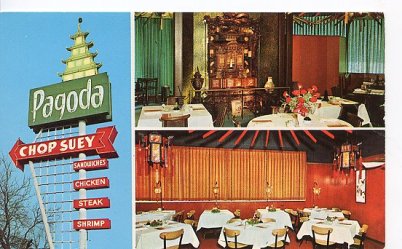
The Pagoda was a truly American Chinese restaurant, built and owned for years by a Chinese-American family, then, after it was already an established and popular eatery, bought by my friend’s father, a Puerto Rican-American,.  The chefs were from Hong Kong primarily; the fry cooks, bussers, and dishwashers were mostly Puerto Rican. Some of them spoke English, but many of them did not. Then there was the wait staff, which included a myriad of varying ethnicities, including Japanese, Laotian, Vietnamese, Cambodians, Oklahomans,  and me–a little bitty, painfully shy girl from Alabama.

pagoda

It was quite a place! Who would have thought, at a Chinese restaurant in the heart of Tulsa, Oklahoma, that I would have tasted such a rich variety of cultures and traditions but always with a distinctly American flavor? This true melting pot extended to the menu, where patrons could feast on traditional dishes like Moo Goo Gai Pan or Chicken Chop Suey, more Americanized fare like Garlic Chicken (garlic-flavored fried chicken) or Steak Kew (thick chunks of sirloin stir-fried with Chinese vegetables in a savory sauce), or all-out All-American eats, including hamburgers, French fries, and Chicken-Fried Steak with White Gravy. (One customer regularly came all the way from Fort Smith for that dish.)

When I first started working at Pagoda, I was so shy, so naive. My parents had moved us to Tulsa when I was still in high school–I graduated from Jenks High School in Jenks, Oklahoma–but I stayed in college at Oral Roberts University, living at home for my first three years in college. Then, about the time I started working at Pagoda, my parents moved back to Alabama, and I moved into the dormitory.

Before that time, I had relied mainly on my family members, my best friend, and her boyfriend for companionship, but now my family was gone, my best friend had moved to a college out of town, and her boyfriend worked a great deal, and I did too, especially at Pagoda.  But my bosses and fellow workers reached out to me, engaged me, joked with me, even protected me, as if they knew I was lost and lonely in a world where I didn’t always fit in.

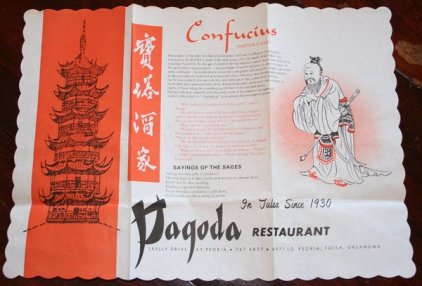
pagoda-placemat-60-thumbOh, so many memories of that time–

  • The time the Japanese servers refused to work unless they could put a TV up in the waitresses’ alcove so they wouldn’t miss a single episode of Shogun
  • The old Chinese chef, who spoke little English but gave us all pet names off the menu–one friend was Fried Won Ton, another was BBQ Rib, and I was, to my consternation, Sweet and Sour Pork.
  • The huge strong chef, who looked like an Asian Mr. Clean, with his bald head and bulging biceps. One day he was tossing fried rice in a gigantic wok over a searing flame and called me over as I walked by. I motioned I was in a hurry, but he insisted, so I went over. He communicated to me that he wanted me to toss the rice. I looked at him, my eyes narrowing, suspecting a setup, but his was a face of stone. So I took hold of the massive spatulas, more like tiny shovels shoved into the mounds of rice, steeled myself and tried to lift them. They didn’t budge–I heard a tiny sputter from the big man. Tried again, nothing–he sputtered a bit louder–then at the third attempt, he could contain it no longer and burst out with a big-bellied laugh at my expense. Then, after he wiped his eyes, he started tossing the rice with an ease and abandon, laughing all the time. I laughed too–unashamedly.
  • There was the tiny Japanese waitress who had been married like four or five times, who came up to me almost every single time I came into work, looked me in the eye and said, “Smile if you got a little last night.”  Of course, I never got any and of course, I always laughed. Oh, how I loved her.
  • Giving a sweet Cambodian couple some English lessons. In thanks, they cooked me a huge turkey at Christmas time, such a generous gesture that I didn’t have the heart to tell them that I lived in a dorm and had no place to put it. I can’t even tell you what I did with the thing, but I remember their kindness to me. I will never forget that.
  • Then there was the self-proclaimed Okie from Muskogee, who smoked like a chimney and spent her free time traveling to Vegas for gambling weekends with one of the other Japanese waitresses. She had lived a hard life, and nobody messed with that woman, but she had raised children too and knew when they needed to be loved. She cursed and complained about many things, but she never had a harsh word for me. Bless her, she knew I needed a little tenderness, so far away from my own mama.

I especially remember sitting down for special meals during holidays and other special occasions, especially Thanksgiving. Everyone celebrated it–all races, nationalities, and creeds. At Pagoda, Thanksgiving meals became times for friendly competition between the two major groups of cooking employees, so when the restaurant would close before Thanksgiving Day, we would have a spread, all the traditional fixin’s with a spicy twist, including two turkeys–one was cooked in a Chinese style, brined with the skin crisped on the outside and the other one in a spicy Puerto Rican style with adobo spices and oregano. (I’m guessing based on what I know now–I only knew the food was delicious back then.)

Both groups would try to get all of the diners, myself included, to declare their favorite, but I never did. I just smiled, laughed, said I had to get another helping before I could be any judge, and headed back to the table for seconds or thirds. I always tried to find my way back in a corner. I was young. I was shy. I didn’t speak their languages, but I ate their perfectly spiced food, watched them, listened, laughed when they did, and longed to understand them more.

Thus was born one of the key tenants of my educational philosophy.  So I tell my students–get out of the classroom. Put yourself in new and uncomfortable situations and listen for that song you’ve never heard before. Go into every situation with a mind open to learning about things and food and cultures and people you never dreamed you would. If you want to truly, deeply learn—then go out and live.

9f3b5a24ef334aa4354bde332a7f3adb--pagoda-restaurant-oklahoma

Caring

writer-605764_640-2I am beginning to put more emphasis in my teaching on caring.

First of all, I want to care more, about how I teach, what I teach, yes, but what I really want to care more about is each and every student–not just the ones who need me most, either. I want to care about them all–the gifted student, the one who seems to have it all together as well as the one who has dissolved into tears in my office. All my students need earnest praise, constructive criticism, encouragement–attention. They deserve it.

I want to care enough to take the time to let the struggling student know what he or she is doing right as well as what needs improvement. It is so tempting to only mark what needs to be improved. I want to care enough to take the time let them know how much I like that creative spark or this interesting fact they found through careful research.

I want to care enough to put away my petty concerns, there are so many, to concentrate on one of the two things I know in my heart I was born to do–teach writing.

Secondly, I want my students to learn to care. When they start caring about their work, amazing things can happen. The process begins when picking a topic. I spend much more time with this part of the process than I ever have before, and I am seeing results.

It isn’t easy for my students to care about writing for a myriad of reasons:

  • They don’t like writing. Many meaningless “busy work” assignments over the years have soured a large number of my students to writing.
  • They don’t think writing is important. Even though my students write all the time in their daily lives, they often don’t see the relevance of learning to communicate well in the written word. Somehow they seem to think they write well enough to be understood and that’s good enough, so why spend time on it, especially if they are going into a STEM career
  • They don’t make time for revision and editing. I am convinced that if students would leave themselves enough time to revise and edit, they would have time to develop, if not a passion for writing, at least a more thoughtful attitude towards it because they would see how caring improves the writing, which begets pride in one’s work, which begets a desire to leave more time for revision and editing. It’s hard to care about something if rushing to keep a deadline.

One tactic I use to instill a little more thoughtful attitude towards writing is to require my freshman composition students to pick a research topic with a local focus. We spend time exploring topics that concern their everyday lives on and off campus. We brainstorm about the issues they care about, which often leads to a willingness to search even harder for solutions to the not so hypothetical questions they are asking.

Doesn’t always work, of course, but for some of my students, learning to care has not only helped them write better papers, but it also has helped them become advocates for change in their communities, making their lives better, too.

***

cover

The spring/summer 2018 edition of Teach. Write.: A Writing Teachers’ Literary Journal is open for submissions until March 1. See submission guidelines for more information


A Classic Education Is Utilitarian

Fun Medical MGD© (2)

At our college’s tutoring center, a colleague and I struggled this past week to help a nursing student understand how to diagram sentences using traditional, Latin-based sentence diagramming methods. The student, a non-traditional-aged student coming back to work on a third degree, was frustrated on multiple levels because not only was she having difficulty with the concepts, especially having been away from anything close to grammar for several decades, she was also having difficulty understanding why she was being asked to diagram sentences in the first place as she sees no practical purpose for it. She’s not alone.

Even in my own composition classes, I have abandoned formal traditional diagramming of sentences in favor of a more informal approach, reminiscent of a structural linguistic method of diagramming, breaking a sentence up based on the functions of the words, phrases, and clauses with a minimum of grammatical terminology.

It is not, however, that I find traditional sentence diagramming a waste of time, and I support its use in the classroom for two main reasons:

  • Diagramming helps students understand the functions of words separate from the appearance of the word, such as verbals, which look like verbs but do not function as verbs.
  • Diagramming helps develop critical thinking skills, which is one of the primary functions of higher education

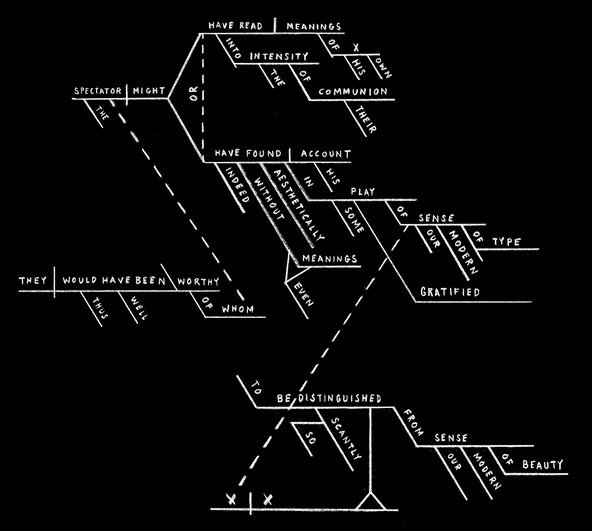
Kitty Burns Florey, author of Sister Bernadette’s Barking Dog: The Quirky History and Lost Art of Diagramming Sentences, eloquently explains the value of diagramming in her New York Times’ article from 2012, “Taming Sentences,” She writes that diagramming helps us think more clearly about what we are writing, and even if it doesn’t do a thing for our writing, it is at the very least, a puzzle that is good exercise for the brain, honing our critical thinking skills.

As a fascinating example, Florey diagrams a compound/complex sentence from Henry James’s The Golden Bowl:

draft-diagram1-tmagArticle-v2

Of course, I find all of this exciting and interesting, not so our struggling nursing student, who sees diagramming as wasted effort because she sees no application for it. I tried to explain that it was like doing drills for an athlete–the athlete may not do the drill during a race or game or match but, by exercising, will be developing the muscles he or she needs to be competitive. My colleague tried to equate the student’s love of reading to the exercise of diagramming–the student does not NEED to read. What she reads has no immediate application to nursing, but reading exercises the brain, which will help her be a better writer, and a better nurse.

Our student didn’t buy it. But because she is a good student and wants to do well, she listened to our explanations and, I believe, we did help her understand better. She even said that she wanted to come back to the tutoring center to get more help on another day.

We’ll be there.

***

Here are some more articles I hope to share with our student that discuss how important it is for nurses to critically think and write well:


From Prompt to Publication

writerwritingframe-300px (2)

My first stab at producing and editing a literary journal–Teach. Write. -is taking shape.

I have accepted quite a few wonderful submissions, but I am hoping to get some more before the August 1 deadline. If you are, or ever have been, a teacher of writing in any capacity, then I would love to see your work–prose or poetry–doesn’t have to be about writing, just writing by a teacher or former teacher. See the submission guidelines for more information.

I was inspired to start Teach. Write. because I have witnessed how writing for publication has enriched my teaching. I am more attune to the power of the revision process, more gentle with my criticism and more accurate, too. Because I am a working writer, I work better with writers who are just learning the process–it keeps me closer to them.

One feature included in Teach. Write. will be called “Write Your Own.” In this feature I would like to highlight writing prompts that  teachers have used successfully in class. To do that, I would like the teacher to not only include and explain the prompt, but also to write something based on their own prompt and submit that piece along with the prompt and explanation.

Here is an example of an explanation, prompt and flash piece that I created for my online British Literature I class:

I’m always trying to find ways to engage online students more effectively. It isn’t always so easy to do. A couple of years ago, however, I came up with a prompt for a discussion forum on Beowulf that has proved to be most successful. I wrote my own response to the prompt when I first posted as an example for my students and liked it so much that I tweaked it a little and sent it out into the cold, cruel world. After a couple of rejections, an online fantasy publication–Mirror Dance–accepted it for publication. I was quite pleased. See the results here: Waiting for Beowulf

The Prompt

The early Anglo-Saxon people were great storytellers. The story of Beowulf, as you saw in the BBC film this week, began as oral tradition, told and re-told around campfires and in great halls for decades, even centuries, before it was finally written down in the form we know it.

Americans are great story-tellers, too, especially here in Appalachia where many of us, including me, have Anglo-Saxon and Celtic blood coursing through our veins. For this assignment I’m going to let you tell part of the Beowulf story your way. Let’s get started:

Directions:

  • Choose one of the scenes you read in Assignment 2.1:
    • First Attack
    • Fight with Grendel
    • Fight with Grendel’s Mother
    • Fight with the Dragon
    • Beowulf’s Funeral
  • Review the scene so you are sure of the plot.
  • Rewrite the scene or a part of the scene from a specific character’s point of view–For example–write the scene of the first attack from one of the surviving men’s point of view or tell it from one of the women’s point of view. Your scene should be one or two well-developed paragraphs in length (seven to ten sentences per paragraph). It may be longer if you are inspired.
  • Post your scene, illustrated by an internet picture you’ve found. See my post to get an example of what to do.
  • Post a thoughtful response to either my sample post (if you are the first one to post) or one of your fellow students’ posts. Take a look at my sample response to get an idea of what I mean by thoughtful response. Also, look at the grading rubric in the Joule Gradebook to see how I will be grading this assignment.
  • Have fun with this assignment!

    The Post and Sample Response

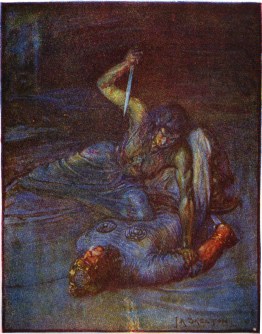
  • stories_of_beowulf_water_witch_trying_to_stab_beowulf

    By J. R. Skelton [Public domain], via Wikimedia Commons


    Waiting for Beowulf

    by

    Katie Winkler

    Come my beauties, writhing sea dragons and serpents, monsters with milky eyes, slouching on slopes by the cliff. Come greet our visitors–the loathsome King Hrothgar and his fiendish followers. And Beowulf, the son-killer, watch him don his war-gear, showing no fear. I will give him cause to tremble, cause to repent how he rent the arm of the monster-child, left him to die like a dog, denying a god the honor of a swift death.

    See the man take up Hrunting, the fool, thinking he will be victorious, boasting to his lord of its great strength as he comes to meet me in my own abode. He will swim to me through the depths, with great and mighty strokes, swim to my home some call a hellish turn-hole. Here he will sling the mighty sword. Its decorated blade will come down singing and ringing. Singing and ringing. But it will not touch the swamp-thing from hell. It will refuse to bite, and then this hag, this witch, shall take her revenge.

  • Response:
    • This creative response shows a good understanding of the scene in Beowulf that depicts the fight with Grendel’s mother. The author includes references to the description of Grendel’s mother in the original work as well as the underwater cave in which she lives. Also interesting is the use of kennings–compound words like war-gear, son-killer and turn-hole. Kennings are common in Anglo-Saxon poetry. Finally, it is interesting to see the story from the creature’s perspective. She is portrayed more as a vengeful mother who has lost her beloved son than a fiendish monster. The illustration is appropriate as well, showing that the illustrator obviously read and/or studied the original work before creating the artwork. Note: I used a different illustration in my post but could not include it here due to copyright issues.

Student Response to the assignment has been positive.

Most students respond well to Beowulf anyway. It is just such an exciting “action hero” story, but this prompt has helped many students take their studies a step further and start to explore the style and artistry of the poem as well as plot and character.

So if you have a prompt you really love, Write Your Own, and submit it and share your good idea with other teachers and writers.

Shameless Plug


unbrokencircleOne more thing before I say good bye. I have a story in this marvelous little anthology: Unbroken Circle: Stories of Cultural Diversity in the South edited by Julia Watts and Larry Smith, published by Bottom Dog Press. You can buy a copy at the Bottom Dog Press website or on Amazon. Print and Kindle editions are available.

Here is what Karen Salyer McElmurray, author of Surrendered Child, said about the book: “In turbulent times, what we need is possibility, and in this rich gathering of diverse voices, Watts and Smith give us just that….These are stories and essays about the blues, about poverty, about families lost and made. Unbroken Circle is about broken and unbroken lives, and ultimately, hope.”


School’s Out for the Summer!

school's out

School’s out for summer! Back in June of 1972, I never would have believed that I would see Alice Cooper singing his anthem of teen rebellion with a bunch of muppets? But look!

https://youtu.be/vmewc2Uqon4

I’m just enough of a rebel to kind of like this, even as a teacher of English, although I don’t think anyone has ever exactly seen me as a typical English composition teacher. I know I haven’t.

And yet, I might be more ordinary than I like to think because I can’t stop writing and revising and editing. That’s why I’m here at the computer on my first official work day off for the summer — writing.

Yes, it is going to be a writing summer that’s for sure, and I’m starting it out with a bang! First of all, later this week I will attend the Looking Glass Rock Writers Conference at Brevard College. My instructor is Pulitzer Prize-winning novelist, Jane Smiley. I’m, to put it mildly, stoked.

lookingglassrockfrompilotzoom

Secondly, one of my stories is officially on sale tomorrow in an anthology put out by Bottom Dog Press called Unbroken Circle: Stories of Cultural Diversity in the South. I am pleased that this story, “I Have Not Yet Returned,” about a young woman coming to grips with her father’s mental illness, has finally found a home.

unbrokencircle

The process from writing to publication, or being accepted to writing residences, has never been easy for me. I was doing some rough calculating in my head, and I have published about two dozen stories in print and online publications since I have started seriously seeking publication. Sounds like a lot until you consider that I sent my first work into the world in August of 1995–24 pieces in 22 years and hundreds, yes hundreds, of rejections in that time.

Listen to me. I sound like I’m bragging. Perhaps I am. Perhaps I should. 22 years of being mostly rejected, but not always, 22 years of not giving up on my dreams of being a writer, has made me a better one. Failure has made me a better teacher, too, even a better person. Not always failing has helped me to survive the process.

What I have learned about persistence has been invaluable to me as a writer and a person, and it is the attribute I most want to pass on to my writing students. Our society makes giving up so easy, why should anyone persist? I can tell them.

I have 24 reasons why.

Because I value so highly what I have learned through seeking publication, I am now accepting submissions for my own literary publication–Teach. Write.  It is specifically targeted to English composition instructors, any level, whether actively teaching or retired. Submissions are open now until July 1. The first issue will come out in September. Complete submission guidelines can be found at this link: Teach. Write.

I look forward to reading your work! Have a writing summer!!

***

If you would like to purchase a copy of Unbroken Circle: Stories of Cultural Diversity in the South, you can do so at Bottom Dog Press, Inc or at Amazon.com

What happens when liberal arts are devalued in the community college?

5653093-steve-jobs-liberal-arts-quoteThere seems to be an increasing hostility in the world today towards the study of the liberal arts. This is not a new subject to readers of my blog. As a community college instructor teaching English, I have grave concerns about how this hostility is affecting many of my students at the college where I teach.

If students don’t value the liberal arts, especially the humanities, they often become resentful of having to complete assignments that appear, to their uninformed minds, to have no practical value. This resentment can turn to inattentiveness and a lack of participation, which sometimes turns to more serious inappropriate behavior, and even to open hostility and violence, according to a 2008 study by educational counselors Dr. Robert Dobmeier and Joseph Moran (“Dealing with the Disruptive Behavior of Adult Learners”).

The feeling that students’ time studying in the humanities classroom is somehow wasted is often times reinforced by negative attitudes within the home, among peers and in the wider community. For example, former Governor Pat McCrory of North Carolina said in a 2013 radio interview referring to certain humanities courses, including gender studies and an African foreign language

“So I’m going to adjust my education curriculum to what business and commerce needs to get our kids jobs as opposed to moving back in with their parents after they graduate with debt,” McCrory said, adding, “What are we teaching these courses for if they’re not going to help get a job?”

If the governor of a state with a rich tradition of superb institutions of higher education feels free to make such uninformed statements, it is logical to assume that some students are hearing similar ones at home and among their peers.

I can attest that this lack of respect has led to disrespect for not only the disciplines I teach, but also for myself. Furthermore, I am not alone. Students are becoming more and more critical of instructors’ assignments, teaching styles and assessments. I don’t mean legitimate questions respectfully asked, which leads to explanations that help students understand the material better, but criticism that is increasingly uncivil, including sleeping, texting or talking in class, posting inappropriate comments in online discussion forums, as well as e-mailing rude and even obscene comments to instructors.

Worse, community college instructors are increasingly confronted with angry and hostile students in the classroom and in our offices. These students are often upset that an instructor has carried out a policy that is stated clearly in his or her syllabus or there is some disagreement about a grade. Sometimes these encounters are upsetting and even frightening to the instructor, his or her colleagues, other students, staff and administrators.

I have been teaching a long time, and I know that incidents like these have been happening since the first classrooms were created, but I have never, in my whole almost 30-year career, had so many adult students with such unhealthy attitudes toward learning for learning’s sake, that inexplicable passion for learning, which leads to all of the things so many people say they desire out of higher education–citizens who can think critically, communicate well, solve problems and adapt to new situations quickly.

Something needs to be done. But what? There are no easy answers, but I am going to begin with educating myself with specific information that supports my belief that the study of the liberal arts should be the bedrock of all our institutions of higher learning.

**********

I found this incredible essay posted on the Academy of Arts and Sciences website, along with a great article entitled, The Vitality of the Humanities in U.S. Community Colleges,” that reiterates my thoughts on the importance of all students studying the arts and humanities in our community colleges:

January 19, 2015

Community College Students and the Humanities: New Opportunities for Learning and Growth

posted by Martha J. Kanter

Martha J. Kanter, Ed.D., is a Distinguished Visiting Professor of Higher Education at New York University and former U.S. Under Secretary of Education from 2009 through 2013.

More than 40 percent of our nation’s adults are unable to read, write, or compute at the competency level expected of America’s high school graduates, so it’s hardly a surprise, even if it is gravely disappointing and frustrating, to inform policy makers, and the public about the worth of the humanities.1 But what better way to elevate the discussion than with facts and policy strategies?

That is why the light that the American Academy of Arts and Sciences is shining on community colleges and the humanities is critical in this endeavor. Even today, too many Americans aren’t aware that the community colleges are the gateway to higher education for more than 40 percent of our nation’s undergraduates. A generation ago the United States was first in the world in the number of college graduates with two-year and four-year degrees. According to the Organisation for Economic Co-operation and Development (OECD), we are now eleventh in the world, tied with Israel.2 The good news is that we are moving in the right direction: we were ranked sixteenth 16th in the world in 2009. It’s a national imperative that we provide Americans the best quality education so we must look to the community colleges and state universities where the middle-class and low-income majority is seeking higher education. (my accent)

Educational improvements and financial support are sorely needed. Sadly, public colleges and universities were hit hard by the recession and lost, on average, about 20 percent of their state support. We need our private universities to join with their colleagues in the community colleges and state universities in a shared vision to reimagine and redesign general education in the years ahead. In doing so, we will ensure that all of our students have access to the fundamental ideas, knowledge, skills, and capacity to learn that will advance greater numbers of students with undergraduate and graduate degrees for America’s prosperity in the 21st century.

Looking at the facts, more than a third of associate’s degrees are awarded in subjects that require a significant humanities course load.3 Exposure to the humanities in the first two years of college as a significant component of general education provides the intellectual framework for students to compare and contrast the viewpoints of those different from themselves and to delve into the learning spheres of analytical reasoning, problem solving, and decision making to tackle the very real problems facing their communities and the greater society.

In a recent survey, the American Association of Colleges and Universities found that 93 percent of CEOs want to hire individuals who demonstrate the “capacity to think critically, communicate clearly and solve complex problems,” capabilities “more important than their undergraduate major. More than nine in ten of those surveyed say it is important that those they hire demonstrate ethical judgment and integrity; intercultural skills; and the capacity for continued new learning.”4  (accent is mine) 

Unfortunately, the collaboration so urgently needed between the arts, humanities, sciences, and business has fragmented into ever more disparate pieces over the last decade when their interaction and integration should be encouraged to spur innovation, entrepreneurship and creativity to drive our nation forward. In the decades ahead, our nation will need more Americans with college degrees who are well versed in the histories and opportunities to address the major societal challenges of our democracy and the world, not the least of which include the education levels of children, income inequality, the social, economic and civic needs of diverse communities, globalization, innovation, and American competitiveness. Interdisciplinary thought leadership and collaboration will be more important than ever in crossing boundaries to address the local, regional, national, and global problems ahead of us.

When Tom Ehrlich spoke about the pathways to ethical and engaged citizenship at Miami Dade College in 2009, he said, “college learning must be about much more that [sic] knowledge—knowledge that may be obsolete in just a few years. Most important, it must be about learning how to learn and to keep on learning. At its core, that is what a liberal education does, it liberates our minds to learn.”5  (accent is mine) 

We should look to the evidence, embrace the liberal arts as a necessary foundation for postsecondary education in all fields of study, and figure out how to give our students the best possible opportunities to discover themselves, their place in the world, and how they can contribute to improving their own lives and the lives of their communities. In doing so, we will be part of the American dream we wish to realize for ourselves and future generations. (accent is mine)

ENDNOTES
1 U.S. Department of Education, Institute of Education Sciences, National Center for Education Statistics, 1992 National Adult Literacy Survey (Washington, DC: U.S. Department of Education, 2000), http://nces.ed.gov/pubsearch/pubsinfo.asp?pubid=199909; and U.S. Department of Education, Institute of Education Sciences, National Center for Education Statistics, “Percentage of adults in each prose, document, and quantitative literacy level: 1992 and 2003,” in 2003 National Assessment of Adult Literacy (U.S. Department of Education, 2003), http://nces.ed.gov/naal/kf_demographics.asp#2.
2 OECD, Education at a Glance 2014: OECD Indicators (Paris: OECD Publishing, 2014), http://dx.doi.org/10.1787/eag-2014-en.
3 American Academy of Arts and Sciences, “Associate’s Degree Completions in the Humanities as a Percentage of All Associate’s Degree Completions, 1987–2013,” in Humanities Indicators, 2014.
4 Hart Research Associates, It Takes More than a Major: Employer Priorities for College Learning and Student Success (Washington, DC: Hart Research Associates, 2013), http://www.aacu.org/sites/default/files/files/LEAP/2013_EmployerSurvey.pdf.
5 Tom Ehrlich, “Ethical and Engaged Citizens: Whose Responsibility?” (talk delivered at Miami Dade College, Miami, FL, May 21, 2009).