Throw Back Sunday

My Work Home

My Work Home

I used to write a BRCC column a couple of times a month for the Hendersonville Times-News. Here’s one of those columns, from back in 2003:

A series of events the past few weeks has caused an identity crisis in me, forcing me to ask that question teachers often find themselves asking. “What exactly do we have to offer—what is our role?

Should we be entertainers? After all, it is difficult to keep students engaged, especially when many have grown up passively viewing a television screen or matching wits with an exciting computer-generated opponent. Sometimes we try to “jazz things up,” yet no matter how witty our illustrations or detailed our demonstrations, despite our high tech visual aids, we teachers can’t match the special effects of Star Wars or Lord of the Rings.

Of course, teachers should make attempts to prompt student responses through group discussion and student comments, but in the end it is the teacher who has the responsibility to bring student discussions to the sticking point, to summarize key points of any discussion. I know it’s become a dirty word in some circles, but sometimes we even need to lecture.  For many students, that’s not entertainment.

If it is not a teacher’s role to be an entertainer or merely a facilitator, is it to be an encourager? Everyone needs praise.  Good teachers know this and try to find real reasons for praise. One word of encouragement from an admired and respected instructor can fuel some students for an entire semester. Sometimes praise can even change a student’s life; however, constructive criticism has also been known to be the making of a person.

Teachers sometimes see themselves as physicians, highly trained professionals who diagnose problems and offer cures.  But others sometimes see us as nothing more than dispensers of grades—recorders. I do the work; you write my A in the grade book and raise my self-esteem.

Are we here to make students feel better about themselves?  Are we counselors? As a writing teacher, I sometimes find it difficult to even constructively criticize a student’s work if I’m aware of his or her difficult circumstances. I ask myself, what if he or she takes my criticism personally. Could my words so sting that the student becomes so angry or discouraged that he or she drops my class or quits school?

In the end, good teachers know avoiding the errors in student performance, no matter what the students’ difficulties, can only block their ability to learn. Our job is to assess students and inform them of their problem areas, not to assure them, “Everything is okay.”

At the beginning of the semester in my freshman composition classes, I relate to students my educational philosophy by describing a scene from the movie All That Jazz, based on the life of Bob Fosse, the late choreographer and Broadway director of Chicago.  The Fosse-like character becomes frustrated with a beautiful young dancer who gets her job more for her sexual appeal than her dancing ability. When the young woman breaks down in tears, the choreographer stops the music and goes to the girl, saying something like this: “I can’t promise you I’ll make you a great dancer.  I can’t even promise I can make you a good dancer. But if you work real hard and listen to what I say, I’ll make you a better dancer.”

Like the choreographer, we can’t make many promises. We can’t say for sure that our students will be stimulated or get A’s or even pass. But we can make the promise that if they will listen, even if the delivery is not of their liking, even if the grade is not what they expect, they will learn.

Reminded then of our promise, our role becomes clear. I know what it is we have to give. It’s not entertainment, not unreserved praise; it’s not a shoulder to cry on. The only thing we can offer our students is what we know—about our disciplines, about learning, about life.

The rest is up to them.

To Become a “Miracle Worker” Too

Miracle worker Anne Bancroft and Patty Duke in 1962’s “The Miracle Worker” by William Gibson When I was a young girl in the 60’s, I loved to watch old movies on Saturday afternoon. Some of these movies made a deep impact on me for one reason or another. I remember watching one of my first Shakespeare plays on Saturday morning–the 1935 version of Midsummer Night’s Dream starring Olivia de Havilland as Hermia, Andy Rooney as Puck and James Cagney, yes, James Cagney, as Bottom. I didn’t know any of those actors then, but I was fascinated by their actions. I barely understood a word of what was said but I was mesmerized by the words. So many movies during those halcyon days, when my viewing choices may have been fewer but have rarely been better, helped form my love not only of film but also of story telling and the theater, psychology and human development, justice and mercy–movies like Citizen Kane and Rebecca, Stage Door and All about Eve, To Kill a Mockingbird and 12 Angry Men. 

However, there is one movie that told a story which stands out above the rest in my mind, a story that helped solidify a desire that was already growing in me before I was a decade old–the desire to teach. That story is told in the 1962 film The Miracle Worker, the story of Helen Keller and her teacher Annie Sullivan. I can’t remember a time I didn’t want to be a teacher, but watching Annie struggle to teach Helen, to give some meaning to the child’s dark and silent life by giving her the gift of language and in return seeing her own life change from dark to light, caused the stirrings of desire to leap into a consuming passion.

I was reminded yesterday of this great story and its impact on my career choice when I went to see our local community theater’s production of William Gibson’s play. I’ve seen it several times over the years and the movie many times, but something about the intimacy of the small theater and the fine acting by my friend who was playing Annie and another friend’s young daughter who played Helen, brought back the force the story and its impact on my life in a way I hadn’t felt in many years. This time, however, I have been a teacher for thirty years, a bit jaded about my profession, especially these days, especially in North Carolina, but watching Helen’s face at the water pump as the water flows over her hands and she finally understands what words are, seeing Annie’s face when Helen comes to her with her new found knowledge and signs that special word “teacher” renewed my love of teaching.

One passage in particular especially rang true to me last night. In the scene Annie is discouraged because she has brought Helen to the threshold of understanding language, has struggled mightily to bring her there, but words are still just a finger play to Helen and time is running out. Annie looks down at the deaf, blind and mute child with such yearning and says these words:

I wanted to teach you—oh, everything the earth is full of, Helen, everything on it that’s ours for a wink and it’s gone, and what we are on it, the—light we bring to it and leave behind in—words, why, you can see five thousand years back in a light of words, everything we feel, think, know—and share, in words, so not a soul is in darkness, or done with, even in the grave. And I know, I know, one word and I can—put the world in your hand—and whatever it is to me, I won’t take less!

Is it any wonder that even way back when I was not much older than Helen was that day the world opened up to her, that my world opened up to me? That day I knew what I wanted to do–help people understand the beauty and power of words. When I got a little older, one of the first biographies I read was Helen Keller’s autobiography, “The Story of My Life.” I chose that book because I had seen the movie and been so intrigued by Annie Sullivan and how it must feel to teach a child. Reading the story from Helen’s perspective fueled my passion for teaching. In this passage Helen describes that day at the water pump:

I stood still, my whole attention fixed upon the motions of her fingers. Suddenly I felt a misty consciousness as of something forgotten–a thrill of returning thought; and somehow the mystery of language was revealed to me. I knew then that “w-a-t-e-r” meant the wonderful cool something that was flowing over my hand. That living word awakened my soul, gave it light, hope, joy, set it free! There were barriers still, it is true, but barriers that could in time be swept away.*

I left the well-house eager to learn. Everything had a name, and each name gave birth to a new thought. As we returned to the house every object which I touched seemed to quiver with life. That was because I saw everything with the strange, new sight that had come to me. On entering the door I remembered the doll I had broken. I felt my way to the hearth and picked up the pieces. I tried vainly to put them together. Then my eyes filled with tears; for I realized what I had done, and for the first time I felt repentance and sorrow.

I learned a great many new words that day. I do not remember what they all were; but I do know that mother, father, sister, teacher were among them–words that were to make the world blossom for me, “like Aaron’s rod, with flowers.” It would have been difficult to find a happier child than I was as I lay in my crib at the close of that eventful day and lived over the joys it had brought me, and for the first time longed for a new day to come.

Some people struggle to know what to do with their lives, to find themselves, but I knew long ago as a little girl watching TV on a Saturday afternoon, when I could have been outside playing, that some day I would be a teacher. As much as I have wanted to escape my destiny over the years, it’s clear that I am where I belong, doing what I was born to do. What William Wordsworth said is true, “The child is father of the man.”

Mother of the woman, too.

It Matters

Yes, dear student, it matters that you capitalize the personal pronoun “I” and that you use salutations in your e-mails. It matters that you refrain from keeping your cell phone on your desk and looking at it every few seconds during the lecture. It matters that you do not use the time I give you on the computer to write personal e-mails and post on facebook.

Yes, dear support staff member, it is important that you knock and ask permission to enter the room when I am conducting class, that you do not speak to me disrespectfully in front of my students when I question the timing of repairs on the classroom printer. It matters that you recognize the most important thing our college does is hold classes and that all classes are important, even, perhaps especially, developmental classes.

Yes, dear administrator, it matters that you allow me to explain my position before you summarily dismiss my request, that you do not raise your voice and speak to me in a derisive tone, but speak to me as a fellow educator, someone who has the best interest of students at heart.

Yes, dear me, it matters what you do, even when it isn’t acknowledged, even when you are treated unfairly, even though you aren’t perfect and make mistakes. What you do matters and it matters that you care so deeply. It matters

So Frustrated I Can’t Write Much, So I’ll Let Tom Hanks Speak for Me

Today, I’m feeling once again minimized, like my efforts to educate people in my community, to try and instill in them not just skills but a love for learning and a desire to be a lifelong learner, to be a thinker, is seen by some people in power to be a waste of people’s time, that College Transfer Programs leading to four years degree are at best excessive and at worst wasteful.

So I come back to my office feeling a little depressed–go figure. Most people have gone home, but I have to type up a reading comprehension test for one of my classes tomorrow. I hate giving reading comprehension tests, but see, my students don’t read their assigned texts–as a whole they don’t do anything unless they get a grade for it. They don’t understand what it means to be educated and very few have any desire to be. I don’t blame them. They are products of a society that has people in power who seem to think that all education needs to be directly measurable, so they naturally do not understand what it means to read something because it will help them understand the material better, because it will help them write their papers better if they apply what they read. Oh no, if the reading does not have the price tag of a grade, then few students will do it. The idea of learning for learning’s sake is alien to them because it is alien to most of the people all around them, a product of the instant world to which they’ve become accustomed.

Anyway, so I haven’t started that quiz yet. Why? In my inbox was this wonderful article by Tom Hanks appearing in the New York Times that made me feel so much better. Did you know that Tom Hanks got a really good liberal arts education at a community college? Yep. So here it is: http://www.nytimes.com/2015/01/14/opinion/tom-hanks-on-his-two-years-at-chabot-college.html?emc=edit_ty_20150114&nl=opinion&nlid=69971608

Read it and then hear me saying, “What he said.” That’s my blog for today.

Mama K and Her Kin, Part II

Lanett

The 1963 Lanett Championship Football Team

In Part I of “Mama K and Her Kin,” I wrote about my grandmother Katherine Dabbs, who was educated at Jacksonville State Teacher’s College in North Alabama, where she met my grandfather Gordon Dabbs (we called him Daddy D) in a music appreciation class. I also talked about one of her experiences teaching in a one-room school house in North Alabama. But Mama K’s educational adventures didn’t end there.

Mama K married Daddy D, and they settled in the Ridge Grove area of Chambers County, not far from Dudleyville and Budston, you read right, Dudleyville and Budston. in between Camp Hill and Lafayette, Alabama, the county seat of Chambers County. Lafayette hit the big time in 1988 when the feature film Mississippi Burning was filmed there. Some people didn’t like how the town was portrayed in the movie, but it did bring some needed funds to the cash strapped county that has long been one of the poorest in the nation.

It was poor when Mama K and Daddy D settled there and Daddy D was the principal of the Ridge Grove school. My mother was born in the little house that is right down the road from the property that my grandfather bought before he took the job as principal of Lanett High School in Lanett, Alabama. I’m sorry that I never met my grandfather, he died of a heart attack the year I was born, but I feel like I know him from the stories people tell him, especially my mother. She is so proud of her papa!

From her I learned that he was a wonderful teacher and principal. He loved science, taught physics, and liked to build things. Mom says that he built a generator from scratch that the family used when they went camping. When I was little, my siblings and I rode on a little go cart that he built, and all of us rocked in the little rocking chair he made for my sister Ronda, the oldest of his grandchildren. My husband John repaired and painted that rocking chair for our daughter Hannah to use, and it is still sitting down in our garage, ready to be handed down to children who will have wonderful memories of rocking and reading and daydreaming. I’ll be sure to explain how that chair was built with love by their great, great grandfather.

Mama K was devoted to Daddy D and she was the quintessential principal’s wife. When my mother and then my Uncle El, (He was also a teacher–he taught Spanish) was born, Mama K stayed home and took care of them, but when they got older, she went back to teaching and taught Alabama history and conservation. Yes, conservation was an important subject for rural Alabamians in the 50’s, my mother tells me. The soil had been badly depleted during the over-farming of the depression and war years, so the public schools stepped in to teach new and sustainable farming techniques to high school students.

Mama K continued to teach during the late 50’s but in 1959 tragedy struck and Daddy D, who had a history of heart problems, died at his home in Lanett. He was greatly mourned by his family, of course, and the whole community, but especially the educational community, both black and white. Even before the landmark Brown vs. Board of Education case in 1954, my grandfather had begun forming a strong relationship with Mr. Brown, the principal of the nearby black high school, but because of the resistance across the US and especially in the South to integration, there was not an immediate move to desegregate the schools, but my grandfather and Mr. Brown were anticipating the move towards integration. My mother remembers asking her father about desegregation, and he told her there might be “a lot of trouble” but that in the end “It’ll all work out.”

After my grandfather’s death, Mama K continued to teach at Lanett High School and the push to desegregate became stronger. Although my mother isn’t sure of the exact timing, my grandmother played a pivotal part in the successful racial integration of the county’s schools. Sometime between 1959 and 1963, the new administration asked for volunteers among the white teachers to go to the black high school to teach, while teachers from the black high school came to Lanett High. Mama K was the first white teacher to volunteer. She told my mother that as the widow of a beloved educational leader, she should set an example for the rest of the teachers.

Mom doesn’t know too many details about that time, but what we do know is that the Lanett City Schools were integrated successfully and without violence. Mama K didn’t teach much longer, however, because sometime in the early 60’s, I’m not sure of the exact date, my grandmother became seriously ill and was hospitalized, so it seemed to be a good time to retire.

My Great Aunt Jane, also a teacher, came to live with my grandmother following Daddy D’s death. As I said in Part I of this blog post, Aunt Jane taught math, including trigonometry and calculus. She continued to teach for years in nearby Valley, Alabama, and even though I was young, I can remember going on errands with her when she still taught and how students and former students would stop and talk to her, telling her what a good teacher she was. I was so proud to be her grand niece.

When I started teaching, Aunt Jane, who was like another grandmother to me, gave some extra special gifts that I continue to cherish to this day–one is a charm bracelet that she received when she retired that has all sorts of math and science teacher charms, including a math book, a beaker, a slide rule and an abacus. I’m an English teacher but I love it–the other is something that looks like an ordinary pen but extends out to be a pointer. I don’t use it any more but I did when I first taught because it always amazed my students–they were easily entertained back then. When Aunt Jane died, Mama K gave some of her things to the grandchildren and to me she gave a heavy marble pen holder that Aunt Jane got when she retired. I have it on my desk at the college where I teach, and every time I look at it and see her name, Jane Leath, I am reminded of the great teaching legacy I belong to and am so glad I have chosen this profession.

When times get bad and I get discouraged I remember them all–my grandmother and grandfather, mother, father, aunts, uncles, cousins, all the teachers in my life who have made a difference in this world–for good.

A

Good Beginnings–Mama K and Her Kin, Part I

cheaha_mt1b

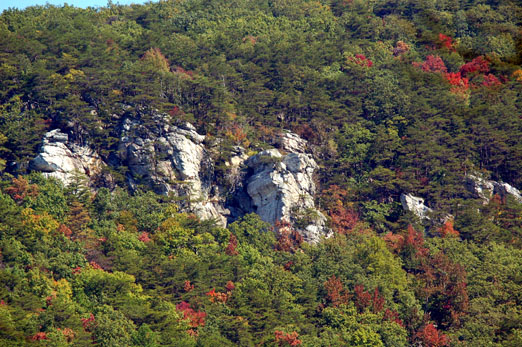
View of Mt. Cheaha near my grandmother’s birthplace in northeast Alabama

My grandmother, my mother’s mother, and one of my namesakes (I was named after my two grandmothers) was a teacher. We called her Mama K. She came from the mountains of Alabama, up near Chattanooga, that’s the tail end of the Appalachian range. It’s beautiful up there. If you ever visit, be sure you go to Mt. Cheaha, the highest point in Alabama.

My grandmother met my grandfather, also a teacher and a principal, at what was then called Jacksonville State Teachers College. Back then, the late 1920’s, a person could complete a teaching degree in just two years. They met in a music appreciation class. He was funny and boisterous, she was proper and reserved. He had grown up near Budston in Chambers County, Alabama, still one of the poorest counties in the nation, and she had grown up in the mountains, also surrounded by poverty, but their families, mostly farmers, managed to give their children good beginnings–childhoods filled with love, security and faith–teaching them self-sufficiency and discipline, but they wanted more for their kids than the hard scrabble life they had, so they managed to find a way to send them to the teachers college, where they could hopefully rise out of the poverty in which they were born.

All but one of my grandmother’s siblings became educators. Uncle John Taylor was principal of a school in Rome, Georgia for years. I didn’t know him well, but I went to his funeral with my mother, and I’ll never forget how packed that church was, how well-respected and loved Uncle John Taylor was.

My Aunt Jane, the baby of the family, completed all the course work for a doctorate in mathematics but didn’t see the need to write a dissertation as she was happy teaching algebra, calculus and trigonometry to high school students, mainly in Valley, Alabama, in the east-central part of the state near the Alabama/Georgia line. My daughter’s middle name is Jane in honor of my great Aunt Jane, who never married and had no children of her own. Her niece, my mother, became a teacher and high school librarian.  I, the grandniece, am a teacher too, having taught English composition and literature over 25 years in private at public schools, at the secondary and college level.

Aunt Dixie, the middle daughter,  also obtained a teaching certificate and maybe taught a year or two, but she went to revival services at the little County Line Baptist Church and fell in love with the handsome young preacher who was preaching that day, my Uncle Judson, and married him. His son, also Judson, became a teacher and principal in the Birmingham, Alabama area, now retired as Dr. Judson L. Jones. His daughter Lea is also a teacher and working on her doctorate in education.

Uncle Jim went into the navy and served his country honorably, becoming a farmer near Troy, Alabama, carrying on his parents’ profession, but it’s interesting to note that his daughter and granddaughter became educators, highly respected in their fields.

When Mama K graduated from Jacksonville State Teachers College, her first teaching position was in North Alabama in a one-room schoolhouse. I remember going through some of Mama K’s old school books from those days when I was a child. It was one of my favorite past times. I loved old books and still love them to this day, the way they smell and feel and look. In between the pages of one of the old textbooks was a little pamphlet about Harry the Hookworm, illustrated with funny little cartoon pictures of a hookworm and explaining how to avoid getting the parasites by using a latrine. The latter part of the pamphlet actually had instructions on how to build an outhouse.

I asked Mama K about it, and she told me this story. Once when she was teaching in that little schoolhouse in North Alabama, there was one little boy who was very poor and usually came to school wearing the same clothes, but she didn’t think anything of it because his clothes, despite being worn, always looked clean, but one day every time he came close to her, she noticed a horrible smell, a body odor that got worse in the next few days, especially now that it was getting colder, and she was keeping the windows and doors of the little schoolhouse closed.

Finally, the smell got so bad that she simply had to say something, so she kept him after school and asked as gently as she could, “Are you taking a bath from time to time?”

He said, “Yes’m”

“Are you taking off your shirt and your pants and getting into a tub?”

“Yes’m. My mama heats up the water on the stove and I get in.”

“Do you scrub all over?”

“Yes’m”

My grandmother didn’t want to embarrass the boy any more than she already had, but she wanted to find out what was causing the smell and she had her suspicions, so she said, “Are you taking off all your clothes, including your underwear?”

He looked surprised at the question, and said, “Why, no ma’am. My mama done sewed me into my underwear!”

She chuckled and I laughed, after she explained it to me as I didn’t have much knowledge of long johns, and then she got serious, telling me that when she taught at the little one-room schoolhouse, a large portion of her teaching was about how to live a healthy life day to day when you were poor and didn’t have much of anything. She talked about how poor her students were and that many of them didn’t have houses with running water or latrines. They didn’t know many of the basic things, so she taught those along with reading and writing and arithmetic. She felt good about the short time she taught those students because she believed she was helping them have better lives.

My grandmother wasn’t sure how the boy resolved his problem, but he never came to school again smelling bad and everyone, including his fellow students I’m sure, were happy about it.

I look back at that story today, as a teacher myself, and am heartened. Sometimes what I have to say is difficult to say and hard for some people to hear. It is embarrassing and uncomfortable. It sometimes leads to confrontations, but if something is wrong at my institution, if something smells bad, then it is my duty as a leader in my classroom and at the college to find the cause of that stink and start scrubbing.

I learned how to seek and scrub partly from my grandmother–Margaret Katherine Dabbs, a brave and honorable woman–and I am thankful for the good beginnings she brought to my life, especially my teaching life. I hope I can be her namesake in more ways than one.

Next up–A story about Mama K during the time of school desegregation in Alabama.