Booking in the New Year

At work, in our faculty work room, is a white board, left over from the days when the long, thin room was an awkward and undesirable classroom. After much complaining, the room was repurposed for its current, much more appropriate purpose.

I think it was my late friend and colleague who first started writing fun questions on the board for her fellow teachers to answer. She was like that–trying to find ways to bring us together, reveling in her new found profession, interacting with faculty in the room where she had been a student, my student, and then become an adjunct, using the room as an office and meeting room amidst the sound of copier, shredder, refrigerator, and ice maker.

But she loved it because she had become a teacher, something she never knew she wanted to be and found out she was born for. When she received her master’s, now qualified to teach more than developmental classes, my friend left the faculty workroom for her own office at the college, now a full-time instructor who became the faculty advisor for the writing club and school newspaper, one of the most innovative instructors I’ve ever known.

My friend left us much too soon, succumbing to the effects of an aneurism she experienced at the college right before her class was about to start. But her friends continued to write questions on the board, the faculty, most who never knew her, continue to post their answers, sometimes half-heartedly, though, as more responsibilities are piled on us, as we are forced to learn more systems that are supposed to help make our work, or someone’s, easier, and as morale sinks lower and lower.

When I returned to work after the holidays, someone had written a new question on the board: What is your New Year’s resolution? Trite perhaps, but I was the first one to answer it–Read more good books.

So, my dear student, colleague, friend whom I miss so much, I will try to stay true to my resolution for your sake, knowing that your spirit remains in the faculty workroom and meanders down the halls and into the classrooms.

Here are descriptions of two books I have read so far in 2022 (pictured above):

Leavings by Wendell Berry–This collection of poems is amazing. Published in 2010, the book speaks of Berry’s personal and our global place, of what its like to grow old and feel hopeless, yet strangely grateful, of continuing to fight the good fight–rescuing our planet from the greed that threatens to destroy it. Listen to his words from Sabbath Poems: 2007, VI:

“Those who use the world assuming/their knowledge is sufficient/destroy the world. The forest/is mangled for the sale/of a few sticks, or is bulldozed/into a stream and covered over/with the earth it once stood upon” (90).

“It is hard to have hope. It is harder as you grow old,/for hope must not depend on feeling good/and there is the dream of loneliness at absolute midnight./…The young ask the old to hope. What will you tell them?/…Because we have not made our lives to fit/our places, the forests are ruined, the fields eroded,/the streams polluted, the mountains overturned. Hope/then to belong to your place by your own knowledge/of what it is that no other place is,/ and by your caring for it as you care for no other place, this/place that you belong to though it is not yours, for it was from the beginning and will be to the end”(91).

Leavings left me with hope–nevertheless. I’m not sure why. Perhaps because my place is good and true and holds me close, safe from a world that does not value it, or me.

The Art of Plain Talk by Rudolf Flesch–The 1946 classic instructs how to create clear, concise prose. I came to the deserted campus during the break to pack up some of the many books in my office as we prepare to move to our shiny new building and I begin my divestiture as I prepare for my retirement. I found Flesch’s book and realized that although I may have read it years ago, I couldn’t recall anything about it. So I brought it home to read before I give it away.

Although the book is a bit dated, the points Flesch makes about the importance of clarity and conciseness are well-taken One of the biggest issues I see in student writing is wordiness and the author offers many examples of ways to cut down on the verbiage.

Here is one statement that reflects the essence of the book: “Plain and simple speech appeals to everyone because it indicates clear thought and honest motives. Here is the point: Anyone who is thinking clearly and honestly can express his thoughts in words which are understandable, and in very few of them. Let’s write for the reader and not for ourselves. Make the writing do what it is intended to” (130).

Good advice to share with my students.

Next post, I will write about the books I’m reading now:

Anger by Thich Nhat Hanh, given to me by a dear friend following a long conversation about this troubling emotion. Hanh, a Buddhist monk, gives practical advice on dealing with anger–not denying it, but embracing it and changing its destructive energy so that it can do good in the world.

The Dictionary of Obscure Sorrows by John Koenig, a special Christmas gift from my dear daughter. It is an unusual book, a collection of invented words and definitions to describe feelings for which English has no words–some short, some essay length. Very cool. My daughter knows me well.

Fight Songs: A Story of Love and Sports in a Complicated South by Ed Southern–Ed is the executive director of the North Carolina Writers’ Network, a terrific writer, and my friend. I am enjoying his interesting work, written during the pandemic.

Mrs. Winkler Workshops and Reads

I have been busy, as usual, but having loads of fun and enjoying my summer immensely. Last weekend I attended my fourth Squire Writers’ Workshop sponsored by the North Carolina Writers’ Network at Appalachian State University in Boone. I usually attend the fiction workshop, but this time I challenged myself with the creative non-fiction class taught by Zachary Vernon, an English professor at Appalachian State University.

Professor Vernon is an excellent instructor–knowledgeable, informative, and most of all, respectful of each writer’s work. I am working on a book about teaching, which my mother has inspired me to write. When I was visiting her in Alabama after her recent hospital stay and was talking about some of my work in my classes this past year, she said, “Katie, you should write a book about teaching.” How could I say no?

I took a chapter of the book in progress for critiquing at the workshop and received such encouragement as well as fantastic suggestions for improvement. Not only that, but I made new writer friends and reestablished friendships with writers I have met in previous conferences. I stayed in a dorm, ate in the cafeteria, drank beer at a popular student watering hole, ate dinner at a professor’s lovely home, and just had a great time. So good for the soul to be around people, other than my dear family and close friends, who encourage and support me.

If you do not know about the North Carolina Writers’ Network, then I encourage you to take a look. I have been a member for quite a few years and am now on the board. Even if you don’t live in North Carolina, you can take advantage of the many opportunities available to writers, including online classes. I am pleased that I have been asked to facilitate an online workshop about alternatives to traditional publication, including blogging, of course.

Click here if you would like more information about the network and the whole 21-22 online workshop series, including my session: “The Big Share: Alternative Forms of Publication in a Digital Age” (Multigenre).

Just a few days before the workshop, I taught 5th and 6th graders during the drama camp at my church. From casting to performance in 4 1/2 days. The camp was something I was, frankly, dreading but ended up enjoying. More about drama camp in another post.

Before that I had a stretch of not too much activity (thank the Lord), so I did some reading. First was Little Platoons: A Defense of Family in a Competitive Age. Again, my dear mother suggested this book to me. Our politics don’t always align, but as she read a review of this book to me when I went to visit, I thought it sounded interesting, and it was. Feeny is able to explain what I have long seen as a problem in American education–the emphasis on where children learn, using children as a way up the social ladder.

However, he does not vilify parents. Far from it. Of course, he discusses the role parents have, especially privileged ones, in pushing for their children’s entrance into elite kindergartens and private schools and then on into the most prestigious colleges and universities, but he explores at length what drives these parents and what the consequences are for less privileged students.

Feeney suggests that the institutions, through the admissions offices primarily, are perpetuating this class bias by increasing the competition and constantly changing the requirements for admission to make themselves look better.

When discussing the current admissions scandals, he says, “The incentives that drive the process leave us in our current unhappy predicament, in which everyone seems to acknowledge that college admissions has gone wildly out of whack, but the only people truly situated to make it better–the admissions officers of prestigious colleges and universities-keep introducing new ways to make it worse.”

Despite his indictment of admissions departments, Feeney acknowledges that the problems of our current educational institutions are a result of a cultural shift where a child’s education is no longer a means to an end but a constant series of wasteful competitions. “This happens,” he writes, “when competition becomes a self-fueling cycle, competition for its own sake, and it consumes more value than it generates.”

It is not only the elite in society who are generating this “dissipative rivalry,” to use a term Feeney borrows from his research. I see this clearly at the community college level–basing the success or failure of a college on the number of students recruited and retained long enough to “count,” encouraging high school students to take more and more college level courses without determining if the students are ready academically or psychologically for those classes, steering students toward business, STEM, and health-related programs instead of promoting all programs of a college. The list goes on and on.

You can see that Feeney’s book had an impact on me, and its more conservative approach to the problem in a strange way increased its veracity in my mind. We don’t have to be on the same political spectrum to agree that something’s rotten in American education today and that we need to work to change it.

photo by Katie Winkler

The next book I will review is special to my heart because it is a gift from my only child. She is a music technician who loves manga and anime, especially horror. A few years ago I wrote a stage adaptation of Frankenstein, and Hannah created some of the music and sound effects for the show. She regularly searches the manga section at local bookstores for new horror titles and found this version of Frankenstein by celebrated manga artist, Junji Ito. The adaptation is more faithful than most versions I’ve read, especially at the beginning, and the art is simply astounding–truly imaginative and appropriately horrific.

Following Junji’s adaptation is a series of original horror tales, featuring a school boy, name Oshikiri. I enjoyed all of these tales, but my favorite was “The Walls.” Spooky. Spooky.

The best thing about this book, of course, is that it is a gift from my kid–not for any other reason except she saw it at the bookstore and thought I would like it. Pretty cool, huh?

Last book I finished reading before I got so busy is pure escapist fun–Worth Dying For, a Jack Reacher novel by Lee Child. Jack Reacher is an ex-military police officer who roams the country righting wrong, fighting evil, and working hard to stay alive. In this novel, Reacher finds himself in Nebraska, trying to solve the disappearance of an eight-year old girl.

photo by Katie Winkler

I like that Child spends time with characters that are often simply glossed over in action thrillers, present just to give the hero someone to save. Not so in this the 15th Jack Reacher novel. Dorothy Coe, a woman in her 60’s who lost her daughter and her husband years before, is the typical grieving mother in expected and poignant ways, but she is also smart, brave, and tough. Since she is about my age, I kind of like this portrayal.

I’m still reading and stocking up on my titles for my trip to Pennsylvania, including the poetry books by my friends at the writers’ workshop and finishing Coyote Loop by my friend Charles Fiore, so be watching for more reviews. Oh, I hope to get another episode of CAMPUS out soon as well.

The summer isn’t over yet!!!

Three More Books

My Front Deck–Favorite Summer Reading Spot–Photo by Katie Winkler

17 or so years ago, John planted a Japanese Maple in our front yard–one of my favorite gifts from him. About ten years ago we had the front deck rebuilt, expanded it, and added a cute bistro set. When John plants flowers every year, he creates the perfect spot for my summer reading.

One of the things I cherish about my work is having the summer’s off so I can spend more time reading and writing. I haven’t done as much writing as I had planned yet (I’m determined to get caught up before summer’s end), but I have done what is for me (I am a slow reader) a great deal of reading. Since last post I have read three more–one non-fiction, one German young adult fiction, and one popular suspense/sci-fi/horror/just for funsies fiction.

I thoroughly enjoyed Dusk, Light, Dawn, Anne Lamott’s collection of essays about dealing with difficult times and emotions, about growing older yet continuing to learn and grow. I’ve always enjoyed Lamott’s self-deprecating humor and often beautiful prose.

From the chapter “Lunch-Money Faith,” for example, Lamott discusses the importance of listening: “Here Elijah meets God, not in the usual special effects of the Exodus tradition not the roar of hurricane or flames, but in a still small voice. Jewish and Christian writers have seen in this a reminder of the importance of contemplation, of quietness, of listening….Growing up, learning. I am slowly making my way from a hypnotized engine of delusion and self-obsession to being a bit more real, a smidge more alive more often. I’ll take it. I am learning to live more often in reckless love” (106).

I like how open Lamott is about her failings, both past and present, not to dismiss them, but to demonstrate how living through dark times has shaped her for better or worse. She writes of learning to forgive herself and others, of the importance of loving and caring for people for no reason other than they are people, how that includes loving herself–Maybe it sounds Pollyannaish the way I’m describing it, but the book is definitely worth a read. It encouraged me, which is something I always need during my summer-reading-on-the-front-deck therapy sessions.

Photo by Katie Winkler

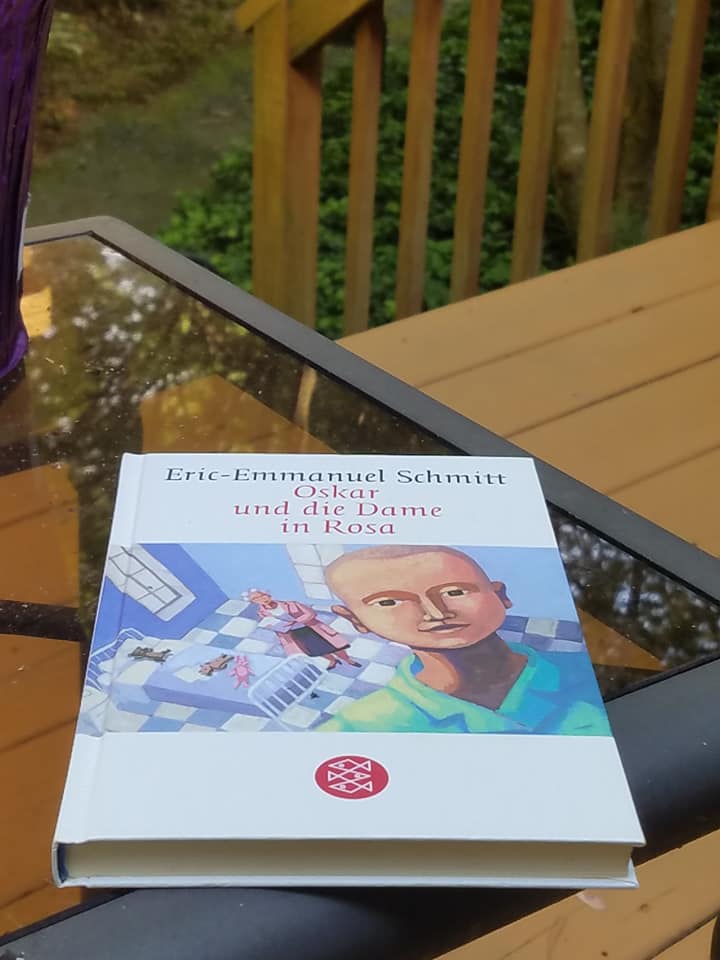
My sister-in-law Bettina loves to read. She frequently gifts me with books in German. My German is not very good I’m afraid, and I often give up pretty quickly on the books she gives me. She gifted me Eric-Emmanuel Schmitt’s lovely, bittersweet little book Oskar und die Dame in Rosa years ago, and this summer, determined to work on my rusty German, I finished reading it for real this time.

I’m so glad I did.

It is an epistolary novel made up of letters to God written by Oskar, a ten-year-old boy with a terminal illness. Die Dame in Rosa (The Lady in Pink) is a very old woman who is a volunteer nurse at the hospital, the oldest one, although I suspect that she may be an angel because she appears almost magically just when Oskar needs her most and brings comfort to the boy by suggesting that he write the letters, even though he, at first, does not believe in God.

His letters take us through the reality of life in the hospital but also through Oskar’s imagined life, one that he will never be able to live. It is a lovely book and not difficult for a rusty reader of German to practice on before moving on to a more difficult gift book from my thoughtful sister-in-law.

Reading on the front deck again–John’s gift tree, the Japanese maple, is in the background.–Photo by Katie Winkler

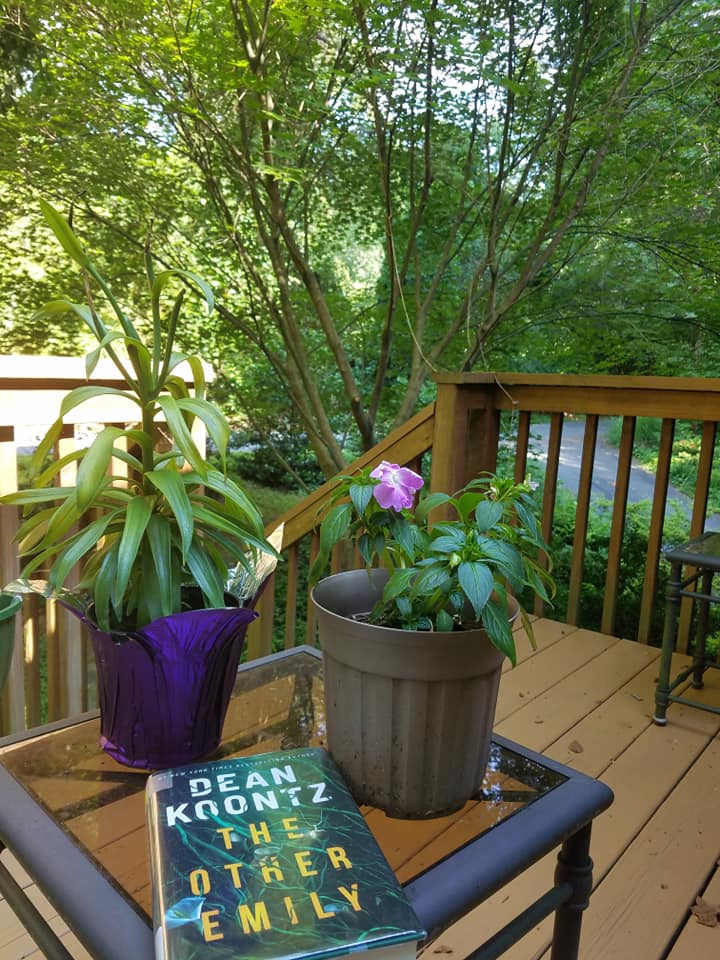
I took a break on the meatier books and read a fun popular thriller for my latest, another sci fi/thriller/horror book by Dean Koontz. I have enjoyed Koontz’ books since I read his first big blockbuster novel Watchers. I especially liked the genius golden retriever in that book. They made a movie of it, but don’t bother with that. The book is so much better. My good teacher friend once gave me a coaster that I still have on my desk at the school that says “Don’t judge a book by its movie.” Very true. Very true.

I have read many Koontz books since then, and although Watchers is still my favorite, I almost always enjoy a Koontz thriller, and I enjoyed The Other Emily as well, despite occasional gratuitous scenes of detailed meal descriptions–those irritate the heck out of me.

The author returns to his common theme of a basically decent person who is struggling with his past and is caught up in extraordinary, often supernatural, situations, battling his own demons as well as horrendous evil in a dark world.

Pure, horrific fun in many ways with terrific suspenseful passages and lively action, The Other Emily has its moments of deep insight and poignancy as most Koontz’ books do. At one point David quotes one of the most famous lines of Keats’ poem “Ode to a Grecian Urn”–Beauty is truth, truth beauty”–then goes on to say “Love without truth isn’t beautiful. It’s not even love” (336).

Then there’s more action and the usual twists and turns of a good Koontz suspense thriller. A fun summer read.

Now, what’s next?

~

It’s not too late to submit your work to my literary journal Teach. Write. I love to get the work of retired or currently working English composition teachers, but I accept work of all kinds from anybody. Submissions are open until September 1, so you have plenty of time. See the submission guidelines for complete information. I would love to hear from you.

~

Also, check out my podel (podcasted novel) CAMPUS: A Novel That Wants to Be a Musical. I have ten episodes so far and another is coming soon!

Keep on Readin’, Mrs. Winkler!

Two more books to review! Man, do I love summer.

Photo of Cover by Katie Winkler

Michele Harper is an emergency room physician, and her book The Beauty in Breaking: A Memoir reminds me of how much teachers have in common with doctors. I’ve blogged about the similarities before. Harper offers more confirmation of my perceptions, especially in “Chapter Two: Dr. Harper: The View from Here,” when Harper describes her internship in internal medicine before completing her residency as an emergency room physician.

In the chapter, she describes one of her professors, Dr. Jaiswal, a “forceful character” (33) whom all the interns feared and loathed. Harper describes how Dr. Jaiswal was particularly cutting and brutal to Harper during the author’s first presentation and in front of the patient, berating Harper for not completing a thorough patient history and for being ill-prepared for her presentation.

Some people, me included, would have been tempted to give up or simply been angry and rejected anything Dr. Jaiswal said out of bitterness and contempt, but Harper learns from the “breaking.”

“I never forgot that encounter,” she writes. “For the entire intern year, I made sure to ask too many questions of my patients….To the best of my ability, I not only read about the topics I didn’t understand, I also read around them. I reviewed the history in my head and practiced my assessment and plan, making sure the reasoning led to a logical conclusion….That was the last time I was unprepared for Dr. Jaiswal’s rounds. What’s important was that in that very long year, she helped me become a better doctor because I saw the good in her, in the value she placed on meticulous preparation and critical thinking” (40-41).

I am not advocating being “deragatory and cruel” (41) as Harper describes Dr. Jaiswahl, but I don’t mind being tough. I don’t really think I am all that tough actually, but in today’s ultra-sensitive world, I am perceived as such by some students, parents, and administrators. I wish I could help them all understand that all I want to do when I challenge and push students is motivate them to stretch themselves–ask too many questions, read about the subjects, read around them. I want them to learn how to think!

Harper offers many stories of encounters with people in her work and personal life who break her or come to her broken, in need of healing. She writes of what she learned from them and how she has come to embrace not the brokenness itself but the lessons that inevitably come from it.

In Chapter Three, Harper writes, “We had all been broken in that moment–broken open by shock and grief and anger and fear. I didn’t know how or when, but this opening could lead to healing. After all, only an empty vessel can be filled by grace; but to get there, we had to help each other rise while we shed the same tears. We had to get up and start again” (68-69).

Another chapter in the book I liked was “Chapter Four: Erik: Violent Behavior Alert.” Harper laments the bureaucratic bull that she has to put up with on her job that does little to nothing to help her patients. Man, can I relate. She speaks about a 2011 study that exposes the myth that most ER patients are uninsured. Not true according to the study. Most are insured and come to the ER for various reasons, including, she says, because they feel “so entitled from unchecked privilege that even polite questioning causes them to blow a fuse” (77). Again, man can I relate.

Harper touches on other issues that doctors and teachers, especially women, experience similarly, including the inequity in how female professionals are treated in the workplace and false perceptions of doctors, but the positive aspects of her work are similar to mine too–helping people, challenging them to take action, to move forward into a new and better life.

The Beauty in Breaking: A Memoir is well-worth the read for anyone, not just doctors and educators; we’ve all been broken, and we all can learn from that breaking–something I want my students to understand.

Harper, Michele. The Beauty in Breaking: A Memoir, Riverhead, 2020.

Photo of Cover by Katie Winkler

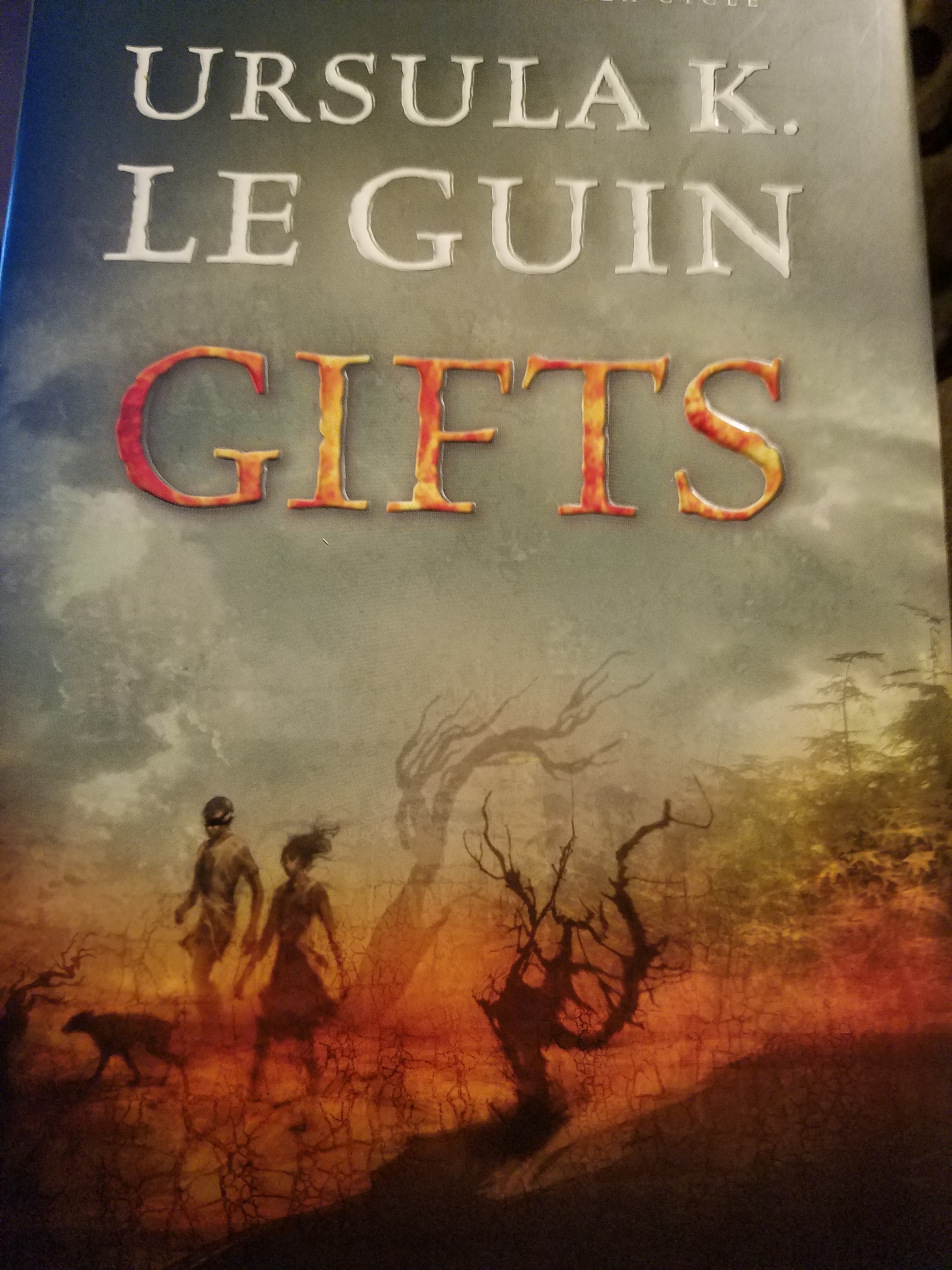
The next book I finished is the young adult fantasy novel Gifts by Ursula K. Le Guin. In this imaginary world, the people of the Lowlands are blessed, or perhaps cursed, with magical gifts–some seemingly benign, like summoning animals, and some dark and sinister, like the ability to twist limbs or melt flesh and bone.

Two young people, Orrec and Gry, friends all of their lives, must face the consequences when they refuse to use their gifts, refuse to take life only to help others retain power.

In the end, the true power lies in friendship, sacrifice, and love.

It also lies in storytelling.

One of my favorite passages in the novel is when the narrator discusses how storytelling empowers us:

“My blindfold and my mother’s illness worked together in one way that was good: we both had time to indulge our love of storytelling, and the stories carried us out of the dark and the cold and the dreary boredom of being useless” (194).

This is why I love to write. It carries me out of the dark and the cold. It gives me purpose.

Le Guin, Ursula K. Gifts, Harcourt, 2004.

Most writers I know aren’t happy keeping their writing to themselves. That is why I started Teach. Write.: A Writing Teachers’ Literary Journal. I wanted to offer a place where other writers out there, especially writing teachers like me, could share their work. Until September 1, I am accepting short fiction, poetry, essays, and more for the 2021 Fall/Winter edition of Teach. Write., and I would love to consider your work. I am especially interested in the work of those who teach writing, but I am open to all. See the submission guidelines for more information.

Photo by Pixabay on Pexels.com

ANOTHER EPISODE OF MY PODEL (PODCASTED NOVEL), CAMPUS: A NOVEL THAT WANTS TO BE A MUSICAL, IS COMING YOUR WAY THIS WEEK! NOW’S YOUR CHANCE TO LISTEN TO THE PREVIOUS EPISODES SO YOU WILL BE READY FOR EPISODE 10. IT’S GOING TO BE A DOOZY!

CAMPUS

Serendipitous Reading

Photo by Katie Winkler

I love it when my summer reading plans fall into place almost magically. In April, for my birthday, my nephew Timothy, a total bibliophile (I love it!) who blogs at The Mugwump Diaries, gave me the book Austerlitz by W. G. Sebald. For one reason or another, I was unable to read the book until later in May.

Another thing that was put off was my correspondence with potential contributors to Teach. Write. Turned out that one of the writers, whose work you will read in the next edition, mentioned W. G. Sebald in his cover letter. In the acceptance email, I told him that I was reading Austerlitz; thus began a brief correspondence about the work and the author that helped solidify some of my thoughts about the work. He suggested that I read another of Sebald’s books, The Emigrants, which I have added to my very long reading list for this year.

In his excellent review of Austerlitz on the website The New Canon: The Best in Fiction Since 1985, Ted Gioia, music critic and book reviewer, writes that Sebald “has written a historical novel that appears to exist outside of history, yet this represents less an escape and more an exile. That dislocation is both the tragedy of Austerlitz the character, and the wonder of Austerlitz the book.” This statement reflects my understanding of the book as well.

Austerlitz is a displaced person, growing up in the UK from the age of five, feeling different and not understanding why until his adoptive parents explain his origins. As he travels through life, drawn more and more to the seemingly immutable architecture of Europe, he also explores his history and the trauma of his childhood. Further highlighting his isolation, Austerlitz tells his story not to a friend or relative but to the narrator, whom he meets by chance at a zoo in Antwerp. Their intermittent friendship develops slowly over the years when the narrator is invited to the various places Austerlitz lives, especially London, where the German-born Sebald lived and worked for a large portion of his life.

Page 5 of Austerlitz–photo by Katie Winkler

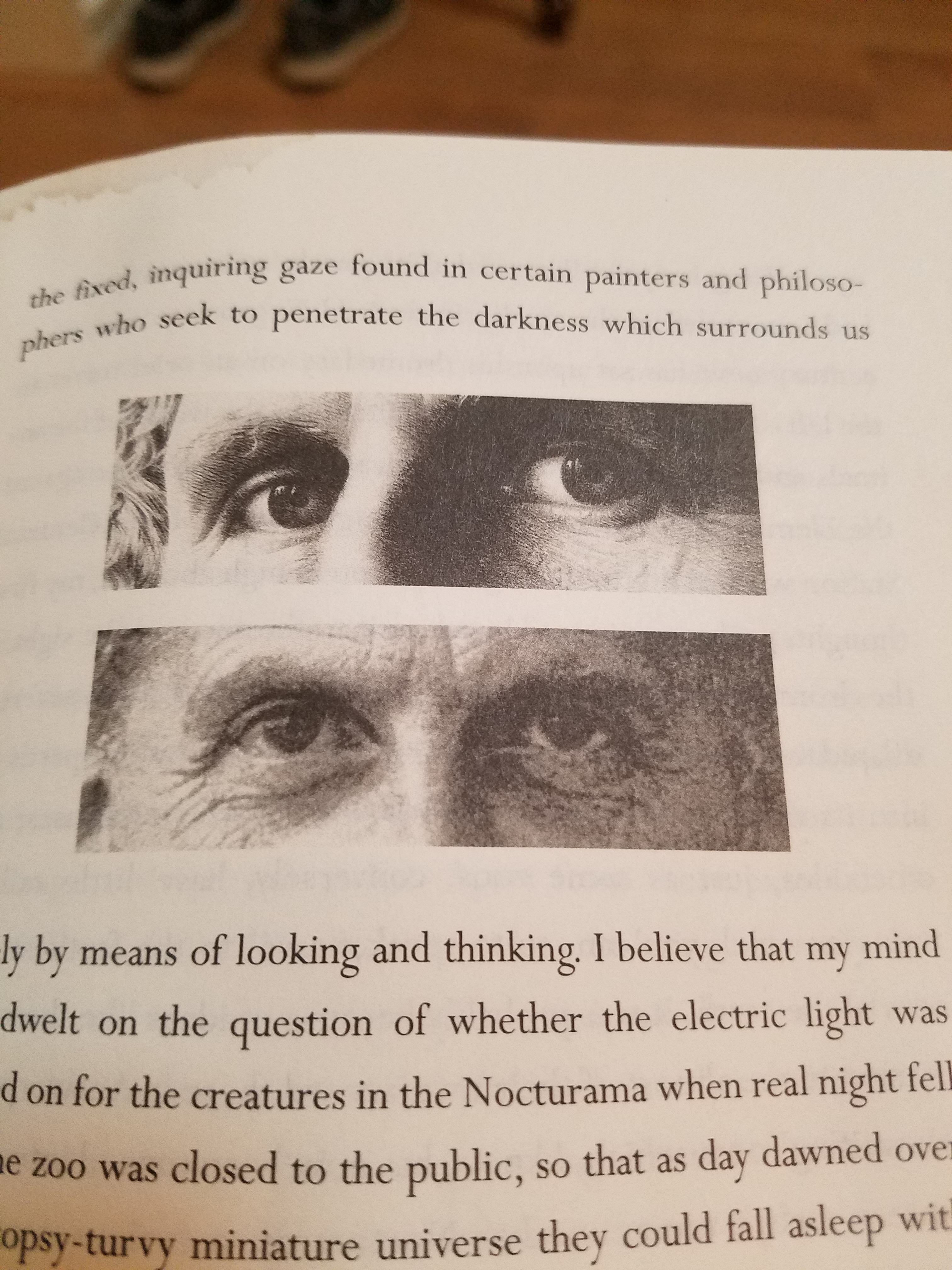
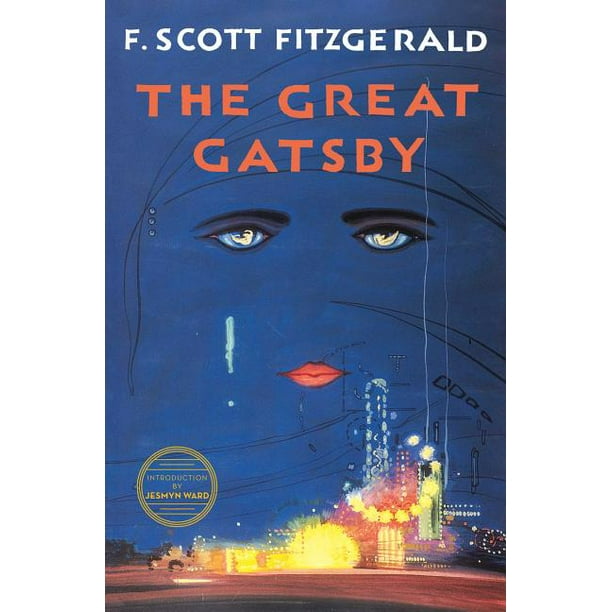
The unusual style of the book is part of its appeal. Like Nick Carraway, the narrator shapes our vision of Austerlitz. We only know what Austerlitz reveals to him and what we see in the various photographs like those below, displayed throughout the book. (You can see why I think of The Great Gatsby now, can’t you?) The long narrative passages with no chapters and very little paragraphing are often punctuated by the words “Austerlitz said,” reminding us that this is not the narrator’s story.

Also unusual are the long sentences and dialog without punctuation. The effect is not exactly stream-of-consciousness, but stream-of-conversation or narration, like when listening to an elderly relative recalling events from childhood, moving seamlessly from one memory to the next, digressing when the recollection leads to some topic of interest or area of expertise.

As a teacher and a writer, I find the digression from the story that speaks about the difficulties of writing particularly interesting. The narrator has come to visit Austerlitz at his home in Alderney St., London; photographs of architectural wonders from around the world are scattered all about, but before Austerlitz can begin taking up the story of his life once again, he explains how he, recently retired from teaching, now wishes to compile his thoughts and ideas about architecture but is having trouble focusing:

“All I could think was that such a sentence only appears to mean something, but in truth is at best a makeshift expedient, a kind of unhealthy growth issuing from our ignorance, something which we use, in the same way as many sea plants and animals use their tentacles, to grope blindly through the darkness enveloping us” (124).

I don’t know a writer who has not felt this way at some point and time. Austerlitz goes on:

“I could see no connections anymore, the sentences resolved themselves into a series of separate words, the words into random sets of letters, the letters into disjointed signs, and those signs into a blue-gray trail gleaming silver here and there, excreted and left behind it by some crawling creature” (124).

And so I hear the words of the reviewer Gioia again–Austerlitz’ tragedy is the wonder of the book, that the character’s growing displacement can bring all of us, not just writers, not just survivors of childhood trauma, but anyone who feels displaced, into a community, giving us a place to belong.

Citation

Sebald, W.G. Austerlitz, 10th Anniversary Edition, Modern Library, 2011.

I feel that I am developing my own community of writers through editing and producing Teach. Write.: A Writing Teachers’ Literary Journal. It is devoted to writing teachers who want to publish their writing, but you don’t have to be a teacher to contribute. I welcome writing from anyone.

Submissions for the Fall/Winter 2021 edition are open until September 1. Follow this link for submission guidelines. I would love to read your work.

My podel has gnomes and fairies, boojums and zombies, along with other outlandish characters, living ordinary, extraordinary lives.

And, no, I have not forgotten my podel (podcasted novel), but I am having some issues, not unlike those encountered by Austerlitz. I am tooling along ,though, and quite proud of the nine episodes I have produced so far and having fun, which is not the only point but a big one. If you would like to hear the podel so far, then follow this link: CAMPUS: A Novel That Wants to Be a Musical.

Mrs. Winkler Gets in Her Summer Groove

Episode 9 of CAMPUS: A Novel That Wants to Be a Musical is now available!

I had fun putting together this episode of my podel (podcasted novel)–CAMPUS: A Novel That Wants to Be a Musical. If you haven’t listened to all of the episodes, they are available all at the same place when you click on the link above. Many podcast platforms carry CAMPUS, so just search your favorite application.

If you like the show and are able, please consider becoming a supporter. I’m not looking to make any profit, but I would like to pay a composer and sound tech to help make the podcast better and maybe invest in some education (hey, there’s a novel idea), so I can improve my skills, just because. Wow! The support button is available on the podcast’s landing page at the link above.

In Episode 9, the plot thickens when we meet the villain of the piece. Oh, you thought it was Dr. DAG? What a lightweight! He’s nothing compared to Mr. M., who isn’t too pleased that the fairy godteachers have chosen Jack and Jill as their proteges and sprinkled them with fairy dust. He has his own plan for them, and it doesn’t include enlightenment or inspiration. 

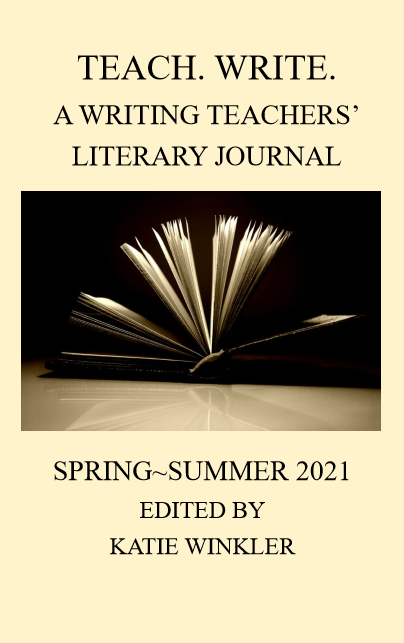
The Spring~Summer 2021 edition of Teach. Write. A Writing Teachers’ Literary Journal is available free online. If you would like a print copy, they are available as well.

Maybe you are a writing teacher on summer break and would like to work on a writing project of your own. Why not consider writing a short story, poem, essay, or ten-minute drama to submit to Teach. Write.? I am accepting work for the 2021 Fall~Winter edition until September 1.

Although I prefer to publish the work of writing teachers of any kind, at any level, I am open to all writers and most genres. If you are interested, see my submission guidelines.

I would love to read your work.

I am getting back into the reading groove as well. My nephew Timothy, whose blog, The Mugwump Diaries, I have mentioned in previous posts, gave me a book for my birthday that I am finally starting to read–Austerlitz by W. G. Sebald. I just started it so more about this interesting book that won the National Book Critics Circle Award in 2019 and has been listed as one of the top 100 novels of the 21st century.

I’m also reading a memoir, The Beauty in Breaking, by Michelle Harper for my Western Carolina University Alumni Book Club and Maranatha Road by my friend Heather Bell Adams. She has a second book out, so I need to get on the stick. I also sneak in a chapter now and then of one of my favorite British mystery writers books–Many Rivers to Cross by Peter Robinson.

I told everyone I would be mainly reading and writing this summer.

I didn’t lie.

Gift Books

I am blessed with special people in my life and one of those people is my nephew Timothy. He is in school studying media arts and has started a blog here on WordPress called the Mugwump Diaries. You can check it out here.

Timothy and I love reading and reviewing books, and for a while now, I have enjoyed reading his reviews on Goodreads, so I am excited that he has started a book review blog. Plus, he has inspired me to get back to my own book reviews.

This Christmas, I received several books that I am looking forward to reading and two Christmas themed books that I just haven’t gotten around to until this year. It just didn’t seem right to read them outside of the Christmas season.

I will write about those last two next post but today, I just want to talk about my gift books and what they mean to me.

Where to begin? Why not at the top? I can’t wait to read In Praise of Difficult Women by Karen Karbo, given to me by a dear friend and colleague who knows that I take it as an ultimate compliment that she finds me difficult. In the introduction, Karbo says, “I love these women because they encourage me to own my true nature. They teach me that it’s perfectly okay not to go along to get along. They show by example that we shouldn’t shy away from stating our opinions. Their lives were and are imperfect. They suffered. They made mistakes. But they rarely betrayed their essential natures to keep the peace” (p.17).

Yeah, that’s what I need to read!

That same friend gave me the book immediately below that, Untamed by Glennon Doyle. I haven’t finished it yet as I was distracted by the Christmas books I was determined to read (before it was too late, ha!), but it is another one that gives voice to my feelings, these feelings I have of not being what people expect me to be, that I’m not an easy keeper, as we say in the South. Doyle speaks to women who don’t want to be defined by their roles in society, who don’t want to be defined at all. Difficult women. Troublemakers.

Women like me.

I’m getting back to reading Untamed today!

The book to the right, Hamnet by Maggie O’Farrell is a gift from my husband and is proof of what a treasure he is. Out of all the books he could have chosen, he picked a historical novel giving life to Shakespeare’s son Hamnet, who died at eleven, during the Plague. A few years after the death of his son, Shakespeare wrote one of the greatest works of literature the world has ever known. Hamlet. Just like my friend, my husband knows me, knows that I would relish reading a beautiful book that will make me cry. He gets me, even though I’m difficult. And he loves me anyway.

To the left is another special book, Podcasting for Dummies, given to me by my dear daughter, who also advised my husband on what equipment to buy me to help me with my big podcasting challenge of 2021–my podel or povel or novcast or whatever you want to call it–this thing that I’m doing. Her gift book is special to me because it shows that she has faith in me and supports what her mother is doing, no matter how weird it is. And believe me, you will see, it is weird. But she gave me the book because she doesn’t care that her mother does do some strange things and doesn’t do or say all of the things mothers are supposed to do or say, except the most important thing, that is. She does say, “I love you.”

And my daughter loves me, too.

A gift book told me so.

All ready for the debut of my podel (podcast novel) CAMPUS, January 10

Thoughts on Just Mercy by Bryan Stevenson

My work has kept me so busy that it took me a while to finish the latest choice for the Western Carolina University Alumni Book Club that I joined this summer.

The book is Just Mercy, written by the founder and executive director of the Equal Justice Initiative in Montgomery, Alabama that has been instrumental in helping to overturn many wrongful convictions and reduce the harsh sentences of poor and disabled people in Alabama and around the country.

The end of book discussion included the following provocative prompt: “A critical theme throughout Stevenson’s book is that the fight for fair and equal treatment of all people under the law is a long and ongoing struggle. Setbacks are common and must be overcome, and even in the aftermath of great victories, there is still more progress to be made. For example, the Supreme Court originally upheld the use of the death penalty on convicted minors, but this was later successfully overturned in 2005; still, the fight for fair and humane treatment of minors in the criminal justice system continues. How does this understanding and approach lead to more effective organization and activism on behalf of marginalized people?”

Here is my response: Stevenson touches on the most powerful approach to effective activism for the sake of poor and disabled people in Chapter Fifteen, titled “Broken.” Stevenson recognizes his extreme brokenness after trying to comfort one of his clients on the night of his execution. On the verge of giving up in the face of overwhelming injustices, the author admits to himself that he is as broken as those he is trying to save, but remembering his own past failures, he finds the strength to go on.

He says, “You can’t effectively fight abusive power, poverty, inequality, illness, oppression, or injustice and not be broken by it. We are all broken by something. We have all hurt someone and have been hurt. We all share the condition of brokenness even if our brokenness is not equivalent.”

There is such humility in recognizing that you are weak and will fail. We are too seldom willing to be humbled by what we cannot do and too often inflated by superficial accomplishments, even when “doing good.” We must ask ourselves if our altruism is born of deep empathy or shallow pity. I must ask myself if I am willing to continue fighting for liberty and justice, even in the face of defeat after defeat, even if I am never recognized for my efforts, or in some cases ridiculed for them. I hope I am, but I don’t know. Time will tell. I do know, however, that this book has inspired me to try.

Mrs. Winkler’s Last Summer Book, but She Keeps Reading

The last book I finished before the craziness of teaching all online, synchronous and asynchronous, was a book my brother gave to me a while back, and I finally pushed through the stack to get to it.

I’m glad I did.

No one Is Coming to Save Us by Stephanie Powell Watts is marketed to be a retelling of The Great Gatsby, and there are certainly echoes of Fitzgerald’s iconic novel here. The twists, however, make the novel rise above a simple re-telling. Jade Chang in her New York Times review describes the novel as a “skillful riff on ‘The Great Gatsby,’ which revolves around a contemporary black family in a declining North Carolina town,” an apt description of the novel.

Jay Gatsby is recast as JJ Ferguson, a young man who has left Pinewood, a small town in the Piedmont, to seek the American Dream. He returns a wealthy man, and begins to court Ava, our Daisy, who is now married to a weak man who is unfaithful to her.

Sound familiar?

Yes, some of the same themes are there, but the novel reveals the importance of setting in a novel. This is not a New York story. It is not one Nick Carraway could have told. It is not a story that any one person can tell, so we discover the hidden truths from multiple points of view, all circling around the most unlikely of Nick-type characters, Ava’s mother Sylvia, who is rooted in the soil of her Southern home.

Perhaps because I am about the same age as Sylvia, her perspective resonates the most with me. Her transformation is quiet and not earth-shattering– acceptance of herself, her past, and her place in life. Forgiveness. During the extraordinary days that have been the Summer of 2020, I have found myself learning these things, too.

And feeling good about it.

Here is a passage that captures Sylvia’s self-deprecating mood at the beginning of the novel, one of the passages that drew me into this amazing woman’s story:

“None of that hoping and believing girl was left in Sylvia now or at least she couldn’t be found. The woman she was now didn’t yearn for sophistication, and as far as she could tell she’d stopped yearning for much at all. The woman she’d become was fat and weighed down, but not just fat, dumb too, and always in the process of adjusting, like there was two of everything, the real thing and the shimmering copy that her brain had to work with focus and concentration to integrate. Her brain in slow-mo or she felt slow–same difference. The result was the girl she’d been had evaporated from her body like an emancipated soul.”

What I like is that Sylvia makes an honest appraisal of herself here. She is not eliciting pity–simply telling the truth.

I find that refreshing.

That is why I liked No One Is Coming to Save Us. Although it first seemed to focus on the deprivation of a black community in the South, I quickly saw it isn’t only about the African-American South or even about poverty in the contemporary South. It is about the American Dream and how these people, in this special place and time, define it, how they lose it or make it come true.

My next book review will be about the next Western Carolina University Book Club read, Bryan Stevenson’s Just Mercy. I have seen the movie version of the book, too, so maybe it will be a book/movie comparison. Spoiler alert: the book is better than the movie, but the movie is very good.

Also, I will soon be unveiling the 2020 fall/winter edition of Teach. Write.: A Writing Teachers’ Literary Journal, slated to appear October 1.

So come back!!

Conviction and Renewal

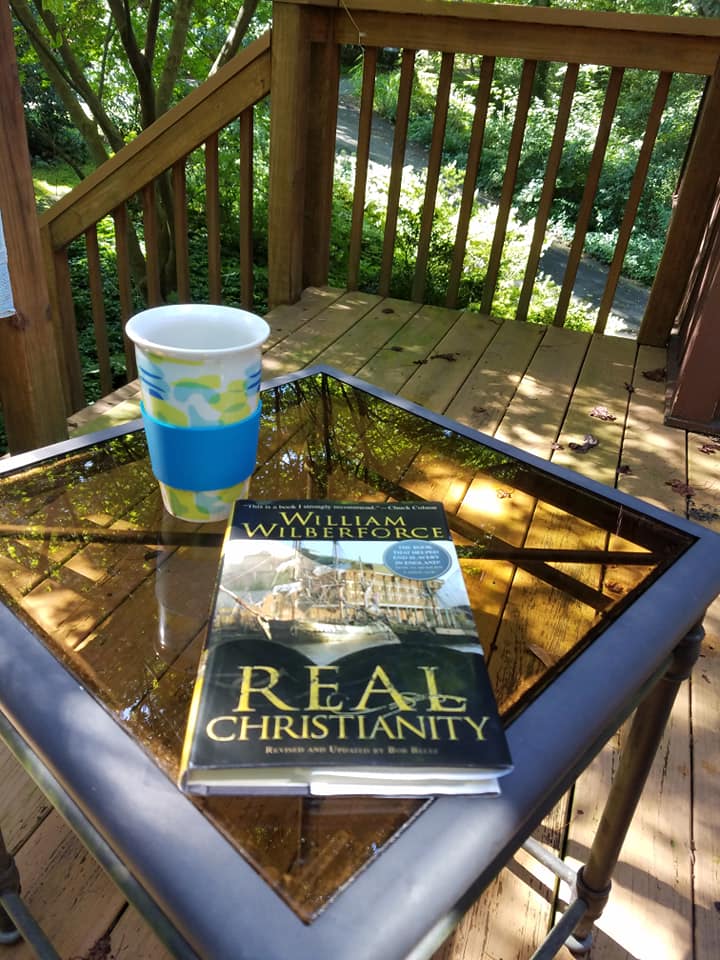
My favorite summer place

This summer continues to be a time of renewal for my spirit, but it hasn’t been easy. My reading adventures, working on this crazy satirical novel , and being alone so much have led me to confront many uncomfortable realities about myself–I have lacked resilience and settled for mediocrity much of my life. I’m often petty, self-absorbed and self-righteous, easily angered, hypocritical, thoughtless, vain, jealous, etc., etc.

Oh, don’t worry, I continue to love myself. That’s kind of the problem. I think of myself more highly than I ought, methinks.

Many of the books I’ve chosen to read this summer have helped me to see some of my many weaknesses, and also, thankfully, validated some of my strengths. As always, the two are inextricably bound to one another. But the book I just finished has not only convicted but also bolstered my spirit and renewed my resolve.

The book is Real Christianity, a paraphrase (by Bob Beltz) of William Wilberforce’s A Practical view of the prevailing religious system of Professed Christians, in the higher and middle classes in this country, contrasted with real Christianity written in 1797. The title alone explains why I read the paraphrase, but someday I will read the original.

William Wilberforce was an abolitionist and member of parliament who helped to end slavery in England. His book, however, never explicitly mentions the battle to abolish slavery, and it addresses, as the original title suggests, the middle and upper classes of the British Empire.

But it didn’t take long at all for me to see myself and my country in the pages of this modern paraphrase, written in 2006 by the man who was one of the producers of the very good biopic Amazing Grace, that tells the story of Wilberforce’s twenty-year fight. More about the movie later.

Many dog-eared pages

For example, here is a quote from early in the book:

“We must remember that almost any ideology can be distorted and misused to bring misery to multitudes or justification to the most bizarre behavior. Nothing is more dangerous. That which is intended to motivate goodness and restrain evil actually can become the instrument of that which it intended to restrain. History is full of examples of how virtues such as liberty or patriotism become twisted when separated from a healthy and authentic faith. Twisted men in every generation and occupation have twisted whatever they must twist to get what they want. Why should we expect that some within the Church would not be guilty of the same actions?” (46).

Wow! See what I mean? And it was written in the 18th Century! Wilberforce himself struggled with the same issues he writes about. He is remembered for being a force for good, for valid reasons, but, of course, he struggled and failed miserably at times, especially in allowing slave labor, thinly veiled by the concept of “apprentices,” to continue in the abolitionist colony of Sierra Leone. See this interesting article on the subject in The Guardian.

See what I mean? Conviction and renewal. Convicted by Wilberforce’s words and renewed by the knowledge that his failure was, and mine is, inevitable. Renewed? How does being reminded of failure possibly revive my soul? Another paradox of my faith, I suppose. I see that the answer is not abandoning my faith or ceasing to struggle to do good, but knowing that I can ask for and WILL receive forgiveness, I can continue striving to do some good in the world.

Not a bad lesson to pass on to my students, is it?

Here’s another one:

“Money and ambition have become idols in our time, especially for individuals in the business and professional worlds. Disguised as common business practice, these forces are allowed to gather great momentum in our lives. Arguments about being diligent at what we do, becoming successful in our profession or providing for our families seduce us so that we no longer have a clear sense of judgment about these issues. Our work consumes us” (73).

It is important to keep in mind that he is addressing Christians here, not people who do not claim to be believers. Knowing that, these words strike me to the core. I have let my work consume me. I have become as data-driven as the rest of the world. What is my retention rate? How many students passed that essay with a C or better? Let me check how many hours I spent working on the LMS. Look at those FTE’s, will you?

I am convicted, but I am renewed because, since March, I have been working from home, so thankful that I have been forced to concentrate my efforts on the people who need me–my family, my friends, and, my students.

It’s about time.

****

If you want to know more about Wilberforce and the battle to end slavery in the British Empire, I highly recommend the film Amazing Grace. Strong performances, especially Benedict Cumberbatch as England’s youngest ever prime minister, William Pitt the Younger, who was a great friend of Wilberforce’s.

Work Cited

Wilberforce, William. Real Christianity. Revised and edited by Bob Beltz, Regal, 2006.