Thinking about Pittsburgh

549cac67c4e3a80f69f5d5a065621db1

davidpwhalen — morguefile.com

In light of recent events, I have been thinking a lot about Pittsburgh. This weekend at the North Carolina Writers’ Network’s fall conference in Charlotte, I was inspired to write the following after a great panel on the importance of place in writing:


City Chicken

When I moved to Beaver, PA, in 1983, I was 23, just graduated from Oral Roberts University, Lord help me, and had come to work at a small Christian school outside of Pittsburgh. I grew up an army brat, who moved from place to place north, south, east, west, yet always carried the South with me as I traveled with my loud, boisterous, loving Alabama family.

Part of my heritage is a powerful streak of non-conformity, independent even from the strong political, religious, and social mores of southern society. So when I was still jobless a couple of weeks before graduation and was invited to apply for a job teaching English and German at Rhema Christian School in Aliquippa, PA, a major steel town outside of Pittsburgh, I didn’t hesitate. It was a grand adventure, moving to a brand new place to explore and new people to meet.

The first thing that struck me when I arrived that June day and was picked up at the Pittsburgh airport was how dang humid and hot it was. Despite that similarity with my home state, on the way to the school from the airport, I knew I wasn’t in AL anymore. The rolling hills were larger than those of the Alabama plains. Instead of one story brick or wooden houses, spacious lawns and pecatrees, we passed two story homes huddled close together in the valley and scattered over the hills, big red barns decorated with brightly colored quilt patterns I know now are PA Dutch Hex signs, long rambling steel mills belching smoke, and the bridges! Silver train bridges beside the huge arches of yellow ones crowded with cars and trucks, moving in and out of small bedroom

Pittsburgh’s bridges

Bandini at morguefile.com

communities and Mill villages.


On the way to the school after leaving the interstate, we passed a Perkins Restaurant, a chain, I was told, much like, but not at all like, Shoney’s in the South. On the marquee I read that the week’s special was City Chicken—city chicken? I thought it was weird but let it go as my nerves took over in anticipation of my first teaching job interview. 

I got the job and moved two months later. Almost my whole family helped me move. We had fun exploring Pittsburgh—the drive through the Fort Pitt tunnel.

Point state park in pittsburgh

Bandini —morguefile.com

opening up to its impressive view of the city during the beginning of its renaissance, lunch at an Italian place, claiming the best pizza in The Burgh, beautiful Point State Park, right where two rivers came together to form the mighty Ohio. Then, hugs, kisses, tears, and they were gone, back to Al together. I was left alone with a map and my dad’s advice on the best route back to my new home.  

After crossing four or five bridges and traveling down numerous wrong roads, I finally found the right one and headed to Beaver. It was getting late, I was already homesick, frustrated that I had lost my way, and therefore powerfully hungry, when I saw a marquee in front of yet another Perkins restaurant, or maybe it was Eat ‘n Park, anyway, the special, according to the sign, was city chicken.

close up photography of orange rooster on brown wooden bench

Photo by Yves Chaput on Pexels.com

I took the bait, parked, was led to a booth, and without thinking or asking or reading the menu, ordered the special from my young, perky, big-haired server.

She wrinkled her nose. “Did you say City Chicken?” Not the first time that day someone had trouble with my accent

“Yes, Ma’am.” I said, smiling.

She gave me a curious look but said nothing. A few minutes later she placed before me a huge plate of meat on a big pile of fluffy white rice with a side order of broccoli. I took a whiff and was suddenly transported back to my grandmother’s kitchen as she prepared fried chicken and rice for a Wednesday night church supper before prayer meeting.

My mouth watering, I took a bite. Oh, my, it wasn’t  chicken at all. City chicken, turns out, is big fat juicy, deep fried pieces of pork tenderloin on a frickin’ stick. It was not like anything I had ever tasted before. But, man, I thought, feeling I had not, after all, made the biggest mistake in my life, it sure was tasty.


Five Easy Ways

rear view of man working in office

Photo by Pixabay on Pexels.com

The first semester as a graduate assistant working on my Masters in English Education at Western Carolina University in Cullowhee, North Carolina, I was required to take a course in teaching methods. Because I already had five years of teaching experience, two years in a private school in Pennsylvania and three years in Rome, Georgia, teaching English and German, I was arrogant enough to think I didn’t need to take the course and was somewhat annoyed that I had to do so.

However, during the course of the semester, I found out how much my professor, Dr. Gayle Miller, had to teach me. One of the best activities Dr. Miller had us complete was teaching to the class. Each one of us had to pick something we were interested in and instruct the class. My friend, who later became a colleague at the school where I teach now, taught a lesson on writing apprehension, offering suggestions I still use today. Another interesting topic was finding a word in an English/Chinese dictionary–surprisingly difficult.

Even the few times Dr. Miller was not there, she always had an interesting person to come in and lecture. It was a long time ago, and I can’t remember her name, but one speaker who came to Dr. Miller’s class made a lasting impact on my teaching by introducing the class to five easy ways that can help students improve their writing.

Although I have modified the list somewhat over the years, I still introduce my freshman composition students to The Five Easy Ways, which I have found especially useful when teaching community college students who may not have been strong writers in high school. The beauty of the The Five Easy Ways is students can improve their writing without knowing much grammar.

Don’t get me wrong! I love grammar, but I have a great deal to accomplish in a short time in freshman English, so I have found that The Five Easy Ways jumpstarts revision among students who may have never truly revised a paper. They just don’t know how!

So here are The Five Easy Ways in their latest iteration:

  1. Avoid the use of first and second person pronouns.
  2. Avoid beginning sentences with There and It.
  3. Eliminate overused expressions and vague modifiers, such as like a lot, lots, very, really, good, bad, awesome, etc.
  4. Avoid over-coordination.
  5. Read backwards and aloud.

Okay, maybe I should not have said they were easy. These five ways may make finding sentences that need revision easier, but fixing them is not always easy.

Okay, okay, there is a little grammar here, too. I usually must explain what first and second person pronouns are and also over-coordination, but most students know the grammar; they just don’t know that they know it. After a few minutes of review, the majority of students begin to remember.

Today, let’s look more closely at the first Easy Way. Students are so used to writing about themselves they find it difficult to think from any other perspective, something we want college English students to do; therefore, I don’t allow first person at all in finished drafts. Also, students learn that stating one’s opinion does not require the phrases I think, I believe, or I feel to precede them. Furthermore, eliminating second person forces students to think more about broadening their audience and often leads them to develop a more mature voice. They can also learn to avoid pronoun errors caused by using the second person incorrectly.

Example: After reading my paper, you can see that it is for the best if you start recycling. 

Oh, me. So many things to talk about–where to begin?  Start with eliminating the first and second person pronouns.

Revised: After reading the paper, most people can see that it is for the best if everyone starts recycling.

Still some things to work on, but for a freshman who doesn’t even know where to begin revising, the sentence is already improved by making just a few simple changes.

Okay, okay, okay. Perhaps you, gentle reader, are thinking how I am forsaking The Five Easy Ways even while explaining them, but I am much more conscious of overusing the first person or inappropriately using the second person. Now, I am consciously looking for this overuse when revising. Looking at the draft of this blog, for example, I noticed the overuse of first person pronouns and have worked to eliminate some pronouns while reconsidering others.

I have incorporated The Five Easy Ways into freshman English classes, which now begin with an assignment that is a personal narrative written in third person.  After completing this assignment, students seem to grasp how avoiding first and second person can strengthen their overall sentence structure.

Here is the assignment and an example:

One of the easiest ways to make writing sound more academic is to eliminate first and second person pronouns (I, me, my, mine, we, us, our, ours, your, your). Although finding the instances of first and second person is a snap, rewriting sentences to get rid of these pronouns can be time-consuming at first. The good thing is once writers begin using third person only, they soon become used to it and will write in third-person more often, making revision easier and easier.

Therefore, in this exercise students will write a one paragraph (five to ten sentences long) narrative. The trick is to write the paragraph totally in third person .  Here are some suggestions for the paragraph, but students are not limited to these topics:

a car accident

                      an event during a family vacation

learning to drive or learning to do something else

winning or losing a game

failing or succeeding at school or work

the first day of elementary school, high school or college

any other topic as long as it is a personal narrative

IMPORTANT NOTE: The paragraph should begin with a topic sentence and be no shorter than five sentences and no longer than ten well-developed sentences. Telling a story in such a short time is difficult so narrow the paragraph down to the climax of the narrative. 

Take a look at the following example to get an idea of what I’m looking for:

Example:

Katie and a Horse Named Butterball

Katie only rode him once, but she will never forget riding Butterball through the Grand Tetons. She was nine and a half, on a trip back from California to Alabama with her parents and siblings when the family stopped at a dude ranch in Wyoming for two nights. The owners found out that Katie and her sister loved horses, so they decided to take the family on a trail ride. Everyone was given a horse that seemed to suit each one, except Katie, small and scared, who was put up on Butterball–the biggest, fattest golden palomino gelding anyone ever saw! Katie’s little legs stuck straight out across the horse’s wide back, and at first, she was terrified. However, when she realized that the horse was a gentle giant, she relaxed enough to look down on her older sister and brother, even her parents. That’s when she began to feel much better. As she walked the trails through the glorious mountains in late summer, she saw sights she had never seen before or since–the Grand Tetons early in the morning, a moose cow and her calf drinking by a lake, wild horses led by a buckskin stallion–all while riding high on a horse named Butterball.

This first assignment does not cure students of overusing or inappropriately using first or second person, but it certainly gives them something to consider when they begin the revision process as college students, and for some, knowing where to begin is the start of a whole new way to look at writing.

Next blog post, I will tackle Easy Way #2.

Trapped in a Cell

man in black and white polo shirt beside writing board

Photo by Pixabay on Pexels.com

A little while ago, I had a worse than usual incident with in-class cell phone usage. It was towards the end of class near the end of a semester when I was so distracted by a student’s texting that I asked him to put the phone away. He put it face down on the table in front of him. Less than a minute later, he was on the phone again. I asked him to put it away again. He put it face down on the table. I asked him to put it out of sight. He put it in his lap. I asked him to totally put it away, and he completely lost it, saying things I knew he would soon regret. (To his credit, he emailed me that evening to apologize.) I asked the student to leave for the day. He left, but reluctantly, and only after saying a few more regrettable things.

I have my own regrets: that I didn’t have a more clear-cut policy in the beginning of the semester, that I have been too loosey-goosey with inappropriate use of technology in my class. So, I have been drafting my new cell phone policy. It’s pretty hard core, at least compared to my previous policy. I know. I know. Some of you will think what a total marshmallow I must be, but like I told one of my teacher friends long ago, “You know what happens when a marshmallow sits on the shelf too long? It gets hard as a rock!”

So here’s the new policy:

Cell Phone Usage: Cell phone usage has become a major problem in my classes, distracting to the students who are texting or surfing, to those around them, and to me, making it harder for me to teach effectively. If I must consistently stop the class to discipline students on cell phones, I waste instructional time and risk embarrassing or angering the cell phone user as well as the rest of the students.

Therefore, I am instituting a stricter policy this year. Once class begins, phones are to be silenced and kept totally out of sight. Any student having a visible cell phone, holding, or using one during class may likely be asked to leave for the day, even if it is the first offense. If I am consistently having to ask any student to leave the class for violation of the cell phone policy, then I may submit a Behavioral Assessment Form to Student Services as described in the student handbook, which could result in further discipline, perhaps even suspension from the class.

What do you think?

Anyone want to share a policy that he or she has found effective?

I would love to hear from you. I have tried so many different things and nothing seems to work.

35CCB4F0-960F-43DD-9348-E2C6A8D04B40


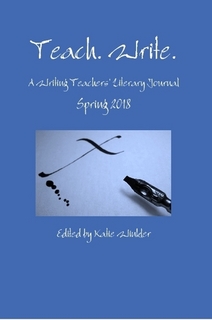
It’s not too late to submit to the Fall/Winter 2018 edition of my online literary journal for writing teachers–Teach. Write. Submissions are open until August 1. Look here for submission guidelines.


No Time to Write

cover

Busy grading and working on the new edition of Teach. Write. slated for publication on April 1, but been thinking a great deal about optimal number of students in online writing intensive classes. Below is a link to an article by Wayne D’Orio, an award-winning education journalist, writing for Inside Higher Education.

“Online class sizes: one size does not fit all.”

Online class sizes

My favorite comment: “All sources for this story agreed that writing intensive courses demand fewer students.”

BTW—online literature courses are writing intensive if taught correctly.

Just sayin’.


The Art of Writing

conventioncenter-day_creditscottdresselmartin_580

Before I was a full-time instructor, over twenty years ago, I presented at my first national conference–the National Conference of Teachers of English. It was in Denver that year, and I paid for the conference myself because I craved professional development, even though I was a lowly adjunct, only teaching three or four large college classes each semester.

In a round table session, I  presented  an exercise that I had created for my developmental English courses called “The Art of Writing.” The students took a reproduction of a famous piece of art (I had many pictures for them to choose from) and told them to brainstorm about what they saw, using a handout I gave them.

One side of the paper was marked “Concrete,” where they wrote what they saw in the picture or what they could imagine that they could experience with their other senses. On the other side of the paper, I wrote “Abstract,” where students wrote words and phrases that represented how the painting made them feel or what memories, or thoughts in general, the painting helped bring to the surface.

After they brainstormed, the would develop some sort of prose writing based on the art and their brainstorming, combining the concrete with the abstract. I used as an example a short piece I wrote that was based on the iconic painting American Gothic by Grant Wood. Here is the painting and the creative piece I wrote based on it:

Grant_Wood_-_American_Gothic_-_Google_Art_Project

American Gothic

I remember marrying him.  We stood together in the country church, farmer’s son and farmer’s daughter, too poor for ought else–too much a part of the land anyway.  My family sitting on those hand-hewn, hard-backed pews, witnessing.

That night I didn’t utter a word or a cry.  Closing my eyes, I imagined I was lying in the distant fields of my home, daises tickling my face and hands and feet.

I worked hard, learning not to expect any praise for the clean floors or hearty food. My greatest joy, to get all of the chores finished in time to head for the fields, to hold the soil of our land in my hand, to feel its moisture and smell its mustiness.

He did praise me once.  After three daughters, who were mine to raise, to teach, to find husbands for, I bore him a son.  I sweat and strained and screamed no less, but somehow it was different, and he thanked me.  Then, my son was gone, no longer mine.  So soon he learned not to cry.  So soon he became a man.

Now, in that same country church, as my youngest daughter gives herself to a farmer too poor to leave and too much a part of the land anyway, I sit in a hand-hewn, hard-backed pew, witnessing.

**

I quite like this little character study, which went on to be published by the way, but more importantly, the piece inspired my developmental students for over a decade. Some of my students’ writing was published in our yearly literary magazine–one even winning a cash prize as  the top fiction piece in that year’s journal.

Another student picked a famous photograph of an American flag on a front porch and wrote an amazing creative non-fiction piece about the meaning of liberty. That student was attending our school under the GI Bill, having served during Operation Desert Storm. I’m telling you, he had a heck of a lot to say about liberty that the younger people in the class needed to hear.

Were they inspired to write or did the assignment just help them feel free to use their creativity? Did the painting give them something to write about, a story already there that they just fleshed out? It was more than likely a combination of things, but whatever it was, many of my students, developmental students, did their best writing when writing about art.

In recent years, the state where I teach has discouraged creative writing or the study of literature  in writing classes, especially in developmental classes. The trend is towards more “practical” writing, utilitarian, without flair or heart or life. Surprise! I am bucking that trend. I don’t use my art assignment any more, but my students engage with and write about music, film, theater, literature and art, and their writing is better for it. They are better for it.

In 1938 Winston Churchill, said, “The arts are essential to any complete national life. The State owes it to itself to sus­tain and encour­age them….Ill fares the race which fails to salute the arts with the rev­er­ence and delight which are their due.”

Maybe the State, as well as college administrators and curriculum developers, should listen to him.

cover

If you are, or were, an English composition teacher, do you have a writing prompt that you have used in class and would like to share like I did at the conference? If so, I would love if you would submit it to my literary magazine Teach. Write. 

In the magazine, I have a feature called “Write Your Own” where you do like I did and write your own creative piece using a prompt that you have once given your students. Accompany your piece with a brief explanation of the prompt or the purpose for the assignment.

I am also accepting general submissions of poetry, flash, short stories, and essays through March 1 for the spring edition. Click for complete submission guidelines. I look forward to reading your work!

Happy New Year!!!

And Merry New Semester!


Thanksgiving at the Pagoda

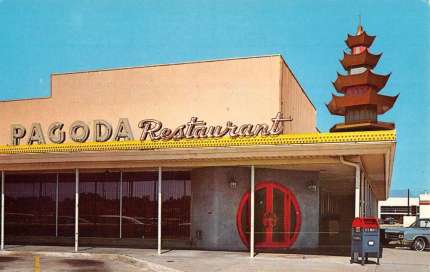
L4b77bf7ebf16aa15a52a4ad03b49010fike many college students that I teach today, when I was in college, not only was I a full-time student, but I also had two jobs. I worked as a secretary in the German department (I majored in English and German), but I also worked as a hostess and cashier at my friend’s parents’ Chinese restaurant–The Pagoda, where I received an education of a totally different sort, but equally as important, to me anyway.
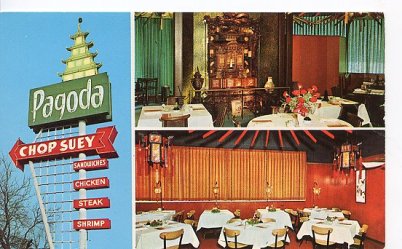
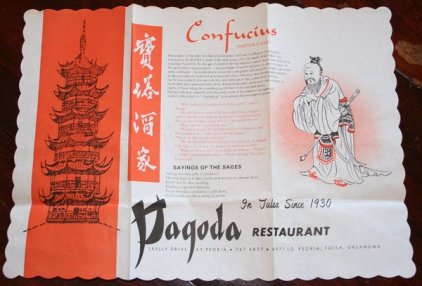
The Pagoda was a truly American Chinese restaurant, built and owned for years by a Chinese-American family, then, after it was already an established and popular eatery, bought by my friend’s father, a Puerto Rican-American,.  The chefs were from Hong Kong primarily; the fry cooks, bussers, and dishwashers were mostly Puerto Rican. Some of them spoke English, but many of them did not. Then there was the wait staff, which included a myriad of varying ethnicities, including Japanese, Laotian, Vietnamese, Cambodians, Oklahomans,  and me–a little bitty, painfully shy girl from Alabama.

pagoda

It was quite a place! Who would have thought, at a Chinese restaurant in the heart of Tulsa, Oklahoma, that I would have tasted such a rich variety of cultures and traditions but always with a distinctly American flavor? This true melting pot extended to the menu, where patrons could feast on traditional dishes like Moo Goo Gai Pan or Chicken Chop Suey, more Americanized fare like Garlic Chicken (garlic-flavored fried chicken) or Steak Kew (thick chunks of sirloin stir-fried with Chinese vegetables in a savory sauce), or all-out All-American eats, including hamburgers, French fries, and Chicken-Fried Steak with White Gravy. (One customer regularly came all the way from Fort Smith for that dish.)

When I first started working at Pagoda, I was so shy, so naive. My parents had moved us to Tulsa when I was still in high school–I graduated from Jenks High School in Jenks, Oklahoma–but I stayed in college at Oral Roberts University, living at home for my first three years in college. Then, about the time I started working at Pagoda, my parents moved back to Alabama, and I moved into the dormitory.

Before that time, I had relied mainly on my family members, my best friend, and her boyfriend for companionship, but now my family was gone, my best friend had moved to a college out of town, and her boyfriend worked a great deal, and I did too, especially at Pagoda.  But my bosses and fellow workers reached out to me, engaged me, joked with me, even protected me, as if they knew I was lost and lonely in a world where I didn’t always fit in.

pagoda-placemat-60-thumbOh, so many memories of that time–

  • The time the Japanese servers refused to work unless they could put a TV up in the waitresses’ alcove so they wouldn’t miss a single episode of Shogun
  • The old Chinese chef, who spoke little English but gave us all pet names off the menu–one friend was Fried Won Ton, another was BBQ Rib, and I was, to my consternation, Sweet and Sour Pork.
  • The huge strong chef, who looked like an Asian Mr. Clean, with his bald head and bulging biceps. One day he was tossing fried rice in a gigantic wok over a searing flame and called me over as I walked by. I motioned I was in a hurry, but he insisted, so I went over. He communicated to me that he wanted me to toss the rice. I looked at him, my eyes narrowing, suspecting a setup, but his was a face of stone. So I took hold of the massive spatulas, more like tiny shovels shoved into the mounds of rice, steeled myself and tried to lift them. They didn’t budge–I heard a tiny sputter from the big man. Tried again, nothing–he sputtered a bit louder–then at the third attempt, he could contain it no longer and burst out with a big-bellied laugh at my expense. Then, after he wiped his eyes, he started tossing the rice with an ease and abandon, laughing all the time. I laughed too–unashamedly.
  • There was the tiny Japanese waitress who had been married like four or five times, who came up to me almost every single time I came into work, looked me in the eye and said, “Smile if you got a little last night.”  Of course, I never got any and of course, I always laughed. Oh, how I loved her.
  • Giving a sweet Cambodian couple some English lessons. In thanks, they cooked me a huge turkey at Christmas time, such a generous gesture that I didn’t have the heart to tell them that I lived in a dorm and had no place to put it. I can’t even tell you what I did with the thing, but I remember their kindness to me. I will never forget that.
  • Then there was the self-proclaimed Okie from Muskogee, who smoked like a chimney and spent her free time traveling to Vegas for gambling weekends with one of the other Japanese waitresses. She had lived a hard life, and nobody messed with that woman, but she had raised children too and knew when they needed to be loved. She cursed and complained about many things, but she never had a harsh word for me. Bless her, she knew I needed a little tenderness, so far away from my own mama.

I especially remember sitting down for special meals during holidays and other special occasions, especially Thanksgiving. Everyone celebrated it–all races, nationalities, and creeds. At Pagoda, Thanksgiving meals became times for friendly competition between the two major groups of cooking employees, so when the restaurant would close before Thanksgiving Day, we would have a spread, all the traditional fixin’s with a spicy twist, including two turkeys–one was cooked in a Chinese style, brined with the skin crisped on the outside and the other one in a spicy Puerto Rican style with adobo spices and oregano. (I’m guessing based on what I know now–I only knew the food was delicious back then.)

Both groups would try to get all of the diners, myself included, to declare their favorite, but I never did. I just smiled, laughed, said I had to get another helping before I could be any judge, and headed back to the table for seconds or thirds. I always tried to find my way back in a corner. I was young. I was shy. I didn’t speak their languages, but I ate their perfectly spiced food, watched them, listened, laughed when they did, and longed to understand them more.

Thus was born one of the key tenants of my educational philosophy.  So I tell my students–get out of the classroom. Put yourself in new and uncomfortable situations and listen for that song you’ve never heard before. Go into every situation with a mind open to learning about things and food and cultures and people you never dreamed you would. If you want to truly, deeply learn—then go out and live.

9f3b5a24ef334aa4354bde332a7f3adb--pagoda-restaurant-oklahoma

First edition of Teach. Write. to launch September 1

writerwritingframe-300px (2)

It is the perfect time for Teach. Write. to launch. As I begin my 23rd year of teaching at a small community college in North Carolina and work on producing the first edition of my first foray into producing a literary journal, I am reminded of how much I love my chosen professions. Since I was a little child I have wanted to be a teacher and soon after that dream was born, thanks to a marvelous English teacher named Mrs. Riskind, I have wanted to be a writer.

Now I am both.

To add editing to those two honored vocations exceeds all my expectations. It is modern technology that makes this journal possible and gives voice to those who deserve to be heard–English composition teachers. These are unique voices–surprising and refreshing. I can’t wait for you to read the short stories, essays and poetry of some special writing teachers.

It won’t be long now, so stay tuned!

From Prompt to Publication

writerwritingframe-300px (2)

My first stab at producing and editing a literary journal–Teach. Write. -is taking shape.

I have accepted quite a few wonderful submissions, but I am hoping to get some more before the August 1 deadline. If you are, or ever have been, a teacher of writing in any capacity, then I would love to see your work–prose or poetry–doesn’t have to be about writing, just writing by a teacher or former teacher. See the submission guidelines for more information.

I was inspired to start Teach. Write. because I have witnessed how writing for publication has enriched my teaching. I am more attune to the power of the revision process, more gentle with my criticism and more accurate, too. Because I am a working writer, I work better with writers who are just learning the process–it keeps me closer to them.

One feature included in Teach. Write. will be called “Write Your Own.” In this feature I would like to highlight writing prompts that  teachers have used successfully in class. To do that, I would like the teacher to not only include and explain the prompt, but also to write something based on their own prompt and submit that piece along with the prompt and explanation.

Here is an example of an explanation, prompt and flash piece that I created for my online British Literature I class:

I’m always trying to find ways to engage online students more effectively. It isn’t always so easy to do. A couple of years ago, however, I came up with a prompt for a discussion forum on Beowulf that has proved to be most successful. I wrote my own response to the prompt when I first posted as an example for my students and liked it so much that I tweaked it a little and sent it out into the cold, cruel world. After a couple of rejections, an online fantasy publication–Mirror Dance–accepted it for publication. I was quite pleased. See the results here: Waiting for Beowulf

The Prompt

The early Anglo-Saxon people were great storytellers. The story of Beowulf, as you saw in the BBC film this week, began as oral tradition, told and re-told around campfires and in great halls for decades, even centuries, before it was finally written down in the form we know it.

Americans are great story-tellers, too, especially here in Appalachia where many of us, including me, have Anglo-Saxon and Celtic blood coursing through our veins. For this assignment I’m going to let you tell part of the Beowulf story your way. Let’s get started:

Directions:

  • Choose one of the scenes you read in Assignment 2.1:
    • First Attack
    • Fight with Grendel
    • Fight with Grendel’s Mother
    • Fight with the Dragon
    • Beowulf’s Funeral
  • Review the scene so you are sure of the plot.
  • Rewrite the scene or a part of the scene from a specific character’s point of view–For example–write the scene of the first attack from one of the surviving men’s point of view or tell it from one of the women’s point of view. Your scene should be one or two well-developed paragraphs in length (seven to ten sentences per paragraph). It may be longer if you are inspired.
  • Post your scene, illustrated by an internet picture you’ve found. See my post to get an example of what to do.
  • Post a thoughtful response to either my sample post (if you are the first one to post) or one of your fellow students’ posts. Take a look at my sample response to get an idea of what I mean by thoughtful response. Also, look at the grading rubric in the Joule Gradebook to see how I will be grading this assignment.
  • Have fun with this assignment!

    The Post and Sample Response

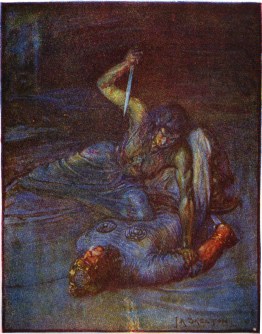
  • stories_of_beowulf_water_witch_trying_to_stab_beowulf

    By J. R. Skelton [Public domain], via Wikimedia Commons


    Waiting for Beowulf

    by

    Katie Winkler

    Come my beauties, writhing sea dragons and serpents, monsters with milky eyes, slouching on slopes by the cliff. Come greet our visitors–the loathsome King Hrothgar and his fiendish followers. And Beowulf, the son-killer, watch him don his war-gear, showing no fear. I will give him cause to tremble, cause to repent how he rent the arm of the monster-child, left him to die like a dog, denying a god the honor of a swift death.

    See the man take up Hrunting, the fool, thinking he will be victorious, boasting to his lord of its great strength as he comes to meet me in my own abode. He will swim to me through the depths, with great and mighty strokes, swim to my home some call a hellish turn-hole. Here he will sling the mighty sword. Its decorated blade will come down singing and ringing. Singing and ringing. But it will not touch the swamp-thing from hell. It will refuse to bite, and then this hag, this witch, shall take her revenge.

  • Response:
    • This creative response shows a good understanding of the scene in Beowulf that depicts the fight with Grendel’s mother. The author includes references to the description of Grendel’s mother in the original work as well as the underwater cave in which she lives. Also interesting is the use of kennings–compound words like war-gear, son-killer and turn-hole. Kennings are common in Anglo-Saxon poetry. Finally, it is interesting to see the story from the creature’s perspective. She is portrayed more as a vengeful mother who has lost her beloved son than a fiendish monster. The illustration is appropriate as well, showing that the illustrator obviously read and/or studied the original work before creating the artwork. Note: I used a different illustration in my post but could not include it here due to copyright issues.

Student Response to the assignment has been positive.

Most students respond well to Beowulf anyway. It is just such an exciting “action hero” story, but this prompt has helped many students take their studies a step further and start to explore the style and artistry of the poem as well as plot and character.

So if you have a prompt you really love, Write Your Own, and submit it and share your good idea with other teachers and writers.

Shameless Plug


unbrokencircleOne more thing before I say good bye. I have a story in this marvelous little anthology: Unbroken Circle: Stories of Cultural Diversity in the South edited by Julia Watts and Larry Smith, published by Bottom Dog Press. You can buy a copy at the Bottom Dog Press website or on Amazon. Print and Kindle editions are available.

Here is what Karen Salyer McElmurray, author of Surrendered Child, said about the book: “In turbulent times, what we need is possibility, and in this rich gathering of diverse voices, Watts and Smith give us just that….These are stories and essays about the blues, about poverty, about families lost and made. Unbroken Circle is about broken and unbroken lives, and ultimately, hope.”


Proverbs

Mom and Dad

Mom and Dad on their honeymoon in New Orleans–December, 1955

I miss my dad. He died three years ago, May 6, at age 80. He always said he would make it to 80, and he did. Dad did most things he put his mind to.  Sometimes I called this characteristic stubbornness, especially when I, like all children, became fiercely angry at him. Other times, like in the last years of his life when he was fighting the debilitating effects of type I diabetes, I called it persistance. Now I call it courage.

By profession, my father was a soldier, a preacher, a singer, a teacher, but above all, a courageous leader.  Here are some memories, things he did, said and wrote, in no particular order, that have helped shape me into the person, the teacher, I am today.  Some of them may seem cliche, but when I heard them from Dad, they were fresh and new because his actions and his character stood behind them.

  • Once, when I was about 13 or so, my dad hit a dog and killed it. He went across the road and knocked on doors until he found the owner of the dog to let them know, apologize and help in any way he could. Afterwards, climbing into the truck to drive away, he said, “You have to go through your problems. Meet them head on. You can’t go around.”
  • “I’m not going to retire. I’m going to refire.”
  • “Do everything you do out of love, and you can’t go wrong.”
  • In answer to the question, “What word best describes your life?” Dad wrote this:
    • Integrity. I believe that we all need to be people of our word. I don’t believe we can go wrong if we adopt this word to live by. I heard of on Indian. A banker was once asked how much money he would loan that Indian. “I’d loan him as much as he wants,” said the banker, “because he will die rather than not pay it back.” That’s integrity. That’s what I want. I want to live by that word.
  • “It’s hard to be a Christian–a true Christian.”
  • “The three most fantastic changes that have taken place in my life time are
    • 1. The advances in medical science. If we had not had the advances in medical science , I would be dead because of my diabetes.
    • 2. The advances in education. If we had not had the advances in education, and I had not taken advantage of my opportunities, I would have been retired from the cotton mill by now.
    • 3. The advances in technology. If we had not had the advances in technology, my children and grandchildren would not be having this abundant life, being blessed and being a blessing to others.
  • I describe success as
    • S–Sharing
    • U–Unity
    • C–Cooperation
    • C–Compassion
    • E–Endurance
    • S–Speaking the Word
    • S–Suffering long
  • ” Love is ever ready to believe the best in others.” Dad said he learned this from my mother, one of the other great teachers in my life. (I will write another blog post about her in the near future.)
  • “That’s the name of the game–helping people.”

    Dad and Rob

    Dad helping my brother Rob tie his shoes, mid-70’s

  • “I like to travel. Travel is a part of education. Learning about different peoples, countries, children, religions is a part of education. I’m glad that all of our children have gotten to travel. I believe all of it has contributed to the positive attitudes they have now about different countries, cultures and peoples.”
  • “Never do anything half-ass.” Mom taught me this too. She just said it in a more refined way: “Anything worth doing is worth doing well.” Same sentiment and one that has served me well.
  • After Dad retired from working as a representative of a large ministry, he went back to teaching. He worked for the county office, taking long-term substitute assignments. This was in the 80’s at the beginning of the AIDS epidemic when there was still a great deal of fear and misinformation about the disease in the country. There was a little boy with hemophilia who had contracted AIDS from a blood transfusion. The school would not let the little boy attend school and could find no one to teach the boy at home–until my dad volunteered. He taught the boy until he was too sick to study, but Dad became more than a teacher to that boy and his family–he was a friend. Years later, the boy’s mother posted under Dad’s obituary, “Mr. Whitlock was a wonderful man….He meant the world to us.”
  • Dad was principal of a Christian school in Georgia. Although the school was started as a dodge around integration, my dad did not pay any attention to the racist’s views of some board members and enrolled the first African-American student. “Do what you know is right,” Dad said, and did.
  • Some of Dad’s favorite scriptures that he counted as important lessons he learned in life:
    • I can do all things through Christ who strengthens me.
    • Whatsoever you do in word or deed, do it all for the glory of God.
    • All things work together for good to those who love the Lord, to those who are called according to his purpose
  • Dad recorded ideas on what it takes for a husband and wife to maintain a healthy marriage:
    • Love each other
    • Pray together
    • Be in unity
    • Put Jesus first
    • Attend church and have all of the family go together
    • Have a spirit of forgiveness toward each other
    • Be patient with each other
    • Build each other up, not tear each other down.
  • “I love everything about your Mom.” Dad called Mom his “little hummingbird.” He loved her fiercely, and their relationship has taught me more about having a successful marriage than anything else could ever do. When two fallible people can live together, for the most part happily, for 58 years, they must have done something right.
    house after tornado

    My parents’ home after the tornado in April, 2011. My brother Rob endured and persisted during this time. His efforts made it possible for my parents to move back in less than a year after the tornado. 


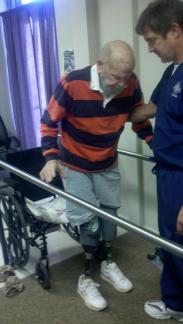
  • Although it was so hard to watch Dad go through what he went through the last years of his life, I learned so much about perseverance, determination and courage from him during that time. Through the death of his oldest child, a devastating tornado, his own failing health, leading to two amputations and eventually succumbing to heart failure, Dad endured much discomfort, pain and embarrassment but rarely complained, usually about not being able to have salt on his food. He continued to be an inspiration to those around him by learning how to walk again with one prosthetic, losing the other leg, then learning to walk on two prosthetic legs. Knowing how athletic and active Dad had been most of his life made it even harder to watch as he struggled to do basic tasks,
    Dad on Prosthetics

    Dad, learning to walk again–December 2012

    but Dad persisted and endured with courage and dignity. The last time I was with Dad, about a week before he died, his heart severely weakened from the effects of diabetic neuropathy, I watched as he tested his own blood sugar and gave himself his own insulin shot. The last thing he ever said to me was, “I love you.”

Two weeks after my dad died, I was diagnosed with Type II diabetes. It was hard to hear as my doctor spoke of possible nerve damage leading to blindness or amputation, especially after watching my dad go through what he did.

But I am his child, so I have determined that this disease won’t lick me. Dad, I’ll do what’s right, won’t do a half-ass job, won’t try to go around.

Life is worth doing, so I’m going to do it well.

Teach. Write. Deadline Extended

Are you a writing teacher who loves to write? Do you write responses to your own writing prompts? Is writing for publication something you have done or dream of doing?

If your answer is yes to any of these questions, then I want to see your writing! The premiere edition of Teach. Write. : A Literary Journal for Composition Teachers is beginning to take shape. I have accepted several impressive creative non-fiction essays and poetry, but I would love to have more, especially flash or short fiction. Therefore, I have extended the submission period to August 1, 2017.

If you are teaching or have taught English composition at any level in any setting, then I want to read your work.

See the page Teach. Write. Submission Guidelines for more information and….

writerwritingframe-300px (2)